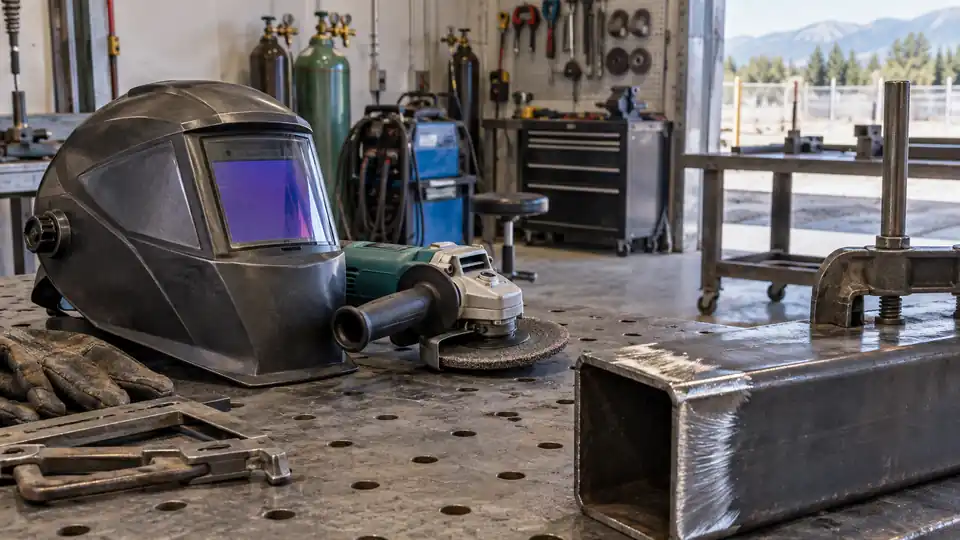
Grinding changes what matters in a welding helmet. A lens that works well for striking an arc can become frustrating when you need a clear view of a weld, a clean cut line, or a small metal edge covered in dust and sparks. The best welding helmet for grinding should offer a genuine grind mode, a usable light-state view, dependable headgear, and enough coverage to keep the hood in place while abrasive debris moves around the work area.
Buyers often focus on switching speed or advertised optical clarity and overlook the control that matters most for this task: the ability to prevent the lens from darkening during grinding. A wide viewing area also helps, but a larger window can add weight. Side lenses improve peripheral awareness on some models, while a simpler front lens may be easier to replace. The Hobart Inventor stands out as the strongest overall balance because its dedicated grind mode, wide viewing area, four arc sensors, and straightforward analog controls all align closely with grinding and welding work.
The options below range from budget-oriented helmets for occasional shop projects to more configurable models with panoramic viewing, work lighting, or broader process support. Rankings reflect documented features, grinding relevance, viewing design, controls, weight, power source, and practical trade-offs rather than brand popularity alone.
Quick Answer
- Best Overall: Hobart 770890 Auto-Darkening Welding Helmet for its dedicated grind mode, 9.3-square-inch viewing area, four arc sensors, and simple shade, sensitivity, and delay controls.
- Best Wide-View Option: ARCCAPTAIN Intelligent Auto-Darkening Helmet for its panoramic lens arrangement, seven sensors, internal controls, memory modes, and built-in light.
- Best Lightweight Choice: Lincoln Electric K4983-1, which weighs 17.5 ounces and includes a dedicated grind mode.
- Best Budget Pick: TOOLIOM True Color Auto-Darkening Helmet for its large viewing area, four sensors, grind shade, and replacement lenses.
Best Welding Helmet for Grinding Comparison Table
| Product | Best For | Grinding Feature | Viewing And Power |
|---|---|---|---|
| Hobart 770890 | Best overall balance | Dedicated grind mode | 9.3 sq. in., auto-on |
| ARCCAPTAIN Intelligent | Panoramic visibility | Grinding mode with gradient control | 7.2 x 3.2 in., rechargeable and solar assist |
| Lincoln Electric K4983-1 | Low weight and broad use | Dedicated grind mode | 4.33 x 3.54 in., solar and battery backup |
| Miller Classic Metal Matrix | ClearLight optics | Grind shade 3 | 6 sq. in., auto-on |
| YESWELDER LYG-Q800D | Side visibility and LED lighting | Shade 3 grind setting | 3.94 x 3.23 in. plus side view |
| MIGVAN Large View | Value with replacement lenses | Grind mode | Large front lens, solar and CR2450 |
| ARCCAPTAIN Large View | Large lens on a lower budget | Adjustable grind use | 3.93 x 3.66 in., solar and CR2450 |
| TOOLIOM Large View | Budget grinding and cutting | Shade 3 grind mode | 3.94 x 3.27 in., replaceable battery |
| Auto-Darkening True Color Helmet | Occasional home use | Grinding listed | True-color lens, adjustable headband |
The detailed reviews explain how each helmet handles the specific demands of grinding, including light-state visibility, controls, weight, lens coverage, and replacement parts.
1. Hobart 770890 Auto-Darkening Welding Helmet, Best Overall
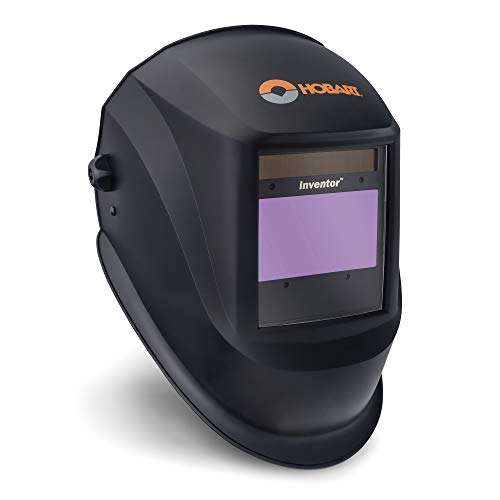
Grinding is the reason this Hobart ranks first. Its documented weld-to-grind mode is a direct match for the task, allowing the lens to remain clear while the grinder is running instead of treating the abrasive wheel like an arc. That distinction saves repeated hood changes during a sequence such as weld, grind, inspect, and weld again. The 9.3-square-inch widescreen viewing area also gives more room to follow a joint and inspect the surrounding workpiece than the smaller windows found on several budget helmets.
PureColor lens technology is intended to provide a clearer, more naturally colored view, while four independent arc sensors support automatic darkening during welding. Shade, sensitivity, and delay are adjusted through analog controls, which may appeal to users who prefer physical knobs over menu-driven settings. The listing does not provide the exact dimensions of the viewing window, so the published 9.3-square-inch figure is more useful here than an assumed width or height.
Pros
- Dedicated weld-to-grind mode keeps the lens clear during grinding.
- 9.3-square-inch viewing area gives broad front visibility.
- Four independent arc sensors support arc detection from different angles.
- Analog shade, sensitivity, and delay controls are quick to adjust.
- Auto-on and auto-off operation reduces manual power management.
Cons
- The listing does not clearly state the helmet’s total weight.
- Its two-sensor alternatives may appeal to buyers seeking a simpler, lower-cost design.
This is the strongest fit for a workshop routine that regularly alternates between welding and grinding. It offers more task-specific usefulness than a helmet that merely lists grinding among its applications because the dedicated mode is clearly identified. Buyers who want panoramic side viewing or a built-in work light may prefer the ARCCAPTAIN Intelligent model, while those prioritizing a very low weight may find the Lincoln more appealing.
To buy this product, click here.
2. ARCCAPTAIN Intelligent Auto-Darkening Welding Helmet, Best Panoramic View

A grinding area can feel cramped when the hood shows only a narrow rectangle of metal. This ARCCAPTAIN addresses that problem with one 4.6 by 3.2-inch main lens and two side lenses, producing a listed total viewing area of 7.2 by 3.2 inches. The side panels are particularly relevant when you need to locate a nearby edge, clamp, or workpiece without repeatedly lifting the hood. Seven arc sensors also provide broader detection coverage than the two-sensor design used by the Miller options here.
The helmet adds unusual controls for this category. Its internal screen allows shade, sensitivity, and delay adjustments from inside the hood, while up to nine memory settings can be saved for repeated tasks. The built-in LED work light may help when a grinding area is poorly illuminated, although it adds another power demand. The rechargeable 500mAh battery is supported by solar assist, and the listing states that operation time is lower with the light enabled than with the light off.
Pros
- Main and side lenses provide a broad panoramic field of view.
- Seven arc sensors offer wide detection coverage.
- Internal display and buttons allow adjustment without removing the hood.
- Up to nine memory modes support repeated welding and grinding setups.
- Rechargeable battery, solar assist, and built-in LED work light broaden its utility.
Cons
- The extra lenses, electronics, and light make the design more complex than a basic hood.
- The published battery runtime changes substantially when the LED light is used.
This helmet suits users who move around large workpieces or frequently work in shadowed areas. Its panoramic arrangement is a more meaningful advantage for grinding than a marginal increase in switching speed, particularly during inspection and alignment. The trade-off is a more involved interface, so buyers who want straightforward knobs and a dedicated grind switch may find the Hobart easier to manage.
To buy this product, click here.
3. Lincoln Electric K4983-1 No Rules No Limits, Best Lightweight Option
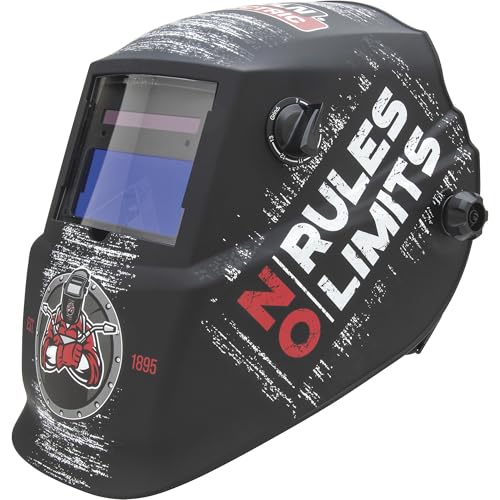
At 17.5 ounces, the Lincoln Electric K4983-1 is the lightest clearly documented option in this selection. That matters during repeated grinding because the hood may stay down through several short passes, inspections, and repositioning steps. Its 4.33 by 3.54-inch viewing area is smaller than the Hobart’s listed widescreen area, yet the shape provides a useful vertical field for following a joint or viewing the edge of a prepared surface.
The helmet includes a dedicated grind mode, variable shade from 7 to 13, solar power with battery backup, and adjustable ratchet headgear with an absorbent sweatband. It also supports a broad set of welding processes, including Stick, TIG, pulsed TIG, MIG, pulsed MIG, flux-core, and gouging. Those process claims do not make the helmet better at grinding by themselves, but they make it suitable for a varied setup where the same hood remains in use across several operations.
Pros
- 17.5-ounce weight reduces the load of extended hood use.
- Dedicated grind mode is clearly identified.
- 4.33 by 3.54-inch viewing area provides a practical front window.
- Solar power and battery backup support flexible use.
- Hard-hat compatibility and extra clear lenses add equipment flexibility.
Cons
- The viewing area is smaller than the wide-screen Hobart specification.
- The listed welding shade begins at 7, which offers less low-shade range than some alternatives.
Choose this Lincoln when neck comfort and low weight matter more than panoramic visibility. It makes particular sense for overhead positioning, frequent movement, or a work routine where a heavier hood becomes distracting. The smaller window and higher minimum welding shade mean it is less compelling for buyers who want the broadest inspection view or frequent low-amperage TIG work.
To buy this product, click here.
4. Miller Classic Series ClearLight Metal Matrix, Best for ClearLight Optics

The Miller Classic Series takes a more focused approach. Its ClearLight lens technology, six-square-inch viewing area, and 3.0 light state are intended to keep the work area visible between welds, which is useful when grinding is part of a short repair sequence. The published grind shade is 3, while cut shades are listed from 5 to 8 and weld shades from 8 to 13. Those separate settings make the helmet more practical for switching between abrasive work, cutting, and arc welding.
Two arc sensors are fewer than the four or seven used by several competing models, so positioning and sensor coverage deserve attention. The helmet provides digital controls for shade, delay, and sensitivity, plus auto-on operation and ratchet headgear. A three-year warranty is listed, but buyers should confirm that current warranty terms match the exact model and seller before ordering.
Pros
- ClearLight lens technology is aimed at high-definition viewing.
- Dedicated grind shade 3 is listed separately from welding and cutting ranges.
- 3.0 light state supports hood-down work between welds.
- Digital shade, delay, and sensitivity controls allow fine adjustment.
- Auto-on operation and ratchet headgear simplify routine use.
Cons
- Two arc sensors provide less sensor redundancy than several four-sensor models.
- The six-square-inch viewing area is smaller than the Hobart’s listed 9.3-square-inch area.
This Miller is a sensible premium-leaning choice for users who place optical presentation and clearly separated light, cut, grind, and weld settings above panoramic coverage. It does not win on window size or sensor count, but its control layout is more structured than the simplest budget helmets. Pick a wider-view model if grinding around large assemblies is the priority.
To buy this product, click here.
5. YESWELDER LYG-Q800D, Best for Side Visibility

The YESWELDER LYG-Q800D brings side visibility to a relatively compact hood. Its main viewing area is listed as 3.94 by 3.23 inches, with side-view panels at DIN 5 that are described as non-auto-darkening. Those panels do not replace the main lens, but they can help with spatial awareness while moving a grinder around a workpiece. For a user who frequently checks nearby edges or reaches around a frame, that extra peripheral view may reduce the need to lift the hood.
The helmet supports a grind shade of 3, adjustable sensitivity and delay, four arc sensors, and a listed switching speed of 1/30,000 second. A solar panel and replaceable CR2450 battery provide the power arrangement. The integrated LED is useful in dim areas, although the listing does not provide a separate runtime figure for the light. The helmet also accommodates magnifying lenses, which may help with close inspection if the correct accessory is obtained separately.
Pros
- Side-view panels broaden awareness around the workpiece.
- Shade 3 grind setting is listed for non-welding use.
- Four arc sensors support detection from multiple positions.
- Solar power and replaceable CR2450 battery simplify long-term ownership.
- Built-in LED can help illuminate darker grinding areas.
Cons
- The side panels are listed as non-auto-darkening and should not be treated like the main lens.
- The main front window is smaller than the wide-screen options in this roundup.
This helmet makes sense for users who value peripheral awareness and a work light more than maximum front-window size. Its side-view design gives it a different purpose than the Hobart or Miller, while the grind shade keeps it suitable for abrasive work. Buyers who need the simplest lens arrangement or a large unobstructed front window may prefer the MIGVAN or ARCCAPTAIN large-view models.
To buy this product, click here.
6. MIGVAN Large-View Auto-Darkening Helmet, Best Value With Replacement Lenses

MIGVAN earns its place through a practical combination of a large front view, a listed grind setting, and replaceable lens parts. The helmet uses a light state of DIN 4 and dark-state ranges of DIN 5 to 9 and DIN 9 to 13, giving it coverage for grinding, cutting, and several welding processes. Four arc sensors support the auto-darkening system, while the published switching speed is 1/10,000 second.
The replaceable CR2450 battery and solar power reduce dependence on a built-in rechargeable pack. The package also lists two inner lenses, two outer lenses, and a storage bag, which is useful for a task that can expose the outer lens to dust and impact. The listing describes a large viewing screen but does not provide its exact dimensions, so shoppers should verify the current product images and documentation if window size is a deciding factor.
Pros
- Grind, cut, and weld shade ranges are clearly separated.
- Four arc sensors support automatic darkening.
- Solar power and a replaceable CR2450 battery simplify maintenance.
- Two inner and two outer replacement lenses are listed in the package.
- Pivoting headgear and breathable padding are intended to reduce fit pressure.
Cons
- The exact viewing-area dimensions are not clearly published in the supplied listing information.
- The listed switching speed is slower than several helmets claiming 1/30,000 second.
This MIGVAN is a practical choice for users who expect lens wear from regular grinding and want replacement parts available in the package. It gives up the Hobart’s clearly published widescreen measurement and the ARCCAPTAIN Intelligent’s memory controls, but its maintenance package is more immediately useful than a bare helmet. Confirm lens availability for the exact version before ordering replacements later.
To buy this product, click here.
7. ARCCAPTAIN Large-View Auto-Darkening Helmet, Best Large Lens on a Lower Budget
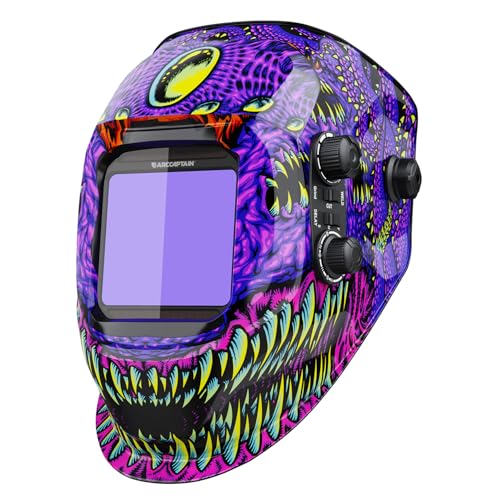
The appeal here is straightforward: a 3.93 by 3.66-inch viewing screen, four arc sensors, and a two-pound listed weight. That broad, nearly square window gives a better front view than compact helmets, while the lower mass should be easier to manage during a work session that includes repeated grinding and inspection. The lens uses a DIN 4 light state and DIN 5 to 9 or 9 to 13 dark ranges, so the helmet can cover grinding, cutting, and welding tasks through separate settings.
Solar power and a replaceable CR2450 battery keep the power system simple. The listing also identifies adjustable shade and sensitivity controls, continuous UV and IR protection, and a PP shell described as shock and flame resistant. Those claims describe listed features rather than a guarantee of protection in every situation, so the manual, replacement lens requirements, and relevant workplace procedures still matter.
Pros
- 3.93 by 3.66-inch viewing area supports broad front visibility.
- Four arc sensors provide broader coverage than two-sensor designs.
- Two-pound listed weight is manageable for extended hood use.
- Solar cell and replaceable CR2450 battery avoid a proprietary rechargeable pack.
- Shade and sensitivity controls support changes between welding and grinding.
Cons
- The listing does not provide a separate dedicated grind-mode control description.
- It lacks the panoramic side lenses and memory settings of the higher-ranked ARCCAPTAIN model.
This model suits buyers who want a large front window and a conventional control layout without moving into the more complex panoramic design. It is a better match for front-facing grinding than for work requiring extensive peripheral visibility. The Hobart remains the clearer choice for a specifically documented weld-to-grind workflow, while this ARCCAPTAIN is attractive for its viewing-area-to-weight balance.
To buy this product, click here.
8. TOOLIOM True Color Large-View Helmet, Best Budget Pick

TOOLIOM keeps the grinding feature set uncomplicated. Its M800D lens provides a listed shade 3.0 grind mode, shade 5 to 9 for cutting, and shade 9 to 13 for welding. That separation is useful for occasional shop work because grinding does not require the darker welding setting, and the operator can switch tasks without changing helmets. The 3.94 by 3.27-inch viewing area is also generous for a budget-oriented design.
Four arc sensors and 1/1/1/1 optical classification are listed, along with adjustable delay and sensitivity. The package includes one replaceable battery, two replacement outer lenses, and one replacement inner lens. Those parts matter in grinding applications because the outer lens can collect fine abrasive dust or suffer impact marks. The supplied information does not identify the exact battery type, so confirm the replacement specification before purchasing extras.
Pros
- Dedicated shade 3.0 grind mode is clearly listed.
- 3.94 by 3.27-inch viewing area provides a useful front window.
- Four arc sensors support the auto-darkening system.
- 1/1/1/1 optical classification and true-color lens design are listed.
- Replacement inner and outer lenses are included.
Cons
- The supplied information does not identify the exact replacement battery type.
- It lacks side viewing, a built-in work light, and the broader controls found on higher-ranked models.
This is the sensible lower-cost choice for occasional grinding, cutting, and welding where a clear mode selector and replacement lenses matter more than advanced electronics. It does not offer the Hobart’s widescreen specification or the Lincoln’s very low documented weight, but it covers the core task without unnecessary complexity. Buyers using a hood for long daily sessions may prefer stronger headgear documentation and a more established control layout.
To buy this product, click here.
9. Auto-Darkening True Color Welding Helmet, Best for Occasional Home Use

This generic-labeled helmet is aimed at occasional home workshop and hobby use, and the listing specifically excludes continuous industrial or commercial work. That limitation helps define its place in this roundup. It offers a true-color view, adjustable headband, anti-fog claims, and support for welding, cutting, and grinding, giving occasional users one hood for several basic tasks rather than requiring a separate grinding visor.
The product information advertises a 0.1ms auto-darkening transition and a 4.0mm hard PVC shell. Those are listing claims, and the supplied data does not identify a formal optical classification, exact viewing-area measurement, battery type, or dedicated grind shade. That missing detail places it below the more fully specified options, particularly for buyers who want to compare lens performance or replacement parts carefully.
Pros
- Listed for welding, cutting, and grinding use.
- True-color viewing is intended to keep the workpiece easier to inspect.
- Adjustable headband supports fit changes between users.
- Anti-fog lens claims may appeal to occasional work in warm conditions.
- Its home-use positioning keeps the feature set aimed at light-duty projects.
Cons
- The listing does not clearly specify the viewing-area dimensions or optical classification.
- It is explicitly intended for hobby and home use rather than continuous industrial work.
This helmet is best reserved for intermittent grinding around a home workbench, especially when the buyer wants a basic hood without paying for memory modes, panoramic lenses, or a work light. The limited published specification set makes it harder to compare with the Hobart, Miller, or Lincoln on technical detail. For regular grinding or work where replacement-lens availability matters, a more fully documented option is the safer purchasing decision.
To buy this product, click here.
Buying Guide: How to Choose a Welding Helmet for Grinding
Look for a Genuine Grind Mode
A grind mode prevents the auto-darkening filter from reacting to sparks and bright reflections produced by an abrasive wheel. This is different from simply using a light welding shade. A dedicated mode, such as the one listed on the Hobart, Miller, Lincoln, and TOOLIOM helmets, gives a clearer indication that the hood is intended for this change in task.
Compare the Light-State View
Grinding takes place while the lens should remain in its light state, so the light-state shade and optical clarity matter more than a headline switching-speed figure. A 3.0 light state is listed for the Miller models, while several alternatives list DIN 4. A lower light-state number generally means a brighter view, but the overall result also depends on lens quality, illumination, and the condition of the outer cover lens.
Match Viewing Area to the Workpiece
A large front window helps when you are following a long seam or inspecting a broad repair. The Hobart lists a 9.3-square-inch viewing area, while the ARCCAPTAIN large-view model lists a 3.93 by 3.66-inch window. Panoramic helmets add side visibility, but side lenses can introduce additional replacement parts and may not provide the same auto-darkening behavior as the main lens.
Do Not Ignore Weight and Headgear
Grinding often involves repeated short passes, so the helmet may remain lowered for longer than a single welding arc. The Lincoln’s listed 17.5-ounce weight gives it a clear advantage for users who want to minimize neck load. A heavier helmet can still be worthwhile if it provides a much larger window, better controls, or a built-in light, but the headgear needs to hold the hood securely without constant readjustment.
Check Lens Replacement Options
Fine abrasive dust, chips, and occasional impact can mark the outer lens. The MIGVAN and TOOLIOM packages list replacement inner and outer lenses, which gives them a practical maintenance advantage. Before ordering a replacement later, confirm the lens dimensions and exact model because similar helmet names can refer to different versions.
Use Sensor Count as Context, Not a Guarantee
Four or seven sensors can provide broader arc-detection coverage than two sensors when the welding position partially blocks one side of the hood. Sensor count does not determine grinding performance because the lens should remain in grind mode during abrasive work. It becomes more relevant when the same helmet is used for welding immediately before or after grinding.
Separate Listed Features From Safety Procedures
A helmet’s listed standards, shell material, and lens features do not replace the manufacturer’s instructions, suitable eye and face protection, ventilation, training, or workplace procedures. Grinding also creates airborne particles and sparks, so the hood should be used as part of a complete setup rather than as the only protective measure.
Best Welding Helmet for Grinding FAQ
Can I Grind With an Auto-Darkening Welding Helmet?
Yes, provided the helmet has a documented grind mode or a suitable light-state setting intended for grinding. Grind mode keeps the lens from darkening in response to ordinary grinder sparks. Check the manual before use because controls and mode names vary between helmets.
Is a Dedicated Grind Mode Better Than a Light Welding Shade?
A dedicated grind mode is generally easier to interpret because it is specifically intended to prevent auto-darkening during abrasive work. A light welding shade may still darken if the sensors detect a bright event, and it may leave the operator guessing about the correct setting. The Hobart, Lincoln, Miller, and TOOLIOM models clearly list a grinding mode or grind shade.
What Light-State Shade Is Useful for Grinding?
The products in this roundup list light states around DIN 3 or DIN 4, depending on the model. A brighter light-state view can make it easier to follow a grinding line, but the result depends on the lens, shop lighting, and outer-cover condition. Use the setting specified by the manufacturer rather than selecting a shade solely from a comparison table.
Does a Larger Viewing Area Make a Helmet Better for Grinding?
A larger viewing area can make it easier to follow a seam, inspect a corner, or see the surrounding workpiece without moving your head. It also tends to add bulk or weight in some designs. The right balance depends on whether the task involves a broad assembly, tight access, or frequent movement around the workpiece.
Are Side-View Welding Helmets Useful for Grinding?
Side-view panels can improve peripheral awareness while you position the grinder around a frame or other large workpiece. They do not necessarily provide the same shade behavior as the main lens. The YESWELDER LYG-Q800D, for example, lists side panels as DIN 5 and non-auto-darkening, so they should be treated as supplemental viewing areas.
How Many Arc Sensors Should a Welding Helmet Have?
Four sensors provide broader detection coverage than two sensors, while seven sensors can cover more angles still. Sensor count is most relevant during welding, since grinding should use a mode that prevents the lens from reacting to sparks. It should be weighed alongside viewing area, controls, headgear, and documented grind settings.
Do I Need a Built-In Light for Grinding?
No. A built-in LED can help illuminate a dark work area, but it adds complexity and consumes power. The ARCCAPTAIN Intelligent and YESWELDER helmets list built-in lighting, while the other recommendations rely on the surrounding workspace. Good shop lighting may be more useful than a small helmet-mounted lamp for larger grinding jobs.
Final Verdict
The Hobart 770890 is the strongest overall choice for grinding because its documented weld-to-grind mode directly matches the task, and its 9.3-square-inch viewing area gives the operator room to inspect a seam or workpiece without constantly lifting the hood. Four arc sensors, auto-on operation, and physical shade, sensitivity, and delay controls make the rest of the workflow straightforward. It does not offer the panoramic side visibility or built-in light of the ARCCAPTAIN Intelligent helmet, but its simpler task-focused design is easier to justify.
Choose the ARCCAPTAIN Intelligent model if broad peripheral visibility, memory settings, and a work light matter more than simplicity. The Lincoln K4983-1 is the better fit for low weight, while TOOLIOM provides a budget-oriented route with a listed grind shade and replacement lenses. Before ordering, confirm the exact light-state and grind settings, replacement lens availability, headgear fit, and the safety instructions for the selected model.
