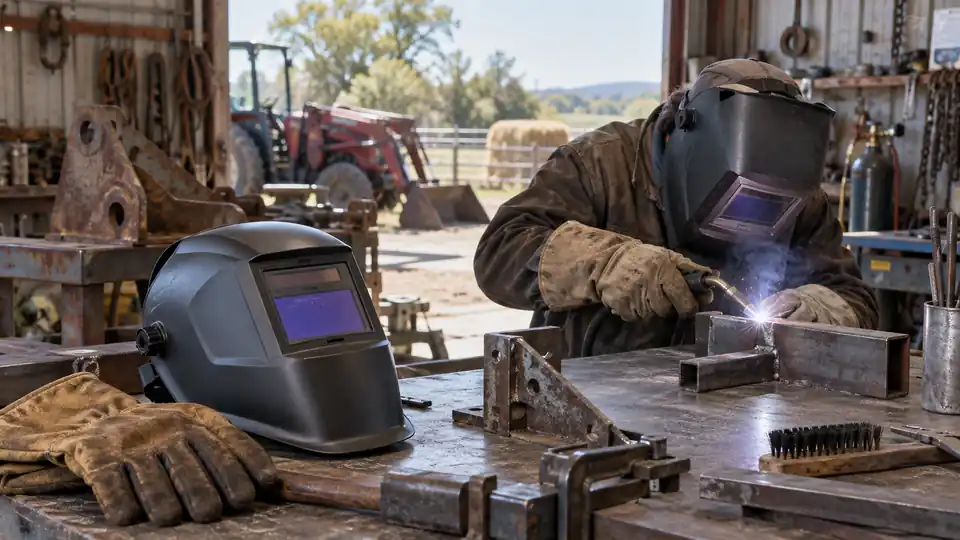
A beginner’s welding helmet needs to make the first few sessions easier to see, adjust, and repeat. A clear lens helps with joint edges and puddle placement, while practical controls reduce the guesswork involved in choosing shade, sensitivity, delay, and grind mode. The strongest options here combine true-color viewing with auto-darkening, replaceable battery support, and headgear that can be adjusted without feeling overly complicated.
Buying by switching speed alone is an easy trap. A fast response figure does not tell you how broad the viewing area is, whether the helmet has two or four arc sensors, or how useful the controls will be when you move between MIG, Stick, TIG, cutting, and grinding. A large lens can make positioning easier, while a lighter shell may be more comfortable during practice sessions. Different buyers will value different details, but the YESWELDER LYG-M800H offers the most balanced starting point in this group.
The selections below focus on clear optics, straightforward adjustment, useful process coverage, fit, power source, and honest limitations. Some are simple budget helmets for occasional projects, while others add a larger viewing area, work light, panoramic lenses, or more advanced automatic controls.
Quick Answer
- Best Overall: YESWELDER LYG-M800H, for its large 1/1/1/1 viewing area, four sensors, broad shade settings, and balanced weight.
- Best Budget Option: Accoral Auto-Darkening Welding Helmet, with true-color optics, external controls, and solar plus battery power at a lower-cost position.
- Best for Low-Light Work: TRQWH Welding Helmet, which adds a rechargeable top LED light and external grind control.
- Best Premium Option: ARCCAPTAIN Intelligent Auto-Darkening Helmet, with panoramic viewing, automatic shade adjustment, memory modes, and a built-in work light.
Best Welding Helmet for Beginners Comparison Table
| Product | Best For | Viewing Area | Key Controls |
|---|---|---|---|
| YESWELDER LYG-M800H | Best overall balance | 3.93 x 3.66 in, 1/1/1/1 | Shade, sensitivity, delay, grind |
| ARCCAPTAIN Auto-Darkening Helmet | Lightweight general use | 3.86 x 1.69 in, 1/1/1/1 | Shade and sensitivity |
| TRQWH Welding Helmet | Dim work areas | Wide view, 1/1/1/2 | Shade, sensitivity, delay, grind |
| Accoral Auto-Darkening Helmet | Budget-conscious buyers | 3.64 x 1.67 in, 1/1/1/1 | External shade, sensitivity, delay |
| MIGVAN Welding Helmet | Broad process coverage | Large view, optical class listed | Shade and sensitivity |
| VILSIN Welding Helmet | Replacement-lens value | 3.78 x 1.58 in, 1/1/1/2 | Shade and headgear adjustment |
| ARCCAPTAIN Intelligent Helmet | Premium visibility | 7.2 x 3.2 in total, 1/1/1/1 | Auto shade, memory, internal display |
| YESWELDER LYG-L600A | Simple controls and blue-light filter | 3.64 x 1.67 in, 1/1/1/1 | Shade, sensitivity, delay, grind |
| ARCCAPTAIN Large-View Helmet | Large lens and work light | 3.94 x 3.66 in, 1/1/1/1 | Shade, sensitivity, delay, grind |
The detailed reviews explain where each helmet fits, what its specifications mean for a new user, and which limitations deserve attention before ordering.
1. YESWELDER LYG-M800H: Best Overall
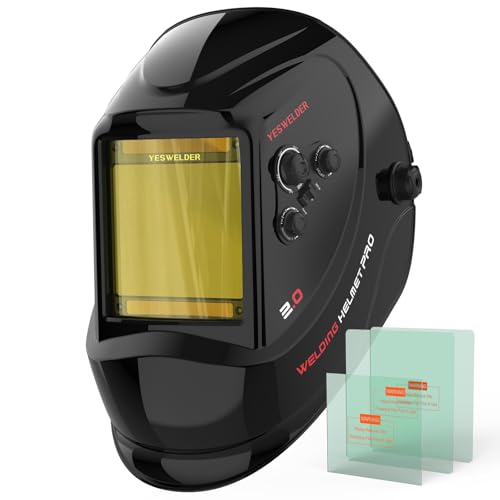
The YESWELDER LYG-M800H earns the top position because its useful features are aimed at the parts of welding that tend to challenge a new user. The listed 3.93 x 3.66 inch viewing area is substantially taller than the compact rectangular lenses used by several alternatives, giving more room to see the joint, torch position, and surrounding workpiece without constantly shifting your head. Its 1/1/1/1 optical classification and true-color design are also meaningful for someone learning to distinguish metal, arc, and puddle rather than looking through a strongly green-tinted lens.
Four arc sensors and a listed 1/30,000-second switching time provide broad detection coverage and responsive darkening across routine TIG, MIG, Stick, cutting, and grinding tasks. The DIN 3/5-9 and 9-13 range gives the wearer a practical way to adjust shade for different processes, while the approximately 1.32-pound weight keeps the large shell from becoming unnecessarily tiring. It is a strong fit for a garage setup where one helmet may need to cover several kinds of work.
Pros
- Large 3.93 x 3.66 inch viewing area
- 1/1/1/1 true-color optical clarity
- Four arc sensors provide broad detection coverage
- Supports shade settings from DIN 5-9 through 9-13, with a listed light state of DIN 3
- CR2450 battery and cheater-lens compatibility
Cons
- Heavier than the approximately one-pound compact alternatives
- The listing does not specify the exact included replacement-lens supply
This helmet makes the most sense for someone who wants room to see while learning positioning and who expects to move between common welding processes. A smaller helmet may be easier to carry, but the LYG-M800H gives up relatively little portability for a much larger lens. Buyers who mainly want the lowest-cost occasional-use option may prefer the Accoral, while those working in dark corners may find the TRQWH’s built-in light more useful.
To buy this product, click here.
2. ARCCAPTAIN Auto-Darkening Welding Helmet: Best Lightweight Option

At approximately one pound, this ARCCAPTAIN model is a sensible choice for a new user who dislikes a bulky hood or expects to spend time practicing in different positions. The 3.86 x 1.69 inch viewing area is smaller vertically than the YESWELDER LYG-M800H, but the listed 1/1/1/1 true-color optics can still give a more natural view of the work than traditional green lenses. Cheater-lens compatibility adds a practical option for close-up work.
The helmet uses four arc sensors and lists a 1/25,000-second switching response. Shade selection covers DIN 4/9-13, and sensitivity adjustment lets the wearer adapt the lens to different lighting and arc conditions. Solar assistance combined with a replaceable CR2450 battery reduces the need to treat the helmet as a disposable item, while the padded adjustable headband should help with fit during longer practice periods.
Pros
- Approximately one-pound listed weight
- Four arc sensors and 1/1/1/1 optical clarity
- Replaceable CR2450 battery with solar assistance
- Cheater-lens compatible design
- Suitable for TIG, MIG, and Stick work according to the listing
Cons
- Viewing area is shorter vertically than the large-view helmets here
- The listing does not identify a dedicated built-in work light
This model suits a learner who values a light helmet and straightforward controls more than a panoramic or oversized lens. It is easier to carry between a bench and a storage shelf than the larger-view designs, although the narrower window may require more deliberate head positioning. The closely similar ARCCAPTAIN B0C4HDC4CB is excluded from this roundup because it offers the same listed core configuration, so buyers should verify the exact model before ordering.
To buy this product, click here.
3. TRQWH Welding Helmet: Best for Low-Light Work

The TRQWH stands apart with a rechargeable top LED light, a feature that can help a new user see joint edges and tools when the work area is dim. The light does not replace proper shop lighting, but it may be useful for indoor repair, evening projects, or a shaded corner where the metal is difficult to inspect before striking an arc. The lens is listed at 1/1/1/2 optical clarity, which is slightly different from the 1/1/1/1 rating found on several alternatives, so the large view and illumination are its stronger reasons for inclusion.
External sensitivity and delay knobs make the important adjustments visible rather than hidden behind the shell. A separate external grind button also reduces the need to remove the helmet when switching from welding to grinding. The listing describes solar and replaceable-lithium power, a 1/20,000-second response, and support for plasma cutting, grinding, DC/AC TIG, MIG, and Stick. Those process labels describe helmet modes, not proof that the helmet itself performs those operations.
Pros
- Rechargeable top LED light for dim work areas
- External sensitivity and delay controls
- External grind-mode button
- Solar and replaceable-battery power arrangement
- Adjustable headgear with forehead padding
Cons
- Listed 1/1/1/2 optical clarity is less uniform than 1/1/1/1 models
- The work light adds another component that requires charging
Choose the TRQWH when visibility around the workpiece matters as much as the view through the lens. It gives up the top optical classification used by the YESWELDER and several ARCCAPTAIN models, but its external controls and light can make early setup less awkward. Buyers who work in a well-lit garage and want the simplest possible arrangement may prefer a basic solar-and-battery helmet instead.
To buy this product, click here.
4. Accoral Auto-Darkening Welding Helmet: Best Budget Option

For occasional garage practice, the Accoral concentrates on the features a first helmet needs without adding a complicated control system. Its 3.64 x 1.67 inch viewing area is compact, but the listing identifies 1/1/1/1 optical clarity and true-color viewing. Large side buttons provide access to shade, sensitivity, and delay settings, which is useful when a learner is still figuring out how those adjustments affect the view.
Two arc sensors and a listed 1/25,000-second response place it below the four-sensor models in detection coverage, yet two sensors can still suit straightforward work when the helmet is positioned correctly. Solar and lithium-battery power reduces routine battery dependence. The pivoting headgear is another practical touch because the lens angle can be adjusted to match the wearer’s position instead of forcing the entire head to tilt.
Pros
- Budget-oriented configuration for occasional use
- 1/1/1/1 optical clarity and true-color viewing
- Large external controls for shade, sensitivity, and delay
- Solar and lithium-battery power
- Pivoting adjustable headgear
Cons
- Two arc sensors provide less detection coverage than four-sensor designs
- Viewing area is smaller than the large-view YESWELDER and ARCCAPTAIN helmets
The Accoral is a sensible starting point for someone who wants functional adjustment and true-color optics without moving into a higher product tier. Its smaller lens means careful head placement matters more, especially during low-amperage work or awkward joints. A buyer expecting frequent multi-process use may gain more from the YESWELDER LYG-M800H, while a buyer who welds only occasionally may not need the extra size.
To buy this product, click here.
5. MIGVAN Welding Helmet: Best for Broad Process Coverage

The MIGVAN is aimed at buyers who want one helmet for MIG, TIG, Stick, cutting, and grinding, with a larger viewing design and four arc sensors. Its listed shade range includes DIN 4 in the light state and DIN 5-9 or 9-13 in dark states, giving a learner room to adjust as projects change. The listing describes an optical-class lens and true-color view, though it does not present the same exact 1/1/1/1 classification shown by several competing models.
Solar charging and a replaceable CR2450 battery provide two power sources, while the pivoting headgear and breathable padding address the physical side of wearing a helmet during repeated practice. The package is also identified as including two inner lenses, two outer lenses, a manual, and a storage bag. Those replacement parts may matter more over time than a small difference in switching-speed figures because exterior lenses eventually collect dust, spatter, and scratches.
Pros
- Four arc sensors for broad arc detection
- Shade settings covering DIN 5-9 and 9-13
- Solar and replaceable CR2450 battery power
- Includes replacement inner and outer lenses
- Storage bag included according to the listing
Cons
- The listing does not state an exact 1/1/1/1 optical classification
- Listed switching speed is lower than the fastest claims in this selection
MIGVAN makes more sense for someone who values a broad accessory package and process coverage over the simplest possible helmet. The replacement lenses and bag can make ownership easier for a learner building a first welding kit, although the optical specification deserves careful checking before purchase. Those who want the clearest documented lens classification should look at the YESWELDER LYG-M800H or LYG-L600A instead.
To buy this product, click here.
6. VILSIN Welding Helmet: Best Replacement-Lens Package

VILSIN gives a new user a practical ownership advantage by listing three replacement outer filter lenses and two replacement inner clear lenses in the package. That matters in a real garage, where a fresh lens can preserve visibility after the original becomes hazy or marked. The viewing area is listed at 3.78 x 1.58 inches, and the optical classification is 1/1/1/2, so its strongest argument is the included lens supply rather than the highest optical rating.
The helmet uses two arc sensors, solar assistance, and a replaceable CR2032 battery. Its listed darkening settings cover DIN 5-9 and 9-13, with a DIN 4 light state. Padded headgear, two top straps, and angle and tightness controls give the wearer several ways to improve fit. The listing also identifies support for DC TIG, AC TIG, MIG/MAG, Stick, plasma cutting, and grinding, although these are helmet applications and should not be read as welding-machine capabilities.
Pros
- Includes three replacement outer lenses
- Includes two replacement inner clear lenses
- Solar assistance with replaceable CR2032 battery
- Padded headband with adjustable angle and tightness
- Broad listed process-mode coverage
Cons
- 1/1/1/2 optical classification is below the 1/1/1/1 models
- Two sensors offer less detection coverage than four-sensor helmets
VILSIN suits someone who expects the first lens to take ordinary workshop abuse and wants replacements ready in the storage box. It trades some optical and sensor specification for package utility, making it less compelling for a learner who primarily wants the clearest possible viewing experience. Before ordering, confirm that the included lens dimensions match the helmet and that the replacement parts are available for the exact version.
To buy this product, click here.
7. ARCCAPTAIN Intelligent Auto-Darkening Helmet: Best Premium Option

The ARCCAPTAIN Intelligent model is the most advanced helmet in this comparison, but advanced does not automatically mean easier for every learner. Its main lens and two side lenses create a listed total viewing area of 7.2 x 3.2 inches, while all three lenses are identified as 1/1/1/1 optical clarity. That panoramic layout can give a broader sense of the work area, particularly when positioning a torch or checking nearby joint edges without moving the hood as much.
Seven arc sensors, automatic shade adjustment, an internal display, nine memory modes, and a built-in LED work light create a far more configurable system than the basic helmets here. The rechargeable 500mAh battery has solar assistance, and the listing provides long standby and operating figures. A new user may appreciate automatic adjustment, but the number of settings can also add a learning curve. The premium price position makes the most sense for someone who expects frequent use and values visibility across several work areas.
Pros
- 7.2 x 3.2 inch listed total viewing area with side lenses
- 1/1/1/1 optical clarity across the lens system
- Seven arc sensors and 1/30,000-second listed response
- Automatic shade adjustment with nine memory modes
- Rechargeable battery, solar assistance, and built-in work light
Cons
- More controls may be excessive for occasional practice
- Larger feature set places it in a higher-cost category
This is the choice for a learner who expects the helmet to remain part of a growing workshop rather than a short-term starter purchase. The panoramic lens and automatic controls are its main advantages over the compact models, while the extra settings require careful reading of the instructions. Someone learning one process in a bright garage may gain more from the simpler YESWELDER LYG-M800H and spend less.
To buy this product, click here.
8. YESWELDER LYG-L600A: Best for Straightforward Controls

The LYG-L600A takes a more compact approach than the LYG-M800H while retaining several specifications that matter to a first-time buyer. Its 3.64 x 1.67 inch viewing area uses 1/1/1/1 true-color optics, and the listed shade range begins at DIN 3.5 before moving through 9-13. That gives it coverage for TIG, MIG, Stick, and grinding, although the shorter lens window offers less vertical context than YESWELDER’s large-view model.
Two arc sensors provide a listed 1/30,000-second response, with sensitivity and delay adjustment for changing lighting and arc conditions. The blue-light-blocking outer lens is a distinctive feature in the listing, while solar assistance and a replaceable CR2450 battery simplify power maintenance. Pivot-style headgear is intended to balance the shell and make the fit easier to adjust, which can be useful when the helmet is raised and lowered repeatedly during setup.
Pros
- 1/1/1/1 true-color optical clarity
- 1/30,000-second listed response
- Adjustable sensitivity and delay controls
- Solar assistance with replaceable CR2450 battery
- Blue-light-blocking outer lens listed by the manufacturer
Cons
- Two arc sensors provide less coverage than four- and seven-sensor models
- Smaller viewing area than the LYG-M800H
The LYG-L600A is a good match for someone who wants familiar controls, a compact shell, and a clearly documented optical classification. It gives up some field of view and sensor coverage compared with the top-ranked YESWELDER, but that may be a reasonable trade for a smaller helmet. Buyers should follow the supplied instructions for shade selection and still use proper lighting, ventilation, and protective equipment around the helmet.
To buy this product, click here.
9. ARCCAPTAIN Large-View Welding Helmet: Best for a Work Light

This ARCCAPTAIN combines the large lens format that helps with joint visibility and a USB-powered LED light that can illuminate the workpiece in a dim area. The viewing area is listed at 3.94 x 3.66 inches, with 1/1/1/1 optical clarity and true-color technology. For someone learning to align a torch or electrode, that additional height can be more useful than a very fast switching claim because it shows more of the surrounding joint before the arc begins.
Four arc sensors and a listed 1/25,000-second response support the helmet’s TIG, MIG, Stick, cutting, and grinding modes. Shade settings include 4/5-8 and 9-13, and the product lists sensitivity and delay controls. The LED light arrives uninstalled according to the listing, so setup involves attaching it before use. Solar panels and a CR2450 battery handle power, while the approximately one-pound listed weight keeps this large-view design relatively manageable.
Pros
- Large 3.94 x 3.66 inch viewing area
- 1/1/1/1 true-color lens classification
- Four arc sensors
- USB-powered LED work light included, with installation required
- Approximately one-pound listed weight
Cons
- Work light needs to be attached before use
- Listed shade configuration is less broad at the low end than some alternatives
This model fits a learner who wants the visual openness of a large helmet but often works where shadows make setup difficult. It is a close alternative to the YESWELDER LYG-M800H, with the work light as its clearest distinction and a slightly different shade arrangement. Buyers who prefer fewer accessories and a simpler setup may find the LYG-M800H easier to manage.
To buy this product, click here.
Buying Guide for the Best Welding Helmet for Beginners
Start With Optical Clarity and Viewing Area
Optical classification describes how consistently the lens transmits the image in areas such as optical clarity, light diffusion, and distortion. A 1/1/1/1 rating is the most uniform classification shown among these products, but the size and shape of the viewing area still matter. A learner positioning a torch near a corner may benefit more from the taller lens of the YESWELDER LYG-M800H than from a smaller lens with the same classification.
Understand Arc Sensors
Arc sensors detect the welding flash and trigger the filter to darken. Four sensors generally provide broader detection coverage than two, which can be useful when the wearer’s position or the workpiece blocks part of the lens. Sensor count does not replace correct shade selection or proper helmet positioning, so it should be viewed as one part of the design rather than a guarantee of performance.
Choose Controls You Can Actually Adjust
Shade, sensitivity, and delay affect how the helmet behaves across different processes and work conditions. External controls, such as those on the Accoral and TRQWH, are easier to reach without removing the helmet. Automatic adjustment, as offered by the premium ARCCAPTAIN model, can reduce manual setup but introduces more controls and modes to understand.
Check the Shade Range
Shade settings should match the welding process and current recommended by the helmet instructions. A broad range gives more flexibility, but a large number on a product page does not replace the manufacturer’s guidance. The LYG-M800H lists DIN 3/5-9 and 9-13 settings, while the LYG-L600A lists 3.5/9-13, so buyers should compare the exact ranges rather than assuming every auto-darkening helmet offers the same adjustment.
Compare Battery and Solar Power
Solar assistance can reduce battery use, while a replaceable lithium battery gives the helmet a clear maintenance path. Rechargeable systems, such as the one in the premium ARCCAPTAIN, remove the need to keep replacement cells available but introduce charging as another routine. Check the exact battery type before ordering because the models here use different cells, including CR2032, CR2450, and rechargeable packs.
Fit and Weight Matter During Practice
A helmet that shifts, presses on the forehead, or feels front-heavy can make setup more frustrating. Compact one-pound models are easier to carry, while large-view helmets provide more visual context at the cost of a larger shell. Adjustable headgear, pivoting mechanisms, padding, and angle controls are practical details that deserve attention alongside the lens specifications.
Do Not Treat a Helmet as a Complete Safety System
A listed ANSI, CSA, or EN standard should be checked against the current product documentation and exact model. The helmet does not replace suitable clothing, gloves, ventilation, hearing protection, training, or the safety instructions for the welding machine. Use the shade, grind, and operating settings specified for the task, and inspect the lens and shell before use.
Best Welding Helmet for Beginners FAQ
What lens type is easiest for a beginner to use?
True-color auto-darkening lenses with clear adjustment controls are usually easier to work with than strongly green-tinted fixed lenses. A 1/1/1/1 classification can indicate consistent optical performance, while a large viewing area helps the wearer see the joint before and during the arc. The YESWELDER LYG-M800H combines both traits in this selection.
Are four arc sensors better than two?
Four sensors can provide broader detection coverage than two, particularly when part of the lens is obstructed by the work position. That does not mean every four-sensor helmet is automatically better in every area. Lens clarity, fit, controls, shade range, and correct setup remain important.
Is a larger viewing area useful for learning?
A larger window can make it easier to see the joint edges, torch position, and nearby metal without moving your head as much. This can be helpful while learning alignment and travel position. A larger shell may weigh more, so compare viewing area with headgear and listed weight.
Do beginners need a grind mode?
Grind mode can be useful when the same helmet is used for grinding or cutting between welds. It changes the lens behavior for that task, but it should not be treated as a substitute for appropriate eye and face protection. An external grind button, such as the one listed for the TRQWH, makes the change easier to access.
Are welding helmets with work lights worth choosing?
A built-in or attachable work light can help illuminate joint edges in a dim area, particularly before striking an arc. It does not replace adequate shop lighting, and it adds another battery or charging consideration. The TRQWH uses a rechargeable top light, while the ARCCAPTAIN Large-View model lists a USB-powered light that arrives uninstalled.
How often should the battery be replaced?
Battery life depends on use, storage, solar exposure, and the exact helmet design. Replaceable-battery models provide a straightforward maintenance option, but the correct cell differs by product. Check the manual for the exact battery type and inspect the helmet’s power indicator or operating behavior before welding.
Can one helmet be used for MIG, TIG, and Stick?
Many auto-darkening helmets list modes for MIG, TIG, Stick, cutting, and grinding. Those labels describe the filter’s intended use, not the capabilities of the welding machine. Choose the shade recommended for the specific process and amperage, and confirm that the helmet is suitable for low-amperage TIG if that is part of the plan.
Final Verdict
The YESWELDER LYG-M800H is the strongest overall choice for most people starting out because it balances a large 3.93 x 3.66 inch viewing area, 1/1/1/1 true-color optics, four arc sensors, useful shade adjustment, and manageable weight. It gives a learner more visual context than the compact budget helmets without introducing the extensive settings found on the premium panoramic ARCCAPTAIN. The Accoral is a reasonable lower-cost alternative for occasional work, while the YESWELDER LYG-L600A offers a smaller shell with clear controls and a blue-light-blocking outer lens.
Buyers who work in dim areas should look closely at the TRQWH or the ARCCAPTAIN Large-View helmet because their work lights address a practical visibility problem. The premium ARCCAPTAIN Intelligent model is better suited to someone who expects frequent use and values panoramic viewing, memory modes, and automatic adjustment. Whichever helmet you choose, confirm the exact model, battery type, shade range, lens standard, and replacement-lens availability before ordering, then follow the manufacturer’s instructions and the safety requirements for the welding process.
