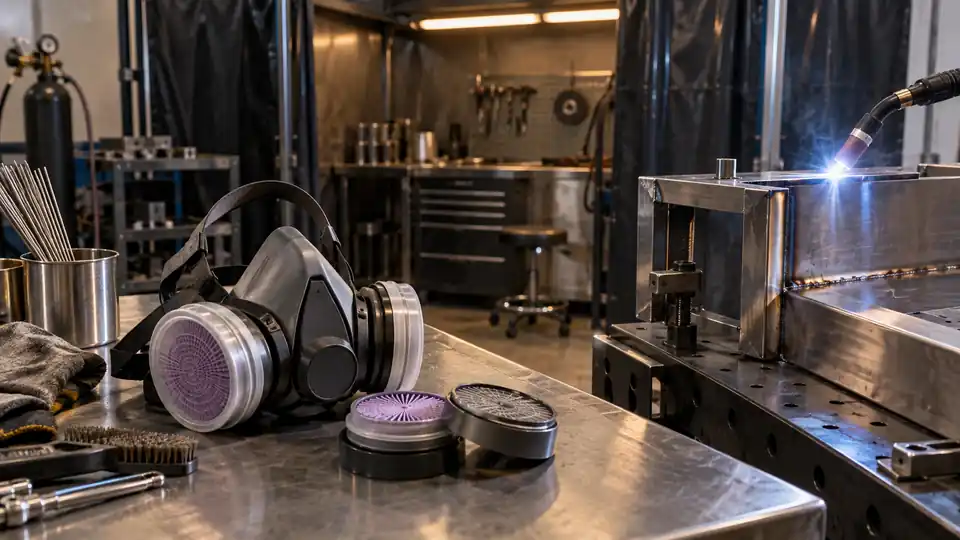
Welding respirators sit close to the face, under a helmet, and often in a hot, noisy workspace. That makes fit, breathing resistance, helmet clearance, and the type of filtration more important than a dramatic marketing number. A low-profile half mask may suit someone who already owns a quality welding helmet, while a powered air-purifying respirator (PAPR) can make more sense for buyers seeking an integrated hood and airflow system.
The main buying mistake is treating every respirator as interchangeable. A P100 particulate filter, a nuisance organic-vapor relief layer, and a P3 cartridge are different configurations with different intended uses. Buyers should also check whether filters are included, whether the mask fits beneath their helmet, and whether the size matches the face. For a conventional under-helmet setup, the Miller LPR-100 Gen. II offers one of the strongest combinations of low-profile design, included filtration, and welding-specific features in this group.
This comparison covers compact half-face respirators, preconfigured P100 kits, and integrated welding helmets with powered filtration. The rankings weigh documented filtration features, helmet compatibility, adjustability, included components, and practical trade-offs. Respiratory protection still needs to be matched with ventilation, workplace procedures, fit requirements, and the product documentation.
Quick Answer
- Best Overall: Miller LPR-100 Gen. II M/L for its low-profile welding fit, P100 filtration claim, nuisance organic-vapor relief, and quick-change filters.
- Best Integrated Option: YESWELDER LYG-M800H PAPR Welding Helmet for buyers who want respiratory and eye protection in one powered hood.
- Best Budget-Oriented Setup: 3M 6503QL for a reusable silicone half facepiece with a quick-latch harness and broad 3M bayonet compatibility.
- Best Ready-to-Use P100 Kit: 3M 6391 Assembly Kit for buyers who want a large half mask and included 2091 P100 filters.
Best Welding Respirator Comparison Table
| Product | Best For | Respirator Type | Key Strength |
|---|---|---|---|
| Miller LPR-100 Gen. II M/L | Under-helmet welding | Half mask with filters | P100 and nuisance OV relief |
| YESWELDER LYG-M800H | Integrated powered protection | PAPR welding helmet | Airflow, lens, and hood combined |
| 3M 6503QL | Frequent on-and-off use | Reusable half facepiece | Quick-latch harness |
| 3M 6391 Assembly Kit | Large-face fit with P100 filters | Half mask kit | 2091 P100 filters included |
| 3M 7502 | Medium-size silicone fit | Reusable half facepiece | Cool Flow valve and bayonet system |
| 3M 6291 Assembly Kit | Medium-size ready-to-use setup | Half mask kit | 2091 P100 filters included |
| Miller LPR-100 S/M | Smaller faces | Low-profile half mask | Helmet clearance and OV relief |
| 3M 6300 | Large-size reusable mask | Half facepiece | Broad cartridge and filter compatibility |
| Parcil Distribution WF-101 | Full-face integrated coverage | Auto-darkening respirator mask | Welding, grinding, and filtration in one system |
The detailed reviews below separate compact under-helmet respirators from integrated powered systems, so the differences are easier to weigh against your own setup.
1. Miller LPR-100 Gen. II M/L — Best Overall
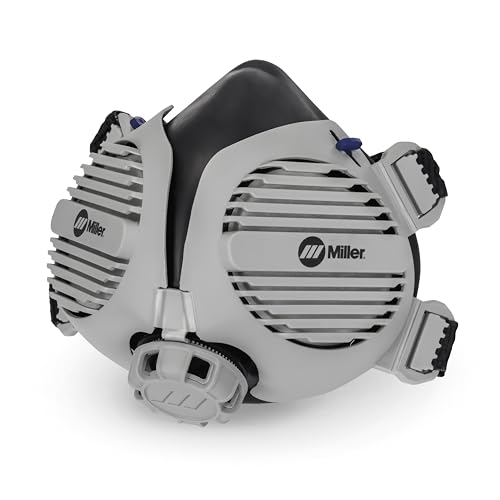
The Miller LPR-100 Gen. II is shaped around the practical problem of wearing respiratory protection beneath a welding helmet. Its low-profile half-mask design is intended to preserve helmet clearance and field of view, while the supplied filters are listed with P100 particulate filtration and nuisance organic-vapor relief. That combination gives it a more welding-specific position than a general-purpose half facepiece equipped with separate filters.
The M/L version also uses a four-point adjustable head strap and turnbuckles for filter changes. The large non-return exhaust valve and pleated filter design are presented as ways to reduce breathing resistance and heat buildup, though fit and workplace conditions still affect actual comfort. The carbon layer is intended for nuisance-level organic-vapor odors, not a universal solution for every gas or fume hazard, so the documentation should be checked for the particular welding environment.
Pros
- Low-profile shape is intended to fit beneath most welding helmets
- Filters are listed with P100 particulate filtration
- Nuisance organic-vapor relief layer adds odor reduction capability
- Quick-change turnbuckles simplify filter replacement
- Large non-return exhaust valve and four-point strap support under-helmet use
Cons
- M/L sizing may not provide the correct seal for smaller faces
- Nuisance OV relief should not be treated as broad gas or vapor protection
This is the strongest conventional choice for someone who wants one respirator specifically shaped around welding-helmet clearance. Compared with a 3M 6503QL or 7502, it arrives with welding-oriented filters and a more specialized low-profile design. Buyers who already have a compliant filter system and prefer broad 3M cartridge availability may still favor 3M, while those seeking an integrated powered hood should look to the YESWELDER or Parcil options instead.
To buy this product, click here.
2. YESWELDER LYG-M800H PAPR Welding Helmet — Best Integrated PAPR

The YESWELDER LYG-M800H takes a different route from the half masks above. Rather than placing a separate respirator under an existing hood, it combines a powered air-purifying system with an auto-darkening welding helmet. The listing describes airflow across the breathing zone and filtration aimed at airborne particles, while the helmet provides respiratory, face, and eye coverage in one setup.
Its 3.93 by 3.66-inch viewing screen and four sensors address visibility during MIG, TIG, Stick, plasma cutting, and grinding. The listed shade range covers DIN 4 through DIN 13, which gives the lens a grind setting and welding shades across several common processes. The product listing also claims up to 99.97% capture for particles as small as 0.3 microns. Buyers should verify the current filter classification, replacement-filter availability, battery details, and PAPR operating requirements before relying on it for a specific workplace program.
Pros
- Combines a powered respirator and auto-darkening welding helmet
- Large documented viewing area supports visibility around the weld zone
- Four arc sensors provide broader detection coverage than basic two-sensor designs
- Shade range includes grinding and common welding settings
- Supports MIG, TIG, MMA, plasma cutting, and grind modes according to the listing
Cons
- Higher-cost and more complex than a standalone half mask
- Replacement filter, battery, and service details should be confirmed before purchase
This system makes sense for buyers who want to reduce the number of separate pieces worn during welding and grinding. It is less attractive for someone who already owns a preferred helmet or needs a simple respirator that can move between welding, sanding, and other tasks. The integrated format may simplify setup, but the exact PAPR documentation deserves closer inspection than a basic reusable facepiece.
To buy this product, click here.
3. 3M Rugged Comfort 6503QL — Best for Frequent On-and-Off Use
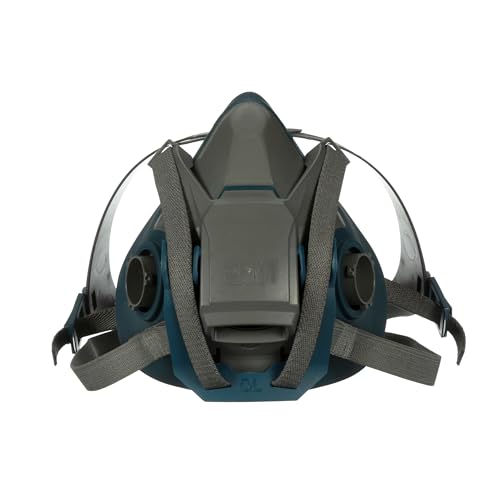
For a respirator that may need to come off between welding tasks, the 3M 6503QL focuses on the harness rather than an integrated hood. Its quick-latch mechanism allows the facepiece to drop away with one hand, which can be useful when moving between a welding station, material preparation, and other work areas. The product is a large-size facepiece, so the seal depends on matching the size to the wearer rather than choosing it by feature list alone.
The silicone faceseal is listed as durable and stable in high-heat environments, while the Cool Flow valve directs exhalation through a valve intended to ease breathing. Its low-profile half-face shape is compatible with welding and grinding shields, and the exhalation cover directs moisture downward to help reduce shield fogging. Filters and cartridges are sold through the 3M bayonet system, so the facepiece itself is flexible, but the correct filter must be selected for the hazard.
Pros
- Quick-latch design supports one-hand removal
- Silicone faceseal provides a reusable sealing surface
- Low-profile design is compatible with welding and grinding shields
- 3M bayonet connection accepts a broad range of compatible filters
- Exhalation cover directs moisture downward to help limit fogging
Cons
- Filters or cartridges may need to be purchased separately
- Large sizing may be unsuitable for smaller faces
The 6503QL is a useful foundation for a modular PPE setup, especially where the facepiece needs to work with more than one type of filter. It ranks below the Miller Gen. II because the supplied product information does not present the same welding-specific filter package. Still, a buyer who values quick removal and established bayonet compatibility may reasonably choose it over a fixed-harness mask.
To buy this product, click here.
4. 3M 6391 Half Facepiece Assembly Kit — Best Large-Size P100 Kit

The 3M 6391 is a straightforward way to obtain a large half facepiece and particulate filters in one package. The kit includes the respirator and 2091 P100 filters, which removes one shopping step for buyers who need a particulate-focused setup rather than an empty facepiece. Its soft, lightweight construction and adjustable straps are intended to support a practical fit beneath compatible face and eye protection.
Compared with the Miller LPR-100, this kit is less specialized around welding-helmet clearance and nuisance odor relief. Its strength is simplicity: the product information clearly identifies the included 2091 P100 filters and bayonet connection. A P100 particulate filter should not be interpreted as protection against every gas or vapor, and users need to confirm that the configuration matches the contaminants and procedures in their work area.
Pros
- Includes a large half facepiece and 2091 P100 filters
- Bayonet connection supports compatible 3M filters and cartridges
- Soft, lightweight facepiece is intended for reusable use
- Adjustable straps simplify fit changes
- Ready-to-use kit avoids sourcing a facepiece and filters separately
Cons
- Large size may not seal correctly on smaller faces
- Particulate filters do not provide universal gas or vapor protection
This kit suits a buyer who wants a clear, particulate-oriented starting point in a large size. It is a more practical selection than an empty respirator when the included 2091 filters match the intended application. Choose the Miller Gen. II for a lower-profile welding-specific design, or the 3M 6503QL if quick-latch removal matters more than receiving a complete filter kit.
To buy this product, click here.
5. 3M 7502 Half Facepiece — Best Medium Silicone Facepiece

The 3M 7502 occupies the middle ground between a basic reusable mask and a welding-specific respirator. Its medium silicone facepiece is listed with a dual-mode harness and quick-latch function, giving it a useful balance for someone who wants a reusable mask that can be removed without fully undoing the straps. The Cool Flow valve is intended to make exhalation easier, which may matter under a helmet where heat and moisture can build quickly.
The facepiece uses 3M bayonet-style cartridges and filters, including several particle-filter families and gas or vapor cartridges. That flexibility makes the empty facepiece adaptable, but it also means the buyer must select the right compatible filter separately. The listing identifies welding among its recommended applications, yet it does not include a welding-specific filter package in the information provided here.
Pros
- Medium-size silicone facepiece offers a reusable sealing surface
- Quick-latch harness supports easier removal
- Cool Flow valve is intended to ease exhalation
- Compatible with 3M bayonet cartridges and filters
- Exhalation cover directs moisture away from the shield area
Cons
- Filters or cartridges are not identified as included
- Medium sizing may not suit every face shape or helmet combination
The 7502 makes more sense for buyers who already understand which 3M filter configuration they need and want a medium silicone facepiece. It offers more harness convenience than the 6300, but the Miller LPR-100 is more immediately aligned with under-helmet welding because its filters and low-profile design are central to the package. Verify fit and filter selection before treating the 7502 as a complete welding respirator setup.
To buy this product, click here.
6. 3M 6291 Half Facepiece Assembly Kit — Best Medium-Size P100 Kit
The 3M 6291 provides the medium-size counterpart to the 6391 kit. It includes a reusable half facepiece and 2091 P100 particulate filters, making it a reasonable choice for buyers who need a complete particulate-filter setup in a smaller size. The mask uses a bayonet connection, so future filter or cartridge choices can remain within the 3M compatible system.
Its appeal is practical rather than specialized. The listing identifies a soft, lightweight facepiece with adjustable straps, but it does not describe the low-profile welding geometry or nuisance organic-vapor relief found on the Miller LPR-100 Gen. II. For someone who already knows that a medium 3M facepiece fits beneath their helmet, the included P100 filters keep the initial setup simple.
Pros
- Medium-size fit is useful for faces that do not suit large masks
- Includes 2091 P100 particulate filters
- Reusable facepiece can accept compatible 3M bayonet filters
- Adjustable straps support fit changes
- Soft, lightweight construction suits repeated use
Cons
- Does not include the Miller-style nuisance organic-vapor relief feature
- Particulate filtration alone may not address every workplace hazard
The 6291 is the practical choice between the two 3M P100 kits when medium sizing is the better match. It may be preferable to the empty 7502 for buyers who want filters included, while the 7502 offers a silicone facepiece and quick-latch harness but requires separate filter selection. Check the seal, helmet clearance, and filter requirements before ordering.
To buy this product, click here.
7. Miller LPR-100 S/M — Best Compact Welding Fit

The original Miller LPR-100 remains relevant because its product information focuses on the cramped space beneath a welding helmet. The small/medium version is listed as fitting beneath most welding helmets, and it includes filters rather than leaving the buyer to assemble a compatible package. That makes it a cleaner option for someone whose main concern is preserving helmet fit while adding a low-profile respirator.
A large non-return exhaust valve is intended to reduce user fatigue by managing exhalation, while the product is identified as meeting NIOSH standards. The supplied information does not provide the same expanded detail as the Gen. II listing, so buyers who want nuisance organic-vapor relief, pleated filter claims, and quick-change turnbuckles may prefer the newer model. The S/M size, however, can be the more important distinction for a smaller face.
Pros
- Small/medium size supports a closer fit for smaller faces
- Designed to fit beneath most welding helmets
- Filters are included with the respirator
- Large non-return exhaust valve addresses exhalation comfort
- NIOSH standards are identified in the product information
Cons
- Product information provides fewer filter details than the Gen. II model
- Small/medium sizing may not suit larger faces
This Miller is a sensible pick when helmet clearance and size take priority over the newest feature description. It is more welding-focused than a general 3M facepiece, while the Gen. II offers a broader documented feature set for buyers willing to choose the newer configuration. Confirm the current replacement-filter details and fit before committing to either Miller model.
To buy this product, click here.
8. 3M 6300 Half Facepiece — Best Large Modular Facepiece

The 3M 6300 is a large reusable half facepiece for buyers who want a basic platform compatible with a wide range of 3M filters and cartridges. Its application list includes welding, grinding, construction, and general industrial maintenance, but the respirator itself does not establish one universal filter configuration for all those tasks. The useful feature here is modularity, provided the selected filter matches the actual contaminant and work procedure.
The facepiece can be disassembled, cleaned, and reused, and the listing identifies adjustable straps and a storage bag. Adjustment points are placed on the facepiece to support compatibility with other PPE, although helmet clearance will still depend on the exact mask, headgear, and face shape. Compared with the 6503QL, it gives up the quick-latch harness. Compared with the 3M kits, it requires the buyer to source the correct filters separately.
Pros
- Large-size reusable facepiece supports a modular PPE system
- Compatible with 3M bayonet cartridges and particle filters
- Can be disassembled, cleaned, and reused
- Adjustment points are intended to work with other PPE
- Storage bag is included according to the listing
Cons
- Filters or cartridges are not identified as included
- No quick-latch harness is listed
The 6300 is best suited to buyers who already have a defined 3M filter plan or need a large facepiece for several tasks. It is less convenient as a first purchase than the 6391 because the kit does not arrive with the 2091 filters. Those who weld beneath a tight helmet may also find the Miller models more purpose-built for clearance.
To buy this product, click here.
9. Parcil Distribution WF-101 — Best Full-Face Integrated System

The Parcil WF-101 combines an auto-darkening welding lens, grinding face shield, and respirator in a full-face format. Its flip-up design is intended to let the wearer move between welding, grinding, and preparation without changing the entire face covering. The lens is listed with DIN 5 to 8 for grinding or lighter tasks and DIN 9 to 13 for MIG, TIG, and Stick welding, giving the system a wider task range than a half mask worn under a separate hood.
Respiratory filtration uses bayonet O-A-X cartridges, with P3 particulate filters identified in the product information. The adjustable multi-point harness and quick-release buckles address fit and removal, while spectacle-insert compatibility may help some users. Buyers should verify the exact cartridge contents, replacement availability, and the applicable certification details before treating this full-face system as a substitute for a workplace-selected respiratory program.
Pros
- Combines welding, grinding, and respiratory equipment in one face covering
- Flip-up format supports fast transitions between tasks
- Auto-darkening shade range covers grinding and common welding processes
- Full-face design provides broader facial coverage than a half mask
- Multi-point harness and quick-release buckles support adjustability
Cons
- Full-face integrated design is less modular than a separate respirator and helmet
- Replacement cartridge details should be confirmed before purchase
The WF-101 is a better match for someone who values an all-in-one arrangement over the lightest under-helmet setup. It may reduce equipment changes around a small fabrication station, yet it also commits the buyer to one integrated system. A half mask such as the Miller LPR-100 is easier to pair with an existing preferred helmet, while the YESWELDER offers powered airflow rather than the WF-101’s cartridge-based arrangement.
To buy this product, click here.
How to Choose the Best Welding Respirator
Match the Respirator to the Helmet
A respirator that seals well but pushes against the inside of a welding hood can create a poor overall setup. Low-profile models such as the Miller LPR-100 are shaped for under-helmet use, while full-face systems such as the Parcil WF-101 replace the separate helmet and respirator arrangement. Check the manufacturer’s fit guidance and make sure the mask does not interfere with headgear, lens movement, or the field of view.
Understand Particulate Filtration
P100 and P3 filters are particulate-focused classifications, but they should not be treated as universal protection against every welding-related gas or vapor. The 3M 6391 and 6291 kits include 2091 P100 filters, while the Miller Gen. II adds a nuisance organic-vapor relief layer. That relief feature is narrower than a cartridge selected for a specific gas hazard, so the label and workplace requirements matter.
Choose the Correct Size
A proper seal depends on the facepiece size and the wearer’s face shape. The Miller LPR-100 is offered here in S/M and M/L versions, while the 3M kits and facepieces vary between medium and large. A mask that is too large or too small can compromise the seal, regardless of how attractive its filter specification appears.
Decide Between a Half Mask and a PAPR
A half mask is usually the simpler route when you already have a welding helmet and want respiratory protection beneath it. A PAPR hood such as the YESWELDER LYG-M800H adds powered airflow and integrates eye protection, but it also introduces batteries, filters, charging, and replacement-part questions. The extra system complexity may be justified for the intended environment, but it should be evaluated against the actual documentation.
Check What Is Included
The 3M 6391 and 6291 are assembly kits with 2091 P100 filters, while the 3M 7502 and 6300 are facepieces whose compatible filters may need to be purchased separately. The Miller products are supplied with filters according to their listings. Check the exact package contents because a facepiece that merely accepts a cartridge is not the same as a complete ready-to-use respirator package.
Keep Ventilation and Fit Testing in the Plan
A respirator does not replace source control, ventilation, training, or workplace procedures. Fit, maintenance, filter changes, and storage all affect how a reusable respirator functions in practice. Buyers using respiratory protection in an occupational setting should follow the applicable program requirements and the manufacturer’s instructions rather than relying on a product title alone.
Best Welding Respirator FAQ
Can a half-face respirator fit under a welding helmet?
Many low-profile half masks are intended for use with welding helmets, but fit depends on the specific facepiece, helmet, headgear, and wearer. The Miller LPR-100 listings specifically emphasize under-helmet use. A larger 3M facepiece may require more clearance, so check the combination before regular use.
Is a P100 filter suitable for welding?
A P100 filter is intended for certain particulate hazards, and several products in this roundup use 2091 P100 filters. It does not automatically provide protection against every gas or vapor. Select filtration based on the actual materials, coatings, processes, and workplace requirements.
What is the difference between a welding respirator and a PAPR welding helmet?
A conventional welding respirator is often a passive half mask worn under a separate helmet. A PAPR welding helmet combines a powered airflow system with the hood and auto-darkening lens. The integrated approach can reduce separate equipment, while the half-mask approach is generally easier to replace or pair with an existing helmet.
Are the Miller LPR-100 S/M and M/L the same respirator?
They are closely related Miller LPR-100 configurations, but the listed sizes differ. The S/M version is intended for smaller faces, while the M/L version is intended for larger faces. Choosing by fit is more useful than treating one size as universally better.
Do 3M respirators include filters?
Some do and some do not. The 3M 6391 and 6291 are assembly kits that include 2091 P100 filters. The 3M 6503QL, 7502, and 6300 listings identify reusable facepieces compatible with 3M filters and cartridges, but buyers should confirm the exact package contents before ordering.
Does nuisance organic-vapor relief protect against all vapors?
No. The Miller Gen. II listing describes a carbon layer for nuisance-level organic-vapor relief. That is a limited feature and should not be treated as broad protection against every vapor or gas. Consult the product documentation and the applicable workplace respiratory-protection requirements for a specific hazard.
Is an integrated welding respirator easier to use than a separate helmet and mask?
It can reduce the number of separate pieces and may simplify transitions between welding and grinding. The trade-off is less modularity, since the lens, face coverage, and respirator are tied together. Buyers who already own a preferred helmet may find a low-profile half mask more practical.
Final Verdict
The Miller LPR-100 Gen. II M/L is the strongest overall choice in this selection because its documented features align closely with the actual welding-respirator decision. Its low-profile shape is intended for helmet clearance, the supplied filters are listed with P100 particulate filtration and nuisance organic-vapor relief, and the quick-change design is more purpose-built than a general empty facepiece. The S/M version is the better fit direction for smaller faces.
Choose the YESWELDER LYG-M800H if an integrated powered hood matters more than a simple under-helmet mask. The 3M 6391 is a sensible large-size kit with included P100 filters, while the 3M 6503QL suits buyers who value quick removal and modular 3M bayonet compatibility. Whichever format you select, match the size, filter classification, helmet clearance, ventilation plan, and workplace requirements before relying on the equipment.
