
A MIG arc can spread a bright pool across the joint in an instant, while the surrounding shop stays dim and hard to read. A suitable auto-darkening helmet keeps the view available between welds, responds to the arc, and gives enough shade range for the settings used by MIG welding. The best welding helmet for MIG should therefore balance lens clarity, viewing area, sensor coverage, shade adjustment, headgear, and replacement-lens practicality.
Large viewing windows are useful, but they do not tell the whole story. A helmet with four sensors may offer broader detection coverage than a two-sensor design, while a lighter shell can reduce neck fatigue during repeated tacks. Buyers can also overvalue advertised switching speed and overlook controls, battery access, grind mode, or whether the headgear holds the lens at a comfortable distance. MIG-only work may call for a simpler helmet, while fabrication, cutting, grinding, and occasional TIG work can justify broader adjustments.
This comparison weighs those differences rather than treating every large-screen helmet as equivalent. The YESWELDER LYG-M800H earns the top position for its combination of a large true-color viewing area, four sensors, practical shade controls, low weight, and accessible battery. A Miller model makes more sense for buyers who place greater value on established documentation and advanced lens systems, while several lower-cost options suit occasional garage work.
Quick Answer
- Best Overall: YESWELDER LYG-M800H, a balanced MIG helmet with a 3.93 by 3.66 inch view, four sensors, and 1/1/1/1 optical clarity.
- Best Premium: Miller Digital Infinity, with a 13.4-square-inch viewing area, ClearLight 4X lens technology, X-Mode, and digital controls.
- Best for Long Sessions: ARCCAPTAIN Intelligent Auto-Darkening Helmet, which combines a panoramic 180-degree view with seven sensors and a rechargeable battery.
- Best Value With Work Light: Sunstac Auto-Darkening Helmet, which adds a rechargeable adjustable light to a true-color lens and dual-power design.
Best Welding Helmet for MIG Comparison Table
| Product | Best For | Viewing Area | Sensor And Power Details |
|---|---|---|---|
| YESWELDER LYG-M800H | Best overall balance | 3.93 x 3.66 in | 4 sensors, CR2450 battery |
| Miller Digital Infinity | Premium visibility | 13.4 sq. in. | 4 sensors, X-Mode, digital controls |
| Miller Classic Series | Documented everyday use | 6 sq. in. | 2 sensors, auto-on power |
| ARCCAPTAIN Intelligent | Panoramic viewing | 7.2 x 3.2 in total | 7 sensors, rechargeable and solar assist |
| MIGVAN Large View | Replaceable lens convenience | Large viewing screen | 4 sensors, CR2450 and solar power |
| ARCCAPTAIN Large View With Light | Dim work areas | 3.94 x 3.66 in | 4 sensors, CR2450, USB light |
| ARCCAPTAIN Auto-Darkening Hood | Simple large-screen setup | 3.94 x 3.66 in | 4 sensors, dual CR2450 batteries |
| Sunstac Auto-Darkening Helmet | Budget work-light setup | 3.94 x 3.27 in | 4 sensors, solar and battery power |
| VILSIN Auto-Darkening Helmet | Lower-cost replacement lenses | 3.78 x 1.58 in | 2 sensors, solar and CR2032 battery |
The detailed reviews explain where each helmet fits, which features matter for MIG work, and where the compromises become visible.
1. YESWELDER LYG-M800H — Best Overall
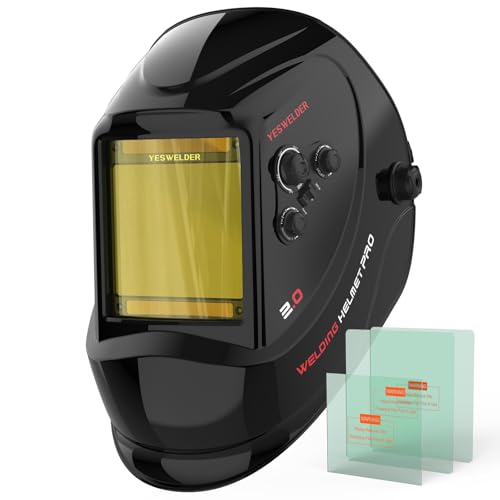
The YESWELDER LYG-M800H lands in the strongest middle ground for MIG users. Its 3.93 by 3.66 inch viewing area gives enough room to see the wire entry point, puddle, and nearby joint edges without moving the helmet constantly. The listing identifies 1/1/1/1 true-color optical clarity, which should provide a more natural view than the green cast associated with older passive-style lenses.
Four arc sensors are useful when a workpiece, torch angle, or tight joint partially blocks one side of the lens. The helmet also offers shade settings across DIN 5-9 and 9-13, with a DIN 3 light state, so it can move beyond routine MIG work into grinding and other listed processes. At approximately 1.32 pounds, it is lighter than many large-view designs. That combination makes it easier to justify for a garage setup that sees frequent short welds, repair work, and occasional fabrication.
Pros
- Large 3.93 by 3.66 inch viewing area suits MIG puddle tracking.
- 1/1/1/1 true-color optical clarity is listed for a more natural view.
- Four arc sensors provide broader detection coverage than two-sensor designs.
- Light approximately 1.32-pound construction reduces helmet weight.
- CR2450 battery access and cheater-lens compatibility simplify routine setup.
Cons
- The product information does not identify a rechargeable battery.
- Shade adjustment is less expansive than the panoramic ARCCAPTAIN model.
Choose this helmet if MIG is the primary process and you want a broad view without moving into the higher cost and complexity of a premium digital hood. The four-sensor arrangement and low weight are more meaningful for repeated tacking than a headline switching number alone. Buyers who need a very wide peripheral view, built-in lighting, or advanced memory functions may prefer another model below.
To buy this product, click here.
2. Miller Digital Infinity — Best Premium

The Miller Digital Infinity is aimed at buyers who want a substantially larger visual field than a conventional rectangular MIG helmet. Its listed 13.4-square-inch viewing area can reduce the tunnel-like effect that appears when tracking a long seam or checking alignment around a larger assembly. ClearLight 4X lens technology and four arc sensors add to the model’s focus on visibility, while X-Mode is intended to reduce sunlight interference and maintain sensor response when the arc is partly obstructed.
This is more helmet than a casual MIG user may need, but its controls give the purchase a clear purpose. Weld, cut, grind, and X-Mode settings separate common tasks, and digital controls adjust shade, sensitivity, and delay. The listing also identifies two memory presets, half-shade settings, Legacy Headgear, and InfoTrack 2.0 arc-time and arc-count tracking. Those features suit a busy fabrication environment where repeatable settings and a broad view matter more than keeping the helmet compact.
Pros
- 13.4-square-inch viewing area is the largest listed here.
- ClearLight 4X technology targets a brighter, more detailed view.
- X-Mode is intended to reduce sunlight-related sensor interference.
- Digital shade, sensitivity, delay, and memory controls support repeatable setup.
- Weld, cut, grind, and X-Mode settings cover more than MIG alone.
Cons
- Its premium positioning may exceed the needs of occasional MIG users.
- The larger feature set adds controls that some buyers may rarely use.
The Digital Infinity makes the most sense for long seams, complex assemblies, and users who spend enough time under a hood to benefit from the larger view and saved settings. It is a stronger choice than the smaller Miller Classic for peripheral visibility, while the YESWELDER remains a simpler and lighter route for routine garage welding. Check the exact current configuration before ordering, especially if a specific accessory or feature is important.
To buy this product, click here.
3. Miller Classic Series Welding Helmet — Best for Documented Controls

The Miller Classic Series takes a more restrained approach than the Digital Infinity. Its six-square-inch viewing area is smaller than the large-screen options, but it still gives a useful view for MIG joints without the bulk of a panoramic hood. ClearLight lens technology, two arc sensors, and a listed switching speed of 1/23,000 second provide a documented feature set suited to regular welding, cutting, and grinding.
Controls for shade, delay, and sensitivity are digital, and the helmet has a light-state shade of 3.0, weld shades from 8 to 13, cut shades from 5 to 8, and grind shade 3 according to the listing. Auto-on activation at the arc reduces the need to manage a separate power switch. The three-year warranty and listed ANSI Z87.1+, CSA, and CE compliance may matter to buyers who prefer a more established specification package over a low-cost generic hood.
Pros
- Six-square-inch viewing area provides a practical middle size.
- ClearLight lens technology is intended for high-definition optics.
- Digital shade, delay, and sensitivity controls allow process adjustment.
- Auto-on power activates when the arc is struck.
- Three-year warranty is listed with the helmet.
Cons
- Two sensors provide less detection coverage than the four- and seven-sensor options.
- The viewing area is smaller than the YESWELDER and both large ARCCAPTAIN models.
This Miller is a sensible fit for MIG users who want a conventional hood with clear controls and published compliance information. The smaller view can be an advantage if a compact shell matters, but it gives up peripheral awareness beside the Digital Infinity. Buyers who frequently weld low-amperage or partially obstructed joints should compare sensor coverage carefully rather than assuming the Miller name settles the choice.
To buy this product, click here.
4. ARCCAPTAIN Intelligent Auto-Darkening Helmet — Best for Panoramic Viewing

A conventional front lens shows the joint ahead of the torch, while the ARCCAPTAIN Intelligent model adds two side lenses to widen the surrounding view. The listing gives a total viewing area of 7.2 by 3.2 inches, with a 4.6 by 3.2 inch main lens and two 1.3 by 2.5 inch side lenses. That layout may help when a MIG operator needs to see fixture edges, nearby tack points, or the approach to a joint without turning the head.
Seven arc sensors, 1/1/1/1 optical clarity, and a listed 1/30,000-second response give this helmet a strong visibility specification. Its internal screen permits shade, sensitivity, and delay adjustments, while nine memory settings can reduce repeated setup when moving between jobs. The rechargeable 500mAh battery uses solar assistance, and a built-in work light can illuminate a dark joint. The trade-off is a more involved control system and a larger feature set than many MIG-only users require.
Pros
- Panoramic lens arrangement provides a 7.2 by 3.2 inch total view.
- Seven arc sensors offer broad coverage around the lens.
- 1/1/1/1 optical clarity is listed for the main and side lenses.
- Rechargeable battery and solar assist reduce reliance on disposable cells.
- Nine memory settings and a built-in work light add practical flexibility.
Cons
- The side-lens design introduces more components to protect and replace.
- Fixed sensitivity in smart auto-adjustment mode may limit manual preference.
This helmet suits MIG work in changing positions, dim areas, or larger assemblies where peripheral awareness has real value. Its controls make more sense for someone who regularly changes between processes and settings than for a user who makes a few occasional repairs. Before purchase, confirm the current lens and battery documentation, and remember that the work light is an aid to visibility rather than a substitute for proper shop lighting.
To buy this product, click here.
5. MIGVAN Large-View Welding Helmet — Best for Lens Replacement Convenience

MIGVAN focuses on the practical details that become noticeable after a helmet has seen sparks, dust, and grinding debris. Its listing describes a large true-color viewing screen, four arc sensors, a DIN 4 light state, and dark-state ranges of DIN 5-9 and 9-13. Those settings cover typical MIG work while leaving room for other listed processes and grinding, provided the selected shade matches the task and the manufacturer’s instructions.
The power system combines solar charging with a replaceable CR2450 battery, which gives buyers two ways to keep the auto-darkening cartridge operating. The package is listed with two inner lenses, two outer lenses, and a storage bag. That replacement-lens supply is more useful than decorative extras because the outer lens is the part most exposed to spatter and scratches. The product information also identifies sensitivity adjustment, pivoting headgear, and breathable padding, though exact weight and viewing dimensions are not clearly published.
Pros
- Four sensors support detection from multiple angles.
- Solar and replaceable-battery power provide flexible maintenance.
- DIN 4 light state and DIN 5-9 and 9-13 dark ranges suit varied tasks.
- Package includes two inner and two outer replacement lenses.
- Storage bag helps protect the helmet between jobs.
Cons
- The available information does not clearly publish the exact viewing dimensions.
- The claimed optical and safety details should be confirmed against current documentation.
MIGVAN is a useful choice for buyers who expect the outer lens to take routine shop abuse and want replacements available from the start. It does not offer the panoramic view or extensive memory controls of the ARCCAPTAIN Intelligent model, but its package is more maintenance-conscious than many basic hoods. Check replacement-lens availability and the exact current configuration before relying on it for regular work.
To buy this product, click here.
6. ARCCAPTAIN Large-View Helmet With Light — Best for Dim Work Areas

The main reason to choose this ARCCAPTAIN model is its combination of a large 3.94 by 3.66 inch viewing area and a USB-powered LED work light. The light has two brightness levels and is supplied uninstalled, so setup includes attaching it before use. That small lamp can help reveal the joint before striking an arc in a shadowed corner, although it does not replace general illumination or a proper inspection light.
Four sensors, 1/1/1/1 optical clarity, and a listed 1/25,000-second switching speed put the lens close to the YESWELDER in the basic comparison. The hood supports DIN 4 in the light state and DIN 5-8 and 9-13 in dark states. At approximately one pound, it is among the lighter listed options. Solar panels and a CR2450 battery handle power, while the adjustable headgear and breathable padding address the comfort side of repeated MIG work.
Pros
- 3.94 by 3.66 inch viewing area gives a broad forward view.
- Four arc sensors provide coverage for angled or partially blocked joints.
- Built-in USB-powered light has two brightness levels.
- Approximately one-pound weight supports easier movement.
- 1/1/1/1 true-color optical clarity is listed.
Cons
- The work light arrives uninstalled and needs separate attachment.
- The light adds another component that requires charging or power management.
This model makes sense for a garage or repair area where the joint regularly falls into shadow. It offers a broader view than the smaller VILSIN while keeping a simpler setup than the panoramic ARCCAPTAIN. Buyers who work in a well-lit shop may prefer the YESWELDER if the extra lamp has little practical value.
To buy this product, click here.
7. ARCCAPTAIN Auto-Darkening Hood — Best for a Simple Large-Screen Setup
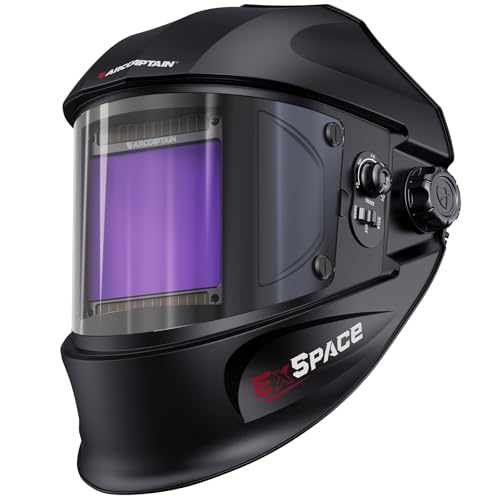
This ARCCAPTAIN hood keeps the central feature set straightforward: a 3.94 by 3.66 inch screen, four arc sensors, adjustable brightness and sensitivity, and a DIN 4 light state with DIN 5-9 and 9-13 dark ranges. For MIG users who want a large forward view without a side-lens system or built-in work light, that simpler arrangement can make more sense. The listing identifies 1/1/1/1 optical clarity and true-color viewing, which are relevant when the puddle and joint edges need to remain visually distinct.
The power setup uses two solar panels and two CR2450 lithium batteries, according to the listing. Its adjustment knob is positioned for operation with gloves, and the headband was rearranged for a closer fit. The product also identifies a PP shell and a stated operating range of -5°C to 55°C, but those material figures do not tell a buyer how the hood will feel or balance during a long session. Fit remains something to verify through adjustment range and return policy.
Pros
- Large 3.94 by 3.66 inch viewing area suits MIG tracking.
- Four sensors provide broader coverage than the VILSIN’s two sensors.
- Glove-accessible adjustment knob simplifies shade changes.
- Two solar panels and two CR2450 batteries provide a dual-power arrangement.
- 1/1/1/1 true-color optics are listed.
Cons
- It lacks the auxiliary work light included with the nearby ARCCAPTAIN model.
- The listing does not provide a documented weight.
Pick this version when a large screen and easy physical adjustment matter more than lighting or advanced memory modes. It is a cleaner alternative to the work-light model for a properly illuminated shop. Buyers who need the light-state view for frequent inspection should compare the listed shade behavior carefully, since product descriptions can vary between configurations.
To buy this product, click here.
8. Sunstac Auto-Darkening Helmet — Best Budget Choice With Work Light

Sunstac gives budget-oriented MIG users a reasonably broad feature mix without moving to a panoramic shell. Its 3.94 by 3.27 inch viewing screen is slightly shorter than the YESWELDER and ARCCAPTAIN large-view designs, but it remains large enough for ordinary joint tracking. The listing identifies four sensors, 1/1/1/1 true-color viewing, and a listed 1/30,000-second switching speed. Those specifications are useful on paper, though they should be interpreted alongside fit, controls, and lens replacement access.
The rechargeable auxiliary light is the more distinctive feature. It can swivel and offers concentrated or wider illumination, which may help with joint placement before the arc begins. Solar and lithium-battery power provide two operating modes, and cheater-lens compatibility is listed, with the magnifying lens sold separately. Shade ranges cover DIN 4 in light and DIN 5-9 and 9-13 in dark states. The smaller viewing height and less documented headgear information keep it below the larger YESWELDER.
Pros
- Four sensors support MIG use from varied torch angles.
- 1/1/1/1 true-color viewing is listed.
- Rechargeable swivel work light offers two illumination patterns.
- Solar and battery power provide flexible operation.
- Cheater-lens compatibility is listed for corrected close viewing.
Cons
- The 3.94 by 3.27 inch view is shorter than several competing large-screen helmets.
- Cheater lens is compatible but sold separately.
Sunstac is a reasonable fit for occasional MIG work in a dim garage, especially if the adjustable lamp solves a real visibility problem. Its feature mix is broader than a basic low-cost helmet, but the YESWELDER remains the stronger overall choice for a larger vertical view and lighter documented weight. Confirm battery charging and replacement-lens details before committing to regular use.
To buy this product, click here.
9. VILSIN Auto-Darkening Welding Helmet — Best for a Lower-Cost Replacement-Lens Package

VILSIN takes a more compact approach to the viewing area, listing a 3.78 by 1.58 inch visible area inside a 4.33 by 3.54 inch cartridge. That narrower window may suit buyers who prefer a smaller hood, but it gives up the surrounding view offered by the top-ranked helmets. Two arc sensors are listed, so this model has less sensor coverage than the four-sensor designs above and should be positioned accordingly for straightforward MIG work rather than obstructed or unusually low-amperage setups.
The lens offers DIN 4 in the light state and DIN 5-9 and 9-13 dark ranges, with solar assistance and a replaceable CR2032 battery. The package includes three outside filter lenses and two inside clear lenses, which gives the buyer useful replacements for routine wear. Adjustable head straps and a padded front band address fit, while the listing identifies compatibility with MIG, DC TIG, AC TIG, plasma cutting, and Stick. Those process labels describe listed compatibility, not proof that every process has identical visibility or performance requirements.
Pros
- Includes three replacement outside filter lenses.
- Includes two replacement inside clear lenses.
- Solar assistance extends the replaceable CR2032 battery system.
- DIN 5-9 and 9-13 dark ranges cover common MIG settings.
- Multiple headgear adjustments help tune lens position and fit.
Cons
- The 3.78 by 1.58 inch viewing area is narrower than the other budget options.
- Two sensors provide less coverage than the four-sensor helmets in this roundup.
VILSIN is best suited to occasional users who value spare lenses and a compact design more than a wide field of view. It can cover ordinary MIG tasks, but the smaller window and two-sensor layout explain its lower ranking. A buyer who frequently tracks long seams, works around obstructions, or wants a broad view of the joint should spend more on a large-screen alternative.
To buy this product, click here.
Buying Guide For The Best Welding Helmet For MIG
Viewing Area Should Match The Joint
A larger viewing area can make it easier to see the puddle, wire entry point, and nearby edges without moving the helmet. The YESWELDER and ARCCAPTAIN large-view models use screens around 3.94 by 3.66 inches, while the Miller Digital Infinity takes a much larger panoramic approach. More area is useful for long seams and awkward positions, but it can also add cost, shell size, or replacement-lens expense. A compact view may be enough for short repair welds performed from a stable position.
Four Sensors Give More Detection Coverage
Arc sensors detect the welding arc and trigger the lens darkening. Four sensors generally cover more angles than two, which can matter when a joint, fixture, or torch blocks part of the cartridge. Sensor count does not replace correct helmet adjustment, shade selection, or manufacturer instructions. For routine MIG work, a well-fitted four-sensor helmet offers a practical balance, while the seven-sensor ARCCAPTAIN model is aimed at buyers who want broader detection coverage.
Use The Correct MIG Shade
Auto-darkening helmets still require the correct shade setting for the welding task. The models here list dark ranges that commonly reach DIN 9-13, while some provide a DIN 4 light state and separate grind settings. Do not choose a shade solely because it is the darkest available. Follow the helmet documentation and applicable workplace guidance for the current process, amperage, and conditions.
Optical Clarity Affects Puddle Visibility
True-color lenses can make the workpiece and puddle appear more natural than older green-tinted lenses. A 1/1/1/1 optical classification is listed for several models here, but that rating should not be treated as a guarantee that every wearer will see the same way. Lens cleanliness, outer-cover condition, head position, ambient lighting, and personal vision correction all affect the view.
Power And Replacement Lenses Matter
Solar assistance can help maintain battery life, while a replaceable cell keeps the cartridge serviceable. Rechargeable systems reduce disposable-battery changes but add charging to the maintenance routine. Outer cover lenses take the brunt of spatter and grinding dust, so check whether replacements are included, readily available, or sold separately. MIGVAN and VILSIN stand out for their listed replacement-lens packages, while cheater lenses for YESWELDER and Sunstac are compatible but separate purchases.
Fit Is More Than Padding
A helmet that shifts when the wearer looks down can make joint tracking frustrating. Look for an adjustable ratchet, stable pivot, useful lens-to-eye distance, and enough range to keep the cartridge centered. Weight also matters during repeated tacks. The YESWELDER is listed at approximately 1.32 pounds, and the ARCCAPTAIN light model at approximately one pound, while exact weights are not published for every product here.
Best Welding Helmet For MIG FAQ
What Lens Shade Is Suitable For MIG Welding?
The correct shade depends on welding current, wire process, and applicable safety guidance. The helmets in this roundup commonly list dark ranges from DIN 5 or 9 through DIN 13, but that range does not mean every setting is suitable for every MIG operation. Use the manufacturer’s instructions and select the shade appropriate to the actual work.
Are Four Arc Sensors Better Than Two For MIG?
Four sensors can provide broader detection coverage when a joint, fixture, or torch angle blocks one portion of the lens. That can be useful for MIG work performed in awkward positions. Sensor count alone does not establish overall helmet quality, since optical clarity, fit, shade controls, and lens condition also affect use.
Does A True-Color Lens Improve MIG Visibility?
True-color technology is intended to reduce the green cast associated with older lens designs, making the puddle and surrounding metal appear more natural. The practical benefit depends on the specific cartridge, lighting, lens cleanliness, and the wearer’s vision. A true-color label should be considered alongside optical classification and viewing area.
Do I Need A Large Viewing Area For MIG?
A large view is helpful for tracking longer seams, checking joint edges, and working around larger assemblies. It is less critical for short welds performed from a stable position. A large lens can also increase helmet size and replacement-lens cost, so choose it when the extra visual area solves a real positioning problem.
Can A MIG Welding Helmet Be Used For Grinding?
Some helmets in this roundup list a grind mode or a light-state setting intended for grinding. Use that mode only as described in the product documentation. Grinding creates different hazards from arc welding, so the helmet should be used alongside suitable face, eye, respiratory, and workshop protection.
Is A Solar-Powered Helmet Better Than A Battery-Only Helmet?
Solar assistance can extend battery life by using available light from the arc and surrounding workspace. A replaceable battery remains useful when the helmet is stored or used in low-light conditions. Rechargeable models add a charging step but can reduce disposable-cell changes. The better arrangement depends on maintenance preference and the work environment.
Are Cheater Lenses Included With These Helmets?
Cheater lenses are not automatically included. The YESWELDER and Sunstac listings identify compatibility, while the lens itself is sold separately. Confirm the correct insert size and availability before ordering if close-up vision correction is part of the setup.
Final Verdict
The YESWELDER LYG-M800H is the strongest overall choice for MIG because it balances the features that affect everyday use: a 3.93 by 3.66 inch viewing area, listed 1/1/1/1 true-color optics, four arc sensors, practical shade controls, low published weight, and a replaceable CR2450 battery. It does not offer the panoramic view or advanced memory system of the ARCCAPTAIN Intelligent helmet, but its simpler arrangement fits more MIG users without adding unnecessary complexity.
Choose the Miller Digital Infinity when a very large viewing area, X-Mode, digital controls, and saved settings justify a premium purchase. The Miller Classic Series is a more restrained alternative with ClearLight optics, auto-on operation, and a three-year warranty. For a dim garage, Sunstac or the ARCCAPTAIN large-view model with a work light may solve a practical visibility problem. Match the helmet to the real work position, shade requirements, lighting, fit, and maintenance routine, then confirm the current product documentation before ordering.
