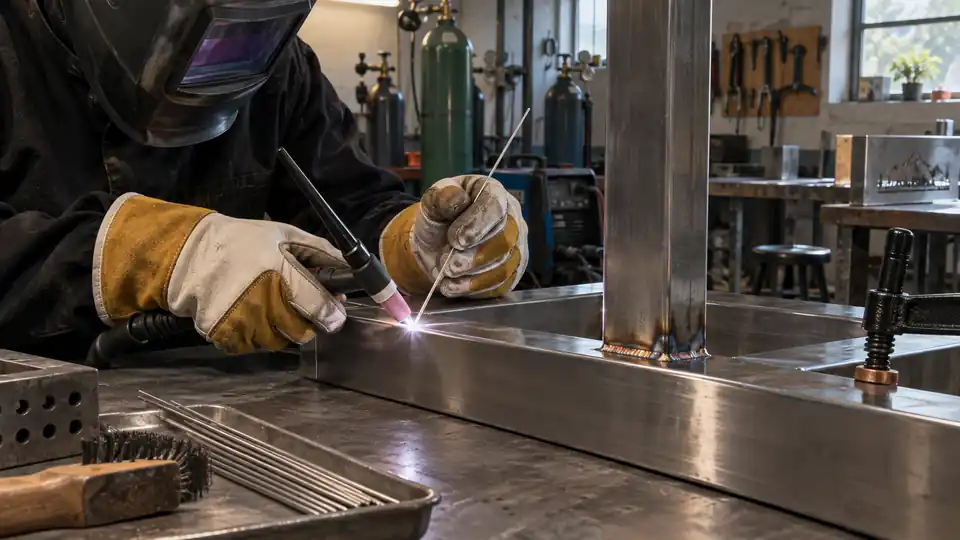
A TIG glove has a very different job from a thick general-purpose welding glove. TIG work often involves a torch, filler rod, and small movements close to the joint, so bulky leather can make an otherwise controlled task feel clumsy. The better options in this roundup use goatskin, kidskin, or a lighter glove construction to balance hand movement with coverage against sparks, abrasion, and heat.
Material alone does not decide the ranking. A soft palm may improve torch control, while a split cowhide back or extended cuff adds coverage at the cost of some flexibility. Buyers also need to watch sizing, cuff length, thumb shape, stitching, and whether a glove is intended for detailed TIG work or broader MIG, Stick, and workshop duties. The Caiman 1540 series earns the top position because its goatskin palm, reinforced areas, four-inch cuff, and shaped wrist design create the strongest overall balance in the group.
The nine selections below cover close-fitting TIG gloves, longer-cuff designs, multi-task options, and heavier leather alternatives. They are ranked by documented construction, dexterity-focused features, coverage, sizing information, and practical fit for TIG work rather than by brand name or listing popularity.
Quick Answer
- Best Overall: Caiman 1540 Large, for its goatskin palm, reinforced construction, shaped wrist, and four-inch cuff.
- Best Budget Option: Tillman 1328, a straightforward goatskin glove with an ambidextrous design.
- Best Extended Coverage: ARCCAPTAIN 14-Inch TIG Gloves, for buyers who want substantial forearm coverage.
- Best for Precise Hand Movement: IRONCAT 6141 Kidskin Gloves, with lightweight kidskin and a straight-thumb design.
Best TIG Welding Gloves Comparison Table
| Product | Best For | Palm Material | Cuff and Fit |
|---|---|---|---|
| Caiman 1540 Large | Best overall balance | Goat grain with reinforced palm | Four-inch cuff, shaped wrist |
| Tillman 1328 | Simple, ambidextrous TIG use | Top grain goatskin | Pull-on design |
| Miller Arc Armor | Multi-task welding | Product listing does not specify | Large size |
| YESWELDER Premium Goatskin | Precision work and broader tasks | Grain leather | Unlined palm, ergonomic fit |
| ARCCAPTAIN 14-Inch TIG Gloves | Extended forearm coverage | Goatskin and cowhide | 14-inch sleeve, oversized cuff |
| John Tillman TrueFit | Short-cuff TIG work | Top grain goatskin | Eleven-inch glove, unlined |
| ARCCAPTAIN Medium | Close fit with extended cuff | Top grain goatskin | Four-inch cuff, medium |
| IRONCAT 6141 | Lightweight dexterity | Top grain kidskin | Four-inch cuff, large |
| SAFEGEAR Cowhide Two-Pack | General welding and spare coverage | Split cowhide | Four-inch cuff, large |
The detailed reviews explain where each glove gains an advantage, where its construction is more limited, and which hand feel or coverage profile makes the most sense.
1. Caiman 1540 Large — Best Overall

The Caiman 1540 has the most complete documented feature set in this selection. Its palm uses premium goat grain leather, while the back uses split cowhide, giving the glove a combination of softer hand contact and more substantial coverage across the back of the hand. For TIG work, that division matters because the palm is the area where finger movement and torch handling are especially important.
Caiman also identifies a Kontour design and Kontour wrist technology. Those features are intended to follow the natural shape of the hand and help limit slippage, although the exact fit will still depend on hand proportions and the large size selected. A four-inch extended cuff, palm reinforcement, and a drag patch add useful coverage for moments when the glove contacts a work surface or encounters more abrasion than a thin TIG glove typically sees.
Pros
- Goat grain palm supports a softer, more flexible hand contact.
- Split cowhide back provides a more protective outer surface.
- Four-inch cuff extends coverage beyond the wrist.
- Kontour wrist design is intended to reduce glove movement during work.
- Palm reinforcement and drag patch address high-wear areas.
Cons
- Large is the only size represented by this specific product listing.
- Split cowhide on the back may feel less flexible than an all-goatskin construction.
This is the strongest starting point for buyers who want one pair for TIG and occasional multi-task welding rather than a minimal glove focused solely on the lightest possible feel. The trade-off is that the reinforced, mixed-leather construction may feel more substantial than the IRONCAT or Tillman 1328. Buyers with smaller hands should use the matching size version rather than relying on the large listing.
To buy this product, click here.
2. Tillman 1328 Large — Best Budget Option

The Tillman 1328 takes a simpler route than the Caiman. It uses top grain goatskin and an ambidextrous pattern, so the gloves can be worn on either hand. That can be convenient in a shared workspace, especially where gloves are removed and put back on repeatedly or where a single replacement glove needs to remain useful on either side.
Its pull-on closure keeps the design uncomplicated. The listing also identifies abrasion-resistant construction, but it does not provide the same level of detail about cuff length, reinforcement zones, or wrist shaping as the Caiman 1540. That makes the Tillman a practical choice for buyers who want a straightforward goatskin TIG glove without paying for a more structured multi-task design.
Pros
- Top grain goatskin is suited to dexterity-focused welding work.
- Ambidextrous design allows use on either hand.
- Pull-on style makes removal and replacement quick.
- Simple construction avoids unnecessary adjustment hardware.
- Large size gives buyers a clearly identified sizing option.
Cons
- The available information does not specify an extended cuff length.
- Fewer reinforcement details are published than for the Caiman 1540.
The 1328 makes more sense for basic TIG work where simple goatskin construction matters more than a long cuff or multiple reinforced zones. It is also a useful option for a workspace that needs an ambidextrous glove. Buyers who regularly rest their hand against metal or want more forearm coverage may prefer the Caiman, ARCCAPTAIN long-cuff model, or IRONCAT instead.
To buy this product, click here.
3. Miller Arc Armor TIG Multitask Glove — Best Multi-Task Option

Miller’s Arc Armor glove is identified as a TIG multitask glove, which places it between a delicate TIG-only glove and a heavier general welding glove. That positioning may suit a workbench where the same gloves are used for torch work, material handling, and occasional tasks around the welding area. The product is listed in large, but the supplied product information does not clearly identify the leather type, cuff length, reinforcement pattern, or lining.
That limited specification detail affects its ranking. A product name can establish intended use, but it cannot confirm how the glove compares with goatskin, kidskin, or split cowhide models. Buyers who prefer a recognized welding-equipment brand may still find the Arc Armor relevant, while shoppers who want to compare hand feel or wrist coverage from documented details have stronger information with the other selections.
Pros
- Identified specifically for TIG and multi-task welding.
- Large size is clearly listed.
- Miller branding may fit buyers building a matching welding setup.
- Multi-task positioning may suit mixed workshop duties.
- Simple product format is easy to evaluate alongside other large gloves.
Cons
- The available listing information does not specify the glove material.
- Cuff length, reinforcement, and lining details are not clearly published.
This glove is best for buyers who value a TIG multitask designation and do not require a detailed material comparison before ordering. It ranks below the Caiman and Tillman options because those products provide clearer construction information that directly relates to dexterity and coverage. Check the current product details carefully if leather type or cuff protection is a deciding factor.
To buy this product, click here.
4. YESWELDER Premium Goatskin TIG Gloves — Best for Precision and Broader Tasks

YESWELDER emphasizes a grain leather construction, unlined palm, seamless index finger, and keystone thumb. Those details are relevant to TIG work because the index finger and thumb do much of the fine positioning around a torch and filler rod. An unlined palm may also provide a more direct hand feel than a padded or lined design, although it offers less separation between the hand and the glove material.
The glove is positioned for work beyond TIG, including construction, farming, demolition, and general outdoor tasks. Reinforced fingertips and palm areas, along with Kevlar-reinforced stitching, point toward a more abrasion-conscious design than a very lightweight TIG glove. This broader-use approach gives it practical range, but buyers seeking the least restrictive glove may prefer the slimmer IRONCAT or Tillman designs.
Pros
- Unlined palm may provide a direct feel for detailed hand movements.
- Seamless index finger supports precise trigger and filler-rod handling.
- Keystone thumb design allows a more natural thumb position.
- Kevlar-reinforced stitching addresses seam wear.
- Reinforced fingertips and palm support broader workshop use.
Cons
- The listing does not clearly specify cuff length or forearm coverage.
- Broader-duty reinforcement may feel less delicate than a dedicated lightweight TIG glove.
Choose the YESWELDER when one pair needs to move between TIG work and rougher tasks around the shop. It has a stronger documented focus on reinforced high-wear areas than the basic Tillman 1328. Skip it if your main priority is the thinnest possible glove or if an extended cuff is essential, since those details are not clearly provided for this listing.
To buy this product, click here.
5. ARCCAPTAIN 14-Inch TIG Gloves — Best Extended Coverage

Forearm coverage is the defining feature of this ARCCAPTAIN model. The listing identifies a 14-inch extra-long sleeve and oversized cuff, which reaches farther up the arm than the four-inch cuff designs in this roundup. That extra material can be useful when the work position leaves the forearm close to the joint, table, or hot workpiece, though longer coverage naturally occupies more space and may feel less compact.
The hand section uses soft goatskin, while cowhide is included in the protective construction. The listing also identifies a sweat-absorbing lining, elastic material on the back of the hand, reinforced stitching, and added leather around the thumb and finger crotch. These details show an attempt to balance a close hand fit with broader coverage, but the “one size fits most” description gives less sizing precision than the medium and large models with a defined size.
Pros
- Fourteen-inch sleeve provides more forearm coverage than standard short-cuff gloves.
- Soft goatskin is intended to preserve hand flexibility.
- Cowhide sections add a more protective material to the construction.
- Reinforced thumb and finger-crotch areas address high-movement zones.
- Lining and elastic back section may help with fit and comfort.
Cons
- One-size-fits-most design gives less sizing control than specific medium or large gloves.
- Long sleeve and oversized cuff may feel excessive for compact bench work.
This is the logical choice for buyers who care more about forearm coverage than the smallest possible cuff. It also suits mixed welding tasks where the glove may be exposed to more sparks or abrasion around the wrist and lower arm. Those working in tight spaces or who prefer a close, minimal glove should look toward the Tillman 1328, IRONCAT, or short-cuff TrueFit instead.
To buy this product, click here.
6. John Tillman TrueFit TIG Gloves — Best Short-Cuff Design

The John Tillman TrueFit uses top grain goatskin and an unlined construction, giving it a clear place among dexterity-oriented TIG gloves. The product is identified as an 11-inch glove with a short cuff, so it offers more hand and wrist length than a very short work glove while avoiding the bulk of the 14-inch ARCCAPTAIN sleeve.
Kevlar thread locking stitch is another useful detail. Stitching can become a weak point in gloves that repeatedly flex around the thumb, fingers, and palm, so a locking stitch design is relevant to long-term wear. The available information does not identify specific reinforcement patches or a detailed thumb shape, which makes the glove easier to position as a clean, straightforward TIG option rather than a heavily reinforced multitask model.
Pros
- Top grain goatskin is appropriate for dexterity-focused TIG work.
- Unlined construction may preserve a direct hand feel.
- Eleven-inch length provides more coverage than a very short cuff.
- Short-cuff format avoids the bulk of an extra-long sleeve.
- Kevlar thread locking stitch is specified for the seams.
Cons
- Short cuff provides less forearm coverage than the Caiman and ARCCAPTAIN extended-cuff models.
- The listing does not clearly specify palm reinforcement or thumb construction.
The TrueFit is a sensible middle ground for a bench setup where a long sleeve would get in the way but a bare wrist area feels too exposed. Compared with the Tillman 1328, it provides more clearly identified length and stitching information. Compared with the Caiman 1540, it gives up documented palm reinforcement and a four-inch extended cuff.
To buy this product, click here.
7. ARCCAPTAIN Soft Goat Grain Medium — Best Medium Fit

This ARCCAPTAIN model targets buyers who want a defined medium size, soft top grain goatskin, and a four-inch extended cuff. The listing gives a hand circumference of 8.34 inches for the medium size, which is more useful than a vague “fits most” statement. Measuring the hand before ordering is still sensible because circumference alone does not capture finger length or palm width.
A straight thumb, reinforced palm layer, and Kevlar-thread stitching shape the glove’s practical profile. The straight-thumb design may suit buyers who prefer a conventional grip, while the palm reinforcement adds wear resistance in an area that sees repeated contact. It does not offer the Caiman’s documented Kontour wrist design or the ARCCAPTAIN 14-inch glove’s forearm reach, but it occupies a useful middle position between those two approaches.
Pros
- Medium size is clearly identified with a published hand-circumference reference.
- Top grain goatskin supports flexible TIG hand movement.
- Four-inch cuff adds wrist and lower-forearm coverage.
- Kevlar-thread stitching is specified across the seams.
- Reinforced palm layer addresses a common wear area.
Cons
- Only medium sizing is represented by this listing.
- Straight-thumb construction may feel less natural to buyers who prefer a keystone thumb.
This model suits buyers whose hands measure close to the published medium reference and who want more wrist coverage than a short-cuff glove provides. The size information gives it an advantage over the 14-inch one-size design, while the shorter cuff makes it easier to manage around a compact welding table. Buyers with larger hands should select a properly sized alternative rather than stretching a medium glove into service.
To buy this product, click here.
8. IRONCAT 6141 Kidskin Gloves — Best for Lightweight Dexterity
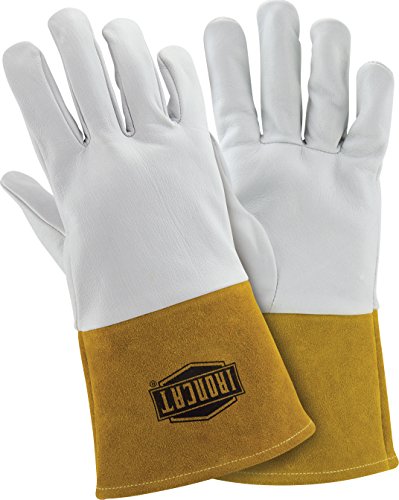
Kidskin gives the IRONCAT 6141 a distinct position among the goatskin options. The listing describes the material as top grain kidskin and links it to dexterity and comfort, making this glove particularly relevant for TIG work that depends on delicate finger positioning. Its straight thumb keeps the pattern familiar, while the listed large dimensions of 12.125 inches long and 5 inches wide give buyers more information for checking fit.
The four-inch gold cuff extends coverage beyond the wrist, and Kevlar threading is specified for the seams. The product information also describes resistance to abrasion and punctures, but it does not provide an independent safety rating for those claims. This is a lighter, more hand-control-focused choice than the SAFEGEAR cowhide gloves, while the cuff offers more coverage than a very short glove.
Pros
- Top grain kidskin is selected for a lighter, dexterity-focused feel.
- Four-inch cuff extends over the wrist and lower arm.
- Kevlar threading is specified at the seams.
- Straight-thumb design provides a conventional grip shape.
- Large dimensions are published for easier fit comparison.
Cons
- Large is the identified size, limiting choice for smaller hands.
- The construction details fewer reinforced palm zones than the Caiman 1540.
The IRONCAT makes sense for TIG operators who place hand movement ahead of heavy multitask protection. Its kidskin construction and published dimensions help distinguish it from generic leather gloves, while the cuff keeps it from being a bare-bones short glove. Those needing a tougher split-cowhide body or a two-pair package should look at SAFEGEAR instead.
To buy this product, click here.
9. SAFEGEAR Cowhide Welding Gloves Two-Pack — Best for General Welding Coverage

SAFEGEAR takes the heaviest-duty approach in this group. The gloves use split cowhide, a four-inch safety cuff, Kevlar lock stitching, a wing thumb, and a seamless forefinger. The product is supplied as two pairs, which can be useful in a shared shop or for keeping a spare pair ready when leather gloves become dirty, damp, or worn.
The listing identifies EN 388 3131 certification for resistance to cuts, abrasions, tears, and punctures. That information is more specific than a general statement that a glove is durable, although EN 388 is not a TIG-specific heat rating and should not be treated as a guarantee of protection in every welding situation. Compared with the goatskin and kidskin options, split cowhide is likely to prioritize general coverage and wear resistance over the finest hand feel.
Pros
- Split cowhide construction is suited to broader welding and work tasks.
- Two-pair package provides a spare set.
- Four-inch cuff extends wrist coverage.
- Kevlar lock stitching is specified.
- EN 388 3131 certification is listed for mechanical risks.
Cons
- Split cowhide may feel bulkier than goatskin or kidskin during fine TIG work.
- Wing-thumb construction may offer less TIG-specific feel than a precision-oriented pattern.
SAFEGEAR belongs near the bottom of a TIG-focused ranking because its strengths point toward general welding and utility work rather than maximum torch sensitivity. Still, it can suit a buyer who wants one pair for TIG, material handling, and other workshop tasks, especially where having a spare pair matters. For small, delicate TIG joints, the Caiman, Tillman, IRONCAT, or YESWELDER designs are more closely aligned with the hand-control demands.
To buy this product, click here.
Buying Guide: How to Choose TIG Welding Gloves
Prioritize Finger Control Over Maximum Thickness
TIG welding involves small torch movements and, often, separate filler-rod control. A thick glove may provide more material between the hand and the workpiece, but it can also make it harder to feel the torch handle or position the fingers precisely. Goatskin and kidskin models such as the Tillman 1328 and IRONCAT 6141 are aimed more directly at this type of hand movement than split cowhide utility gloves.
Thinner does not automatically mean better. A glove that is too light for the work area may leave the back of the hand or wrist with less coverage, particularly when sparks travel beyond the joint. The right balance depends on how close the hand sits to the heat source and whether the same pair will be used for other welding processes.
Match Leather Type to the Work
Goatskin is common in TIG gloves because it can provide a softer, more flexible hand section. Kidskin, as used by IRONCAT, is another lightweight material associated with dexterity-focused designs. Split cowhide generally gives a more substantial work-glove feel, as seen with SAFEGEAR and the Caiman back panel.
Leather labels do not provide a complete performance guarantee. Thickness, tanning, stitching, lining, reinforcements, and fit all change how a glove behaves. Look at the full construction rather than choosing from the material name alone.
Choose Cuff Length for the Work Position
A short cuff may be easier to position around a compact bench, while an extended cuff gives more coverage around the wrist and lower forearm. The Caiman 1540, ARCCAPTAIN medium, and IRONCAT use four-inch cuff designs. The ARCCAPTAIN long-cuff model reaches farther with a 14-inch sleeve, making it the more coverage-oriented option.
Longer is not automatically better. Excess material can bunch around the forearm or occupy more room near a torch lead. Think about the position of the hand, the clothing worn underneath, and whether the glove will be used for overhead or close-quarters work.
Check Thumb and Forefinger Construction
The thumb and index finger receive constant movement during TIG work. A keystone thumb, such as the one identified on the YESWELDER, is shaped to support a more natural thumb position. Straight-thumb designs, found on the ARCCAPTAIN medium and IRONCAT models, use a more conventional pattern.
A seamless forefinger can reduce a seam directly across a high-movement finger, while palm reinforcements can add durability where the glove contacts a torch, table, or workpiece. These features should be weighed against the fit of the complete glove, since a theoretically useful pattern still needs the right size.
Measure Before Ordering
Glove sizes are not perfectly standardized. The ARCCAPTAIN medium listing provides an 8.34-inch hand-circumference reference, and the IRONCAT listing provides large glove dimensions. These details are helpful starting points, but they do not replace checking the seller’s current size chart.
A glove that is too loose can reduce fingertip control and allow the material to catch on objects. A glove that is too tight can restrict movement and increase seam stress. Measure around the hand according to the current product instructions, then check finger length and cuff fit as separate concerns.
Separate TIG Use from General Welding Use
A TIG glove is usually chosen for a balance of dexterity and protection. A general welding glove may be better suited to rough handling, heavier sparks, or tasks where fine torch feel is less important. The SAFEGEAR two-pack and YESWELDER models have broader work-use positioning, while the Tillman 1328 and IRONCAT 6141 are more focused on a lighter hand feel.
Multi-task labels should not be treated as proof that one glove is ideal for every process. Read the construction details and select the glove that matches the actual work area, cuff needs, and amount of hand movement.
Best TIG Welding Gloves FAQ
What Material Is Commonly Used for TIG Welding Gloves?
Goatskin is common in TIG gloves because it can provide a flexible palm and useful hand sensitivity. Kidskin is another lightweight option, while split cowhide generally provides a more substantial work-glove construction. The material should be evaluated alongside thickness, lining, stitching, reinforcement, and fit.
Are TIG Gloves Suitable for MIG or Stick Welding?
Some TIG gloves are labeled for multitask use, but a lightweight TIG glove may offer less coverage than a glove intended for heavier welding work. The Caiman 1540, Miller Arc Armor, YESWELDER, and ARCCAPTAIN models are positioned for broader use. Check cuff coverage and construction before using a glove for a process that produces more sparks or places the hand closer to heat.
Should TIG Gloves Have an Extended Cuff?
An extended cuff can cover more of the wrist and lower forearm, which may be useful when the hand rests close to the workpiece. A four-inch cuff provides moderate coverage, while the ARCCAPTAIN model with a 14-inch sleeve offers substantially more. Shorter cuffs can feel less restrictive around a compact bench.
Are Thinner TIG Gloves Safer?
Thickness alone does not determine suitability or safety. A thinner glove may improve dexterity, while a more substantial glove may provide greater coverage in a spark-heavy environment. Select a glove that matches the work position, heat exposure, cuff requirement, and manufacturer information, then follow appropriate welding PPE and workplace procedures.
What Is the Difference Between Goatskin and Cowhide TIG Gloves?
Goatskin is commonly used where flexibility and hand movement matter. Cowhide tends to provide a more substantial construction, though the actual feel depends on the leather grade, thickness, lining, and pattern. The Caiman combines goat grain on the palm with split cowhide on the back, while SAFEGEAR uses split cowhide throughout its listed construction.
How Should TIG Welding Gloves Fit?
The glove should allow the fingers to bend without excessive slack at the fingertips or palm. A loose fit can reduce control, while a tight fit can restrict movement and stress the seams. Use the current product size chart, measure the hand, and account for finger length and cuff position.
Do Kevlar Seams Make a Glove Heatproof?
No. Kevlar stitching can address seam strength and resistance to certain wear conditions, but it does not make a glove heatproof or guarantee protection from every welding hazard. Product materials, cuff coverage, work practices, ventilation, and the rest of the required PPE still matter.
Final Verdict
The Caiman 1540 Large is the strongest overall choice among these nine TIG gloves because its documented construction covers the main buying priorities in one design. A goat grain palm supports hand movement, the split cowhide back adds a more substantial outer layer, the four-inch cuff extends coverage, and the shaped wrist and reinforced areas give it more structure than a basic pull-on glove. It is a balanced selection for TIG work that may occasionally expand into other welding tasks.
The Tillman 1328 is the better fit for a simpler, ambidextrous goatskin glove, while the ARCCAPTAIN 14-inch model is the clear alternative for buyers who place forearm coverage first. The IRONCAT 6141 has a strong case for lightweight dexterity, and SAFEGEAR makes more sense when general welding coverage and a spare pair matter more than delicate TIG feel. Match the final choice to hand size, cuff preference, work position, and the actual level of exposure around the joint.
