
A 110V flux-core welder earns its place in a garage, trailer, farm shed, or roadside repair kit because it can run from a common household-style circuit and weld without a shielding-gas cylinder. That combination keeps setup simple, especially for outdoor work where wind can disturb gas coverage. The important comparison is not peak amperage alone. Wire diameter, low-end control, feed adjustment, portability, included leads, and the machine’s actual process support all shape how useful it will be.
A high output number can look tempting, yet it does not automatically mean better results from a 110V circuit. Buyers can also overlook whether a listed TIG mode needs a separately purchased torch, whether Stick electrodes are genuinely supported, or whether the machine accepts the wire spool size they already own. Synergic controls may simplify setup by linking current, voltage, and wire speed, while manual adjustment gives more room for fine-tuning thin steel and different flux-core wires. The YESWELDER 135A is the strongest overall balance here, while the dual-voltage YESWELDER 160A makes more sense for buyers who may later move to 220V power.
This roundup compares nine machines that support 110V operation and offer gasless flux-core welding, with attention to portability, controls, process flexibility, wire compatibility, and honest limitations. Some are compact single-purpose flux-core choices, while others add Stick or Lift TIG capability for repair work.
Quick Answer
- Best Overall: YESWELDER 135A balances flux-core capability, synergic controls, manual voltage trimming, portability, and useful three-process flexibility.
- Best Premium Option: YESWELDER 160A adds 220V operation, solid-wire MIG support, larger spool compatibility, and broader process coverage.
- Best Budget 2-in-1: AWT 140A keeps the controls and process list simple with flux-core MIG and Stick modes.
- Best Complete Starter Kit: Futelo 145A includes a broad collection of basic accessories, though its Lift TIG torch is separate.
Best 110V Flux Core Welder Comparison Table
| Product | Best For | Processes | Output And Weight |
|---|---|---|---|
| YESWELDER 135A | Best overall balance | Flux MIG, Stick, Lift TIG | 135A, 11.4 lb |
| YESWELDER 160A | Future 220V flexibility | Gas MIG, Flux MIG, Stick, Lift TIG | 160A, 19.4 lb |
| AWT 140A | Simple budget setup | Flux MIG, Stick | 140A, 9 lb |
| Futelo 145A | Included accessories | Flux MIG, Stick, Lift TIG | 145A, 7.5 lb |
| ARCCAPTAIN 135A | Portable digital controls | Flux MIG, Stick, Lift TIG | 135A, 9.48 lb |
| XR MARKET 160A | Lightweight multi-process use | Flux MIG, Stick, Lift TIG | 160A listed, 6.6 lb |
| MIGVAN M-140 | Wire-size flexibility | Flux MIG, Stick, Lift TIG | 140A, 12.56 lb |
| AZZUNO 130A | Basic flux-core projects | Flux MIG | 130A, 8.6 lb |
| SEESII 135A | Compact outdoor repairs | Flux MIG, Stick, Lift TIG | 135A, 7.7 lb |
The detailed reviews explain where each machine fits, what its published specifications mean, and which compromises matter before ordering.
1. YESWELDER 135A — Best Overall

The YESWELDER 135A is a well-balanced answer for a buyer who wants a 110V flux-core machine without giving up useful adjustment range. Its gasless MIG mode accepts .030-inch and .035-inch flux-core wire, while the synergic control links recommended voltage and wire speed to the selected setting. That can shorten setup time for a first project, yet the separate voltage micro-adjustment gives more experienced users a way to refine the arc rather than accepting a fixed preset.
At 11.4 pounds, this machine is easier to carry from a garage outlet to a driveway or outdoor repair area than heavier shop-oriented units. The listing identifies 135A output and a published mild-steel capability up to 3/32 inch, so it is better matched to light fabrication, repairs, brackets, and thin-to-moderate steel than extended work on heavy plate. Stick and Lift TIG modes add flexibility, but the Lift TIG torch is an extra purchase, not part of the standard flux-core setup.
Pros
- Supports .030-inch and .035-inch flux-core wire
- Synergic control simplifies initial voltage and wire-speed selection
- Separate voltage trimming provides useful arc adjustment
- Includes Stick and Lift TIG modes alongside flux-core MIG
- Moderate 11.4-pound weight suits mobile repairs
Cons
- Lift TIG torch is sold separately
- Published thickness guidance is aimed at lighter steel work
This model makes the most sense for someone who wants a compact 110V machine with more control than a basic single-knob unit. Its combination of wire-size support, digital display, and three-process capability gives it a stronger overall position than simpler budget machines. Buyers planning long welding sessions on thick material, or those who need full TIG equipment in the box, should look higher in the range or choose a different configuration.
To buy this product, click here.
2. YESWELDER 160A — Best Premium Option

The YESWELDER 160A stands apart because 110V operation is only part of its power story. It also supports 220V input, so a buyer can start with a household-style circuit and later use a suitable 220V supply. That flexibility matters for someone setting up a permanent workshop, since the machine is less likely to become redundant after moving from occasional repairs to more demanding fabrication.
Its four-process layout covers gas MIG, gasless flux-core MIG, Stick, and Lift TIG. The machine accepts 2-pound and 10-pound spools of .030-inch and .035-inch wire, a meaningful difference from compact units limited to smaller rolls. At 19.4 pounds, it is still portable by shop-equipment standards, although the weight and larger capability make it less convenient for repeated one-handed carrying than the Futelo or SEESII.
Pros
- Supports both 110V and 220V input
- Offers gas MIG as well as gasless flux-core welding
- Accepts 2-pound and 10-pound wire spools
- Includes Stick and Lift TIG modes
- Provides both synergic and manual controls
Cons
- Heavier than the compact 110V-focused machines
- Lift TIG torch must be purchased separately
This is the strongest alternative for buyers who see 110V as a starting point rather than a permanent limitation. Its broader wire and input-voltage support justify the higher position, but a person welding small brackets or thin sheet metal from one outlet may gain little from the extra size. Confirm the circuit, plug, and output conditions in the current documentation before expecting the full advertised capability.
To buy this product, click here.
3. AWT 140A — Best Budget 2-in-1

Some buyers do not need Lift TIG or gas MIG. They need a straightforward 110V flux-core welder for a gate hinge, exhaust repair, metal craft, or occasional maintenance task. The AWT 140A keeps that use case in view with two documented processes, gasless MIG and Stick, while its synergic control adjusts parameters around .030-inch and .035-inch flux wire.
The 9-pound metal-cased machine sits in a practical middle ground for portability. The listing states up to 140A output and a published mild-steel capability up to 5/32 inch, although real results depend on joint design, preparation, wire, settings, and available circuit power. Its Stick mode is identified for E6013 electrodes, so buyers should not assume the same electrode range as the more broadly specified YESWELDER 160A.
Pros
- Flux-core MIG and Stick cover two useful repair processes
- Synergic control supports .030-inch and .035-inch flux wire
- 9-pound chassis is convenient for mobile work
- Metal case offers a more enclosed construction than some plastic-bodied units
- Includes a MIG torch, ground clamp, wire, and contact tips
Cons
- Does not provide a documented Lift TIG mode
- Stick electrode support is specifically listed around E6013
Choose the AWT when a simpler process list is an advantage rather than a limitation. It avoids paying for a TIG function that may never be used, and the included .030-inch wire helps reduce the number of initial purchases. A buyer who expects to weld stainless steel with Lift TIG or use several electrode types should select a more capable multi-process machine.
To buy this product, click here.
4. Futelo 145A — Best Complete Starter Kit
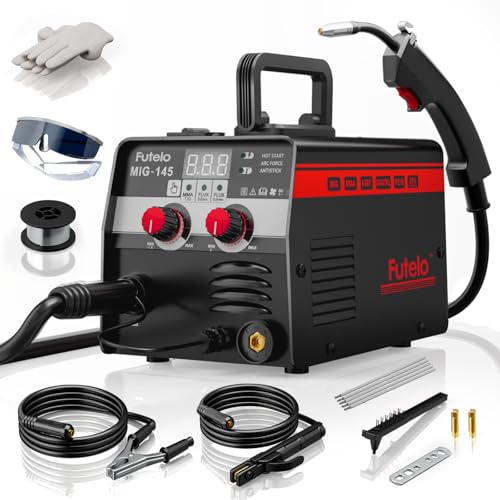
The Futelo 145A is aimed at buyers who want a small machine and a broad box of accessories. The package identifies a MIG torch, ground clamp, electrode holder, welding rods, .9 mm flux-core wire, contact tips, safety goggles, gloves, brush, hammer, and wrench. That makes the initial setup less dependent on separate accessory orders, though the included items should still be checked against the intended process and the manufacturer’s instructions.
Its 30A to 145A range, digital display, and synergic adjustment give the operator a clearer path from wire selection to starting settings. The 7.5-pound weight is one of the lowest in this roundup, which helps when the welder must move between a garage bench and an outdoor repair. Lift TIG is supported, but the TIG torch is specifically excluded, and the published material range should be treated as a product claim rather than a universal result for every joint.
Pros
- Very low 7.5-pound machine weight
- Includes MIG, Stick, and Lift TIG modes
- Package includes basic welding and protective accessories
- Synergic control uses wire diameter and amperage settings
- Digital display shows amperage and wire information
Cons
- Lift TIG torch is not included
- Included safety items do not replace proper PPE and ventilation procedures
The Futelo is a sensible pick for a first 110V setup where portability and included basics matter more than future 220V expansion. Its small footprint will appeal to someone with limited storage, while the extra process modes leave room to explore Stick or TIG later. Buyers who already own leads and protective gear may prefer the YESWELDER 135A for its more clearly documented arc-adjustment approach.
To buy this product, click here.
5. ARCCAPTAIN 135A — Best for Portable Digital Control

The ARCCAPTAIN 135A focuses on a compact control experience. Its listing describes a large digital display, synergic parameter matching based on wire size and material thickness, and manual adjustment for users who want more direct control. That pairing is useful in a shared workshop, where one person may value quick setup while another prefers to tune wire speed and voltage independently.
The 9.48-pound frame and shoulder strap make this machine suitable for moving around a property or carrying to an outdoor repair. Its three modes cover gasless flux-core MIG, Stick, and Lift TIG, but the TIG torch is an additional purchase. The listing also mentions 2T and 4T trigger modes and Stick hot-start and arc-force adjustments, features that broaden control beyond the basic flux-core task without turning the machine into an AC TIG unit.
Pros
- Synergic and manual MIG control modes
- Large digital display for setting visibility
- Includes 2T and 4T trigger options
- Stick mode lists hot-start and arc-force adjustment
- 9.48-pound body includes a carrying handle and shoulder strap
Cons
- Lift TIG torch is sold separately
- Published performance claims are not a substitute for a stated duty-cycle comparison
This model suits a buyer who values adjustment access and carrying convenience in equal measure. It offers more control detail than the basic AZZUNO while remaining much lighter than the YESWELDER 160A. The lack of a documented dual-voltage input keeps it firmly in the 110V class, so it is less attractive for someone planning a later move to higher-voltage workshop power.
To buy this product, click here.
6. XR MARKET 160A — Best Lightweight Multi-Process Option
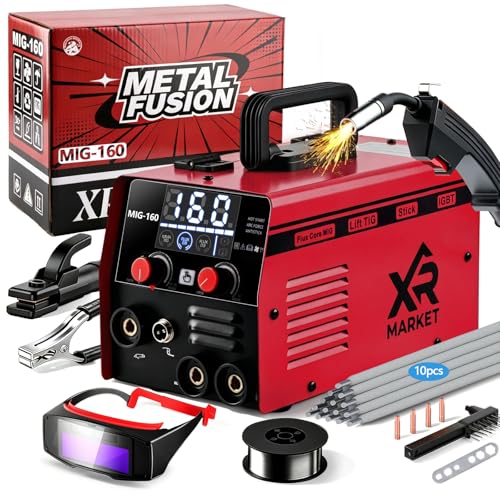
The XR MARKET is unusually light for a machine listing 160A output. At 6.6 pounds, it is easy to store on a shelf or carry to a repair location, and its three independent interfaces are intended to reduce the need to rewire when changing between MIG and Stick. The machine supports gasless flux-core MIG, Stick, and Lift TIG, making it more flexible than a dedicated wire-feed unit.
The included package lists a MIG torch, earth clamp, electrode holder, a small supply of welding rods, .030-inch wire, contact tips, and auto-darkening goggles. The Lift TIG torch is not included. The listing gives broad material and thickness claims for MIG and Stick modes, but it does not provide the same level of practical context as a full duty-cycle chart, so this is better viewed as a compact repair machine than a continuous-production unit.
Pros
- 6.6-pound weight is exceptionally easy to transport
- Supports flux-core MIG, Stick, and Lift TIG
- Separate interfaces simplify process changes
- Includes starter wire, rods, tips, and auto-darkening goggles
- Digital display is intended for clear parameter reading
Cons
- Lift TIG torch is not included
- Very low weight may matter more for portability than sustained shop work
The XR MARKET makes sense for occasional repairs where carrying effort matters and the machine will not be asked to weld continuously for long periods. Its accessory package is useful for getting started, although buyers should confirm the condition and suitability of included protective equipment before use. A heavier machine with documented larger-spool support is preferable for more regular fabrication.
To buy this product, click here.
7. MIGVAN M-140 — Best for Wire-Size Flexibility

The MIGVAN M-140 earns its position through a relatively broad listed flux-wire range. It supports .030-inch, .035-inch, and .039-inch flux-core wire, giving the buyer more consumable choice than machines limited to two common diameters. Its synergic controls connect wire diameter and current with a recommended voltage and feed rate, while a separate adjustment mode allows voltage changes of up to 3V in either direction.
This is a three-process machine with gasless MIG, Stick, and Lift TIG modes. The 3.54-inch LED display should be easy to read in bright or dim conditions, and the 12.56-pound body remains manageable for driveway or yard repairs. The product description refers to an 8-layer mainboard and protective resin, but those construction claims do not replace a published service record or duty-cycle comparison, so buyers should focus on the documented process and control features.
Pros
- Supports .030-inch, .035-inch, and .039-inch flux-core wire
- Synergic control includes separate voltage adjustment
- Large 3.54-inch LED display
- Provides Flux MIG, Stick, and Lift TIG modes
- Includes a welding gun and flux-core wire
Cons
- Lift TIG torch requirements should be confirmed before ordering
- 12.56-pound weight is higher than several compact alternatives
Pick the MIGVAN when wire compatibility matters more than the lowest machine weight. The extra .039-inch support may help a buyer who already keeps different flux-core consumables on hand, while the voltage adjustment gives more flexibility than a fully fixed preset. Its position below the lighter models reflects the heavier body and less clearly documented accessory details.
To buy this product, click here.
8. AZZUNO 130A — Best for Basic Flux-Core Projects

The AZZUNO 130A is the most focused machine in this selection. It concentrates on gasless MIG rather than adding Stick or Lift TIG, which keeps the control layout and intended use easier to understand. The listing identifies a voltage knob, wire-speed adjustment, synergic operation, and compatibility with 2.2-pound rolls of wire.
At 8.6 pounds, it is light enough for a small garage or portable repair kit. The package includes a MIG torch, ground clamp, brush and hammer, .030-inch flux-core wire, and two contact tips. Published output is 130A, with a claimed mild-steel capacity up to 3.0 mm. Since no duty-cycle comparison is supplied in the product information, this machine is better suited to short projects than assumptions about extended high-output welding.
Pros
- Simple gasless MIG-only layout
- Synergic control links amperage, voltage, and wire speed
- Accepts wire rolls up to 2.2 pounds
- 8.6-pound body is easy to move
- Includes wire, torch, clamp, tips, and cleaning accessories
Cons
- Does not provide documented Stick or Lift TIG modes
- Published information does not give a detailed duty-cycle comparison
The AZZUNO is a reasonable fit for someone who wants a dedicated 110V flux-core machine and has no need for extra welding processes. It gives up the flexibility of the YESWELDER, Futelo, and ARCCAPTAIN in exchange for a simpler product identity. Choose another model if Stick welding rusty material or Lift TIG work is part of the plan.
To buy this product, click here.
9. SEESII 135A — Best Compact Repair Kit

The SEESII 135A targets the same practical niche as several compact machines here, with gasless flux-core MIG, Stick, and Lift TIG in a 7.7-pound package. Its listing identifies a 30A to 135A range, support for 1/16-inch to 1/8-inch welding rods, and a 1-pound spool of .030-inch wire in the kit. Those details make it relevant for quick repairs where the machine, torch, clamp, and wire need to travel together.
Its large digital display is intended to make settings easier to read, and the package includes a brush and contact tips. Lift TIG is supported, but the torch is excluded, so the machine should not be treated as a ready-to-use TIG package. The listing makes broad penetration and safety claims, yet the available information does not provide a detailed duty-cycle table, which keeps this model better suited to intermittent work than heavy continuous fabrication.
Pros
- 7.7-pound portable body
- Supports flux-core MIG, Stick, and Lift TIG
- Includes a 1-pound spool of .030-inch flux wire
- Large digital display supports easier setting checks
- Package includes a MIG torch, ground clamp, brush, and contact tips
Cons
- Lift TIG torch is not included
- Published information does not clearly establish a detailed duty cycle
The SEESII is worth a look for a buyer who values minimum carrying weight and a basic out-of-box flux-core arrangement. It ranks below the Futelo because the accessory description is narrower, and below the YESWELDER 135A because the latter offers more clearly described voltage fine-tuning. For short outdoor repairs, the SEESII’s compact format can be more useful than a heavier machine with capabilities that will rarely be used.
To buy this product, click here.
Buying Guide For A 110V Flux Core Welder
Match The Machine To The Circuit
A machine listed for 110V operation is convenient, but the available circuit still matters. Extension-cord length, wire gauge, outlet condition, and other connected loads can affect practical use. A dual-voltage model such as the YESWELDER 160A provides a future 220V option, while a 110V-only machine may be the better fit for simple portability and lower complexity.
Flux-Core Wire Diameter
Most machines here list support for .030-inch and .035-inch flux-core wire. Smaller wire can suit lighter work, while larger wire may be useful for higher deposition rates, but the correct choice depends on the machine’s feed system, settings, material, and joint. The MIGVAN stands out by listing .039-inch compatibility as well, although buyers should confirm the current manual before purchasing an uncommon wire size.
Synergic Versus Manual Controls
Synergic control links related settings so a starting point can be selected with fewer adjustments. It can be helpful for a first project, but it is still a starting recommendation rather than a guarantee of the correct arc for every wire and joint. Manual voltage and wire-speed controls matter more to buyers who expect to tune thin material, compensate for fit-up differences, or use more than one flux-core formulation.
Multi-Process Features
Flux-core MIG, Stick, and Lift TIG are separate welding processes. A machine supporting Lift TIG does not automatically include a TIG torch, high-frequency start, AC output, or aluminum TIG capability. Check which leads and torches are included, which are compatible, and which must be purchased separately.
Portability And Spool Size
Low weight helps when welding locations change frequently, but a very compact machine may accept only a small spool or provide less room for accessories. A 6.6-pound XR MARKET or 7.5-pound Futelo is easier to carry than the 19.4-pound YESWELDER 160A. The heavier model, however, accepts larger spools and supports both 110V and 220V operation.
Published Thickness Claims
Product listings often provide a maximum material thickness, but that number depends on material type, joint design, preparation, wire, polarity, settings, and technique. Treat the figure as a guide to intended capability rather than a guaranteed result. For light sheet metal, low-end control and suitable wire may matter more than the largest advertised amperage.
Best 110V Flux Core Welder FAQ
Can A 110V Flux-Core Welder Run Without Gas?
Yes. Self-shielded flux-core wire contains flux that produces shielding as it burns, so a gas cylinder is not required for the listed gasless MIG mode. The machine still needs the correct wire, polarity, contact tip, and settings for that wire type.
Is Flux-Core Welding The Same As MIG Welding?
They use a similar wire-feed format, but gasless flux-core welding uses self-shielded wire, while conventional MIG generally uses solid wire with an external shielding gas. A machine may support both configurations, but the product must specifically identify solid-wire MIG, gas connections, and the required accessories before you assume it can perform both.
Can These Machines Weld Aluminum?
Do not assume so. Generic flux-core or Lift TIG support does not establish aluminum capability. Aluminum MIG usually requires appropriate wire handling and often a spool gun or another compatible feeding arrangement. None of the listed machines should be treated as an aluminum solution without exact manufacturer documentation.
Does Lift TIG Mean The Welder Includes A TIG Torch?
No. Several machines in this roundup list Lift TIG support while separately stating that the torch is not included. Lift TIG also differs from high-frequency TIG start and does not establish AC TIG capability. Check the package contents before planning a TIG project.
What Size Flux-Core Wire Should A Beginner Use?
.030-inch wire is a common starting point for lighter projects because several machines in this roundup list it as compatible and include it in the package. The correct diameter still depends on the material thickness, machine settings, wire specification, and the manufacturer’s recommendations.
Is A Higher Amp Rating Always Better?
No. Higher advertised output may help with thicker work, but usable low-end control, wire feeding, circuit capacity, duty cycle, and process support also matter. A 135A machine with better fit for thin steel can be more useful than a higher-rated model that is harder to tune or transport.
Can A 110V Welder Run From An Extension Cord?
The answer depends on the machine instructions, cord length, wire gauge, outlet, and load. An unsuitable extension cord can cause voltage drop and heating. Follow the manufacturer’s electrical guidance and avoid treating a thin household cord as interchangeable with a properly rated welding extension setup.
Final Verdict
The YESWELDER 135A is the strongest overall choice for this group because it combines 110V flux-core operation with .030-inch and .035-inch wire support, synergic setup, voltage fine-tuning, a readable display, and Stick and Lift TIG modes. Its 11.4-pound weight keeps it practical for moving between work areas, while its limitations remain clear: the Lift TIG torch is separate, and the published thickness guidance points toward lighter steel work rather than sustained heavy fabrication.
Choose the YESWELDER 160A if future 220V access, gas MIG, and larger wire spools matter more than minimum weight. The AWT 140A is the cleaner choice for a straightforward flux-core and Stick setup, while the Futelo 145A offers a particularly broad starter package in a very light body. Whichever machine you select, verify the exact wire diameter, polarity, accessory list, circuit requirements, and current manual before starting a project.
