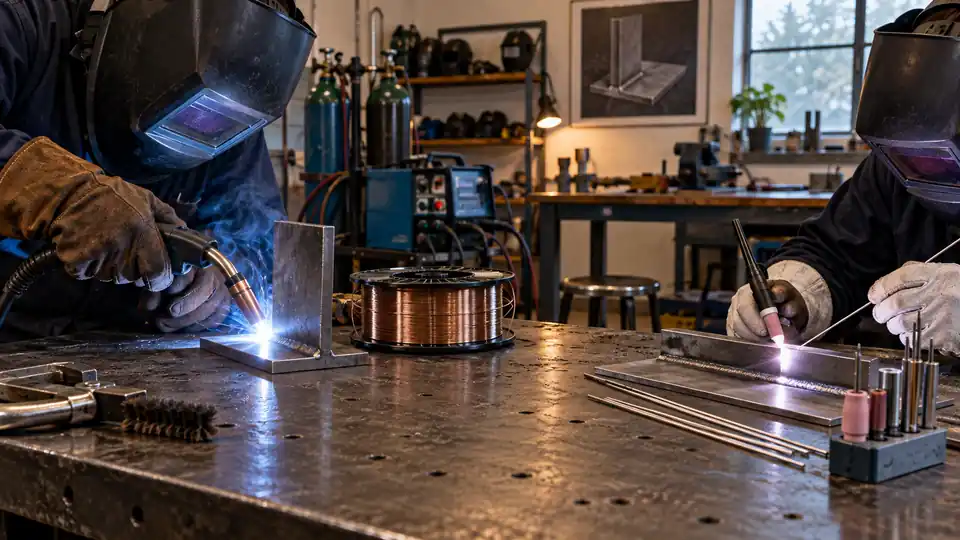
Choosing between MIG vs TIG welding usually comes down to a trade-off between speed and control. MIG uses a continuously fed wire electrode, so it can fill a joint quickly and keep a fabrication job moving. TIG uses a nonconsumable tungsten electrode and a separate filler rod when needed, giving the welder finer control over heat, puddle size, and bead placement. That difference becomes obvious when a quick repair, thin sheet, stainless tubing, or visible aluminum work is on the bench.
MIG is generally the practical choice for higher production, longer welds, and general steel fabrication. TIG usually makes more sense for precise work, thin materials, clean-looking welds, and applications where careful heat control matters. Neither process wins every job. The material, thickness, joint design, position, appearance requirements, and available equipment all shape the decision.
MIG and TIG at a Glance
| Comparison Area | MIG Welding | TIG Welding |
|---|---|---|
| Process name | Gas metal arc welding, or GMAW | Gas tungsten arc welding, or GTAW |
| Electrode | Continuously fed consumable wire | Nonconsumable tungsten electrode |
| Filler metal | Wire electrode supplies filler metal | Separate filler rod may be added, or the joint may be fused without added filler |
| Shielding | Usually shielding gas with solid wire, or flux protection with self-shielded flux-core wire | Shielding gas, commonly an inert gas such as argon |
| Typical working pace | Faster deposition and longer continuous welds | Slower, with more manual control |
| Control and appearance | Efficient and consistent after setup, with more visible spatter possible | Highly controllable arc and a clean bead when technique and preparation are sound |
| Common applications | Frames, brackets, automotive repairs, equipment fabrication, and general steel work | Thin sheet, stainless tubing, aluminum components, precision fabrication, and visible joints |
A person repairing a steel gate may value the steady wire feed and fast deposition of MIG. Someone fabricating a thin stainless handrail may prefer TIG because the torch, filler, and heat can be coordinated more delicately. The table shows the broad pattern, but the practical differences become clearer once each process is separated.
How MIG Welding Works
MIG welding feeds a consumable wire through a gun while an electric arc melts the wire and the base metal. Shielding gas flows from the nozzle to protect the molten puddle from atmospheric contamination. The operator controls the gun travel, work angle, wire feed speed, and voltage settings while the machine supplies wire continuously, creating a familiar soft buzz and a relatively fast welding rhythm. The underlying wire-feed process, equipment, and terminology are covered in more detail in what MIG welding is and how it works.
With solid wire, the process generally relies on an external shielding gas selected for the wire and base material. Self-shielded flux-core wire uses flux inside the wire to create its own protective shielding, which changes the equipment setup, cleanup, polarity requirements, and outdoor suitability. A machine labeled for MIG may support one or both wire processes, so the manual and compatible consumables matter.
MIG suits work that involves repeated welds or substantial joint length. A fabricator assembling a mild-steel cart can keep the gun moving while the wire supplies filler automatically. A repair worker handling an outdoor bracket may choose self-shielded flux-core wire because wind can disturb external shielding gas, although the process produces slag and has its own operating requirements.
Where MIG Usually Has the Advantage
- Speed: Continuous wire feed supports faster deposition than manually adding short lengths of TIG filler.
- Ease of filler delivery: The gun supplies electrode and filler metal at the same time.
- Long welds: MIG is convenient for seams, frames, and repeated joints.
- General fabrication: It is commonly used for carbon steel, stainless steel, and, with suitable equipment, aluminum.
- Reduced hand coordination: The operator does not need to control a separate filler rod during every weld.
That convenience has limits. MIG settings can require adjustment as material thickness, wire diameter, shielding gas, joint position, and transfer mode change. Wire feeding can also be affected by liner condition, drive-roll selection, gun length, and the softness of aluminum wire. A machine with a MIG label does not automatically have the correct setup for every alloy.
How TIG Welding Works
TIG welding creates an arc between a nonconsumable tungsten electrode and the workpiece. Shielding gas protects the tungsten and weld puddle, while the operator adds a separate filler rod when the joint requires additional metal. The torch hand controls the arc, and the other hand can meter filler into the puddle one small addition at a time. That two-handed rhythm is slower to learn, yet it gives the process its precise feel. A fuller explanation of the tungsten electrode, shielding system, AC/DC distinction, and equipment is available in how TIG welding works.
TIG can produce very clean welds because the process does not use flux and the tungsten electrode does not continuously melt into the joint. Clean results still depend on clean base metal, correct gas coverage, suitable tungsten preparation, stable torch movement, and careful heat control. A dirty glove, oily edge, contaminated tungsten, or excessive torch distance can quickly turn a neat puddle into a gray, unstable mess.
Picture a thin stainless tube with a joint that will remain visible after fabrication. TIG allows the operator to add small amounts of filler and limit heat input as the joint progresses. A similar approach can help with delicate sheet metal, but the slower travel speed raises the chance of overheating the work if the operator lingers.
Where TIG Usually Has the Advantage
- Fine heat control: The operator can manage arc length, torch travel, filler addition, and amperage with precision.
- Thin materials: TIG can be well suited to thin sheet and small components when the machine and technique are appropriate.
- Visible welds: Correctly prepared TIG joints can have a clean, controlled appearance.
- Material flexibility: TIG is commonly used on steel, stainless steel, aluminum, copper alloys, and other materials with suitable settings and consumables.
- Filler control: The operator can select filler type and add it only as needed.
TIG capability depends heavily on the machine configuration. DC TIG is commonly used for steel and stainless steel. Aluminum TIG generally requires AC capability, because AC helps manage the oxide layer on aluminum during welding. A machine with a TIG mode or lift-TIG function is not automatically an AC TIG machine, and a TIG-capable power source may be sold without a torch, foot pedal, regulator, or other accessories.
Speed, Control, and Weld Appearance
The largest day-to-day difference is pace. MIG deposits filler continuously, so it can cover a joint quickly once the wire feed, voltage, gas, and travel speed are coordinated. TIG asks the operator to maintain the arc, guide the torch, and add filler separately. A long series of steel brackets may feel efficient with MIG, while a short precision joint may reward TIG’s slower, deliberate approach.
Control tells a different story. TIG gives the operator direct influence over puddle size and filler placement, which can help with tight joints, changing gaps, and thin edges. MIG offers control through machine settings and gun movement, but the continuously fed wire can add metal faster than a delicate joint needs. Excessive heat or filler can create distortion, burn-through, or an oversized bead.
Appearance is shaped by preparation and technique, not by process name alone. TIG can leave a clean bead with little post-weld cleanup, while MIG may leave spatter that requires removal. A poorly cleaned TIG weld can discolor or contain contamination, and an accurately set MIG weld can look consistent and professional. The shiny finish people associate with TIG comes from a complete process, not from pressing a TIG button.
Material and Thickness Differences
Carbon Steel
Both processes are widely used for carbon steel. MIG often suits frames, brackets, repair work, and thicker fabrication where deposition rate matters. TIG can be useful for thin sections, root passes, close-fit joints, and visible work that benefits from careful heat management. A steel table frame may favor MIG for efficient assembly, while a thin decorative bracket may justify TIG’s extra time.
Stainless Steel
MIG and TIG can both weld stainless steel with suitable wire or filler, shielding gas, polarity, and settings. TIG is often selected for stainless tubing, food-service components, and visible joints because the operator can control heat and filler closely. MIG can make practical stainless repairs and production welds faster, but excessive heat can increase discoloration and distortion, making preparation and post-weld cleaning important.
Aluminum
Both processes can weld aluminum, but neither process label guarantees aluminum capability. Aluminum MIG commonly requires aluminum wire, suitable shielding gas, and a wire-feeding arrangement that can handle soft wire, such as a spool gun or another compatible system. Those requirements make feeding hardware and spool-gun compatibility especially important when choosing a MIG welder for aluminum. Aluminum TIG generally requires an AC-capable power source, an appropriate tungsten setup, aluminum filler, shielding gas, and careful oxide removal.
A steel-focused MIG machine may lack the spool-gun support or drive system needed for aluminum. A DC-only TIG machine may weld steel and stainless effectively while being unsuitable for typical aluminum TIG work. Checking the exact machine manual prevents an expensive mismatch between the base metal and the process configuration.
Thin Sheet and Thick Sections
TIG can offer excellent control on thin sheet, but it requires a steady hand and careful heat management. MIG can also weld thin material when the machine, wire, settings, and technique are appropriate. That makes process type, low-output control, and the ability to manage heat important considerations when choosing a welder for sheet metal. MIG’s continuous wire feed may make short, controlled welds more important on delicate material. For thicker sections, MIG’s higher deposition rate often saves time, while TIG may be used for a specific root, finish, or precision joint.
Equipment and Setup Differences
A basic MIG setup commonly includes a power source, gun, wire spool, drive rolls, contact tip, shielding gas equipment for gas-shielded wire, and a work lead. The wire diameter and type must match the machine’s feed components and the material. With self-shielded flux-core wire, external gas may not be needed, but the wire’s polarity and cleanup requirements still need attention.
A TIG setup commonly includes a power source, TIG torch, tungsten electrode, collet and gas lens or nozzle components, shielding gas equipment, work lead, and filler metal when required. A foot pedal or hand control may be useful for amperage adjustment, but support for that accessory depends on the machine. Lift TIG starts the arc by contact-related technique, while high-frequency TIG uses a different starting method. One should not be treated as proof of the other.
Gas management matters for both processes. MIG gas selection depends on the wire and base metal, while TIG commonly uses an inert shielding gas selected for the application. Gas flow, leaks, drafts, nozzle condition, torch distance, and joint cleanliness can all affect porosity and arc stability. A regulator and cylinder connection that fits one process does not make every gas suitable for every material.
Which Process Makes More Sense for Your Job?
Choose MIG when production pace and practical efficiency lead the decision. It is often a strong fit for carbon-steel frames, equipment repairs, shop fabrication, long seams, and work that involves many similar joints. It also suits operators who prefer a gun-based process with automatic filler delivery. Outdoor work may point toward self-shielded flux-core welding, provided the wire and machine support that process.
Choose TIG when control, thin material, or visible weld quality carries more weight. Stainless tubing, small aluminum components, thin sheet, precision repairs, and appearance-sensitive joints can benefit from TIG. The extra setup and slower travel are easier to justify when a small amount of heat and filler control can prevent distortion or reduce cleanup.
A mixed approach can be sensible. A fabrication shop may use MIG for most of a steel assembly, then TIG a visible stainless joint. A repair may use TIG for a precise root and MIG for faster fill, provided the joint design, procedure, materials, and operator skill support that sequence. The best process can change from one joint to the next.
Common Mistakes in the Comparison
- Assuming TIG always makes a stronger weld: Weld quality depends on joint design, fusion, material compatibility, preparation, settings, and technique.
- Assuming MIG is too rough for thin material: Suitable equipment and controlled settings can make MIG practical for thin work, although TIG may provide finer control.
- Calling every wire-fed process MIG: Solid-wire MIG, gas-shielded flux-core, and self-shielded flux-core have different consumables and operating requirements.
- Assuming every TIG machine welds aluminum: Typical aluminum TIG work generally requires AC capability.
- Ignoring preparation: Oil, paint, rust, mill scale, and oxide contamination can undermine either process.
- Comparing machines by maximum amperage alone: Output, duty cycle, current type, accessories, and material-specific capability matter more than one headline number.
A new welder may blame the process after a porous bead or a wandering arc, yet the cause can be a gas leak, poor joint cleaning, incorrect polarity, contaminated tungsten, unsuitable wire, or unstable travel speed. A short diagnostic pause often saves more time than changing several settings at once.
Frequently Asked Questions
Is MIG easier to learn than TIG?
MIG often feels easier at the beginning because the machine feeds filler wire automatically and the operator controls one main tool. TIG requires coordination between torch movement, arc control, and filler addition, so it usually demands more practice. MIG still requires sound setup and technique, especially for thin material and out-of-position joints.
Which process is faster, MIG or TIG?
MIG is generally faster for depositing filler and completing repeated or lengthy welds. TIG moves more slowly because filler is separate and heat control is more deliberate. Actual productivity also depends on fit-up, position, material, cleanup, setup time, and the quality required.
Can TIG weld aluminum?
Yes, with an AC-capable TIG machine and suitable aluminum filler, tungsten, shielding gas, preparation, and settings. DC-only TIG should not be treated as equivalent to AC TIG for typical aluminum work.
Can MIG weld stainless steel and aluminum?
MIG can weld stainless steel with compatible stainless wire, shielding gas, polarity, and settings. Aluminum MIG requires aluminum wire and a suitable feeding arrangement, often involving a spool gun or another system approved for the machine. A generic MIG label does not confirm either material capability.
Which process produces less cleanup?
TIG generally produces little spatter and no slag when used with the appropriate setup, though discoloration and surface contamination may still require cleaning. Solid-wire MIG can also produce a clean weld, but spatter is more common. Flux-core welding may leave slag that must be removed.
The Practical Takeaway
MIG is usually the better fit for speed, general fabrication, repeated joints, and efficient steel work. TIG earns its place through control, precision, thin-material capability, and careful work on stainless steel or aluminum when the machine configuration supports it. For a real MIG vs TIG welding decision, start with the material and joint, then check thickness, appearance requirements, production pace, shielding method, current type, and the accessories included with the equipment.
