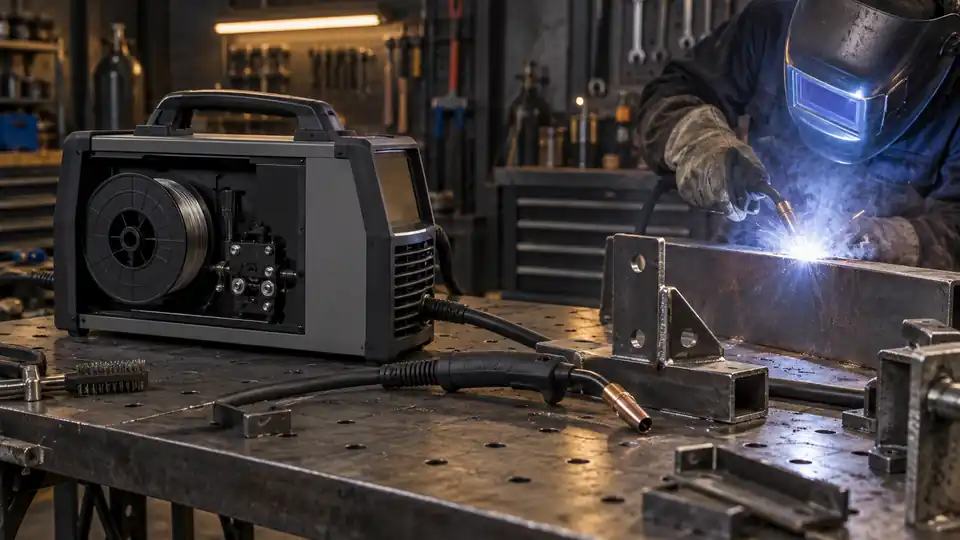
A gasless MIG welder earns its place in a garage, trailer, or outdoor repair kit because self-shielded flux-core wire removes the need for a shielding-gas cylinder. That can simplify setup when a cylinder is awkward to transport or wind makes gas coverage unreliable. The trade-off is that flux-core welding produces more smoke, slag, and spatter than many gas-shielded setups, so wire compatibility, polarity, feed control, and cleanup still matter.
Maximum amperage is an easy number to notice, but it does not tell the entire story. A 110V machine with sensible low-end control may be a better fit for thin steel than a larger unit that requires a 220V circuit for its highest output. Dual-voltage flexibility, spool capacity, synergic controls, manual adjustment, weight, and the difference between included and optional accessories all shape the buying decision. The YESWELDER 160A ranks first here because it combines gasless MIG support, 110V and 220V input, compatibility with 2-pound and 10-pound spools, and manual or synergic control.
The nine welders below range from compact 110V machines for light repairs to broader multiprocess units with higher output and additional functions. Their published specifications are treated as claims rather than universal guarantees, since actual results depend on material, joint design, wire, polarity, power, preparation, and technique.
Quick Answer
- Best Overall: YESWELDER 160A MIG Welder, for its dual-voltage input, larger spool compatibility, and balanced gasless MIG features.
- Best for Higher Output on 110V and 220V: ARCCAPTAIN 165A MIG Welder, with a listed 60% duty cycle and 2T/4T operation.
- Best Budget Option: AZZUNO 130A MIG Welder, a compact 110V machine with synergic control and a simple accessory package.
- Best for Maximum Process Coverage: ARCCAPTAIN 200A MIG Welder, which adds gas MIG, spot welding, Lift TIG, and optional spool-gun support.
Best Gasless MIG Welder Comparison Table
| Product | Best For | Input and Output | Gasless MIG Details |
|---|---|---|---|
| YESWELDER 160A MIG Welder | Best overall balance | 110V/220V, up to 160A | 2 lb and 10 lb spools, synergic and manual control |
| ARCCAPTAIN 165A MIG Welder | Longer welding sessions | 110V/220V, up to 165A | 2 lb spool, 60% listed duty cycle |
| BESTMIG 165S | Complete multiprocess kit | 110V/220V, up to 165A | Gasless MIG, synergic control, 2T/4T |
| YESWELDER 135A MIG Welder | Portable 110V work | 110V, up to 135A | Includes .030 and .035 inch flux-core wire |
| ARCCAPTAIN 135A Flux Core MIG | Simple beginner setup | 110V, up to 135A | Synergic settings, 2T/4T, Stick mode |
| SEESII 135A MIG Welder | Lightweight outdoor repairs | 110V, up to 135A | 7.7 lb chassis, includes 1 lb flux-core spool |
| AZZUNO 130A MIG Welder | Budget DIY projects | 110V, up to 130A | 2.2 lb spool capacity, synergic control |
| ARCCAPTAIN 200A MIG Welder | Broader process capability | 110V/220V, up to 200A | Gasless MIG, spot weld, optional spool-gun connector |
| FEMEROL 200A Welder Combo | Welding and plasma cutting | 110V/220V, up to 200A | Gasless MIG plus plasma cutter and HF TIG |
The detailed reviews explain how each machine handles gasless MIG work, where its controls and power options help, and which limitations deserve attention before ordering.
1. YESWELDER 160A MIG Welder, Best Overall

The YESWELDER 160A has the most useful balance for gasless MIG buyers who want room to grow. Its 110V and 220V input lets the same machine fit a household outlet setup or a workshop with higher-voltage power, while the listed 160A output gives it more headroom than the compact 130A and 135A models. That flexibility matters when a small repair becomes a thicker bracket or a longer fabrication project.
Its spool support is a meaningful advantage. The product information identifies compatibility with both 2-pound and 10-pound spools of .030-inch and .035-inch solid or flux-core wire, so buyers are not limited to the smaller spool format listed for the ARCCAPTAIN 165A. Synergic control can recommend voltage and wire-feed settings based on thickness or amperage, while manual control leaves room for adjustment after the initial setup. The Lift TIG torch is optional, and the machine should not be treated as an aluminum TIG or AC TIG welder.
Pros
- 110V and 220V input expands power-system flexibility
- Supports both 2-pound and 10-pound wire spools
- Gasless MIG, gas MIG, Stick, and Lift TIG modes
- Synergic and manual MIG controls serve different experience levels
- Supports commonly listed .030-inch and .035-inch wire sizes
Cons
- Lift TIG torch is sold separately
- Published output claims do not replace checking duty-cycle conditions and circuit requirements
This is the strongest general recommendation for someone who wants gasless MIG now without locking the machine into a strictly 110V, small-spool setup. It gives up some portability to the sub-10-pound welders, but the larger 19.4-pound body is a reasonable trade for dual-voltage operation and 10-pound spool support. Buyers who only need short repairs on thin material may save weight with the YESWELDER 135A or AZZUNO 130A instead.
To buy this product, click here.
2. ARCCAPTAIN 165A MIG Welder, Best for Dual-Voltage Output

ARCCAPTAIN’s 165A model is aimed at buyers who want gasless MIG with a more structured control system than a basic single-process machine. It supports 110V and 220V input, and the listing gives a 60% rated duty cycle, although the associated amperage and test conditions should be confirmed in the current documentation. That makes the machine more suited to repeated work than a tiny unit intended mainly for quick tacks and short repairs.
The gasless MIG setup is limited to a 2-pound spool, which is less convenient than the YESWELDER 160A for extended wire-feed work. Still, its synergy controls, manual MIG mode, Stick adjustments, large LED display, and 2T/4T trigger modes create a useful operating range. The 4T setting can reduce the need to hold the trigger continuously during a longer seam, while the 2T setting is simpler for short welds. Lift TIG is supported, but the WP-17V torch must be purchased separately.
Pros
- 110V/220V input supports different workshop power arrangements
- Published 60% duty-cycle rating provides a useful comparison point
- Synergic and manual MIG settings offer different levels of control
- 2T and 4T modes suit short welds and longer runs
- Includes a .035-inch, 2-pound flux-core spool and MIG hardware
Cons
- 2-pound spool limit is less convenient for extended gasless MIG work
- WP-17V Lift TIG torch is not included
This machine makes sense for a garage that has access to both common household power and a 220V circuit. It sits above the compact 110V options in capability, while its smaller spool capacity keeps it from taking the top position. Check the voltage-switching procedure carefully, since the listing instructs users to turn the screen and fan off before changing input voltage.
To buy this product, click here.
3. BESTMIG 165S, Best Complete Kit

The BESTMIG 165S targets buyers who want a gasless MIG machine bundled with more of the basic equipment needed to begin. The product information lists a welding helmet, gloves, MIG torch, ground clamp, wire, and other accessories, which can reduce the number of separate items a new setup requires. The machine itself supports 110V and 220V input and lists up to 165A output with a 60% rated duty cycle.
Its gasless MIG controls are built around a synergic mode that links current, voltage, and wire-feed recommendations, with a manual mode for independent adjustment. That combination is useful when a new operator wants a starting point but later needs to fine-tune the arc. The listing also identifies 2T and 4T operation, plus Stick features such as hot start, arc force, anti-stick, and VRD. The included helmet and gloves are convenient, but buyers should still verify their suitability and follow appropriate PPE and ventilation practices.
Pros
- 110V/220V dual-voltage flexibility
- Gasless MIG, gas MIG, Lift TIG, and Stick modes
- Synergic and manual controls accommodate different setups
- 2T and 4T modes provide trigger-control flexibility
- Package includes a helmet, gloves, wire, and MIG accessories
Cons
- Lift TIG torch is not identified as included
- Full listed output is recommended on 220V, limiting 110V operation
The BESTMIG 165S is a practical choice for someone building a first welding station and wanting more than a bare machine in the box. It does not have the larger spool flexibility of the YESWELDER 160A, but its accessory package may simplify setup. Buyers who already own a helmet, gloves, and leads may prefer a machine ranked higher for its underlying wire-handling flexibility.
To buy this product, click here.
4. YESWELDER 135A MIG Welder, Best Portable 110V Option

At a listed 11.4 pounds, this YESWELDER is easier to carry between a garage, driveway, and outdoor repair location than the larger dual-voltage machines. Its 110V input keeps the power requirement straightforward, and the product information lists 135A output with suitability for mild steel up to 3/32 inch. Thickness results still depend on preparation, joint design, wire, settings, and available circuit performance.
The machine includes .030-inch and .035-inch E71T-GS flux-core wire, which gives a buyer two common wire sizes to work with immediately. Synergic control links voltage recommendations to wire-feed speed, while a listed plus-or-minus 3V adjustment provides some manual fine-tuning. Gasless MIG is the main reason to choose it, though Stick and Lift TIG modes add flexibility. The Lift TIG torch is an extra purchase, and the 110V-only design gives up the power flexibility found in the YESWELDER 160A.
Pros
- Compact 11.4-pound format with a carrying handle
- Runs from 110V input
- Includes .030-inch and .035-inch flux-core wire
- Synergic control with listed voltage micro-adjustment
- Adds Stick and Lift TIG support to gasless MIG
Cons
- 110V-only input provides less flexibility than dual-voltage machines
- Lift TIG torch is sold separately
This model suits short outdoor repairs, thin-to-moderate mild-steel work, and buyers who value a manageable carrying weight more than maximum output. It is more portable than the 19.4-pound YESWELDER 160A, but its lower output range and single-voltage input make it less adaptable for a growing workshop. The included wire is useful, though consumable availability should be checked before committing to a particular spool size.
To buy this product, click here.
5. ARCCAPTAIN 135A Flux Core MIG, Best for Simplified Controls

The ARCCAPTAIN 135A focuses on a straightforward gasless MIG setup rather than broad power flexibility. Its synergic control allows the operator to select wire size and material thickness before the machine recommends wire-feed speed and voltage. That approach can make initial setup less intimidating, while the manual adjustment range and Stick hot-start and arc-force controls leave room for more deliberate tuning.
Its 9.48-pound chassis and included shoulder strap make it one of the easier machines in this group to move. The 110V input also fits basic power arrangements, although it limits the available headroom compared with the dual-voltage products. The listing identifies 2T and 4T modes, a large LED display, and support for gasless MIG, Stick, and Lift TIG. The torch for Lift TIG is optional, so that process should not be counted as ready to use from the box.
Pros
- Light 9.48-pound design with handle and shoulder strap
- Synergic setup uses wire size and thickness selections
- Manual voltage and wire-feed adjustments remain available
- 2T and 4T trigger modes add operating flexibility
- Includes Stick mode with hot-start and arc-force controls
Cons
- 110V-only operation limits power flexibility
- Lift TIG torch is not included
This machine is a sensible fit for short repairs where carrying weight and simple setup matter more than a large spool or higher output. It is less capable as a long-session shop machine than the 165A dual-voltage choices, but the simplified interface can be useful for someone learning how wire selection, thickness, voltage, and feed speed interact. Buyers should compare its included wire and spool arrangement with the consumables they expect to use.
To buy this product, click here.
6. SEESII 135A MIG Welder, Best Lightweight Choice

The SEESII 135A is the lightest machine in this comparison, with a listed weight of 7.7 pounds. That small footprint can matter when a welder needs to move from a vehicle to a fence line or another outdoor work area. Its 110V input keeps the setup accessible, and the package includes a MIG torch, ground clamp, brush, contact tips, and a 1-pound flux-core spool.
The machine supports gasless MIG, Stick, and Lift TIG, with a listed current range from 30A to 135A. The product information also identifies compatibility with 1/16-inch to 1/8-inch welding rods in Stick mode. The published claim that it can penetrate up to 5/16-inch mild steel should be treated as application-dependent rather than a universal capacity. Lift TIG is available as a function, but its torch is not included.
Pros
- Very light 7.7-pound chassis for mobile work
- 110V operation suits basic electrical setups
- Includes a 1-pound flux-core spool and MIG hardware
- Supports gasless MIG, Stick, and Lift TIG modes
- Listed 30A to 135A range covers light repair settings
Cons
- 1-pound included spool runs out sooner than larger spool formats
- Lift TIG torch must be purchased separately
Choose the SEESII when carrying weight is the deciding factor. It gives up the spool capacity, dual-voltage input, and broader adjustment range of the YESWELDER 160A, but it is considerably easier to carry one-handed. The compact format is most convincing for brief gasless MIG repairs and mobile maintenance rather than repeated long seams or heavier fabrication.
To buy this product, click here.
7. AZZUNO 130A MIG Welder, Best Budget-Oriented Option

AZZUNO keeps the gasless MIG setup relatively simple. This 110V machine lists 130A output, a synergic control system, separate voltage and wire-speed adjustment knobs, and support for wire rolls up to 2.2 pounds. Those details create a compact starting point for small household projects, metal crafts, and short repairs where a 110V outlet is more realistic than a dedicated 220V circuit.
The package includes a MIG torch, ground clamp, brush and hammer, contact tips, and a 1-pound spool of .030-inch flux-cored wire. That is a useful starting kit, although the included spool is smaller than the machine’s stated capacity. The product information says it can weld mild steel plate up to 3.0mm, but actual results depend on the material, joint, settings, wire, and preparation. It does not offer the Stick, Lift TIG, or dual-voltage flexibility found on several higher-ranked alternatives.
Pros
- Compact 8.6-pound body with a carrying handle
- 110V input keeps the electrical setup simple
- Synergic control provides a starting point for settings
- Accepts rolls up to 2.2 pounds
- Includes MIG torch, ground clamp, wire, and basic accessories
Cons
- Gasless MIG is the main process, without listed Stick or TIG modes
- Included 1-pound spool does not use the full stated spool capacity
The AZZUNO is best for buyers who want a small, dedicated flux-core machine and do not need multiprocess capability. It is lighter than most of the dual-voltage units, but its 130A ceiling and 110V-only design limit its growth potential. Someone who expects to move into Stick or Lift TIG later may find the ARCCAPTAIN 135A or YESWELDER 135A more adaptable.
To buy this product, click here.
8. ARCCAPTAIN 200A MIG Welder, Best Premium Multiprocess Option

The ARCCAPTAIN 200A sits in a different category from the small 110V gasless machines. It supports gas MIG, gasless flux-core MIG, Stick, spot welding, and Lift TIG, with 110V and 220V input. The broader process list is useful for a workshop that expects to switch between wire types and repair methods, but it also introduces more setup decisions than a dedicated flux-core machine.
Its gasless MIG support includes .030-inch and .035-inch flux-core wire, while solid-wire and aluminum-wire compatibility are also listed. A spool-gun connector is available, but the spool gun itself is not included, and some rollers must be purchased separately. Ten stored parameter groups, burn-back adjustment, crater adjustment, pre-flow, post-flow, and 2T/4T modes give experienced operators more control. Buyers who only want occasional gasless MIG may be paying for functions they will rarely use.
Pros
- 110V/220V input with listed output up to 200A
- Supports gasless MIG, gas MIG, Stick, spot welding, and Lift TIG
- Includes burn-back, crater, pre-flow, and post-flow adjustments
- Stores up to 10 parameter groups according to the listing
- Spool-gun connection expands aluminum MIG possibilities
Cons
- Spool gun and TIG torch are optional rather than included
- Some rollers must be purchased separately for listed wire sizes
This model makes more sense for a workshop that needs one machine to cover several processes. Its advantage over the YESWELDER 160A is broader process control and higher listed output, while its drawback is greater complexity and accessory cost. Gasless MIG buyers should choose it only if the additional functions, stored settings, or future spool-gun plans justify moving beyond a simpler machine.
To buy this product, click here.
9. FEMEROL 200A Welder Combo, Best for Welding and Cutting

The FEMEROL combination machine is aimed at buyers who need gasless MIG alongside cutting and additional welding processes. Its listed functions include flux-core MIG, gas MIG, Stick, HF TIG, spot welding, and plasma cutting. That makes it substantially broader than the compact welders above, especially for a workshop where cutting plate and welding replacement parts happen at the same bench.
The product information lists 110V and 220V input, a 60% duty cycle for the plasma-cutting specification, and a 10mm ideal clean cut with a 16mm maximum severance cut under 220V. Clean-cut and severance figures describe different results, so they should not be treated as interchangeable. The package lists a MIG torch, plasma torch and consumables, air filter regulator, TIG torch and consumables, gas hose, ground clamp, electrode holder, and an adapter. Buyers still need to provide suitable compressed air for plasma cutting and confirm the current configuration before ordering.
Pros
- Combines gasless MIG, gas MIG, Stick, HF TIG, spot welding, and plasma cutting
- 110V/220V input supports different power arrangements
- HF TIG start differs from the Lift TIG systems in most products here
- Package lists MIG, TIG, and plasma accessories
- Published clean-cut and severance figures provide useful cutting context
Cons
- More complex than needed for buyers focused solely on gasless MIG
- Plasma cutting requires an appropriate compressed-air supply
This is the specialist choice for a workshop that genuinely needs cutting capability alongside gasless MIG. It ranks below the simpler machines for a buyer seeking the best flux-core setup alone because extra functions add cost, controls, and setup requirements. The HF TIG capability is also a meaningful distinction, but it should not be confused with AC TIG or automatic aluminum TIG support.
To buy this product, click here.
Gasless MIG Welder Buying Guide
Choose Flux-Core Compatibility First
Gasless MIG normally means self-shielded flux-cored welding, where the wire contains compounds that create shielding as it melts. That removes the cylinder, regulator, and gas hose from the basic setup, which is useful outdoors or wherever wind could disturb external shielding gas. It does not remove the need to select the correct wire, polarity, contact tip, and machine settings.
Check whether the welder supports the wire diameter you plan to buy. Several machines here list .030-inch and .035-inch flux-core compatibility, while the AZZUNO package specifically includes .030-inch wire. A machine that accepts your preferred spool size can save repeated reloads during a longer repair.
Match Input Voltage to the Available Circuit
A 110V machine is convenient for a standard household outlet, but the circuit still needs to meet the machine’s electrical requirements. Dual-voltage equipment gives more flexibility, particularly when a workshop later gains access to 220V power. It does not mean the machine produces its full advertised output on both inputs.
The BESTMIG 165S listing recommends 220V for its full 165A output, and similar limitations can apply to other dual-voltage machines. Check the manual and avoid changing voltage settings while the machine is powered. The ARCCAPTAIN 165A listing specifically instructs users to turn off the screen and wait for the fan to stop before switching.
Understand Synergic and Manual Control
Synergic control links settings that normally require separate adjustment. A machine may use the selected material thickness, wire size, or current to recommend a wire-feed speed and voltage. That can shorten setup time, especially when the operator is learning how changes affect arc behavior.
Manual control remains useful because published recommendations are starting points rather than guarantees. Joint fit-up, surface condition, wire type, and circuit performance can change the result. The YESWELDER 160A and BESTMIG 165S combine synergic and manual modes, giving buyers both a guided starting point and more adjustment room.
Check Spool Capacity
Small 1-pound or 2-pound spools keep a compact welder easy to carry, but they require more frequent replacement during repeated work. The SEESII includes a 1-pound spool, while the ARCCAPTAIN 165A is listed for a 2-pound spool. The YESWELDER 160A stands apart by listing support for both 2-pound and 10-pound spools.
Spool capacity does not prove arc quality, but it affects convenience and machine fit. Confirm the physical spool space and roller configuration before buying a larger wire roll, particularly if the listing describes several compatible sizes.
Do Not Confuse Extra Processes With Included Equipment
A multiprocess label can be useful, but the accessory list matters. Lift TIG support does not mean a TIG torch is in the box. Spool-gun compatibility does not mean the spool gun is included, and aluminum-wire support does not automatically mean the machine includes the correct roller, liner, or gun.
For gasless MIG, the essential items are the machine, MIG torch, ground connection, correct flux-core wire, suitable contact tips, and any required polarity arrangement. A helmet, gloves, and brush may be included in a bundle, but PPE and ventilation still need to match the work environment.
Treat Thickness Ratings as Starting Points
A listing may state that a machine handles a particular plate thickness, but that figure depends on more than amperage. Material type, joint design, edge preparation, wire diameter, power input, travel speed, and the desired number of passes all affect the result.
Use thickness claims to compare machines broadly, not as a promise that every weld on that thickness will be successful. A compact 110V machine may suit thin brackets and repair work, while a dual-voltage model has more room for thicker sections and longer operation when connected to the appropriate circuit.
Best Gasless MIG Welder FAQ
Is a gasless MIG welder the same as a flux-core welder?
In this category, gasless MIG generally refers to self-shielded flux-cored welding. The machine feeds flux-cored wire without an external shielding-gas cylinder. Some products also support gas MIG with solid wire, but that requires a different setup and suitable gas equipment.
Can these welders run on a standard 110V outlet?
The 110V models are listed for 110V input, and the dual-voltage models identify both 110V and 220V operation. Actual output depends on the circuit, extension-cord arrangement, machine settings, and the manufacturer’s instructions. Confirm the required breaker and input procedure in the current manual.
Does gasless flux-core welding work outdoors?
It can be more practical outdoors than gas-shielded MIG because there is no external shielding-gas envelope to disturb. Wind, moisture, dirty material, incorrect polarity, and poor surface preparation can still affect the weld. Outdoor work also requires appropriate ventilation and PPE.
Is a higher amperage rating always better?
No. Higher output can provide more headroom for thicker material, but it may come with a heavier chassis, greater power requirements, or more controls than a light repair setup needs. Low-end control, wire compatibility, duty-cycle conditions, and power flexibility may matter more for thin material and short welds.
Can a gasless MIG welder weld aluminum?
Do not assume it can. Generic gasless MIG support does not establish aluminum capability. Aluminum MIG usually requires suitable wire handling, a compatible gun or spool gun, appropriate rollers and liner arrangements, and often shielding gas. The ARCCAPTAIN 200A lists optional spool-gun connectivity, but the spool gun is not included.
Do these machines include Lift TIG torches?
Most of the compact multiprocess models list Lift TIG support while identifying the torch as optional or sold separately. The FEMEROL combination machine lists a TIG torch in its package, but buyers should confirm the current configuration. Lift TIG is also different from HF TIG and does not establish AC TIG capability.
What size flux-core wire should a beginner use?
The correct size depends on the machine, material, and application. Several products here list support for .030-inch and .035-inch wire, while some packages include one of those sizes. Follow the machine manual and wire manufacturer’s guidance rather than selecting solely by the largest diameter the listing mentions.
Do I need shielding gas for the products in this roundup?
You do not need shielding gas for their listed gasless flux-core mode. A machine that also supports gas MIG will require a cylinder, regulator, hose, and solid wire when used in that configuration. Gasless and gas-shielded modes should be set up according to the machine and wire instructions.
Final Verdict
The YESWELDER 160A is the strongest overall choice for most buyers seeking a gasless MIG welder. Its dual-voltage input, support for both 2-pound and 10-pound spools, synergic and manual controls, and additional Stick and Lift TIG modes create a more adaptable package than the lighter 110V-only machines. The larger chassis is less convenient to carry, and the Lift TIG torch is optional, but those trade-offs are reasonable for a workshop machine with room to grow.
The ARCCAPTAIN 165A and BESTMIG 165S are sensible alternatives for buyers who value a listed 60% duty cycle, 2T/4T controls, or a fuller accessory bundle. For simple mobile repairs, the YESWELDER 135A, ARCCAPTAIN 135A, SEESII 135A, and AZZUNO 130A reduce weight and setup demands. Choose the ARCCAPTAIN 200A or FEMEROL combo only when the broader process coverage justifies the added complexity. Before ordering, verify input requirements, spool capacity, wire compatibility, included torches, and the current manufacturer documentation.
