
A good pair of welding gloves has to balance heat coverage with enough control to handle a gun, torch, electrode holder, or workpiece. Thick leather and long cuffs can reduce exposure to sparks and spatter, yet excessive bulk may make it harder to position metal or manage a small weld. The best welding gloves depend heavily on the process, the heat level, and how much forearm coverage the job requires.
Material and construction matter more than a large heat number printed in a product title. Cowhide models with reinforced palms suit MIG and Stick work where abrasion and spatter are persistent concerns, while goatskin TIG gloves generally favor finger movement and torch control. Long, lined gloves such as the RAPICCA and TOPDC models make more sense around heavy spatter, forging, or hot material handling, while the Caiman and Tillman options are more focused on dexterity.
This comparison weighs leather type, reinforcement, cuff length, lining, stitching, intended process, and practical trade-offs. The Black Stallion GM1611-WT earns the top position because its reinforced palm, thumb, index finger, wrist, and side padding create a balanced MIG glove without the extreme bulk of some 16-inch heat gloves.
Quick Answer
- Best Overall: Black Stallion GM1611-WT for reinforced MIG protection and a balanced fit.
- Best for TIG Control: Caiman 1540-5 for goatskin dexterity, a shaped wrist, and an extended cuff.
- Best Forearm Coverage: RAPICCA 16-Inch Welding Gloves for MIG, Stick, flux-core, forge, and hot-work tasks.
- Best Heavy-Heat Option: SpecxArmor GrayWolf for a listed aluminized outer surface and high-heat applications.
The table below gives a quick way to compare the nine selected pairs before moving into the detailed reviews.
Best Welding Gloves Comparison Table
| Product | Best For | Construction | Coverage |
|---|---|---|---|
| Black Stallion GM1611-WT | MIG protection | Cowhide with reinforced patches | Glove cuff |
| Caiman 1540-5 | TIG control | Goat grain palm, cowhide back | 4-inch extended cuff |
| RAPICCA 16-Inch | Forearm coverage | Layered leather, foil, cotton | 16 inches |
| TOPDC 16-Inch | MIG and Stick | Cowhide with cotton lining | 16 inches |
| WZQH 16-Inch | Hot-work versatility | Split cowhide, foil, cotton | 16 inches |
| TICONN 16-Inch | Extended MIG coverage | 2.4 mm cowhide, layered lining | 16 inches |
| Tillman 1328 | Basic TIG work | Goatskin | Standard cuff |
| YESWELDER Forge Gloves | MIG dexterity | Top grain and split leather | 16 inches |
| SpecxArmor GrayWolf | High-heat handling | Aluminized split leather, Kevlar | Extended glove |
The detailed reviews explain where each pair fits, what its construction changes in use, and which compromises deserve attention.
1. Black Stallion GM1611-WT — Best Overall
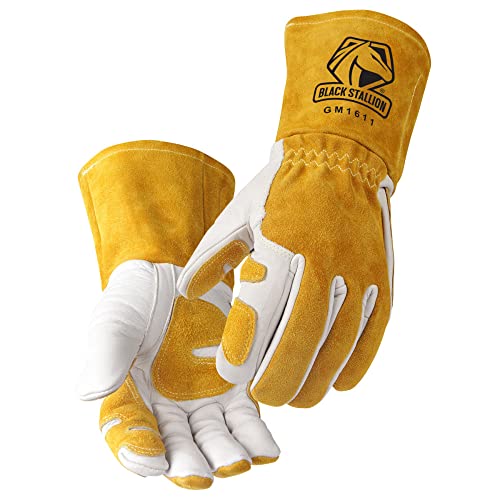
The Black Stallion GM1611-WT takes a sensible middle path between a thin TIG glove and a heavily insulated forge glove. Its top-grain cowhide construction is suited to MIG work, where sparks, spatter, abrasion from the gun, and repeated contact with metal can wear through lighter gloves. Reinforced patches cover the palm, thumb, and index finger, the areas that often take the most friction during gun handling.
Protection is also built around the seams and wrist. Kevlar stitching is listed for the glove, while DragPatch side padding and RestPatch wrist padding add material around exposed areas. That combination gives this pair a stronger case for regular MIG work than a plain leather glove, without the full 16-inch sleeve found on several alternatives. The large size is the only size shown for this specific listing, so fit should be checked carefully before ordering.
Pros
- Top-grain cowhide provides a substantial outer material for MIG work.
- Reinforced palm, thumb, and index finger address common abrasion points.
- Kevlar stitching supports seam durability around heat and friction.
- Wrist and side padding add coverage without a full forearm sleeve.
- More balanced for routine MIG handling than heavily layered forge gloves.
Cons
- The shorter cuff provides less forearm coverage than 16-inch alternatives.
- The listed configuration is large, which may not suit smaller hands.
This is the strongest general recommendation for buyers who want a dedicated MIG glove with reinforced wear zones and a documented focus on cowhide construction. Buyers working around frequent sparks above the wrist may prefer RAPICCA, TOPDC, or SpecxArmor instead. The Black Stallion makes more sense where hand protection and manageable bulk need to coexist.
To buy this product, click here.
2. Caiman 1540-5 — Best for TIG Control

For TIG work, finger movement can matter more than maximum insulation. The Caiman 1540-5 uses a supple goat grain palm with a split cowhide back, creating a material combination aimed at torch control while retaining more protection on the back of the hand. Its Kontour design is described as following the natural shape of the hand, and the shaped wrist is intended to reduce slippage.
A four-inch extended cuff adds useful wrist coverage without turning the glove into a long forearm gauntlet. The combination palm reinforcement and drag patch also give it more abrasion resistance than an ultra-light TIG glove. It is a better fit for TIG and multi-task work than for heavy MIG spatter, where the Black Stallion or a 16-inch lined glove offers more coverage.
Pros
- Goat grain palm is suited to controlled TIG torch handling.
- Split cowhide back adds protection behind the hand.
- Kontour shaping is intended to improve finger alignment.
- Four-inch cuff covers more of the wrist than a short TIG glove.
- Reinforced palm and drag patch support repeated tool contact.
Cons
- The shorter cuff leaves more forearm exposed than long MIG gloves.
- Its lighter TIG-oriented construction is less suited to heavy spatter.
The Caiman is the right direction for a large-size buyer who values torch control and wrist coverage. It should not be treated as a substitute for a heavily insulated glove during forge work or high-spatter Stick welding. Compared with the Tillman 1328, it offers more structured wrist and palm protection, while giving up some simplicity.
To buy this product, click here.
3. RAPICCA 16-Inch Welding Gloves — Best for Forearm Coverage
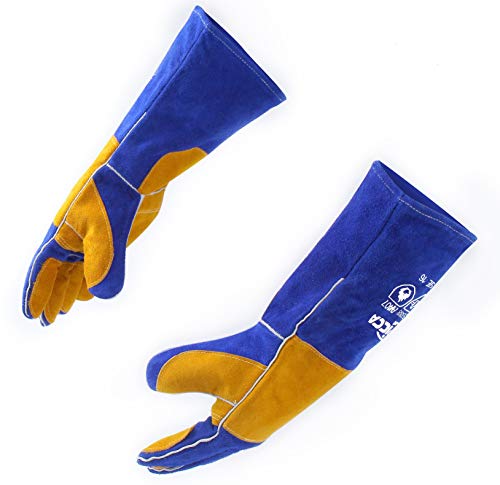
Short gloves can leave the wrist and lower forearm exposed when sparks fall from above. RAPICCA addresses that problem with a 16-inch glove and a listed 7.5-inch sleeve. The layered construction combines an outer leather surface, an insulating aluminum foil layer, and a flame-retardant cotton liner, while reinforced leather appears at the fingers, palms, elbows, and back.
The listing identifies this pair for Stick, MIG, and flux-core welding, along with forge and blacksmith work. That broad task positioning makes it more useful for a workshop where the same gloves may move from a welding machine to a hot fire or furnace-related task. The trade-off is predictable: layered insulation and long cuffs usually mean less delicate finger control than a goatskin TIG model.
Pros
- 16-inch length and 7.5-inch sleeve extend protection over the forearm.
- Layered leather, foil, and cotton construction adds insulation.
- Reinforced areas cover fingers, palms, elbows, and the back of the hand.
- Listed for Stick, MIG, flux-core, forge, and blacksmith applications.
- Kevlar stitching supports the seams around repeated heat exposure.
Cons
- The layered build may feel less precise than a dedicated TIG glove.
- Long sleeves can be cumbersome during small, detail-oriented tasks.
RAPICCA suits buyers who want one long glove for welding and adjacent hot-work tasks. It is a stronger coverage choice than a standard cuff glove, particularly where sparks can reach the forearm. Buyers focused mainly on fine TIG control should choose Caiman or Tillman instead.
To buy this product, click here.
4. TOPDC 16-Inch Welding Gloves — Best Budget Long-Cuff Option
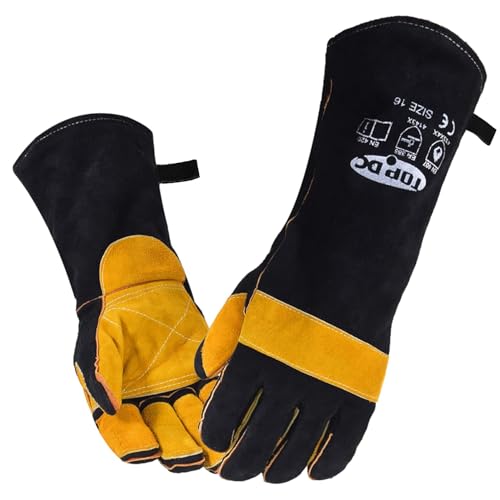
TOPDC focuses on the basic requirements of a long MIG and Stick glove: cowhide leather, reinforced stress points, internal lining, and extended coverage. The product information lists 1.2 mm natural cowhide, double leather stitching, Kevlar reinforcement, and a 16-inch length with a 7.5-inch sleeve. Those details place it closer to a general heat and spatter glove than to a precision TIG model.
The cotton-lined interior may be useful during longer tasks because it adds a fabric barrier between the hand and leather. Its advertised applications stretch into fireplace, grill, furnace, and outdoor work, although welding process fit should remain the main purchasing consideration. Compared with RAPICCA, the documented construction is similar in purpose, while the product positioning is more directly centered on MIG and Stick.
Pros
- 16-inch length provides extended wrist and forearm coverage.
- Natural cowhide construction suits MIG and Stick handling.
- Kevlar and double leather stitching reinforce high-wear areas.
- Cotton lining adds an interior barrier during extended use.
- Long-cuff format is useful around falling sparks and hot debris.
Cons
- Bulkier construction offers less finger sensitivity than TIG-focused gloves.
- The listing does not provide process-specific dexterity measurements.
TOPDC is a practical lower-cost route to long-cuff coverage for MIG and Stick work. It suits a buyer who values forearm protection and broad utility more than fine torch manipulation. A shorter glove such as the Black Stallion remains easier to manage when the task produces little spatter above the hand.
To buy this product, click here.
5. WZQH 16-Inch Welding Gloves — Best for General Hot-Work Versatility
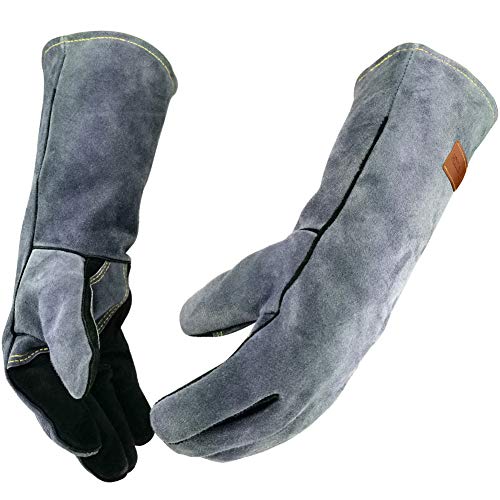
WZQH uses a three-layer concept with split cowhide outside, an aluminum foil and flame-retardant cotton middle layer, and a soft cotton-fiber lining. The product information lists a 16-inch length and 7.5-inch sleeve, so its main distinction is broad coverage rather than delicate hand movement. Reinforced double stitching at the palm is intended to address a common failure area.
The listing identifies the gloves for Stick, MIG, and flux-core welding, as well as forging, grilling, fireplace work, and other hot tasks. That range may appeal to a workshop where gloves are moved between metalwork and outdoor heat handling. The manual sizing note is also relevant. The listed size is large, and the product information says measurements may vary, so buyers should verify fit rather than assume the label will match another brand.
Pros
- Layered construction combines split leather, foil, and cotton.
- 16-inch body and 7.5-inch sleeve provide broad forearm coverage.
- Listed for MIG, Stick, flux-core, and forging applications.
- Double stitching reinforces the palm.
- Soft inner lining may improve comfort over bare split leather.
Cons
- Long layered construction can reduce precision for TIG-style work.
- Manual sizing variation makes fit confirmation especially important.
WZQH is a sensible choice for mixed hot-work duties where coverage takes priority. It is less compelling for a buyer who spends most of the day manipulating a small TIG torch or filler rod. Compared with TOPDC, it offers a similar long-cuff concept but uses a clearly described foil layer within the construction.
To buy this product, click here.
6. TICONN 16-Inch Leather Welding Gloves — Best for Thick Cowhide Coverage

TICONN takes a heavier construction route than the standard short-cuff glove. Its product information lists a 2.4 mm cowhide outer layer, an insulating aluminum foil middle layer, and a flame-retardant cotton inner layer. It also lists a 16-inch length and 7.5-inch cuff, making this pair relevant to MIG, Stick, forge, and other tasks where sparks can reach the forearm.
Double leather stitching is described across the palm, fingers, and back, with Kevlar thread at key stress points. An elastic band at the cuff opening is intended to help limit slippage. Those features address movement and wear, although the thicker layered build will usually be less nimble than the Caiman or Tillman gloves. The listing also mentions TIG and soldering use, but the strongest fit remains broad heat and spatter coverage rather than precision TIG.
Pros
- Listed 2.4 mm cowhide outer layer provides substantial material thickness.
- Layered foil and cotton construction adds insulation.
- 16-inch length covers the wrist and forearm.
- Kevlar thread and double stitching reinforce stress points.
- Elastic cuff band is intended to reduce sleeve slippage.
Cons
- Thicker construction may limit fine finger movement.
- The listing does not provide independent test details for the heat claim.
TICONN fits buyers who favor a thick, extended glove for MIG, Stick, fabrication, or forge work. Its construction gives it a clear coverage advantage over Tillman, though Tillman remains the more natural choice for dexterity. Check sleeve fit and hand size carefully because a glove this substantial can become awkward if it is too loose.
To buy this product, click here.
7. Tillman 1328 Top Grain Goatskin Gloves — Best Simple TIG Option

The Tillman 1328 is a more straightforward TIG glove than the Caiman 1540-5. It uses goatskin, lists an abrasion-resistant construction, and has an ambidextrous design. For a buyer who wants a reusable glove that can be pulled on either hand, the uncomplicated format may be useful in a shared workshop or as a basic TIG glove.
Its strengths are also its limits. The available product information does not identify an extended cuff, layered insulation, reinforcement patches, or a specific heat-resistance rating. That makes the Tillman better suited to controlled TIG work than to heavy MIG spatter, forge handling, or tasks where forearm protection is central.
Pros
- Goatskin construction supports flexible TIG handling.
- Ambidextrous design permits use on either hand.
- Abrasion-resistant construction adds durability beyond a disposable glove.
- Pull-on closure allows quick use and removal.
- Simple design avoids the bulk of long insulated gloves.
Cons
- Available information does not list an extended cuff or forearm sleeve.
- Heat-resistance details are less specific than several alternatives here.
Tillman 1328 is a sensible fit for TIG users who value a simple goatskin glove and do not need long-cuff coverage. Buyers working primarily with MIG, Stick, or flux-core should move toward Black Stallion or one of the 16-inch models. The Caiman remains the more protective TIG-oriented option because its wrist and palm construction are described in greater detail.
To buy this product, click here.
8. YESWELDER Forge Gloves — Best for MIG Dexterity
YESWELDER positions this 16-inch glove around MIG control rather than maximum insulation. The product information describes soft grain leather, a seamless index finger, and a keystone thumb. Those details matter because the index finger and thumb do much of the work when positioning a MIG gun, moving material, or adjusting a tool.
The construction combines top-grain and split leather with Kevlar thread and reinforcement at high-wear points. A thin knit cotton liner is listed on the top hand, while the bottom hand is unlined to preserve dexterity. This arrangement separates the glove from fully layered 16-inch options such as TICONN and RAPICCA. It may provide a more direct grip, though it offers less documented insulation on the palm side.
Pros
- Seamless index finger supports MIG gun control.
- Keystone thumb design is intended to improve hand movement.
- Top-grain and split leather balance flexibility with wear resistance.
- Kevlar thread reinforces high-wear areas.
- 16-inch length adds forearm coverage compared with short gloves.
Cons
- Unlined bottom hand provides less insulation than fully layered gloves.
- The listing centers on MIG and does not establish a dedicated TIG fit.
YESWELDER is a strong alternative for buyers who want a long glove without the fully insulated feel of a forge glove. It makes more sense for active MIG handling than for moving extremely hot objects. Compared with Black Stallion, it offers longer coverage and a more dexterity-focused description, while Black Stallion provides more clearly listed palm, thumb, wrist, and side padding.
To buy this product, click here.
9. SpecxArmor GrayWolf — Best for High-Heat Handling

The GrayWolf is aimed at conditions where heat reflection and layered protection take priority. Its listing identifies an aluminized top hand, split leather construction, internal Kevlar and foam lining, and Kevlar-stitched seams. The top-hand aluminized surface is intended to reflect radiant heat, which gives this glove a different purpose from the plain cowhide options above.
The product information also identifies the glove for Stick and MIG welding, foundry work, furnace handling, forging, and high-heat tasks. A listed EN 11612 certification claim appears in the product description, but buyers should confirm the current manufacturer documentation and exact model marking before relying on any certification for a workplace requirement. Its high-heat focus comes with more bulk than a TIG glove, so delicate torch work is not its strongest use.
Pros
- Aluminized top hand is intended to reflect radiant heat.
- Internal Kevlar and foam lining provide layered coverage.
- Split leather construction aims to balance protection and movement.
- Kevlar seams address seam durability in high-heat work.
- Listed for MIG, Stick, forge, foundry, and furnace applications.
Cons
- High-heat construction is likely less nimble than TIG-focused gloves.
- Certification claims should be verified against current documentation before workplace use.
GrayWolf is the specialist choice in this group for buyers who face more radiant heat than an ordinary MIG glove is intended to handle. It offers a different protection strategy than RAPICCA or TOPDC because the aluminized surface is central to its design. For routine shop welding without substantial radiant heat, Black Stallion or YESWELDER may be easier to manage.
To buy this product, click here.
Buying Guide
Match the Glove to the Welding Process
MIG and Stick work usually produce more spatter and radiant heat around the hand than controlled TIG work, so reinforced cowhide or a long lined glove often makes more sense. TIG gloves tend to favor goatskin and finger movement. A glove that feels comfortable for fine torch control may provide less coverage for a high-spatter repair.
Choose Coverage Based on Spark Direction
A standard cuff may be enough when the hand stays below the weld and the workpiece is positioned carefully. A 16-inch glove with an extended sleeve is more useful when sparks fall toward the wrist, when hot material is handled, or when the forearm regularly approaches the work area. Longer coverage can also add bulk, so it should match the task rather than automatically be treated as better.
Look at Reinforcement Zones
Palm, thumb, and index-finger patches are meaningful because those areas frequently contact a MIG gun, electrode holder, tools, and rough metal. Kevlar stitching can strengthen seams, but stitching alone does not tell you how flexible or durable the leather will be. Look for a combination of material, reinforcement placement, cuff design, and lining.
Understand Heat Claims Carefully
A listed temperature figure is not a guarantee that a glove can be worn indefinitely at that temperature. Exposure time, direct contact, radiant heat, moisture, movement, and the condition of the glove all affect real use. Treat product heat numbers as listing information, follow the manufacturer’s instructions, and use the glove for the process and environment it was intended to cover.
Prioritize Fit and Finger Movement
A glove that is too loose can reduce control around a torch or gun, while one that is too tight can restrict movement and wear quickly at the seams. Check the specific size listing because glove sizing varies by brand. Large, layered gloves may need extra room for comfort, but excessive space can make tool handling clumsy.
Separate Welding Protection from General Heat Work
Several gloves here are also marketed for grills, fireplaces, gardening, or forge work. Those uses do not automatically make a glove suitable for every welding process. A pair intended for occasional fireplace handling may lack the dexterity, reinforcement, or coverage needed for repeated MIG or Stick work, so welding relevance should remain the first filter.
Best Welding Gloves FAQ
Are thicker welding gloves better?
Thicker gloves generally provide more material between the hand and heat, sparks, or abrasion, but they can reduce finger control. Thick layered gloves suit MIG, Stick, forge, and hot-material handling, while thinner goatskin gloves are usually more appropriate for TIG control. The right thickness depends on the heat and spatter produced by the task.
What type of leather is used for welding gloves?
Cowhide is common in MIG and Stick gloves because it provides a substantial, abrasion-resistant outer material. Goatskin is often used for TIG gloves because it can offer more flexibility. Split leather and grain leather have different surface characteristics, so the leather type should be assessed alongside lining, reinforcement, stitching, and cuff length.
Are 16-inch welding gloves necessary?
They are useful when sparks or hot debris can reach the wrist and forearm, or when the glove is also used for forging and other hot-work tasks. A shorter glove may be easier to control for routine MIG or TIG work where the forearm remains away from the weld. Long cuffs add coverage but can make the glove warmer and less flexible.
Can TIG gloves be used for MIG welding?
They can be used for some light MIG tasks, but a TIG glove may offer less insulation and reinforcement than a MIG glove. MIG work often produces more spatter, especially with flux-core welding, so a reinforced cowhide glove or long-cuff model may be a better fit. Check the glove’s intended use instead of assuming all leather gloves provide the same protection.
Does Kevlar stitching make gloves heatproof?
Kevlar stitching is intended to improve seam resistance around heat and abrasion, but it does not make the entire glove heatproof. The leather, lining, fit, exposure time, and condition of the glove also affect performance. Follow the product instructions and replace gloves when the leather, lining, or seams become damaged.
How should welding gloves fit?
Fingers should reach the ends without being compressed, and the palm should stay reasonably secure when gripping a tool. Excess slack can interfere with torch or gun control, while a tight fit can strain the seams. Compare the manufacturer’s size information with your hand measurements, especially for long layered gloves.
Can welding gloves protect against every welding hazard?
No glove handles every hazard or replaces proper welding procedures. Gloves address hand contact, heat, sparks, and abrasion within their intended use, but they do not replace suitable eye protection, clothing, ventilation, training, or the manufacturer’s safety instructions. Choose coverage and materials that match the actual process.
Final Verdict
The Black Stallion GM1611-WT is the strongest overall choice because it combines cowhide construction with targeted reinforcement at the palm, thumb, index finger, wrist, and side of the glove. That balance suits routine MIG work better than a thin TIG glove, while avoiding some of the bulk associated with fully layered 16-inch models. It is the option to choose when a general-purpose MIG glove needs meaningful abrasion and spatter protection.
Caiman 1540-5 is the better alternative for TIG control, while RAPICCA offers broader forearm coverage for mixed MIG, Stick, flux-core, and forge work. Buyers facing substantial radiant heat should look closely at SpecxArmor GrayWolf, provided its current certification details match the workplace requirement. Before ordering, match the glove to the process, confirm the size, and treat advertised heat figures as product information rather than a substitute for safe work practices.
