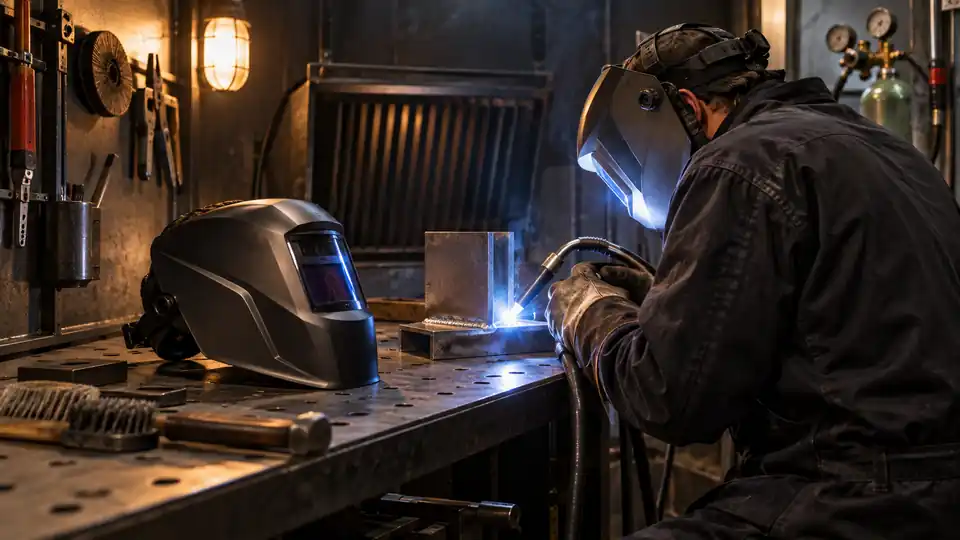
A lightweight welding helmet can make a long session feel very different. A hood that weighs around one pound places less load on the neck than a heavier design, while a large viewing area can make it easier to track the joint, electrode, and surrounding workpiece without constantly lifting the helmet. The strongest options balance weight with lens clarity, useful shade controls, dependable headgear, and a shell that suits the work environment.
Weight alone is a poor buying filter. A very light helmet may have a smaller viewing window, fewer sensors, or a simpler headband, while a large panoramic model can add bulk despite its generous sightline. Optical clarity also matters more than a dramatic switching-speed figure on its own. A 1/1/1/1 lens rating, multiple arc sensors, adjustable sensitivity, and a replaceable battery can make a bigger practical difference during TIG, MIG, Stick, cutting, or grinding work.
This roundup compares nine helmets with a strong emphasis on published weight, viewing area, lens performance, controls, and power design. The YESWELDER LYG-M800H earns the top position because it combines a broad 3.93 by 3.66 inch view, 1/1/1/1 optical clarity, four sensors, and a listed weight of about 1.32 pounds without moving into the most feature-heavy designs.
Quick Answer
- Best Overall: YESWELDER LYG-M800H, for its large true-color viewing area and balanced weight.
- Best Lightweight Budget Option: ARCCAPTAIN Auto Darkening Helmet, listed at about one pound with 1/1/1/1 optics.
- Best for Dark Work Areas: ARCCAPTAIN Helmet with Light, which adds a USB-powered LED work light to a large-view lens.
- Best Premium Option: ARCCAPTAIN Intelligent Auto-Darkening Helmet, with panoramic side lenses, internal controls, memory modes, and a rechargeable battery.
Best Lightweight Welding Helmet Comparison Table
| Product | Best For | Weight or Size | Lens and Power |
|---|---|---|---|
| YESWELDER LYG-M800H | Best overall balance | About 1.32 lb, 3.93 x 3.66 in view | 1/1/1/1, four sensors, CR2450 |
| ARCCAPTAIN Auto Darkening | Lightweight daily use | About 1 lb, 3.86 x 1.69 in view | 1/1/1/1, four sensors, solar and CR2450 |
| ARCCAPTAIN Helmet with Light | Dim workshops | About 1 lb, 3.94 x 3.66 in view | 1/1/1/1, four sensors, solar and CR2450 |
| ARCCAPTAIN Intelligent Helmet | Maximum visibility and controls | 7.2 x 3.2 in total view | 1/1/1/1, seven sensors, rechargeable |
| Auto-Darkening Hobby Helmet | Occasional home projects | Weight not clearly listed | True color, 0.1 ms listed response |
| ARCCAPTAIN Large Screen Helmet | Large lens on a simple setup | About 2 lb, 3.93 x 3.66 in view | 1/1/1/1, four sensors, solar and CR2450 |
| Miller Classic Series ClearLight | Recognized safety documentation | 6 sq. in. viewing area | ClearLight, two sensors, replaceable battery |
| MIGVAN True Color Helmet | Accessory bundle and storage | Large viewing screen, weight not listed | Four sensors, solar and CR2450 |
| BESTCLUB True Color Helmet | Basic cutting and grinding use | Weight not clearly listed | 1/1/1/2, four sensors, solar powered |
The detailed reviews below focus on how each helmet’s weight, lens design, controls, and power system affect daily use.
1. YESWELDER LYG-M800H : Best Overall
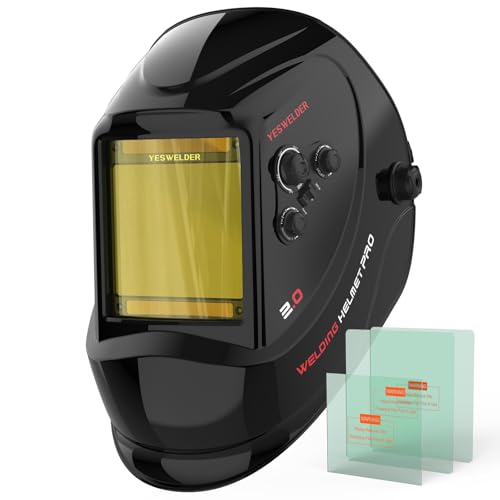
The LYG-M800H takes the strongest overall position because its lightweight specification does not come at the expense of viewing area. At approximately 1.32 pounds, it is lighter than many large-window helmets, yet the 3.93 by 3.66 inch opening gives the wearer a broad look at the joint and nearby metal. That combination matters during awkward starts, corner joints, and work where moving the head is less convenient than keeping the hood in place.
The listing identifies 1/1/1/1 true-color optical clarity, four arc sensors, and a listed 1/30,000-second switching speed. Its DIN 5 to 9 and 9 to 13 welding ranges also suit several common processes, while grind and cut functions add flexibility around the bench. A CR2450 battery is accessible for replacement, and cheater-lens compatibility gives close-up work more room for adjustment.
Pros
- About 1.32 pounds, with a useful balance between low weight and a large viewing area.
- 3.93 by 3.66 inch lens gives a broad sightline around the weld zone.
- 1/1/1/1 true-color optical classification is clearly listed.
- Four arc sensors and adjustable shade ranges support varied welding tasks.
- Compatible with magnifying lenses and uses a replaceable CR2450 battery.
Cons
- The listing does not provide a detailed headgear adjustment range or replacement-lens schedule.
- At about 1.32 pounds, it is not as light as the smallest one-pound options in this comparison.
This is the most balanced choice for someone who wants a light helmet but dislikes narrow viewing windows. The larger lens makes more sense for general fabrication, repairs, and mixed MIG, TIG, Stick, cutting, and grinding work than a compact hood with fewer sensors. Buyers seeking the lowest possible weight may prefer one of the one-pound ARCCAPTAIN models, while those wanting a premium panoramic view will find more advanced controls elsewhere.
To buy this product, click here.
2. ARCCAPTAIN Auto Darkening Helmet : Best Lightweight Option

At about one pound, this ARCCAPTAIN model is among the lightest clearly specified helmets in the selection. That reduced mass can matter during repeated hood-up and hood-down movement, particularly for bench work where the helmet stays on for long stretches. Its 3.86 by 1.69 inch viewing area is narrower than the YESWELDER’s, but the 1/1/1/1 optical classification aims to preserve a clear, natural view through that smaller window.
Four arc sensors, adjustable sensitivity, and shade settings from 9 to 13 give the lens a useful range for common TIG, MIG, and Stick applications. Solar assistance works with a replaceable CR2450 battery, so the power arrangement does not depend on a sealed cell. The listing also identifies compatibility with cheater lenses, a practical detail for close joints or small workpieces.
Pros
- Listed weight of about one pound supports a lighter feel than the larger-view alternatives.
- 1/1/1/1 optical clarity and true-color viewing are clearly identified.
- Four sensors provide broader arc-detection coverage than two-sensor designs.
- Solar power and a replaceable CR2450 battery simplify routine power maintenance.
- Cheater-lens compatibility helps users who need magnification for close work.
Cons
- The 3.86 by 1.69 inch viewing area is substantially narrower than panoramic designs.
- The published information does not clearly provide a detailed grind-shade range.
This helmet is a sensible fit for buyers who place neck comfort and low mass above maximum peripheral visibility. It is especially appealing for routine TIG, MIG, or Stick work where a narrow but clear lens is sufficient. The trade-off is easy to see: it weighs less than the broad-window YESWELDER, but it does not offer the same tall field of view.
To buy this product, click here.
3. ARCCAPTAIN Helmet with Light : Best for Dim Work Areas

A dark corner under a vehicle or a poorly lit fabrication bench can make joint alignment frustrating before the arc even starts. This ARCCAPTAIN adds a USB-powered LED work light with two brightness levels, giving the helmet a useful distinction beyond lens speed. The light is supplied uninstalled, so buyers should expect a small setup step rather than a ready-to-use lamp attached to the hood.
The helmet also has one of the broadest front viewing areas here, measuring 3.94 by 3.66 inches. The listing identifies 1/1/1/1 optics, four sensors, a listed one-pound weight, and shade ranges of 5 to 8 and 9 to 13. Solar panels and a CR2450 battery provide the power arrangement, while the LED introduces another component that may require charging or connection management.
Pros
- Large 3.94 by 3.66 inch viewing area supports a broad forward sightline.
- Listed weight of about one pound is low for a large-window helmet.
- USB-powered LED light can illuminate dark work areas and alignment points.
- 1/1/1/1 true-color optics and four sensors are specified.
- Solar assistance and a replaceable CR2450 battery support extended use.
Cons
- The work light arrives uninstalled and adds another component to manage.
- Published information does not clearly specify the helmet’s total weight with the light attached.
This model makes sense for garages, crawl spaces, and benches where ambient light often falls short. The LED should be viewed as an alignment aid, not a substitute for proper shop lighting or task illumination. Buyers who work in bright conditions may prefer the simpler ARCCAPTAIN large-screen model, while those who want a large lens at low listed weight have a clear reason to choose this version.
To buy this product, click here.
4. ARCCAPTAIN Intelligent Auto-Darkening Helmet : Best Premium Option

This is the feature-rich choice for buyers who care more about visibility and adjustment control than achieving the lowest helmet weight. Its main lens and two side lenses create a listed total viewing area of 7.2 by 3.2 inches, which can provide a much wider sense of the surrounding work area than a conventional front-only window. Seven arc sensors and 1/1/1/1 optics add to the emphasis on broad detection and clear color.
The internal screen displays settings for shade, sensitivity, and delay, while memory storage allows up to nine custom settings according to the listing. A rechargeable 500mAh battery works with solar assistance, and the built-in LED light can be activated from the internal controls. This package brings more capability, but the extra lenses, electronics, and controls mean it is unlikely to be the simplest or lightest choice in the group.
Pros
- Panoramic design provides a listed total viewing area of 7.2 by 3.2 inches.
- 1/1/1/1 optical clarity is listed for the main and side lenses.
- Seven sensors offer broad arc-detection coverage.
- Internal display, memory modes, and adjustable shade, sensitivity, and delay improve control flexibility.
- Rechargeable battery, solar assistance, and an integrated work light reduce reliance on disposable power.
Cons
- The listing does not clearly state the helmet’s total weight, which limits direct lightweight comparison.
- More electronics, side lenses, and controls create a more involved setup than basic auto-darkening hoods.
This helmet suits users who want a wide field of view and repeatable settings for different tasks. The nine memory modes may help someone who switches between welding, cutting, and grinding, while the internal screen keeps adjustments visible without removing the hood. It is less compelling for a buyer whose main goal is minimal neck load and simple battery replacement.
To buy this product, click here.
5. Auto-Darkening Hobby Welding Helmet : Best for Occasional Home Projects

The strongest reason to look at this generic auto-darkening helmet is its stated focus on occasional home and hobby use. The product information lists true-color optics, an anti-fog design, and a 0.1 millisecond response figure. Those features may appeal to someone who wants one hood for light welding, grinding, and cutting without moving into a more elaborate setup.
Its hard PVC construction and adjustable headband are presented as practical features for basic workshop use, but the supplied information does not clearly state the helmet’s weight, optical classification, sensor count, or exact shade ranges. That missing detail matters in a roundup centered on lightweight equipment. The listing also expressly limits the product to hobby and home use rather than continuous industrial or commercial work.
Pros
- Product information clearly identifies occasional home and hobby use.
- True-color viewing is listed for welding, grinding, and cutting tasks.
- Anti-fog lens design may help maintain visibility in warm workshop conditions.
- Adjustable headband allows fit changes for different users.
- One hood supports several common workshop activities according to the listing.
Cons
- The supplied specifications do not clearly state the helmet’s weight or optical classification.
- The product is expressly positioned for hobby and home use rather than continuous industrial work.
This is a reasonable budget-oriented option for occasional projects where documented weight is less important than a basic multi-use hood. It ranks below the better-specified one-pound models because the central lightweight claim cannot be evaluated as precisely from the available information. Check the current listing and manual for lens ratings, shade details, and fit information before relying on it for more demanding work.
To buy this product, click here.
6. ARCCAPTAIN Large Screen Helmet : Best for a Broad Front View
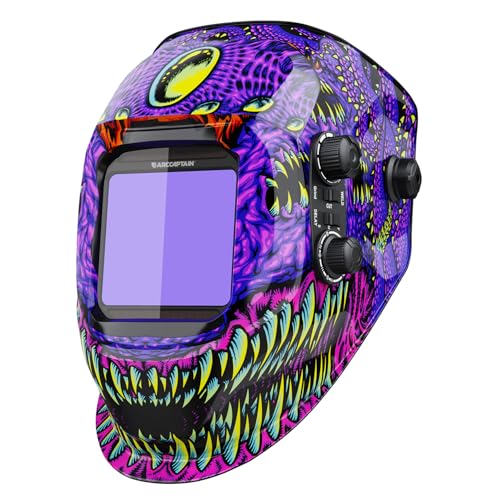
The large-screen ARCCAPTAIN offers the same general kind of front visibility that makes the YESWELDER appealing, with a 3.93 by 3.66 inch viewing area and 1/1/1/1 true-color optics. The difference is weight. The listing identifies this model at about two pounds, so it belongs in a lightweight comparison mainly because its large lens and headgear are positioned as lighter than some comparable designs, not because it is among the lightest entries here.
Four sensors, shade settings of 5 to 9 and 9 to 13, and adjustable sensitivity cover common ARC, MIG, and TIG work. Solar power and a replaceable CR2450 battery reduce the need for frequent battery changes. The shell is identified as PP material and the listing references ANSI Z87.1, EN379, and CSA Z94.3 compliance, though buyers should confirm current documentation for the exact configuration.
Pros
- 3.93 by 3.66 inch viewing area provides broad forward visibility.
- 1/1/1/1 true-color optical clarity is listed.
- Four sensors support arc detection from several angles.
- Solar assistance and a replaceable CR2450 battery provide flexible power.
- Adjustable headgear and breathable padding are included in the documented design.
Cons
- At about two pounds, it is heavier than the other clearly listed lightweight options here.
- The large front window does not provide the side visibility of a panoramic helmet.
Choose this model if the front viewing area matters more than achieving the lowest possible mass. It can suit users who prefer a substantial hood with a wide forward lens and straightforward controls. Someone who spends hours moving between positions may find the one-pound ARCCAPTAIN models easier to carry, while someone working mainly straight ahead may value this helmet’s generous window.
To buy this product, click here.
7. Miller Classic Series ClearLight : Best for Documented Controls

The Miller Classic Series takes a different route from the ultra-light generic hoods. Its published features focus on ClearLight lens technology, digital shade, delay, and sensitivity controls, plus a ratchet headgear system. The six-square-inch viewing area is smaller than the largest rectangular windows in this roundup, yet it remains substantial enough for general welding and precision work.
The shade range covers weld shades 8 to 13, cut shades 5 to 8, and grind shade 3. Two arc sensors and a listed 1/23,000-second switching speed handle auto-darkening, while auto-on power activates at the arc. A three-year warranty is listed, along with ANSI Z87.1+, CSA, and CE references. The main limitation for this search is clear: the product information does not state a specific weight, so its lightweight position cannot be confirmed as closely as the models with listed mass.
Pros
- ClearLight lens technology is specified for high-definition viewing.
- Digital controls provide adjustment for shade, delay, and sensitivity.
- Six-square-inch viewing area offers useful working visibility.
- Documented weld, cut, and grind shade ranges support several tasks.
- Three-year warranty and listed ANSI, CSA, and CE references add documentation value.
Cons
- The available product information does not clearly state the helmet’s weight.
- Two sensors provide less detection coverage than the four- and seven-sensor alternatives.
This is a better fit for buyers who value a known control layout, a ratchet headgear system, and clearly listed shade modes over the lowest published weight. The smaller sensor count is a meaningful trade-off, especially where the viewing angle or helmet position can obstruct a sensor. Buyers who need a confirmed lightweight specification should rank it below the YESWELDER and one-pound ARCCAPTAIN options.
To buy this product, click here.
8. MIGVAN True Color Helmet : Best for Included Extras

MIGVAN earns a place through its combination of a large viewing screen, adjustable shade controls, replaceable lenses, and a storage bag. The package listing identifies two inner lenses, two outer lenses, a manual, and a heavy-duty storage bag as included. That is useful for someone who wants replacement lens parts and basic storage without assembling an accessory package separately.
The helmet uses four arc sensors, solar assistance, and a replaceable CR2450 battery. Its listed shade settings cover DIN 4 in the light state and DIN 5 to 9 or 9 to 13 in dark states, with sensitivity adjustment. The product information calls the lens lightweight and lists ergonomic padding, but it does not provide a precise helmet weight or a full optical classification, leaving some uncertainty for shoppers who are comparing grams as closely as possible.
Pros
- Large viewing screen supports a broader look at the work area.
- Four arc sensors and adjustable sensitivity are listed.
- Solar power works with a replaceable CR2450 battery.
- Package includes two inner lenses, two outer lenses, and a storage bag.
- Shade range covers common welding, cutting, and grinding applications.
Cons
- The available specifications do not clearly state the helmet’s weight.
- The supplied information does not identify a 1/1/1/1 optical classification.
This model is more compelling for buyers who care about replaceable lens parts and storage than those who need a verified low-weight figure. The included extras may reduce maintenance friction, while the four-sensor system is more flexible than a basic two-sensor hood. Confirm the exact optical rating and weight before ordering if those details determine whether a helmet qualifies as lightweight for your setup.
To buy this product, click here.
9. BESTCLUB True Color Helmet : Best for Basic Multi-Mode Use

The BESTCLUB helmet keeps the controls straightforward by covering weld, grind, and cut modes in one hood. Its 1/1/1/2 optical classification and true-color lens are listed, along with four arc sensors and a 1/25,000-second response figure. Those details make it a practical lower-cost candidate for mixed metalworking where the user wants to move between an arc, a grinder, and a plasma cutter without changing headgear.
The shell is described as high-impact and flame-retardant, while pivot-style headgear is intended to distribute the helmet more evenly. The product information calls the design lightweight, but it does not provide a numerical weight. Its shade information is also presented broadly, with DIN 9 to 13 identified for welding, so buyers working at the low end of the shade range should verify the current controls and manual.
Pros
- Weld, grind, and cut modes support several workshop tasks.
- Four sensors offer broader detection coverage than two-sensor designs.
- 1/1/1/2 optical classification and true-color viewing are listed.
- Solar-powered design reduces reliance on frequent battery changes.
- Pivot-style headgear is intended to distribute the hood more evenly.
Cons
- The listing does not clearly provide a numerical helmet weight.
- The published shade information is less detailed than the broader control ranges on several alternatives.
This helmet suits users who want a simple multipurpose hood for light welding, cutting, and grinding. Its limitations are documentation and control detail rather than an obvious lack of basic modes. Buyers with frequent low-amperage TIG work may prefer a model with a more clearly specified shade range and 1/1/1/1 optics, while general workshop users may appreciate the uncomplicated layout.
To buy this product, click here.
Buying Guide: How to Choose a Lightweight Welding Helmet
Start With Verified Weight
A lightweight welding helmet should have a documented weight, not simply a product title that uses the word “lightweight.” In this comparison, several models list weights around one pound, while the YESWELDER is specified at about 1.32 pounds. The MIGVAN, BESTCLUB, Miller, and hobby helmet listings do not clearly provide a numerical weight in the available information, so their portability is harder to compare directly.
Remember that the listed figure may exclude accessories such as an LED light, magnifying lens, or additional outer cover. Headgear balance matters as well. A slightly heavier hood with a well-positioned pivot can feel more manageable than a lighter model that sits far forward, although fit cannot be confirmed from specifications alone.
Compare Viewing Area With Total Mass
A large viewing window helps with joint tracking and peripheral awareness, but more lens area can add weight. The YESWELDER and two ARCCAPTAIN large-screen models list viewing areas near 3.9 by 3.6 inches. The premium ARCCAPTAIN adds side lenses for a listed total view of 7.2 by 3.2 inches, though its total weight is not clearly specified.
A narrow window is not automatically a poor choice. The one-pound ARCCAPTAIN model has a smaller 3.86 by 1.69 inch viewing area, which may be enough for straightforward bench work. Choose the larger lens when head movement, joint visibility, or workpiece positioning makes a narrow window frustrating.
Understand Optical Classification
Optical classification describes how consistently the lens transmits light and how much distortion it introduces across the viewing area. A 1/1/1/1 rating is listed for the YESWELDER, two ARCCAPTAIN models, and the premium panoramic ARCCAPTAIN. BESTCLUB lists 1/1/1/2, while the MIGVAN information does not identify a full optical classification.
These ratings do not tell you whether a helmet fits comfortably or whether its controls are convenient. They are one part of the decision, but they are more useful than vague claims about “crystal-clear” viewing because they provide a standardized description.
Look Beyond Switching Speed
Many product listings emphasize extremely fast transitions from light to dark. A response figure can be useful, but it should be read alongside sensor count, shade range, sensitivity, delay, and lens quality. Four sensors may offer broader detection coverage than two sensors when the helmet angle or work position partially blocks one side.
Switching speed also does not replace correct shade selection or proper use of the helmet. The Miller uses two sensors with a listed 1/23,000-second response, while several ARCCAPTAIN models list four sensors and 1/25,000-second response. Those numbers alone do not establish which hood will suit every welding position.
Check the Actual Shade Controls
Shade ranges should match the processes you perform. The YESWELDER lists DIN 5 to 9 and 9 to 13 welding ranges, while the ARCCAPTAIN large-screen model lists 5 to 9 and 9 to 13. The Miller identifies weld, cut, and grind shades separately, which gives a clearer description of how the hood is intended to be used.
Adjustable sensitivity and delay can help refine the lens response for different arc conditions and work rhythms. A helmet with automatic shade features may reduce manual adjustment, but the premium ARCCAPTAIN’s fixed sensitivity in smart mode means buyers should understand which controls remain available.
Distinguish Solar Assistance From Battery Replacement
Solar panels can extend battery life, but they do not mean the battery is unnecessary. The YESWELDER, ARCCAPTAIN, MIGVAN, and BESTCLUB models use solar assistance with replaceable batteries. The premium ARCCAPTAIN uses a rechargeable battery with solar support, which changes the maintenance routine but adds a charging step.
For occasional use, a replaceable coin cell may be convenient because a spare can be kept in the toolbox. Frequent users may prefer a rechargeable design, provided the charging method and battery condition are easy to manage.
Check Whether Extras Are Included
A cheater lens being compatible does not mean one is included. The same distinction applies to LED lights, storage bags, replacement lenses, and batteries. The MIGVAN listing specifically identifies two inner lenses, two outer lenses, and a storage bag as included, while the ARCCAPTAIN helmet with light identifies the lamp as included but uninstalled.
Review the box contents for the exact ASIN before ordering. Accessory bundles can change between product versions, and a replacement lens designed for one model should not be assumed to fit another.
Best Lightweight Welding Helmet FAQ
What Weight Is Considered Lightweight for a Welding Helmet?
There is no single universal cutoff, but a helmet listed around one pound is clearly positioned toward the lighter end of this selection. The YESWELDER is listed at about 1.32 pounds, while two ARCCAPTAIN models are listed at about one pound. Weight should be evaluated with the headgear, lens size, balance, and any attached accessories in mind.
Is a Larger Viewing Area Better?
A larger viewing area can make it easier to see the joint, nearby edges, and work position without turning the head. It may also increase total mass or cost. A broad front window suits fabrication and awkward joints, while a smaller window can be sufficient for straightforward bench work if low weight is the priority.
Are Four Arc Sensors Better Than Two?
Four sensors provide more detection points around the lens than two sensors. That can be useful when the welding position or helmet angle partly obstructs one side. Sensor count does not establish overall lens quality by itself, so compare it with optical classification, shade controls, headgear, and documented standards.
Does True Color Mean the Helmet Has Better Optical Clarity?
True-color technology generally refers to a more natural view through the lens than the strong green cast associated with older designs. Optical classification is a separate specification. For example, several helmets in this roundup list both true-color viewing and 1/1/1/1 optics, while BESTCLUB lists 1/1/1/2.
Can One Helmet Be Used for TIG, MIG, Stick, Cutting, and Grinding?
Several products list modes or shade ranges for these tasks, but the exact controls differ. A helmet can support multiple applications through different shade settings and grind or cut modes. Always check the manual for the correct shade range and operating instructions for the process being used.
Is a Replaceable Battery Better Than a Rechargeable Battery?
A replaceable battery makes it easy to restore power with a spare cell, while a rechargeable battery avoids regular coin-cell replacement. Solar assistance can extend either system. The best choice depends on whether you prefer carrying replacement batteries or managing a charging routine.
Should a Lightweight Helmet Be Used for Professional Work?
Weight alone does not determine suitability for commercial or industrial work. Review the helmet’s documented standards, lens protection, replacement-lens availability, headgear, and intended-use information. The generic hobby model in this roundup is specifically positioned for home and light hobby use, so it should not be treated as an industrial helmet without stronger documentation.
Final Verdict
The YESWELDER LYG-M800H is the strongest overall choice for a lightweight welding helmet because it balances the factors that matter most in daily use. Its listed 1.32-pound weight is low enough to support easier movement, while the 3.93 by 3.66 inch viewing area avoids the cramped sightline found on many lighter hoods. Four sensors, 1/1/1/1 optics, adjustable shade ranges, and a replaceable CR2450 battery give it a well-rounded specification set.
Choose the one-pound ARCCAPTAIN model if minimum weight is the priority and a narrower window is acceptable. The ARCCAPTAIN helmet with LED light is a better fit for dim work areas, while the premium panoramic model suits buyers who value side visibility, memory settings, and internal controls more than simplicity. Before ordering, verify the current weight, lens classification, included accessories, and replacement-lens availability for the exact listing.
