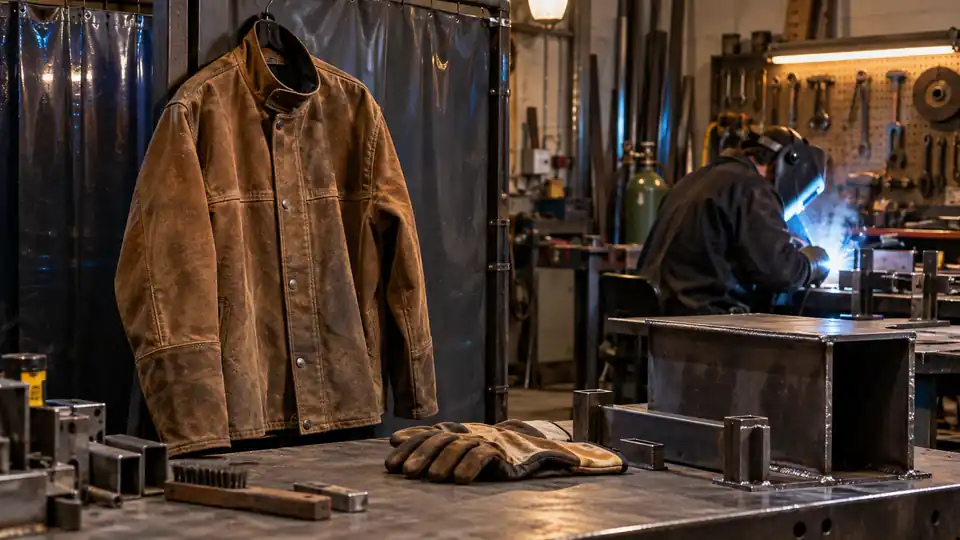
A welding jacket has a straightforward job: cover the torso, neck, wrists, and clothing beneath it while sparks and spatter are flying. The best welding jacket for light TIG work may be a breathable FR cotton coat, while frequent grinding, torch cutting, or heavier MIG work can justify leather across the sleeves and shoulders. Material, coverage, closure design, cuff adjustment, and care instructions matter more than a dramatic product title.
A high weight rating alone does not tell the whole story. A 9 oz cotton jacket can be easier to wear through a long shift, while an 11 oz option offers a denser fabric layer. Leather adds more resistance across high-exposure areas, but it can feel warmer and less flexible. Buyers should also check the collar style, pocket placement, sizing chart, and whether the jacket’s stated certification applies to the exact model and configuration.
This comparison places the ARCCAPTAIN 11 oz FR cotton jacket first because it combines documented FR cotton, a stand-up collar, adjustable cuffs, reflective strips, and four pockets without moving to a full leather design. The leather and hybrid options remain useful for harsher spatter, while the lighter cotton jackets suit buyers who place breathability and lower bulk higher on the list.
Quick Answer
- Best Overall: ARCCAPTAIN 11 oz FR Cotton Welding Jacket, with 11 oz fabric, adjustable cuffs, four pockets, and reflective strips.
- Best Leather Option: ARCCAPTAIN Leather Welding Jacket, with cowhide leather, a cotton lining, Velcro closure support, and broad pocket storage.
- Best Hybrid Design: QeeLink Split Leather Sleeves Welding Jacket, which places leather over the sleeves, shoulders, and chest while using FR cotton elsewhere.
- Best Lightweight Work Jacket: MAGID SparkGuard 1830, a 9 oz cotton jacket with ASTM D6413 information and a 30-inch length.
Best Welding Jacket Comparison Table
| Product | Best For | Material | Standout Features |
|---|---|---|---|
| ARCCAPTAIN 11 oz FR Cotton Jacket | Best overall balance | 11 oz FR cotton | Reflective strips, four pockets, adjustable cuffs |
| Black Stallion FN9-30C | Simple full-coverage cotton | 9 oz treated FR cotton | 30-inch length, welder’s collar |
| YESWELDER 11 oz FR Cotton Jacket | Neck coverage and daily wear | 11 oz FR cotton | Stand-up collar, adjustable cuffs |
| YESWELDER Leather Welding Jacket | Leather coverage | Split cowhide leather | Cotton lining, Kevlar stitching, tool pocket |
| ARCCAPTAIN Leather Jacket | Heavy-duty coverage and storage | Cowhide leather with cotton lining | Velcro front support, four storage areas |
| QeeLink Hybrid Welding Jacket | Leather protection with less bulk | Leather and 10 oz FR cotton | Leather sleeves, shoulders, and chest |
| Lincoln Electric K2985-M | Lightweight established-brand design | 9 oz FR cotton | ASTM D6413 information, machine washable |
| MAGID SparkGuard 1830 | Breathable maintenance work | 9 oz cotton sateen | 30-inch length, reinforced snaps |
| YESWELDER 11 oz FR Cotton Alternate Listing | Another 11 oz cotton configuration | 11 oz FR cotton | Stand-up collar, pockets, adjustable cuffs |
The detailed reviews below focus on coverage, fabric weight, closures, storage, maintenance, and the situations where each jacket makes more sense.
1. ARCCAPTAIN 11 oz FR Cotton Welding Jacket: Best Overall

The ARCCAPTAIN cotton jacket earns the top position through a useful middle ground. Its listed 11 oz, or 310 g, FR cotton is heavier than the 9 oz fabric used by several lighter options here, while remaining less bulky than a full leather coat. That makes the jacket a practical fit for general MIG, TIG, and cutting work where a fabric shell is preferred.
Small details give it an advantage in daily use. The snap closure can be operated with gloved fingers, the two-position cuffs allow a closer wrist fit, and four pockets provide more storage than the simpler jackets. Reflective strips may also help visibility around a dim workshop or outdoor repair area, although they do not replace task lighting or other required PPE.
Pros
- 11 oz FR cotton provides a denser fabric layer than 9 oz alternatives.
- Two-position cuffs help reduce open gaps around the wrists.
- Four pockets include an inner pocket and a chest pen holder.
- Reflective strips can improve visibility in low-light work areas.
- Six listed sizes provide more sizing choices than a single-size listing.
Cons
- The non-stretch fabric may feel restrictive if the size is borderline.
- Cotton does not provide the same sleeve coverage as a leather jacket.
This is the strongest general-purpose choice for buyers who want more coverage and storage than a basic cotton coat without moving to full leather. Check the chest, sleeve, and length measurements carefully because the listing specifically warns that muscular builds may need to size up. Buyers doing frequent heavy grinding or torch cutting may prefer one of the leather designs below.
To buy this product, click here.
2. Black Stallion FN9-30C: Best for Simple Full Coverage

The Black Stallion FN9-30C takes a more traditional approach. Its 30-inch length gives the torso more coverage than a short shop coat, and the 9 oz treated FR cotton keeps the garment lighter than leather. A welder’s collar adds material around the neck, which is useful when sparks land high on the chest or the work position leaves the collar exposed.
Its storage arrangement is aimed at common fabrication tools rather than general personal items. The scribe pocket can hold welding pencils, soapstone, or paint markers, while the inside pocket keeps smaller items closer to the body. Leather reinforcement around the six snaps addresses a common wear point, though the listing does not provide the same cuff adjustability or pocket count as the ARCCAPTAIN cotton model.
Pros
- 30-inch length provides extended torso coverage.
- 9 oz treated FR cotton keeps the jacket lighter than leather construction.
- Welder’s collar adds coverage around the neck.
- Six snap closures simplify front fastening.
- Dedicated scribe and inside pockets suit fabrication tasks.
Cons
- 9 oz fabric is lighter than the 11 oz cotton jackets in this comparison.
- The available information does not identify adjustable cuffs.
This jacket fits buyers who prefer a straightforward, longer cotton coat with useful tool storage. It is less feature-heavy than the top-ranked model, but that may be an advantage for someone who wants fewer extras and a familiar layout. Check the listed size carefully, since this ASIN is identified as Large.
To buy this product, click here.
3. YESWELDER 11 oz FR Cotton Welding Jacket: Best for Neck Coverage

YESWELDER’s 11 oz cotton jacket centers its protection around a stand-up collar and adjustable cuffs. Those areas matter because an open collar or loose sleeve can leave a small path for sparks and slag. The listing identifies the fabric as NFPA 2112 certified, so buyers should still confirm the current label and documentation for the exact size and version before relying on that claim for workplace requirements.
The jacket has two pockets, including a covered chest pocket and an arm pocket. That is a more compact storage layout than the ARCCAPTAIN’s four-pocket design, yet it keeps the front relatively simple. The product information also describes the material as breathable and lists care involving dry cleaning and washing cycles up to 165 degrees Fahrenheit, which makes the care label especially important.
Pros
- 11 oz FR cotton offers more fabric weight than 9 oz alternatives.
- Stand-up collar extends coverage around the neck.
- Adjustable cuffs help close the sleeve openings.
- Covered chest and arm pockets provide task-oriented storage.
- Listed as suitable for MIG and TIG work.
Cons
- Two pockets provide less storage than several competing designs.
- The care instructions may be less convenient than machine-washable alternatives.
This model makes sense for someone who values a higher collar and a moderate fabric weight for routine welding. It gives up the broad storage and reflective detailing found on the ARCCAPTAIN, but the simpler layout may feel less cluttered. Verify washing instructions and sizing before ordering, especially if the jacket will be worn over another layer.
To buy this product, click here.
4. YESWELDER Leather Welding Jacket: Best for Leather Coverage

Full leather changes the emphasis from breathability to physical coverage. This YESWELDER jacket uses split cowhide leather, a stand-up collar, and a cotton lining. That combination is better suited to work where repeated sparks, spatter, or hot debris may reach the torso and arms, though leather can feel warmer than the cotton jackets above.
Double stitching with the listed U.S. Kevlar thread and copper-plated buttons address durability around seams and closures. The product information also describes a tool pocket and a cotton lining intended to make the heavier shell more wearable. These details do not make the jacket suitable for every climate or task, but they give it a clear reason to sit above fabric-only options for higher-exposure work.
Pros
- Split cowhide leather covers the torso and sleeves.
- Stand-up collar adds coverage around the neck.
- Cotton lining can reduce direct contact with the leather shell.
- Double stitching is specified for added seam durability.
- Tool pocket keeps selected work items close at hand.
Cons
- Leather is likely to feel warmer and less flexible than FR cotton.
- The listing provides less pocket detail than the ARCCAPTAIN leather model.
Choose this jacket when leather coverage matters more than the lightest feel. It is a sensible step up from a cotton coat for frequent cutting, fabrication, or work around heavier spatter. Buyers working in a hot shop or needing maximum arm mobility may prefer the QeeLink hybrid design instead.
To buy this product, click here.
5. ARCCAPTAIN Leather Welding Jacket: Best for Heavy-Duty Storage

The ARCCAPTAIN leather jacket is built around full cowhide coverage, a cotton-lined stand-up collar, and a closure system that includes adhesive Velcro support. That combination aims to reduce open areas around the front and neck, which may be useful during cutting, grinding, and welding where debris approaches from different angles.
Storage is its clearest distinction. The listing describes a large outer pocket, a large inner pocket, a chest pencil pocket, and an arm-side pocket. Double Kevlar stitching and gasket-backed oil-plated buttons are also listed. The jacket therefore suits a work setup where carrying small tools matters, although a leather shell and multiple pockets can add bulk compared with a lightweight cotton coat.
Pros
- 100% cowhide leather provides broad shell coverage.
- Cotton lining covers the interior of the jacket.
- Stand-up collar and Velcro support help close front openings.
- Four described storage areas accommodate tools and personal items.
- Double Kevlar stitching is specified for reinforcement.
Cons
- Full leather construction may feel warmer than hybrid or cotton designs.
- The larger pocket layout may add bulk during precise or confined work.
This is the leather option for buyers who want more storage and a more enclosed front than the YESWELDER leather coat describes. It is better suited to demanding shop work than casual, low-spatter TIG sessions. Review the size chart carefully and leave enough room for normal movement and any base layer.
To buy this product, click here.
6. QeeLink Hybrid Welding Jacket: Best Hybrid Design

The QeeLink hybrid jacket places split cowhide leather over the sleeves, shoulders, and chest while using 10 oz FR cotton in other areas. That layout targets the sections most likely to face direct spatter while avoiding a fully leather body. It is a useful middle path for buyers who find cotton too exposed and full leather too warm or stiff.
Adjustable neck, cuffs, and waist give this jacket more ways to close gaps than the basic cotton coats. Heat-resistant Kevlar thread and corrosion-resistant rivets are listed at high-stress points. The trade-off is that the jacket’s protection depends on the position of those leather panels, so buyers should inspect the product images and sizing information to understand the exact coverage for their work.
Pros
- Leather covers the sleeves, shoulders, and chest.
- 10 oz FR cotton reduces the amount of leather in the garment.
- Neck, cuff, and waist adjustments help refine the fit.
- Kevlar thread and rivets are specified at high-stress areas.
- Suitable for welding, torch work, and related shop tasks.
Cons
- It does not provide full leather coverage across the entire jacket.
- The medium listing requires careful sizing before purchase.
The QeeLink is a strong choice for buyers who need reinforced upper-body and arm areas but still want cotton across selected panels. It sits between the cotton and full leather groups, making it more specialized than the ARCCAPTAIN cotton jacket. Choose a full leather coat instead if broad, uniform coverage is the priority.
To buy this product, click here.
7. Lincoln Electric K2985-M: Best Lightweight Established-Brand Option

The Lincoln Electric K2985-M uses 9 oz FR black cotton, placing it among the lighter jackets in this comparison. Its product information identifies ASTM D6413 compliance, an anti-static coating, a flip-up collar, and adjustable cuffs with chrome-plated metal snaps. Those details create a straightforward jacket for buyers who want lighter fabric and familiar coverage points.
Care is a major differentiator. The listing states that the jacket can be machine washed through up to 50 commercial cycles while retaining its flame-resistant properties. Buyers should still follow the garment label, since washing temperature, detergent, and service conditions can affect clothing over time. One large inside pocket provides protected storage, though the jacket lacks the broader pocket selection found on several newer designs.
Pros
- 9 oz FR cotton keeps the shell relatively light.
- ASTM D6413 compliance is identified in the product information.
- Flip-up collar adds neck coverage.
- Adjustable cuffs use metal snaps.
- Machine-washable care information supports routine maintenance.
Cons
- One inside pocket provides limited tool storage.
- The 9 oz fabric is lighter than the 11 oz cotton alternatives.
This jacket makes sense for routine welding where breathability and easier washing take priority over leather reinforcement or multiple pockets. It is less suited to buyers who need a tool-heavy layout or extra material over the arms. The medium configuration should be matched against the wearer’s measurements rather than selected by usual shirt size alone.
To buy this product, click here.
8. MAGID SparkGuard 1830: Best for Breathable Maintenance Work
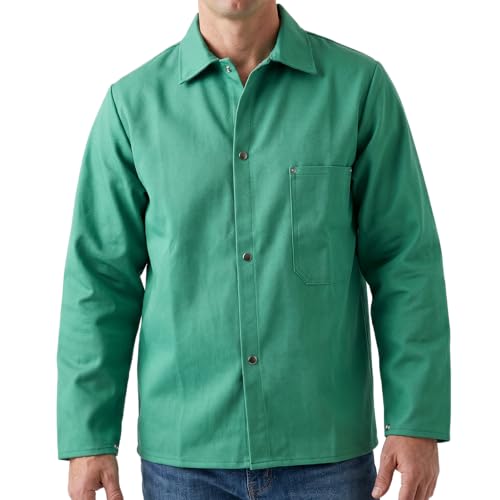
The MAGID SparkGuard 1830 is a lightweight 9 oz cotton sateen jacket with a 30-inch length. Its green color is more visible than the black and navy options in this roundup, which may help with quick PPE identification on a busy site. The product information identifies ASTM D6413 and describes the coat for welding, fabrication, and maintenance work.
Its closure details are practical rather than elaborate. Leather-reinforced metal snaps appear on the front and wrists, and the jacket uses set-in snap-closure sleeves, a lay-down collar, and a riveted inside left breast pocket. The lighter fabric may be more comfortable in warm conditions, but this model does not offer the stand-up collar of several competitors or the leather panels of the QeeLink.
Pros
- 9 oz cotton sateen offers a lighter fabric option.
- 30-inch length provides extended torso coverage.
- ASTM D6413 information is included in the listing.
- Leather-reinforced snaps support the front and wrists.
- Visible green color may simplify PPE identification.
Cons
- Lay-down collar provides less neck coverage than stand-up designs.
- The listing describes one inside pocket rather than several tool pockets.
The SparkGuard suits buyers who want a breathable, longer cotton jacket for fabrication or maintenance areas. Its lighter construction is easier to justify for lower-spatter work than for repeated heavy cutting. Pick the Lincoln model instead if machine-wash information and a flip-up collar matter more than high visibility.
To buy this product, click here.
9. YESWELDER 11 oz FR Cotton Alternate Listing: Best for a Basic 11 oz Cotton Setup
This YESWELDER listing presents the same core 11 oz FR cotton concept found in the brand’s other selected cotton configuration. The stand-up collar, adjustable cuffs, covered chest pocket, and arm pocket create a practical coverage package for routine MIG and TIG work. Buyers should compare the current size chart, color, and listing details carefully because Amazon variations can change by ASIN.
The fabric weight places it above the 9 oz Lincoln, MAGID, and Black Stallion jackets on paper, while the cotton construction remains less cumbersome than leather. Care information identifies dry cleaning and washing cycles up to 165 degrees Fahrenheit. That is useful information, but the garment label should control the actual maintenance routine, particularly if the jacket will be washed frequently.
Pros
- 11 oz FR cotton provides a heavier fabric option than 9 oz jackets.
- Stand-up collar adds coverage around the neck.
- Adjustable cuffs help close sleeve openings.
- Covered chest and arm pockets support small-item storage.
- Listed for MIG and TIG use.
Cons
- Limited pocket count compared with the ARCCAPTAIN cotton jacket.
- Exact size and configuration details should be confirmed before ordering.
This listing suits buyers who want the basic features of an 11 oz cotton jacket and are comfortable checking the exact configuration before purchase. It ranks below the ARCCAPTAIN because the available information shows fewer pockets and no reflective strips. A leather or hybrid jacket remains the better match for work dominated by heavy spatter.
To buy this product, click here.
Buying Guide for the Best Welding Jacket
Choose Cotton, Leather, or a Hybrid Shell
FR cotton is generally the lighter, more breathable choice for routine welding and fabrication. The 9 oz jackets in this group favor lower bulk, while 11 oz cotton adds a denser fabric layer. Leather offers broader physical coverage against spatter, but it can feel warmer and restrict movement more than fabric. A hybrid jacket places leather over high-exposure areas and cotton elsewhere, creating a middle option.
Look at the Collar and Cuffs
Sparks do not need a large opening to become a problem. Stand-up or flip-up collars cover more of the neck than a lay-down collar, while adjustable cuffs can reduce gaps around gloves and wrists. A jacket with fixed cuffs may still work, but the sleeve opening deserves attention before purchase.
Check the Closure Design
Snap closures are easy to operate and can be useful when wearing gloves. Leather reinforcement around snaps may help at high-wear points. Velcro support can close gaps quickly, though buyers should inspect how it is positioned and whether it may catch on other clothing or equipment.
Match Pockets to the Job
A chest pencil pocket is useful for soapstone, markers, or a scribe. An inside pocket can keep small personal items away from direct spatter, but phones and other heat-sensitive items should not be treated as protected simply because they are inside a jacket. Four-pocket designs provide more organization, while one-pocket coats tend to remain less bulky.
Read the Care Instructions
FR clothing needs proper maintenance. Some listings describe machine washing, while others identify dry cleaning or a maximum wash temperature. Follow the label for the exact garment and avoid assuming that every detergent, heat setting, or repair preserves the original FR treatment.
Use the Size Chart, Not Habit
Welding jackets often need enough room for movement and a base layer, but an overly loose sleeve or open cuff can create unwanted gaps. Compare chest, sleeve, and jacket-length measurements with the listing’s chart. Non-stretch cotton and leather will not compensate for a borderline size as easily as a flexible everyday shirt.
Best Welding Jacket FAQ
Is an FR cotton jacket suitable for MIG welding?
FR cotton can suit MIG welding when its coverage, condition, and care instructions match the work. MIG welding may produce more spatter than some TIG tasks, so buyers should select a collar and cuff design that closes exposed areas. Heavier spatter, frequent cutting, or extended arm exposure may justify leather or a hybrid jacket.
Is a leather welding jacket better than cotton?
Leather provides a more substantial physical barrier and is often better suited to heavier spatter and torch work. Cotton is generally lighter and more breathable. The better choice depends on exposure, shop temperature, movement requirements, and how long the jacket will be worn.
Does 11 oz fabric provide twice the protection of 9 oz fabric?
No. Fabric weight alone does not establish a complete protection comparison. An 11 oz jacket has more fabric mass than a 9 oz jacket, but collar design, cuffs, seams, coverage, garment condition, and the manufacturer’s documented ratings also matter.
What does FR mean on a welding jacket?
FR means flame resistant. It describes fabric behavior under specified conditions, not a guarantee that the garment prevents every burn or remains suitable after improper care. Follow the manufacturer’s instructions and use the jacket with appropriate welding PPE and workplace controls.
Should a welding jacket fit tightly?
A welding jacket should allow normal movement without leaving large open gaps at the collar, front, or cuffs. A tight fit can restrict arm movement and make layering difficult, while an excessively loose fit can snag or leave openings. Use the product’s chest, sleeve, and length measurements to choose.
Can a welding jacket replace gloves and other PPE?
No. A jacket covers selected areas of the torso, neck, and arms. It does not replace welding gloves, eye and face protection, suitable footwear, ventilation, or other procedures required for the task.
Final Verdict
The ARCCAPTAIN 11 oz FR cotton jacket is the strongest overall pick because its documented feature set balances coverage, daily usability, and storage. The heavier cotton fabric, adjustable cuffs, four pockets, and reflective strips give it more practical detail than the simpler 9 oz coats, while it remains less cumbersome than full leather. Check the size chart carefully, since the non-stretch fabric needs enough room for movement.
Choose the QeeLink if leather over the shoulders, chest, and sleeves is the more important requirement, or move to the ARCCAPTAIN leather jacket for broader leather coverage and more storage. The Lincoln Electric and MAGID jackets make more sense for buyers who prioritize lighter cotton and straightforward care. Match the jacket to the actual spatter, cutting, heat, and movement demands of the work, then follow the garment instructions and complete PPE requirements.
