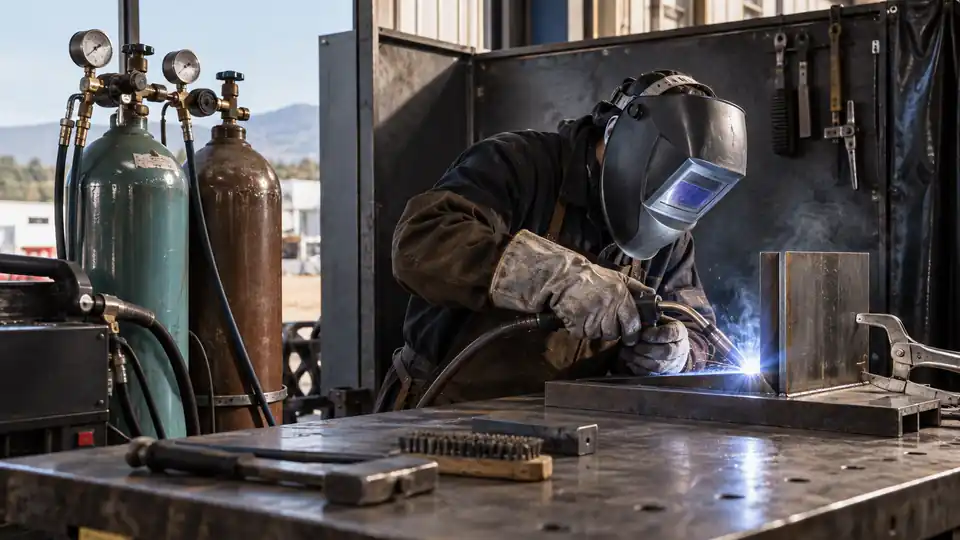
If you are asking what gas is used for MIG welding, the short answer is usually carbon dioxide, argon, or a mixture of the two. The right choice depends on the metal, wire, transfer mode, and weld characteristics you need. A gas cylinder beside a compact MIG machine may look simple, but the shielding gas strongly affects arc smoothness, spatter, penetration, and bead appearance.
For ordinary solid-wire welding on mild steel, an argon-carbon dioxide blend is a common starting point. Pure carbon dioxide can also work well on steel, while aluminum generally requires pure argon or an argon-rich blend. Stainless steel uses gas mixtures selected for that alloy and welding method, so one cylinder should not be treated as a universal answer.
Common Shielding Gases for MIG Welding
MIG, formally called gas metal arc welding (GMAW), uses a continuously fed wire electrode and an external shielding gas. The gas pushes atmospheric oxygen, nitrogen, and moisture away from the molten weld pool. Without suitable shielding, the arc can sound rough, the puddle may become contaminated, and the finished bead can contain visible porosity.
| Shielding gas | Common application | Typical practical effect |
|---|---|---|
| Carbon dioxide | Carbon steel with suitable solid wire | Strong penetration, an energetic arc, and generally more spatter |
| Argon and carbon dioxide blend | General-purpose carbon steel MIG welding | Smoother arc behavior, reduced spatter, and a cleaner-looking bead |
| Pure argon | Aluminum MIG welding and some specialized applications | Stable shielding for aluminum with the correct wire-feeding setup |
| Argon-rich blends | Some steel, stainless steel, and aluminum applications | Arc characteristics suited to specific transfer modes and materials |
The table gives a useful starting point, but the exact gas should match the wire manufacturer’s guidance and the machine’s setup information. A cylinder labeled argon may be correct for aluminum yet unsuitable for ordinary steel solid-wire work, while a carbon dioxide-heavy blend can produce an arc that feels harsher than a new operator expects.
Argon and Carbon Dioxide for Mild Steel
Argon-carbon dioxide blends
An argon-carbon dioxide blend is often chosen for mild steel because it balances arc smoothness and penetration. Argon supports a softer, more stable arc, while carbon dioxide contributes arc energy and penetration. A common blend sold for general steel MIG welding contains mostly argon with a smaller portion of carbon dioxide, often identified as 75 percent argon and 25 percent carbon dioxide.
That blend can make a noticeable difference on a small fabrication job. A person repairing a steel bracket may prefer its calmer arc and lower spatter because less cleanup is needed around the weld. A shop joining clean steel tubing may value the more controlled puddle, particularly when appearance matters alongside sound fusion.
Argon-rich mixtures also support transfer modes that may be difficult or impractical with pure carbon dioxide. The appropriate mixture still depends on wire diameter, amperage, voltage, joint design, and the machine’s capabilities, so the gas label alone cannot determine the final settings.
Pure carbon dioxide
Pure carbon dioxide is used for MIG welding carbon steel and can provide strong penetration at a comparatively economical gas cost. Its arc tends to be more forceful, with more spatter and a rougher sound than many argon-carbon dioxide blends. That does not automatically make it a poor choice. For a heavy steel repair where penetration and cost matter more than a polished bead, CO2 may be practical.
The extra spatter can become frustrating on a thin sheet-metal panel or a visible bracket. A beginner who switches from a mixed gas to pure CO2 may hear a sharper crackle and see more droplets around the joint, then mistakenly suspect a faulty machine. Gas choice is one possible reason, although voltage, wire-feed speed, stickout, polarity, and surface contamination also affect arc behavior.
What Gas Is Used for Aluminum MIG Welding?
Aluminum MIG welding commonly uses pure argon. Aluminum transfers heat quickly, develops an oxide layer, and often requires equipment that can feed soft aluminum wire reliably. The shielding gas must be paired with the appropriate aluminum wire, polarity, drive-roll arrangement, liner or gun configuration, and machine settings.
A MIG welder that handles steel does not automatically handle aluminum. For example, an aluminum project may require a spool gun or another suitable wire-feeding system because soft wire can buckle inside a conventional gun. A cylinder of pure argon cannot turn a steel-only machine into an aluminum-capable system.
Argon-helium blends are also used in some aluminum applications where additional heat input or a particular arc characteristic is needed. They are more specialized than pure argon and should be selected from applicable welding procedures or manufacturer recommendations rather than guessed from the material alone.
Shielding Gas for Stainless Steel MIG Welding
Stainless steel requires more careful gas selection than ordinary carbon steel because the shielding mixture can influence arc behavior, bead appearance, and the finished weld’s surface condition. Depending on the grade, wire, transfer mode, and procedure, stainless MIG welding may use argon with controlled additions of carbon dioxide or oxygen, or a specialized multi-gas mixture.
A stainless wire spool sitting beside a carbon-steel cylinder is a useful reminder that material changes the gas decision. A small stainless exhaust component may call for a different mixture than a structural stainless fabrication, even when both jobs use the same basic GMAW process. The wire data sheet and welding procedure should guide the choice.
Do not substitute a general-purpose steel gas simply because the regulator fits the cylinder. A gas mixture suitable for carbon steel may produce an undesirable arc or surface result on stainless steel, and the wrong shielding arrangement can waste expensive wire while leaving a discolored, contaminated-looking bead.
Gas-Shielded MIG and Flux-Core Welding Are Different
Solid-wire MIG welding depends on an external shielding gas. Flux-cored arc welding uses a tubular wire containing flux, and some flux-cored wires create their own shielding gas as the flux burns. This self-shielded process is often marketed as “gasless MIG,” but it is technically different from conventional solid-wire MIG.
Gas-shielded flux-cored wire is another category. It uses both flux inside the wire and an external shielding gas, often for applications where deposition behavior or weld performance differs from solid wire. The wire package should state whether external gas is required, and polarity must follow the wire manufacturer’s instructions.
This distinction matters outdoors. Wind can disturb an external shielding cloud, much like a breeze scattering smoke from a small campfire. Self-shielded flux core may be more suitable for some outdoor repairs, but it creates slag and has its own operating requirements. Switching from solid wire to flux core may require changing polarity, drive settings, wire, and technique rather than simply removing the gas hose.
How to Choose the Correct MIG Gas
Start with the base metal and wire classification. Then check the wire manufacturer’s recommended shielding gas, the welder manual, and any applicable welding procedure. A practical selection sequence looks like this:
- Identify the material. Carbon steel, stainless steel, and aluminum commonly use different gas arrangements.
- Confirm the wire type. Solid wire, gas-shielded flux-core wire, and self-shielded flux-core wire do not share identical requirements.
- Match the transfer mode. Short-circuit, globular, spray, and pulsed spray operation can call for different gas characteristics.
- Check the machine and accessories. The welder must support the intended wire, polarity, gun, and feeding system.
- Inspect the work area. External shielding gas can be disrupted by drafts, fans, and outdoor wind.
- Verify the regulator and connections. Use equipment rated for the gas service and check for leaks according to safe shop procedures.
Gas flow that is too low may allow atmospheric contamination, while excessive flow can create turbulence that pulls air into the shielding area. The appropriate flow setting depends on the torch, nozzle, joint, surroundings, and manufacturer’s guidance. Turning the regulator up until the sound is loud is not a reliable adjustment method.
Why the Gas Choice Changes Weld Results
Shielding gas affects the way the arc transfers metal from the wire to the puddle. That changes the amount of spatter, the shape of the bead, the penetration profile, and how easy it is to control the weld. A blend that feels smooth on clean, thin steel may behave differently on rusty plate or a joint with poor fit-up.
Gas cannot correct every welding problem. Porosity may result from leaks, drafts, a blocked nozzle, excessive stickout, contaminated metal, or an unsuitable flow setting. A tall bead may relate more to travel speed or electrical settings than to the cylinder choice. Troubleshooting works best when one variable is checked at a time instead of changing gas, wire speed, voltage, and technique all at once.
The Practical Takeaway
For general solid-wire MIG welding on mild steel, an argon-carbon dioxide blend is a common choice, while pure carbon dioxide remains useful when its stronger arc and extra spatter are acceptable. Aluminum commonly uses pure argon, and stainless steel usually requires a mixture selected for the alloy, wire, and welding procedure.
The answer to what gas is used for MIG welding is therefore material-specific rather than universal. Read the wire documentation, confirm the process, account for the welding environment, and treat spool-gun support, polarity, and gas requirements as separate compatibility questions.
