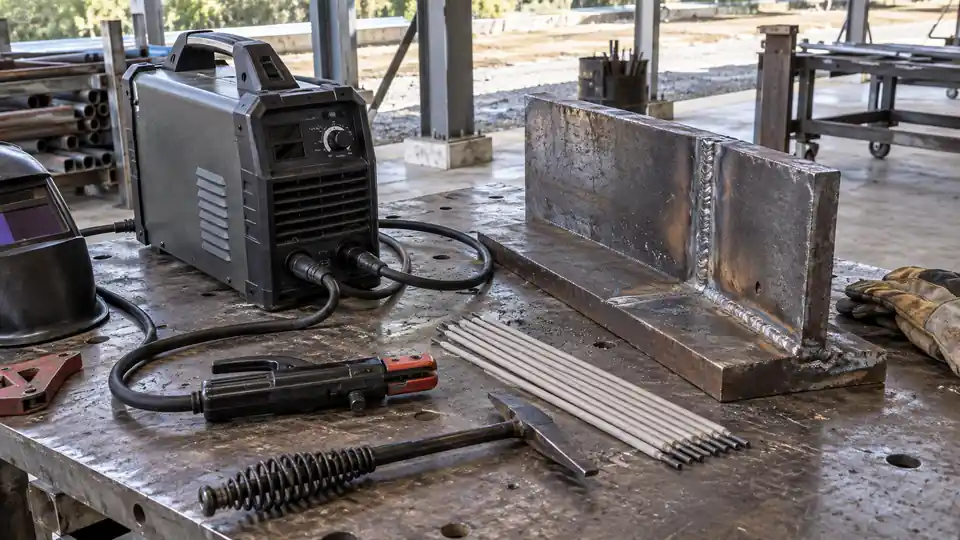
Thick steel changes the welding-machine decision. A compact 110V inverter may strike an arc on steel, yet that does not mean it can sustain the amperage, electrode size, or duty cycle needed for heavier plate. For this search, the useful questions are whether the machine supports 1/8-inch electrodes, whether it can run from 230V or 240V power, how clearly its output limits are documented, and whether its published thickness claims match the intended work.
Maximum amperage alone can be misleading. A small machine advertising 250 amps may have a much lower practical output on a household circuit, while a dual-voltage unit can deliver more usable headroom on a 230V supply. Electrode choice matters too. E6011 and E6013 can suit general repairs, while E7018 is commonly selected for stronger low-hydrogen welds on structural carbon steel. The Lincoln Electric Weld-Pak 225i earns the strongest overall position here because its documentation identifies dual-voltage operation, a 225-amp range, and single-pass capability up to 5/16-inch steel.
The nine machines below cover shop-oriented dual-voltage equipment, portable 110V inverters, and multi-process options with Stick capability. Some favor output and sustained work, while others make more sense for occasional repairs where portability and household power matter more. Published thickness figures are useful starting points, not guarantees, since results also depend on joint design, fit-up, electrode diameter, polarity, material preparation, and welding technique.
Quick Answer
- Best Overall: Lincoln Electric Weld-Pak 225i, the strongest documented match for thicker steel and 230V shop power.
- Best Adjustable Portable Option: ARCCAPTAIN ARC250, with a broad adjustment range, 230V input, and separate hot-start and arc-force controls.
- Best Dual-Voltage Value: YESWELDER 205A, which gives buyers 110V and 220V flexibility in a compact package.
- Best Budget 110V Choice: Rotvik 200A, for lighter thick-steel repairs where access to 220V power is limited.
Best Stick Welder For Thick Steel Comparison Table
| Product | Best For | Input And Output | Thick-Steel Advantage |
|---|---|---|---|
| Lincoln Electric Weld-Pak 225i | Overall thick-steel work | 120V/230V, 10 to 225A | Published 5/16-inch single-pass claim |
| ARCCAPTAIN ARC250 | 230V flexibility and control | 230V, 20 to 250A | Adjustable arc force and hot start |
| YESWELDER 205A | Dual-voltage portability | 110V/220V, up to 205A | Supports common 6010, 6011, 6013, and 7018 rods |
| Rotvik 200A | Household and 220V versatility | 110V/220V, 20 to 200A | Dual-voltage operation with lift TIG |
| Hpoouo 200A | Highly portable repairs | 110V, 20 to 200A | Supports rods up to 1/8 inch |
| HONE 205A | Compact 110V work | 110V, 20 to 205A | Hot start, arc force, and anti-stick |
| WRDLOSY 250A | Budget home repairs | 110V, 20 to 250A peak | Lists 150A effective output at 110V |
| TOOLIOM 135A | Light-duty Stick and Lift TIG | 110V, 135A class | Simple portable setup |
| YESWELDER 135A 3-in-1 | Mixed-process portability | 110V, 135A | Stick mode plus flux-core MIG |
The detailed reviews explain where each machine fits, which specifications matter for thicker steel, and where the published information leaves meaningful limits.
1. Lincoln Electric Weld-Pak 225i : Best Overall

The Weld-Pak 225i has the clearest documented connection to thick-steel work in this roundup. Its 10 to 225 amp output range and 120V/230V input give it a useful combination of low-end flexibility and higher-voltage headroom. Most importantly, the product information states that it can weld up to 5/16-inch steel in a single pass and lists a 30 percent duty cycle at 225 amps on 230V input. Those details provide more context than a large peak-amperage number alone.
A 230V circuit gives this machine a more appropriate foundation for heavier electrodes and longer welding sessions than the small 110V units. At 20 pounds, it is still portable enough for movement around a garage or workshop, while the built-in toolbox top and shoulder strap help keep leads and accessories together. Touch-start TIG is supported, but the required TIG accessories are additional, so the machine should be purchased primarily for its Stick capability if thick steel is the central task.
Pros
- Dual-voltage input supports both 120V and 230V power setups.
- Published 10 to 225 amp output range suits a broad range of electrode sizes.
- Product information identifies single-pass welding up to 5/16-inch steel.
- 30 percent duty cycle at 225 amps on 230V is clearly associated with its operating condition.
- Includes long work and electrode cables, a shoulder strap, and input adapters.
Cons
- Touch-start TIG accessories are required separately.
- Heavier and more expensive than the compact 110V inverters.
This is the most defensible choice for buyers planning repeated work on thicker carbon-steel plate, especially where a 230V circuit is available. The documented thickness claim does not remove the need for proper beveling, fit-up, and multiple passes on demanding joints, but it gives this model a stronger evidence base than the machines that list only broad material ranges. Buyers who need a tiny field unit or occasional light repair may find the extra size unnecessary.
To buy this product, click here.
2. ARCCAPTAIN ARC250 : Best for Adjustable Arc Control

The ARCCAPTAIN ARC250 is built around 230V operation, which immediately makes it more relevant to thick-steel work than a 110V-only machine. Its listed MMA range runs from 20 to 250 amps, and the controls allow separate adjustment of hot start and arc force. Hot start can help with electrode ignition, while arc force changes how the machine responds when the electrode approaches the workpiece. That control can be useful with larger rods and changing joint conditions.
A 3.2-inch LED display and synergic mode simplify setup by allowing the operator to select an electrode diameter before making manual adjustments. The listing identifies compatibility with E6010, E6011, E6013, and E7018 electrodes. Lift TIG is available, but the torch is sold separately, so that feature adds flexibility rather than a complete second process package.
Pros
- 230V input is suited to higher-demand Stick work.
- 20 to 250 amp MMA range provides broad adjustment room.
- Adjustable hot start and arc force allow more control over arc behavior.
- Large 3.2-inch display makes settings easier to read.
- Includes a shoulder strap, 10-foot leads, and starter rods.
Cons
- Lift TIG torch is sold separately.
- The published listing does not provide a duty-cycle figure tied to its maximum amperage.
This machine makes sense for a buyer who has 230V power and wants more adjustment than a basic portable inverter provides. Its listed amperage range is useful, yet buyers should not treat 250 amps as proof of a particular plate thickness without a documented duty cycle or thickness specification. Compared with the Lincoln, it offers more control detail but less clearly documented single-pass capacity, making it a strong alternative rather than the overall leader.
To buy this product, click here.
3. YESWELDER 205A Digital Inverter : Best Dual-Voltage Value

The YESWELDER 205A brings dual-voltage operation into a compact 8.4-pound package. That combination is useful for someone who may practice or handle small repairs on 110V power, then move to a 220V circuit for more demanding steel. The manufacturer listing identifies support for 6010, 6011, 6013, and 7018 electrodes, giving it a more useful consumable range for structural-style repairs than machines limited to basic 6013 rods.
Its digital display and precision adjustment knob make current changes easier to track, while 1-to-10 adjustment levels for hot start and arc force offer more control than simple fixed-function machines. The listing also describes anti-stick and voltage-fluctuation compensation. These features may reduce setup frustration, but the available product information does not state a specific thick-steel thickness rating or duty cycle at 205 amps.
Pros
- Supports both 110V and 220V input.
- Compatible with common 6010, 6011, 6013, and 7018 electrodes.
- Hot start and arc force have 1-to-10 adjustment levels.
- Digital display and control knob improve setting visibility.
- 8.4-pound body is easier to transport than shop-oriented machines.
Cons
- No specific single-pass thick-steel rating is listed in the supplied information.
- Lower documented output than the Lincoln and ARCCAPTAIN options.
The YESWELDER is a sensible middle ground for buyers who need power flexibility more than a large shop chassis. It can move between household and higher-voltage circuits, which is a meaningful advantage over 110V-only models. For regular work on thick plate, the lack of a published duty-cycle and thickness figure makes the Lincoln a safer recommendation, while this model fits intermittent repair work and portable setups better.
To buy this product, click here.
4. Rotvik 200A Dual-Voltage Welder : Best Accessory Package

Rotvik targets buyers who want one portable machine for household repairs and occasional work from a 220V supply. The listing identifies automatic 110V/220V switching and a 20 to 200 amp output range. That does not place it in the same documented class as the Lincoln, yet the extra-voltage flexibility gives it more room than a basic 110V mini welder when thicker steel demands a larger electrode.
The package includes an argon-arc torch, electrode holder, ground clamp, adapter, helmet, gloves, and rods. The torch expands the machine beyond Stick welding, although the listing does not provide enough information to establish AC TIG capability, so it should not be treated as an aluminum TIG machine. Hot start, arc force, anti-stick, and a digital display support more controlled operation, while the built-in storage and shoulder strap suit mobile repair work.
Pros
- Automatic 110V/220V input switching expands placement flexibility.
- 20 to 200 amp range covers common Stick repair settings.
- Includes a Lift TIG torch rather than listing TIG as compatibility only.
- Digital display, hot start, arc force, and anti-stick are included.
- Package includes a helmet, gloves, rods, and basic welding leads.
Cons
- The listing does not document a specific duty cycle or plate thickness.
- AC TIG capability and aluminum suitability are not established.
Rotvik suits a buyer who values a broad starter package and the ability to work from two common input voltages. The included accessories can reduce setup purchases, though accessory quantity does not replace output documentation. Choose it for general repairs where portability matters; choose the Lincoln or ARCCAPTAIN for a more clearly documented, higher-demand thick-steel setup.
To buy this product, click here.
5. Hpoouo 200A Mini Stick Welder : Best Ultra-Portable Option

At about 3.7 pounds and roughly toolbox size, the Hpoouo is aimed at repairs where carrying space matters. Its 110V input and 20 to 200 amp adjustment make it practical for remote locations with ordinary household-style power, while the listing identifies support for 1/16-inch to 1/8-inch electrodes. That rod range includes common choices for steel repair, though available power and duty cycle still limit how aggressively it can be used on thick sections.
Hot start, arc force, and anti-stick are useful functions in a small inverter because they address the awkward moments of striking and maintaining an arc. The package includes 20 rods, gloves, and chipping hammers. The listing mentions E7018 compatibility, but it also gives polarity guidance for different electrode types, so users should follow the machine and rod instructions rather than assume every rod behaves identically.
Pros
- 3.7-pound body is easy to carry to elevated or remote work areas.
- 20 to 200 amp adjustment supports common Stick applications.
- Accepts 1/16-inch to 1/8-inch electrodes according to the listing.
- Includes hot start, arc force, anti-stick, and thermal protections.
- Starter rods, gloves, and chipping tools are included.
Cons
- 110V-only operation limits headroom for sustained thick-steel work.
- The listing does not provide a duty-cycle figure or independently documented plate rating.
This is better suited to occasional brackets, repairs, and moderate steel sections than to repeated fabrication on heavy plate. Its tiny footprint is the main reason to select it over the larger machines, while the lack of 230V input is the central compromise. Buyers should treat the advertised output as a setting range, not a promise of continuous 200-amp welding.
To buy this product, click here.
6. HONE 205A Mini Welder : Best Compact 110V Feature Set
The HONE 205A occupies a similar portable niche but adds Lift TIG and VRD to its feature list. Its published adjustment range is 20 to 205 amps, and the product information identifies compatibility with E6010, E6011, E6013, E7018, and E308 electrodes in 1/16-inch to 1/8-inch sizes. For a small 110V unit, that is a useful selection of consumables, particularly for repair work that moves between mild steel and stainless steel.
Its 4.4-pound weight and compact dimensions make it easy to store in a truck or small workshop. Hot start, arc force, and anti-stick may help with arc initiation and rod handling, while VRD is listed as a voltage-reduction function. The TIG torch is not included, so the second process requires additional equipment. The listing also does not connect its advertised thickness range to a duty-cycle figure.
Pros
- Compact 4.4-pound design is convenient for transport.
- 20 to 205 amp adjustment covers common repair settings.
- Supports several common electrode types, including E7018 and E308.
- Includes hot start, arc force, anti-stick, and VRD functions.
- Includes rods, gloves, chipping hammer, and wire brush.
Cons
- Lift TIG torch is not included.
- 110V input and unspecified duty cycle limit confidence for prolonged thick-plate work.
HONE is a reasonable choice for a compact repair kit where Stick welding is the primary process and Lift TIG is an occasional possibility. It offers more listed functions than some similarly sized units, yet buyers should not mistake process count for higher steel capacity. Select it over the Hpoouo when VRD and the expanded accessory kit matter; select a dual-voltage machine for more demanding work.
To buy this product, click here.
7. WRDLOSY 250A Stick Welder : Best Budget Starter Kit

The WRDLOSY listing makes an important distinction that many compact welder descriptions leave unclear. Although the machine is advertised with a 250-amp peak figure, the same information identifies 150A effective output at 110V and recommends a dedicated 20A circuit for best results. That lower figure is more useful for judging its place in a thick-steel comparison. It remains a small 110V machine, so its practical role is light repair and short welding runs rather than sustained heavy fabrication.
The unit includes hot start, arc force, anti-stick, and a digital amperage display. The listing gives a material range of approximately 0.06 to 0.2 inch and says it is unsuitable for aluminum. It also recommends higher power for E7018, despite listing compatibility with several common rod types. Those qualifications make the machine easier to position honestly: it can be useful for smaller steel repairs, but the 250A headline should not be read as equivalent to a 230V shop welder.
Pros
- Lists 150A effective output at 110V rather than hiding behind the peak figure.
- Includes hot start, arc force, anti-stick, and digital current display.
- Compact machine weighs about 3 pounds before accessories.
- Starter kit includes rods, gloves, holder, ground clamp, and chipping tools.
- Listing provides a practical material range and explicitly excludes aluminum.
Cons
- 110V operation and 150A effective output limit heavier continuous work.
- The product information recommends higher power for E7018 electrodes.
This model makes sense for a buyer who needs an inexpensive entry point for small steel repairs and wants the basic accessories included. It ranks below the dual-voltage machines because thick steel often benefits from more input power and sustained output. A dedicated circuit and careful electrode selection are especially relevant here, and a larger machine is preferable for structural or repeated plate work.
To buy this product, click here.
8. TOOLIOM 135A Stick Welder Kit : Best for Light-Duty Portability

The TOOLIOM 135A is the most limited machine in this group for thick steel, yet it remains relevant for buyers whose projects involve smaller sections and who need a straightforward 110V setup. Its documented output class is 135 amps, and the package includes Stick and Lift TIG capability, E6013 rods, gloves, and a Lift TIG torch. That included torch separates it from several products that merely state TIG compatibility.
VRD, hot start, and arc force are listed as operating functions, while the LCD display provides a clearer view of the selected setting than a basic analog dial. The lower output means it should not be selected for repeated work on heavy plate or large structural joints. It is better matched to repair practice, small brackets, and lighter steel where a compact kit matters more than maximum penetration.
Pros
- Runs from standard 110V household power.
- Includes a Lift TIG torch in the package.
- VRD, hot start, and arc force support easier arc management.
- LCD display makes the selected setting easier to read.
- Shoulder strap and compact design simplify transport.
Cons
- 135A output is less suitable for thick steel than the higher-output machines.
- The listing does not provide a duty-cycle figure or material-thickness rating.
Choose this machine only when the steel sections are moderate and the work is intermittent. Its included TIG torch and compact kit give it a practical advantage for mixed light-duty tasks, but the lower output is a real limitation for thick plate. Buyers comparing it with the HONE or Hpoouo should choose TOOLIOM for the included TIG hardware rather than for greater Stick capacity.
To buy this product, click here.
9. YESWELDER 135A 3-in-1 : Best Mixed-Process Option

The YESWELDER 135A earns its place through process flexibility rather than thick-steel output. It supports gasless flux-core MIG, Stick, and Lift TIG from a 110V supply, with a listed 135-amp output and a published mild-steel thickness claim up to 3/32 inch. That thickness range places it well below the Lincoln and ARCCAPTAIN for this specific search, yet it can be useful if the same machine will also handle thin material and outdoor flux-core work.
Synergic control links recommended voltage to wire-feed speed, and a small voltage adjustment allows finer tuning. The supplied flux-core wire helps establish the machine’s MIG role, while the Lift TIG torch is an additional purchase. Stick welding is therefore one function among several, not the reason to choose this model for heavy plate. Its 11.4-pound weight and carrying handle are practical advantages for mobile, mixed-process setups.
Pros
- Combines flux-core MIG, Stick, and Lift TIG support.
- Synergic control can simplify flux-core setup.
- 110V input suits common household power.
- 11.4-pound body is portable for a multi-process unit.
- Published mild-steel thickness guidance clarifies its lighter-duty position.
Cons
- 135A output and 3/32-inch published thickness limit thick-steel suitability.
- Lift TIG torch is sold separately.
This is the right pick only when a buyer values flux-core MIG alongside occasional Stick work. It should be skipped for a dedicated thick-steel machine because its documented capacity is lower and its 110V design leaves less output headroom. Compared with the TOOLIOM, it offers more process variety; compared with every higher-ranked unit, it gives up Stick output for that flexibility.
To buy this product, click here.
Buying Guide For A Stick Welder For Thick Steel
Input Voltage And Available Circuit
Input voltage is one of the clearest dividing lines in this roundup. A 110V machine can be convenient for a garage outlet, but its practical output is constrained by the circuit and internal design. A 230V machine such as the Lincoln or ARCCAPTAIN has more suitable electrical headroom for larger electrodes and higher welding current. Dual-voltage models offer placement flexibility, but buyers should verify the required plug, adapter, breaker, and circuit capacity before connecting the machine.
Output Range And Electrode Diameter
Thicker steel generally requires more heat, which may mean a larger electrode, higher current, joint preparation, or multiple passes. A machine that accepts 1/8-inch electrodes gives more room than one intended mainly for small rods. The advertised maximum should be read alongside the input voltage and duty cycle. The WRDLOSY listing demonstrates why this matters, since its 250-amp peak number is accompanied by a 150A effective-output figure at 110V.
Duty Cycle At The Relevant Amperage
Duty cycle describes how long a machine can operate within a stated period under specified conditions. A 30 percent duty cycle at 225 amps on 230V, as listed for the Lincoln, tells more than an isolated maximum-amperage claim. If a product does not publish duty-cycle information, do not assume it will sustain its highest setting for long runs. Short repair beads and repeated structural passes place different demands on the power source.
Electrode Compatibility And Polarity
E6011, E6013, E7018, and stainless-steel electrodes do not behave identically. E6011 is often selected for penetration and less-than-perfect preparation, while E6013 is commonly used for general-purpose work. E7018 is a low-hydrogen electrode that requires appropriate storage and machine settings. Check the machine’s polarity guidance and the electrode manufacturer’s instructions instead of assuming that a broad compatibility list guarantees equal results with every rod.
Hot Start, Arc Force, And Anti-Stick
Hot start temporarily adds current during arc initiation, which can make striking a larger electrode easier. Arc force changes the response when the arc length shortens, while anti-stick is intended to reduce the chance of an electrode remaining fused to the workpiece. These functions can improve control, but they do not create additional output or replace correct current selection. Adjustable versions, such as those on the ARCCAPTAIN and YESWELDER, give more room for tuning than fixed controls.
Published Thickness Claims
Thickness figures should be treated as application guidance rather than universal guarantees. Steel grade, joint geometry, edge preparation, electrode type, polarity, fit-up, and operator technique all influence penetration. The Lincoln has the strongest published claim here because its information identifies up to 5/16-inch steel in a single pass and ties its highest output to 230V operation. Machines with broad claims but no duty-cycle details deserve more conservative expectations.
Best Stick Welder For Thick Steel FAQ
Is 110V Enough For Thick Steel?
It can be enough for some repair work, particularly with thinner sections, smaller electrodes, short beads, and good joint preparation. A 110V machine generally has less output headroom than a 230V model, so it is a weaker choice for repeated passes on heavy plate. Check the product’s effective output and duty-cycle information rather than relying on its peak amperage.
What Amperage Is Needed For Thick Steel?
There is no single amperage that covers every thickness and joint. Electrode diameter, steel type, joint design, position, and the number of passes all affect the setting. A machine capable of running 1/8-inch electrodes and delivering higher current from 230V power gives more practical flexibility than a small 110V unit, but the correct setting should follow the electrode and welding procedure guidance.
Is E7018 A Good Rod For Thick Steel?
E7018 is commonly used on carbon-steel structures because it is a low-hydrogen electrode with high tensile-strength characteristics. It requires proper storage and handling, and the machine must support the required current and polarity. A listing that mentions E7018 compatibility does not prove that a compact 110V machine can run it effectively at sustained output.
Is A Higher Amperage Rating Always Better?
No. A high rating may describe peak output rather than continuous usable output, especially on compact 110V machines. The circuit, duty cycle, electrode range, cooling design, and documented thickness capability are more useful for comparison. The Lincoln’s 225-amp rating is meaningful because its product information also identifies the input condition and duty cycle associated with that output.
Can A Stick Welder Also Weld Aluminum?
Do not assume so. Standard Stick capability does not establish aluminum capability, and Lift TIG does not equal AC TIG. Aluminum TIG generally requires AC output, while aluminum Stick electrodes are a separate and specialized matter. The supplied product information does not establish AC TIG capability for the machines in this roundup, so buyers should verify the exact manual before planning aluminum work.
Does Lift TIG Make A Stick Welder A Full TIG Machine?
Lift TIG can provide a TIG starting method, but it is more limited than a dedicated TIG machine with high-frequency start and broader controls. Some products include a TIG torch, while others list Lift TIG support but require the torch separately. Check whether the torch, gas hose, regulator, and other accessories are included before treating the feature as a ready-to-weld TIG setup.
Should I Choose A Multi-Process Welder For Thick Steel?
Choose a multi-process unit when flux-core MIG or TIG will receive meaningful use alongside Stick welding. If thick steel is the primary job, a dedicated or strongly documented Stick machine may provide a clearer fit. Multi-process capability does not automatically mean higher Stick output, and included accessories vary from one product to another.
Final Verdict
The Lincoln Electric Weld-Pak 225i is the strongest overall choice for thick steel because its documented specifications connect output, input voltage, duty cycle, and material thickness more clearly than the alternatives. Its 120V/230V flexibility helps it fit different workshops, while the listed 5/16-inch single-pass steel capability gives buyers a more useful reference point than a peak-amperage claim alone. It is heavier and positioned above the compact budget machines, but those trade-offs make sense for more demanding work.
The ARCCAPTAIN ARC250 is the better alternative for buyers who want 230V operation and detailed hot-start and arc-force adjustment. The YESWELDER 205A suits those who need dual-voltage portability, while the Rotvik offers a broad starter package for mixed household and 220V use. Small 110V machines such as the Hpoouo, HONE, and WRDLOSY are practical for occasional repairs, but their headline output should be weighed against circuit limits and missing duty-cycle data. Match the machine to the actual steel thickness, electrode, power supply, and expected welding time before ordering.
