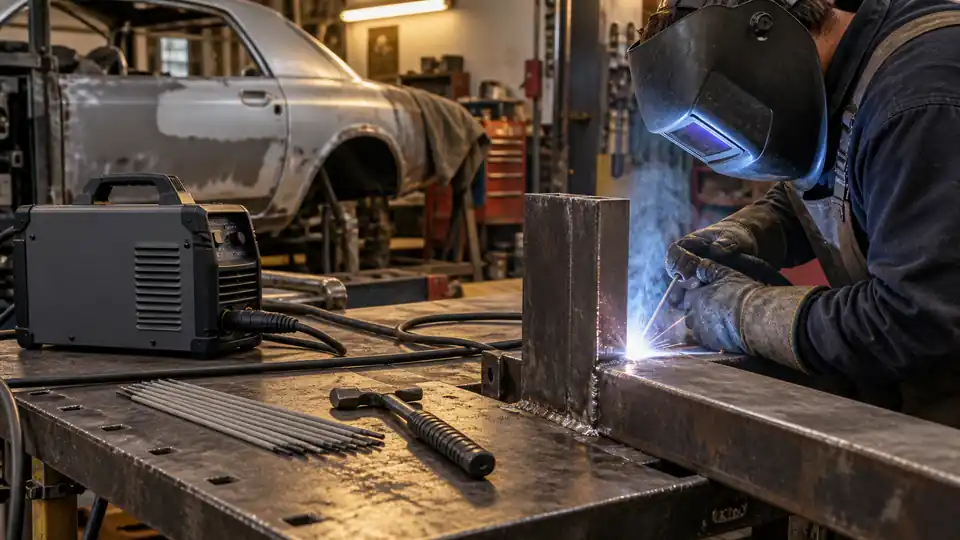
A good stick welder needs to do more than display a large amperage number. Buyers usually need a machine that can run common electrodes, start an arc without excessive sticking, work with the electrical service they already have, and survive the stop-and-start rhythm of repair work. Portability matters for a fence repair or farm maintenance job, while duty cycle and output range matter more when the machine will spend long periods joining heavier steel.
Maximum output can be a poor shortcut. A compact 110V machine may be easier to carry, yet its usable output on household power is more limited than the headline rating suggests. Dual-voltage models offer more flexibility, and features such as adjustable hot start, arc force, anti-stick, digital controls, or synergic settings can make a bigger practical difference than another few advertised amps. Lift TIG support can add usefulness, although it does not turn a basic DC stick welder into an AC TIG machine for aluminum.
This comparison places the Lincoln Electric Weld-Pak 225i first because its dual-voltage design, documented output range, included leads, and Touch Start TIG support create the strongest overall balance. More affordable models from YESWELDER, ARCCAPTAIN, Hpoouo, HONE, S7, and TOOLIOM offer different combinations of portability, controls, and electrode support for lighter repair work.
Quick Answer
- Best Overall: Lincoln Electric Weld-Pak 225i, for its 120V/230V flexibility, 10 to 225 amp range, included cables, and Touch Start TIG capability.
- Best for Adjustable Arc Control: YESWELDER 205Amp Stick Welder, with separately adjustable hot start and arc force levels plus dual-voltage operation.
- Best for Portability: Hpoouo 200Amp Mini Stick Welder, weighing about 3.7 pounds and fitting easily into a toolbox or backpack.
- Best for Higher-Output 230V Work: ARCCAPTAIN 250A Stick Welder, with a 20 to 250 amp MMA range and expanded hot-start and arc-force adjustments.
Best Stick Welder Comparison Table
| Product | Best For | Input and Output | Key Strength |
|---|---|---|---|
| Lincoln Electric Weld-Pak 225i | Best overall | 120V/230V, 10 to 225A | Included leads and Touch Start TIG |
| YESWELDER 205Amp | Adjustable arc control | 110V/220V, up to 205A | Adjustable hot start and arc force |
| ARCCAPTAIN 205A | Connected controls | 120V/240V, up to 205A | App support and synergic settings |
| ARCCAPTAIN 250A | 230V output | 230V, 20 to 250A | Broad adjustment range |
| ARCCAPTAIN 200A | Beginners | 110V/220V, up to 200A | Synergic control and LED display |
| Hpoouo 200Amp Mini | Ultra-portable repairs | 110V, 20 to 200A | About 3.7-pound chassis |
| HONE 205Amp Mini | Low-cost portability | 110V, 20 to 205A | Lift TIG, VRD, and accessories |
| S7 250A Stick Welder | Budget dual-voltage use | 110V/220V, up to 250A | Common electrode support |
| TOOLIOM 135A Mini | Compact dual-voltage use | 110V/220V, 135A | VRD and Lift TIG support |
The detailed reviews below explain where each machine fits, what its published specifications mean, and which trade-offs deserve attention before ordering.
1. Lincoln Electric Weld-Pak 225i — Best Overall

The Weld-Pak 225i earns the top position by covering the practical middle ground unusually well. Its 120V and 230V input options let a buyer start with a common household circuit and move to a higher-voltage supply when the work demands more output. The documented 10 to 225 amp range gives it a useful spread for lighter sheet work through substantially heavier steel, although the exact result still depends on electrode choice, joint preparation, and available power.
Portability is sensible rather than ultra-light. At about 20 pounds, it is heavier than the small inverter units, but the built-in toolbox top, shoulder strap, and long 13-foot work and electrode cables make it easier to organize around a repair area. The listing also specifies a 30 percent duty cycle at 225 amps on 230V input, which gives the high-output figure useful context. Touch Start TIG is supported, but the additional TIG accessories are required.
Pros
- Supports both 120V and 230V input.
- Offers a documented 10 to 225 amp output range.
- Includes 13-foot work and electrode cables.
- Supports Touch Start TIG with additional accessories.
- Includes a shoulder strap and integrated storage area.
Cons
- Heavier than the compact inverter welders in this selection.
- Touch Start TIG accessories are not included in the listed kit.
This is the strongest choice for someone who wants one dedicated stick machine for a garage, workshop, or mobile repair setup and may later add basic TIG capability. The higher weight is a reasonable trade for its broader power compatibility and supplied cable package. Buyers who only need occasional light repairs on 110V power may spend less and carry less with a mini inverter model.
To buy this product, click here.
2. YESWELDER 205Amp Stick Welder — Best for Adjustable Arc Control

A large LED display and a front-panel adjustment knob give this YESWELDER a more controlled interface than the simplest mini welders. The machine supports 110V and 220V input and is listed with output up to 205 amps, so it can move between a household setup and a stronger workshop circuit. That flexibility matters for buyers who may begin with small brackets or repairs and later work on heavier steel.
Its most useful distinction is the separate 1-to-10 adjustment range for hot start and arc force. Hot start adds current during arc initiation, while arc force can help maintain the arc when the electrode approaches the work. Anti-stick is also listed, and the machine supports common 6010, 6011, 6013, and 7018 electrodes. Lift TIG is supported, but the product information should be checked for the exact accessory requirements before purchase.
Pros
- Supports 110V and 220V input.
- Offers adjustable hot start and arc force from levels 1 to 10.
- Large LED display shows operating settings clearly.
- Supports common 6010, 6011, 6013, and 7018 rods.
- Weighs about 8.4 pounds and includes a carrying handle.
Cons
- The listing does not establish a high-output duty-cycle figure at 205 amps.
- Lift TIG accessory details require confirmation before ordering.
This model suits buyers who want more control over arc behavior without moving to the heavier Lincoln. Compared with a basic 110V mini welder, its dual-voltage input and adjustable control levels provide a wider operating envelope. It may be unnecessary for short occasional repairs where low weight matters more than fine adjustment.
To buy this product, click here.
3. ARCCAPTAIN 205A Stick Welder — Best for Connected Controls
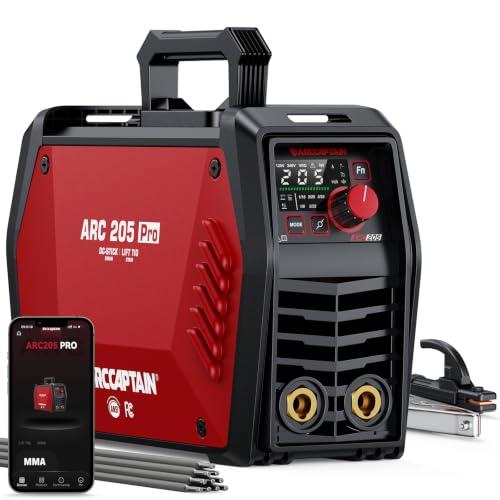
The ARCCAPTAIN 205A combines a relatively compact 8.2-pound body with 120V/240V operation. Its output is listed as 20 to 150 amps on 120V and 20 to 205 amps on 240V, a distinction that is more useful than treating the 205 amp headline as available from every circuit. Buyers using a standard receptacle can still handle lighter work, while a 240V supply opens the upper portion of the range.
Its app connection is unusual among the dedicated stick welders here. The listing says the app can adjust parameters within 10 meters, monitor machine status, and provide operating information. Some buyers will appreciate remote access, while others may prefer a simpler knob and display. Synergic control can match current and voltage after electrode diameter or workpiece thickness is selected, but Lift TIG remains DC Lift TIG and the torch is not included.
Pros
- Supports both 120V and 240V input.
- Lists separate output limits for each input voltage.
- Offers app-based parameter adjustment and status monitoring.
- Includes synergic control, hot start, arc force, and anti-stick.
- weighs about 8.2 pounds and includes a shoulder strap.
Cons
- Lift TIG torch is not included.
- App-dependent controls may be unnecessary for buyers who prefer direct machine adjustments.
This machine makes sense for a mobile setup that moves between 120V and 240V power and benefits from simplified parameter selection. It ranks below the YESWELDER because the app adds complexity without replacing the need to understand electrode polarity and settings. Confirm the voltage change procedure and let the display shut down as directed before switching input configurations.
To buy this product, click here.
4. ARCCAPTAIN 250A Stick Welder — Best for Higher-Output 230V Work

When a 230V circuit is already available, the ARCCAPTAIN 250A offers the broadest documented MMA range in this group. The listing specifies 20 to 250 amps for stick welding and 20 to 220 amps for Lift TIG. That does not guarantee a particular plate thickness or weld result, but it gives the machine more adjustment headroom than the small 110V units.
The 3.2-inch LED display, synergic control, and adjustable hot start from 0 to 60 amps provide more information and adjustment than a basic dial-only inverter. Arc force is listed from 0 to 100 amps, giving the operator a wide control range for different electrodes and arc conditions. At 11.5 pounds, it remains manageable for occasional transport, and the included 10-foot leads, rods, wire brush, handle, and shoulder strap reduce initial setup purchases.
Pros
- Provides a 20 to 250 amp MMA range on 230V input.
- Offers separate Lift TIG output up to 220 amps.
- Includes a large 3.2-inch LED display.
- Provides broad hot-start and arc-force adjustment ranges.
- Includes 10-foot leads, 10 rods, and a shoulder strap.
Cons
- 230V input limits use where only standard household power is available.
- Lift TIG torch must be purchased separately.
This is the better fit for a workshop with suitable 230V power and a need for higher-output stick work. It gives up the plug-in flexibility of the Lincoln and the ultra-light portability of the Hpoouo, but its control range is more substantial on paper. Buyers should verify the circuit, electrode requirements, and cooling instructions before planning extended high-current work.
To buy this product, click here.
5. ARCCAPTAIN 200A Stick Welder — Best for Beginners
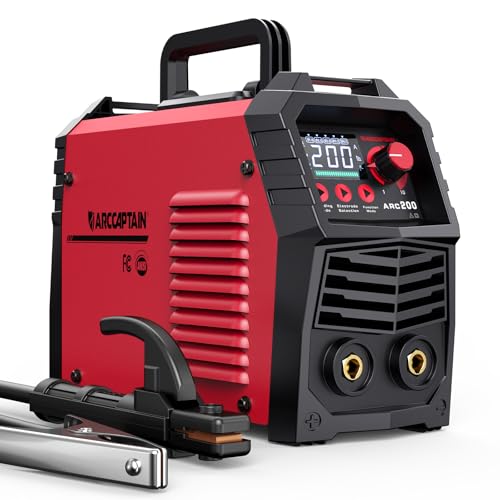
Automatic parameter matching gives this ARCCAPTAIN a clear beginner-oriented angle. After selecting the electrode diameter, the machine can match current and voltage, while manual adjustment remains available for users who want to learn how those settings affect the arc. The 110V/220V input also makes it more adaptable than a 110V-only mini welder.
At 7.2 pounds, it is light enough for a garage shelf, vehicle, or small maintenance kit. The LED display is easier to read than a bare analog dial, and the product supports common 6010, 6011, 6013, and 7018 rods. Lift TIG is available, but the torch is excluded, so that feature should be treated as future expandability rather than a complete second process in the box.
Pros
- Supports 110V and 220V input.
- Provides synergic current and voltage matching.
- Includes hot start, arc force, and anti-stick controls.
- Weighs about 7.2 pounds and includes a shoulder strap.
- Supports common 6010, 6011, 6013, and 7018 electrodes.
Cons
- Lift TIG torch is not included.
- The published information does not provide a duty-cycle figure for direct comparison.
This model is a sensible starting point for someone learning electrode selection and basic current adjustment. The automatic mode can reduce the number of settings at the beginning, while manual controls leave room to develop better process awareness. More experienced buyers may prefer the YESWELDER or ARCCAPTAIN 250A for broader adjustment information.
To buy this product, click here.
6. Hpoouo 200Amp Mini Stick Welder — Best for Ultra-Portable Repairs

The Hpoouo is built around low carrying weight. Its listed 3.7-pound chassis measures about 7.8 by 3.9 by 5.3 inches, which makes it far easier to place in a toolbox than the larger dual-voltage machines. It runs from 110V power and offers a stated 20 to 200 amp adjustment range, so it is aimed at light repair work where compact storage and transport matter more than extended high-output operation.
The package includes 20 rods, gloves, and two chipping hammers, giving a new owner useful starting accessories. The product information lists compatibility with E6013, E6011, E6010, E7018, and E308 electrodes from 1/16 to 1/8 inch, with polarity guidance for different rod types. That guidance matters because electrode connection should follow the rod manufacturer’s instructions rather than a one-size-fits-all assumption.
Pros
- Weighs about 3.7 pounds.
- Compact dimensions suit toolbox or backpack storage.
- Offers hot start, arc force, and anti-stick functions.
- Supports several common electrode types.
- Includes rods, gloves, and chipping hammers.
Cons
- 110V-only input offers less flexibility than dual-voltage models.
- The listing does not provide a duty-cycle figure for its 200 amp claim.
This is the machine to choose when a repair kit must stay small and light. It can suit occasional brackets, mild steel repairs, or maintenance work near a standard outlet, but the compact body should not be treated as equivalent to a 230V shop machine. Buyers planning long welds or larger electrodes may prefer a heavier model with clearer high-output documentation.
To buy this product, click here.
7. HONE 205Amp Mini Stick Welder — Best for a Low-Cost Portable Kit
HONE takes a similar compact approach to the Hpoouo, with a 4.4-pound body and listed dimensions of about 8.4 by 3.7 by 5.3 inches. Its 110V input and 20 to 205 amp adjustment range are aimed at small repairs, while the included 25 rods, gloves, face shield, wire brush, and chipping hammer create a broad starter bundle. The accessories may be useful for initial setup, but they should not outweigh the machine’s actual electrical limitations.
Lift TIG, hot start, arc force, anti-stick, and VRD are listed among its functions. VRD is a voltage-reduction feature, but it does not replace proper PPE, ventilation, electrical preparation, or the manufacturer’s instructions. The product also lists compatibility with 6010, 6011, 6013, 7018, and E308 rods from 1/16 to 1/8 inch, giving it useful consumable flexibility for a small 110V unit.
Pros
- Weighs about 4.4 pounds.
- Includes Lift TIG mode and VRD.
- Supports common 1/16 to 1/8 inch electrodes.
- Includes 25 rods and several starter accessories.
- Provides hot start, arc force, and anti-stick functions.
Cons
- 110V-only operation limits high-output flexibility.
- Lift TIG torch is not included.
HONE is suited to buyers who want a small repair kit with more included accessories than a bare machine. Its place below the Hpoouo reflects the same broad limitation: neither product provides the voltage flexibility of the larger dual-voltage units. Check the actual circuit capacity and allow cooling time during demanding work rather than treating the headline amperage as continuous output.
To buy this product, click here.
8. S7 250A Stick Welder — Best for Budget Dual-Voltage Use

The S7’s principal advantage is input flexibility at a compact size. The listing identifies 110V and 220V operation and advertises output up to 250 amps, giving it a broader nominal range than many inexpensive 110V-only machines. The 220V option is the meaningful part of that specification because higher-output work depends on an appropriate circuit, suitable electrodes, and adequate cooling.
Common 6010, 6011, 6013, and 7018 electrodes are listed as compatible. Hot start, arc force, anti-stick, and a digital display address the basic control issues that can make a small stick machine frustrating to adjust. The product information does not identify a Lift TIG mode, so it is better viewed as a focused stick welder rather than a multi-process purchase.
Pros
- Supports 110V and 220V input.
- Lists compatibility with common stick electrodes.
- Includes hot start, arc force, and anti-stick.
- Uses a digital display for current adjustment.
- Compact inverter design supports easier transport.
Cons
- The listing does not provide a clear duty-cycle figure at maximum output.
- Lift TIG capability is not identified in the available product information.
This machine makes sense for a buyer who wants dual-voltage stick capability without paying for TIG functions or a large accessory package. It gives up the documented output detail and brand support of the Lincoln, but its simpler process focus may be preferable for general steel repair. Confirm the supplied voltage adapter and local circuit requirements before connecting it to 220V service.
To buy this product, click here.
9. TOOLIOM 135A Mini Stick Welder — Best for Compact Dual-Voltage Operation

The TOOLIOM takes a more modest output approach, listing 135 amps while supporting both 110V and 220V through a voltage conversion line. That combination suits light maintenance where a buyer values input flexibility but does not need the higher advertised range of the 205A and 250A models. The machine supports 6011, 6013, and 7018 electrodes, along with mild steel, cast iron, stainless steel, and hard surfacing applications as listed.
VRD, hot start, and arc force provide useful arc-management functions, while Lift TIG adds a second process if the appropriate torch is purchased separately. Ten E6013 rods, gloves, and an adjustable shoulder strap are included. The documented instructions warn that the machine needs time to cool when switching from 220V to 110V, so the conversion procedure should be followed carefully rather than treated like an instant selector switch.
Pros
- Supports 110V and 220V input.
- Includes VRD, hot start, and arc force.
- Supports Lift TIG with a separately purchased torch.
- Includes E6013 rods and welding gloves.
- Shoulder strap supports transport between work areas.
Cons
- 135 amp output is lower than the other dedicated stick models here.
- Lift TIG torch is sold separately.
The TOOLIOM is a better fit for light repairs than for sustained heavy steel work. Its lower output can be an advantage when the goal is a smaller, simpler machine, but buyers should match electrode diameter and material thickness to the documented capability. Those needing more headroom on 220V power will find the ARCCAPTAIN 250A or Lincoln more suitable.
To buy this product, click here.
Buying Guide for the Best Stick Welder
Match Input Voltage to the Available Circuit
A 110V welder can be convenient for a garage outlet, but the available circuit limits how much output the machine can realistically deliver. Dual-voltage models such as the Lincoln, YESWELDER, and ARCCAPTAIN units offer more flexibility, while the 230V ARCCAPTAIN 250A is aimed at a dedicated higher-voltage setup. Check the plug, adapter, circuit rating, and manufacturer’s instructions before connecting any machine.
Choose Electrodes for the Work
6011 and 6010 electrodes are commonly associated with penetration and less-than-perfect steel preparation, while 6013 is often used for general-purpose work. 7018 has different storage and handling requirements. A machine listing that names several rod types is useful, but the correct polarity and amperage still depend on the electrode manufacturer’s instructions.
Understand Hot Start, Arc Force, and Anti-Stick
Hot start briefly adds current during ignition, which can help strike an electrode. Arc force adjusts the machine’s response as the arc length changes, while anti-stick is intended to reduce problems when the rod contacts the workpiece. These controls can make a machine easier to manage, but they do not replace correct rod selection, clean material, or sound technique.
Do Not Treat Advertised Amperage as Continuous Output
A maximum rating is only one part of the decision. Duty cycle, input voltage, electrode size, cooling time, and the machine’s documentation determine how useful that output will be during repeated welds. The Lincoln is the only model in this group with a clearly supplied 30 percent duty-cycle figure at 225 amps on 230V, so the other high-amperage claims should be read more cautiously.
Lift TIG Is a Limited Expansion Path
Lift TIG starts the arc by touching and lifting the tungsten rather than using high-frequency ignition. It can be useful for some steel or stainless-steel work, but it does not provide AC TIG capability for aluminum. A Lift TIG torch is also frequently optional, as shown by several machines in this roundup.
Portability Has a Practical Limit
A 3.7-pound mini welder is easy to carry, but its 110V-only design gives up the electrical flexibility found in a 20-pound dual-voltage machine. A heavier unit with longer leads and a broader output range may be easier to use once at the job, even if it is less convenient to transport. Choose based on how often the machine moves and how demanding the work will be.
Best Stick Welder FAQ
What input voltage is best for a stick welder?
That depends on the available circuit and the work. A 110V machine is convenient for light repairs, while 220V or 230V input generally gives a compatible welder more room for higher-output electrode work. Dual-voltage models offer the most flexibility, provided the included adapter and electrical requirements match the installation.
Is a higher amperage rating always better?
No. Higher amperage can help with larger electrodes and heavier material, but the rating may apply only at a particular input voltage and operating condition. Controls, duty cycle, electrode compatibility, and usable low-end adjustment may matter more for thin material or short repair jobs.
Can a stick welder run 6011 and 7018 rods?
Many machines in this roundup list both 6011 and 7018 compatibility, including the Lincoln, YESWELDER, and ARCCAPTAIN models. Always verify the exact product documentation and follow the electrode manufacturer’s polarity, amperage, and storage guidance.
Does Lift TIG mean the machine can weld aluminum?
No. Lift TIG on these machines is generally a DC process. Aluminum TIG normally requires AC capability, which is not identified for the products reviewed here. A Lift TIG label should therefore be treated as added DC process flexibility, not proof of aluminum TIG capability.
Are TIG torches included with these stick welders?
Several products support Lift TIG while listing the torch as optional or sold separately. The Lincoln supports Touch Start TIG but requires additional accessories, and the ARCCAPTAIN models also identify the torch as excluded. Check the exact package contents before ordering.
What is the lightest stick welder in this comparison?
The Hpoouo is listed at about 3.7 pounds, followed by the HONE at about 4.4 pounds. Their low weight helps with transport, but both are 110V-oriented mini machines. The lighter chassis does not automatically mean they can match the sustained output of a larger dual-voltage model.
Can these welders be used outdoors?
Stick welding is often selected for outdoor repair because it does not require a shielding-gas cylinder, but the machine still needs suitable electrical power, dry handling conditions, correct PPE, and adequate ventilation. Follow the manual and workplace safety procedures, especially around extension cords, moisture, and unstable power.
Final Verdict
The Lincoln Electric Weld-Pak 225i is the strongest overall choice for the best stick welder category because its 120V/230V input, 10 to 225 amp range, included long leads, storage design, and Touch Start TIG support create a balanced package. Its 20-pound weight and additional TIG accessory requirement are real trade-offs, yet the documented 30 percent duty cycle at 225 amps on 230V gives its top-end specification more useful context than many lower-cost listings provide.
The YESWELDER 205Amp is a strong alternative for adjustable hot-start and arc-force control, while the ARCCAPTAIN 250A suits a 230V workshop that needs a wider MMA adjustment range. For occasional repairs where every pound matters, the Hpoouo or HONE mini welders are easier to carry, though their 110V limitations deserve attention. Match the machine to the circuit, electrode sizes, duty requirements, and material before focusing on the biggest number printed on the front panel.
