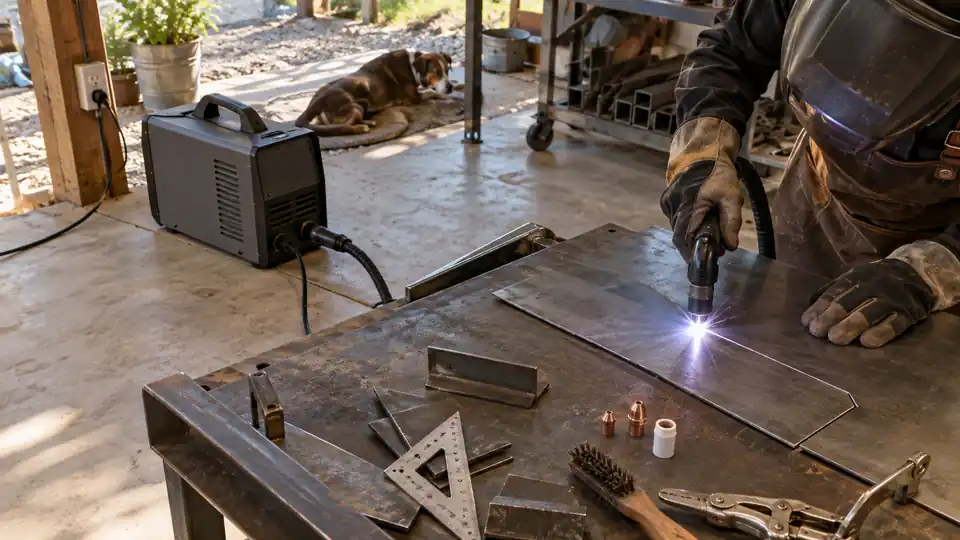
A 110V plasma cutter can make short work of sheet, brackets, tubing, and repair stock without requiring a 240V circuit. The catch is that a machine advertised as “50A” or “65A” may deliver different cutting results from a 110V outlet than it does at 220V. For this category, the useful questions are whether the cutter genuinely supports 110V input, what clean-cut thickness it lists at that voltage, how much compressed air it needs, and whether its torch uses pilot arc or contact starting.
Peak amperage is an easy number to notice, but it does not tell the whole story. A 110V-only machine such as the Bestarc 45A model gives up dual-voltage flexibility in exchange for a straightforward household-power setup, while a dual-voltage cutter may offer more output later if a 220V circuit becomes available. Pilot arc also matters if you regularly cut painted, rusty, coated, or expanded metal. The ARCCAPTAIN 50A earns the top spot here because it combines 110V compatibility, a documented 12mm recommended cutting thickness at 110V, low weight, and useful air and control displays.
The products below are ranked around real 110V use rather than maximum numbers listed for 220V operation. Some favor portability, some offer more capable controls, and others keep the design simple for occasional garage work. Every model still requires an appropriate dry compressed-air supply, and published thickness figures should be treated as reference points affected by material, settings, consumables, and cutting technique.
Quick Answer
- Best Overall: ARCCAPTAIN 50A Plasma Cutter offers a strong balance of 110V capability, portability, pilot-style controls, and documented cutting capacity.
- Best for Rusty or Painted Metal: Bestarc 50A Non-Touch Pilot Arc starts without requiring the torch tip to contact the workpiece.
- Best Dedicated 110V Option: Bestarc 45A 110V Contact Cutting avoids 220V settings and focuses on household-power operation.
- Best for Expanded Metal: ARCCAPTAIN 60A Plasma Cutter includes separate cutting modes for plate, expanded metal, and rust removal.
Best 110V Plasma Cutter Comparison Table
| Product | Best For | 110V Cutting Information | Starting Method |
|---|---|---|---|
| ARCCAPTAIN 50A Plasma Cutter | Best overall balance | 12mm recommended at 35A | Non-touch pilot arc |
| Bestarc 50A Non-Touch Pilot Arc | Dirty, painted, or rusty stock | 1/2-inch clean cut listed | Non-touch pilot arc |
| Bestarc 50A Pilot Arc Machine | Air-pressure feedback | 1/2-inch recommended at 35A | Non-contact pilot arc |
| Bestarc 50A Multi-Purpose Cutter | Garage and farm repairs | 1/2-inch recommended at 35A | Non-touch pilot arc |
| ARCCAPTAIN 60A Plasma Cutter | Expanded metal and rust removal | 12 to 16mm range listed | Non-touch pilot arc |
| Bestarc 45A 110V Contact Cutter | Dedicated household-power use | 8mm clean cut at 35A | Contact start |
| 50A PT31 Plasma Cutter | Basic DIY cutting | Up to 1/2-inch steel listed | Listing does not specify pilot arc |
| YESWELDER CUT-55DS PRO | Compact dual-voltage flexibility | 5/16-inch ideal cut at 110V | Non-HF blow-back pilot arc |
| YESWELDER CUT-65DS PLUS | Higher-output 110V work | 5/16-inch ideal cut at 110V | Non-HF blow-back pilot arc |
The detailed reviews explain how each machine’s 110V rating, air setup, torch design, and control layout affect practical cutting work.
1. ARCCAPTAIN 50A Plasma Cutter, Best Overall
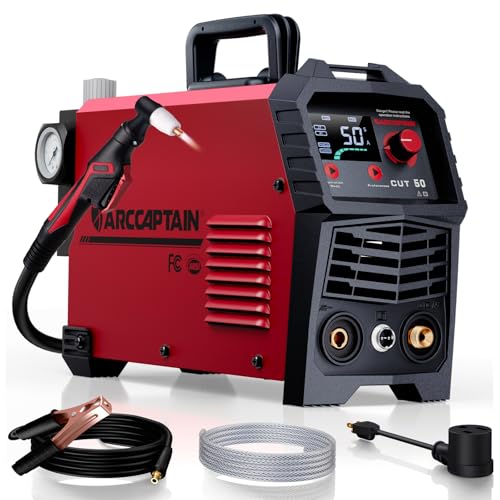
The ARCCAPTAIN 50A is the most balanced match for shoppers who need a genuine 110V plasma cutter but do not want to give up future flexibility. Its published input range includes 110V and 220V, with the listing identifying a 20 to 35A output range at 110V. At that setting, the recommended maximum cutting thickness is listed as 12mm, or roughly 1/2 inch, while the higher 220V figures should not be confused with what a household circuit can provide.
Portability strengthens its case. The machine is listed at 13 pounds and includes a shoulder strap, so it is easier to move from a garage bench to a repair area than the larger high-output models. A front LED display shows current and voltage, while adjustable post-flow, 2T, and 4T controls give the operator more control over torch cooling and trigger operation. The listing also identifies a non-contact pilot arc, a pre-installed 1/4-inch NPT air connection, and built-in overload and overheat protection.
Pros
- Supports both 110V and 220V input.
- Lists a 12mm recommended cutting thickness at 110V and 35A.
- At approximately 13 pounds, it is among the easier models here to transport.
- Includes non-contact pilot arc operation for coated or dirty metal.
- Provides LED voltage and current information plus 2T and 4T controls.
Cons
- The 110V output range tops out below the machine’s 220V output range.
- An air compressor is required and is sold separately.
This model makes the most sense for a garage or mobile setup that may eventually gain access to 220V power. Its combination of a documented 110V cutting range, compact body, pilot arc, and readable controls gives it a wider practical fit than the simpler contact-start model. Buyers who need the deepest possible cuts from 110V alone should keep their expectations measured, since the machine’s higher amperage figures apply to 220V operation.
To buy this product, click here.
2. Bestarc 50A Non-Touch Pilot Arc, Best for Rusty or Painted Metal
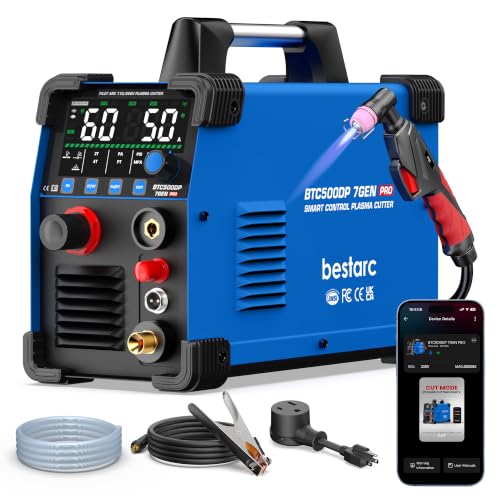
Rust, old paint, and thin surface coatings can make contact-start cutting awkward because the torch tip must touch the workpiece to begin the cut. This Bestarc 50A uses a non-touch pilot arc, so the arc can start above the surface. That distinction is especially useful for old brackets, farm repair stock, and expanded metal where repeatedly dragging the tip across the workpiece can interrupt the cut.
The listing supports 110V and 220V input and identifies a recommended 50 to 80 PSI air range. Its front display reports air pressure, voltage, and current, which gives the operator more information than a simple amperage dial. The published features also include adjustable pilot arc duration, 2T and 4T operation, and post-flow adjustment from 3 to 15 seconds. At roughly 15 pounds, it remains reasonably portable, though the ARCCAPTAIN 50A is lighter.
Pros
- Non-touch pilot arc suits rusty, painted, and coated surfaces.
- Dual-voltage input supports both 110V and 220V circuits.
- Front display shows air pressure as well as electrical settings.
- Adjustable pilot arc duration can help with expanded metal.
- 2T, 4T, and adjustable post-flow settings support different cutting styles.
Cons
- The listing’s maximum thickness figure applies to 220V operation and should not be treated as a 110V result.
- At approximately 15 pounds, it is less portable than the lightest model here.
This is a strong choice for buyers who expect to cut less-than-clean material and want air information visible at the machine. The pilot arc is more meaningful than a decorative feature in that situation, since it changes how the torch starts over the surface. A dedicated 110V user should still verify circuit and compressor requirements before ordering, particularly for longer cuts where air delivery becomes important.
To buy this product, click here.
3. Bestarc 50A Pilot Arc Plasma Cutter, Best for Air-Pressure Feedback

Air quality and pressure sit at the heart of plasma cutting, yet many compact machines leave the operator to adjust a regulator without much feedback. This Bestarc model adds a real-time air indicator that changes color when pressure is outside the listed operating range. The product information specifies approximately 55 PSI at 110V and 50 to 65 PSI at 220V, giving buyers a useful starting point for setup rather than a vague instruction to connect a compressor.
At 110V and 35A, the listing identifies a recommended 1/2-inch cutting thickness. It also lists a 2/3-inch recommended maximum at 220V and a non-contact AG60P pilot arc torch. The front display covers current, voltage, operating mode, air status, and error codes. That collection of information is useful for a new operator who is trying to separate an air-supply problem from a machine-setting problem, although it cannot replace dry air filtration or the compressor’s own capacity.
Pros
- Lists a 1/2-inch recommended cut at 110V and 35A.
- Real-time air indicator helps confirm pressure before cutting.
- Non-contact pilot arc can start over dirty or coated metal.
- Displays cutting mode, current, voltage, and error information.
- Supports 2T, 4T, pilot arc timing, and post-flow adjustment.
Cons
- The air compressor is not included.
- The recommended breaker requirements may be significant for some 110V circuits.
This version is a sensible pick for someone who wants more guidance during setup than a basic display provides. Its strongest advantage is diagnostic clarity: the air indicator makes it easier to identify whether the incoming supply is too low or too high. Buyers who want the lowest possible cost may find its extra controls unnecessary, while users who frequently change material or workpiece condition may appreciate the added information.
To buy this product, click here.
4. Bestarc 50A Multi-Purpose Plasma Cutter, Best for Garage and Farm Repairs

Routine repair work rarely arrives as a clean, uniform project. One day the material may be thin steel, and the next it may be painted plate or a section of stainless stock. This Bestarc 50A is aimed at that mixed-use setting, with 110V and 220V input, a non-touch pilot arc, and published support for steel, stainless steel, aluminum, and copper. Its listed 110V recommendation is 1/2 inch at 35A, assuming suitable air pressure and cutting conditions.
The machine includes an air-pressure display and a pre-installed filter with a 1/4-inch NPT quick connection. The product information specifies a recommended air flow of 250 liters per minute and says the compressor must be purchased separately. That requirement matters more than the compact machine body suggests. The 2T and 4T modes can help with short cuts or longer trigger runs, while adjustable pilot and post-flow times give more control over torch operation.
Pros
- Supports 110V and 220V operation.
- Lists a 1/2-inch recommended thickness at 110V.
- Pilot arc operation suits rough, painted, or rusty surfaces.
- Includes a built-in air display and pre-installed air filter.
- Published material coverage includes steel, stainless steel, aluminum, and copper.
Cons
- The listing does not include a compressor.
- The air-flow requirement may exceed the capability of small compressors.
Choose this model when the appeal lies in broad everyday utility rather than one specialized cutting feature. Its air display and pilot arc place it above a basic contact-start cutter for varied repair work, while the dual-voltage input leaves room for a different circuit later. It is less compelling for occasional thin-sheet work where the simpler 45A 110V model may provide a more direct setup.
To buy this product, click here.
5. ARCCAPTAIN 60A Plasma Cutter, Best for Expanded Metal

Expanded metal creates a different cutting problem from a solid plate. The arc has to bridge openings without repeatedly extinguishing, so a dedicated mesh mode can matter more than a larger headline amperage. The ARCCAPTAIN 60A provides separate modes for plate cutting, expanded metal, and rust removal. It supports 110V and 220V, with the listing identifying a 20 to 35A range at 110V and a 12 to 16mm cutting range at that input.
The machine also uses non-touch pilot arc starting and includes an air-pressure display with error codes for pressure outside the listed range. At 110V, the recommended pressure is 55 PSI. The large display reports current, voltage, mode, air pressure, and PA/PT settings, while 2T and 4T operation can reduce trigger fatigue during longer cuts. Its full 60A output belongs to 220V operation, so buyers using a standard outlet should judge it by the 110V figures rather than the maximum number on the label.
Pros
- Provides dedicated plate, expanded-metal, and rust-removal modes.
- Supports 110V and 220V input with a 20 to 35A range at 110V.
- Lists a 12 to 16mm cutting range at 110V.
- Non-touch pilot arc works over rough or coated material.
- Large display shows air pressure, current, voltage, and operating mode.
Cons
- The 60A headline output is associated with 220V operation.
- An external compressor is required.
This cutter earns its position through application-specific controls rather than simple amperage. A person cutting grating, mesh panels, or corroded material may gain more from the dedicated modes than from a less expensive machine with similar 110V output. For straightforward solid plate and occasional small repairs, its additional controls may be more than necessary.
To buy this product, click here.
6. Bestarc 45A 110V Contact Plasma Cutter, Best Dedicated 110V Option

Some buyers have no interest in dual-voltage capability. They have a standard 110V circuit, a limited collection of metal projects, and a preference for controls that are easy to understand. The Bestarc 45A is built around that use case. Its product information identifies it as a 110V machine, with a recommended clean cut of 8mm at 35A and a maximum thickness of 14mm at 45A under listed conditions.
The contact-start torch must touch the workpiece to begin cutting, which differs from the pilot arc models above. Contact starting can provide a steady reference for following a marked line, but it is less convenient on rust, paint, coatings, and expanded metal. The machine includes a manual air regulator, 2T and 4T modes, adjustable post-flow from 3 to 15 seconds, and an LED display. Its 40A recommended breaker and listed 250 liters-per-minute air flow should be checked against the intended setup.
Pros
- Built specifically around standard 110V operation.
- Lists an 8mm clean cut at 35A and 14mm maximum cut at 45A.
- Contact starting can help keep the torch close to a marked cutting line.
- Includes 2T, 4T, post-flow, and LED display functions.
- Manual air regulation keeps the setup straightforward.
Cons
- No pilot arc function for starting above rusty or coated surfaces.
- It cannot provide the future 220V flexibility of the dual-voltage models.
This is the clearest choice for a buyer who values direct 110V compatibility over broader capability. It fits small garage projects, templates, and clean material where contact starting is acceptable. Skip it if the work regularly involves painted plate, expanded metal, or surfaces that make torch contact inconvenient, since a pilot arc will be more useful there.
To buy this product, click here.
7. 50A PT31 Plasma Cutter, Best for Basic DIY Cutting

This compact 50A cutter takes a simpler route than the newer machines with air sensors, pilot arc timing, and multiple cutting modes. Its listing identifies 110V and 220V input, a digital display, a PT31 torch, and a recommended clean-cut capability of up to 1/2-inch steel under appropriate settings and air pressure. The straightforward current adjustment may appeal to someone who wants a basic tool for brackets, light fabrication, home repairs, or occasional farm maintenance.
The PT31 torch and common-style consumables are a practical detail because replacement parts are easier to identify than an unusual torch system. The available information does not clearly specify a non-touch pilot arc, so buyers should not assume that it behaves like the Bestarc or ARCCAPTAIN pilot-arc models. Its compact body is easy to store, but the listing provides less detail about air monitoring, post-flow controls, and other setup aids than the more feature-rich alternatives.
Pros
- Supports both 110V and 220V input.
- Lists cutting capability up to 1/2-inch steel with suitable conditions.
- Includes a PT31-style torch and basic cutting accessories.
- Compact format suits storage in a small garage or workshop.
- Simple current adjustment may be easier for occasional work.
Cons
- The available information does not clearly specify a pilot arc function.
- It provides less air and process feedback than the newer display-equipped models.
This model makes sense when the job list is modest and the priority is a basic dual-voltage plasma cutter rather than a diagnostic-rich control panel. It gives up pilot arc certainty and advanced air monitoring, so it ranks below the more capable options for rusty stock or repetitive cutting. Buyers should confirm the exact included accessories and starting method before ordering if those details affect the planned work.
To buy this product, click here.
8. YESWELDER CUT-55DS PRO, Best Compact Dual-Voltage Option

The CUT-55DS PRO offers dual-voltage flexibility with a non-high-frequency blow-back starting system. That starting method can be useful in areas where electrical interference is a concern, while the non-touch pilot arc supports work over rough, painted, or rusty surfaces. The listing identifies a 5/16-inch ideal clean cut at 110V and a 5/8-inch maximum cut at 110V, with separate figures for 220V operation.
This distinction between ideal clean cutting and maximum severance matters. A maximum figure may describe the upper limit for separating material, while a cleaner edge generally requires a thinner workpiece and suitable settings. The machine also provides a digital display, adjustable post-flow from 5 to 20 seconds, 2T and 4T operation, and overload and overheating protection. It is a more structured option than the basic PT31 machine, although the 110V clean-cut figure is lower than the 1/2-inch claims listed for several 50A competitors.
Pros
- Supports both 110V and 220V input.
- Uses a non-HF blow-back starting system.
- Non-touch pilot arc suits rough, painted, and rusty surfaces.
- Displays air pressure, voltage, current, and error information.
- Offers adjustable post-flow and 2T/4T trigger modes.
Cons
- The listed ideal clean cut at 110V is 5/16 inch, below several 50A alternatives.
- The air compressor is not included.
Choose this model for the starting system and control package rather than its headline 55A rating. It is a reasonable fit for a buyer who wants 110V operation today and 220V flexibility later, especially where pilot arc and non-HF ignition are useful. Someone focused on the deepest clean cuts from a 110V circuit may prefer the ARCCAPTAIN 50A or one of the Bestarc 50A models.
To buy this product, click here.
9. YESWELDER CUT-65DS PLUS, Best for Higher-Output 110V Work
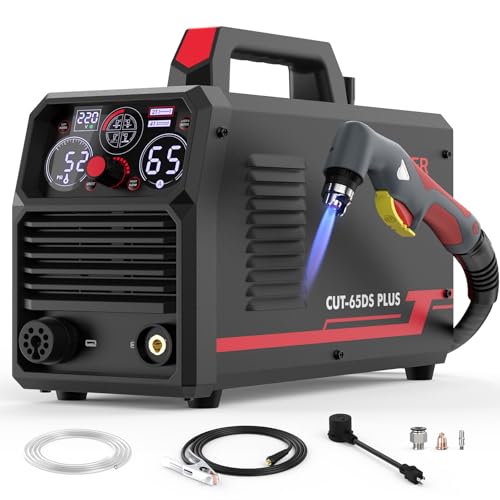
The CUT-65DS PLUS is aimed at buyers who want more operating modes and higher stated output than a basic 45A or 50A machine. It supports 110V and 220V input, uses non-HF blow-back starting, and provides separate functions for plate cutting, grid cutting, gouging, and marking. At 110V, the listing identifies a 5/16-inch ideal clean cut and a 5/8-inch maximum cut. Those figures place its practical 110V role closer to controlled light and medium work than to the deeper cuts suggested by its 65A label.
Grid mode is relevant for grating and perforated stock, while gouging and marking extend the machine beyond ordinary plate separation. The IPT40 pilot arc torch can start without touching the metal, and the front display reports air pressure, voltage, and current. The listing also states that the product includes overload and overheating protection, a two-year warranty, and North America support. Buyers should still verify the exact electrical requirements and included torch accessories for the current configuration.
Pros
- Supports 110V and 220V input.
- Includes plate, grid, gouging, and marking functions.
- Non-HF blow-back start and non-touch pilot arc support coated material.
- Lists a 5/16-inch ideal clean cut at 110V and 5/8-inch maximum cut.
- Product information identifies a two-year warranty and North America support.
Cons
- The 65A rating does not translate into a 65A output from a 110V circuit.
- Its additional modes may be unnecessary for straightforward plate cutting.
This machine suits a more varied fabrication setup where grid cutting, gouging, or marking can justify the added controls. It ranks below the best overall pick for ordinary 110V cutting because its listed ideal clean-cut figure is more modest, yet it offers functions the simpler models do not. Buyers planning only occasional cuts in clean sheet or plate may get better usability from a less complex machine.
To buy this product, click here.
110V Plasma Cutter Buying Guide
Match the Machine to the Available Circuit
A product can list 110V input and still require a substantial circuit for its maximum stated output. The Bestarc 45A model lists a 40A breaker recommendation, while other machines provide different electrical guidance. Check the manufacturer’s requirements, the circuit capacity, extension-cord limitations, and local electrical rules before connecting a cutter. A standard-looking outlet does not guarantee that the circuit can support every setting.
Separate 110V Figures from 220V Figures
Dual-voltage machines often advertise their largest cutting number beside the 220V specification. That is useful only if the intended workspace has suitable 220V power. For a true 110V purchase, give more weight to the 110V current range and the 110V clean-cut or recommended-thickness figure. The ARCCAPTAIN 60A, for example, lists much higher output at 220V than at 110V.
Understand Clean Cut and Maximum Cut
A clean-cut rating generally describes a thickness where the machine is expected to produce a more usable edge under stated conditions. A maximum or severance figure describes a limit for separating material and may involve more slag, slower travel, or additional cleanup. Material type, air pressure, consumable condition, torch height, and travel speed all affect the result. Treat published figures as a guide for choosing capacity, not as a guaranteed edge finish.
Choose Pilot Arc for Rough Surfaces
A non-touch pilot arc starts above the metal, which is helpful over rust, paint, mill scale, and coatings. It can also make expanded-metal work easier when the arc must bridge openings. Contact cutting has a different advantage. Keeping the tip close to a clean workpiece can help some users follow a marked line, but the tip physically touches the work and is less convenient over uneven or coated surfaces.
Check Compressor Requirements
Every cutter in this selection requires compressed air, and none should be treated as a self-contained cutting system. The pressure number alone is not enough. Air flow, moisture control, filtration, hose size, and the compressor’s ability to maintain supply during a long cut all matter. A small compressor may reach the listed pressure briefly yet struggle to maintain the required flow, leading to an unstable arc or incomplete cut.
Look for Useful Controls, Not the Longest Feature List
Air-pressure displays, error codes, adjustable post-flow, and 2T/4T operation can simplify setup and longer cuts. They also add controls that may be unnecessary for occasional work. A dedicated 110V contact cutter can be easier to understand, while a pilot-arc machine with pressure feedback is better suited to varied material and changing work conditions. Choose the control package that addresses a real problem in the intended workspace.
Best 110V Plasma Cutter FAQ
Can a 110V plasma cutter cut 1/2-inch steel?
Some models in this roundup list a recommended 1/2-inch cutting thickness at 110V, including the ARCCAPTAIN 50A and several Bestarc 50A machines. That figure depends on suitable air, consumables, current, material condition, and travel technique. A clean edge on 1/2-inch steel may require more favorable conditions than simply separating the material.
Does a 50A plasma cutter actually produce 50A on 110V?
Not necessarily. Dual-voltage machines commonly provide a lower output range on 110V and their full advertised amperage on 220V. The ARCCAPTAIN 50A, for example, lists 20 to 35A at 110V and 20 to 50A at 220V. Read the input-specific specifications rather than relying on the largest number in the product name.
Is pilot arc better than contact start?
Pilot arc is generally more useful for rusty, painted, coated, or expanded metal because the torch can start without touching the workpiece. Contact start can be suitable for clean material and may help an operator keep the torch close to a marked line. The better choice depends on the surfaces and cutting patterns expected in the workspace.
Do these plasma cutters include an air compressor?
No. The product information for these machines identifies compressed air as required, and the compressor is sold separately. Check both the recommended pressure and air-flow requirement. A compressor that reaches the listed PSI may still be inadequate if it cannot maintain the required flow during a longer cut.
Can a 110V plasma cutter run from an extension cord?
The answer depends on the machine’s electrical requirements, the circuit, cord length, conductor size, and local electrical guidance. A long or undersized extension cord can create voltage drop and affect operation. Follow the product manual and electrical safety requirements instead of assuming any household extension cord is suitable.
Are dual-voltage models better than 110V-only models?
Dual-voltage models offer more flexibility if a 220V circuit may become available, and they usually provide higher output at 220V. A dedicated 110V machine can make more sense when the workspace will remain limited to household power and the projects fit its published capacity. The Bestarc 45A is an example of a simpler 110V-focused design.
Can these cutters remove rust as well as cut metal?
Some models list a rust-removal mode, including the ARCCAPTAIN 60A. A pilot arc can also start over rusty or painted surfaces, but cutting through a coating and removing surface rust are different functions. Follow the product documentation and use appropriate ventilation, eye protection, gloves, and other required safety equipment.
Final Verdict
The ARCCAPTAIN 50A is the strongest overall choice for a 110V plasma cutter because its documented 110V output range, 12mm recommended thickness, non-touch pilot arc, compact 13-pound body, and readable controls form a practical balance. It does not turn 110V power into 220V performance, but it gives the buyer useful flexibility without becoming a large shop-only machine. The Bestarc 50A Non-Touch Pilot Arc is the better alternative for frequent work on rusty or painted stock, while the Bestarc 45A is a more direct fit for buyers who want dedicated 110V operation and contact cutting.
For expanded metal and rust-removal work, the ARCCAPTAIN 60A offers more specialized modes. The YESWELDER CUT-65DS PLUS adds grid cutting, gouging, and marking for a broader fabrication setup, though its 110V clean-cut figure should be read carefully. Before ordering, match the cutter to the actual circuit, verify compressor capacity, and compare 110V specifications rather than 220V headline ratings. The right machine is the one whose documented capacity and starting method fit the material, air supply, and work area already available.
