
A plasma cutter with a built-in air compressor is appealing for a simple reason: the machine can travel to the work instead of requiring a separate compressor, hose, fittings, and a suitable air supply. That matters in a crowded garage, beside a trailer, or on a remote repair job where the loud thump of a standalone compressor is more nuisance than help. The strongest choices combine self-contained air with useful cutting control, suitable input power, and a realistic distinction between clean-cut and maximum severance ratings.
Peak amperage alone does not settle the decision. A 45A machine may suit household repairs and sheet work, while a 55A or 50A model gives more room for thicker stock. Input voltage matters just as much. A 120V unit is easier to use from a standard circuit, whereas a 220V or dual-voltage machine may deliver greater output. Buyers should also check whether the internal compressor is the only air option, whether an external compressor is supported, and whether a claimed thickness refers to a clean cut or a slower severance cut.
The ANDELI 55A model earns the top position because its built-in air setup is paired with non-HF starting, non-contact cutting, grid-cutting automation, MMA capability, and a useful digital display. Other products make more sense for a lighter 120V setup, dual-air flexibility, portability, or a lower-cost entry point. The comparison below separates those priorities so the specifications have practical meaning.
Quick Answer
- Best Overall: ANDELI 55A Plasma Cutter, for buyers wanting higher output, built-in air, non-HF starting, and MMA versatility.
- Best for Dual-Voltage Flexibility: LOTOS Apex LTP5600CD, with 110V/220V operation, internal or external air, and drag-cut guidance.
- Best Premium Option: Lincoln Tomahawk 30 Air, for buyers who place greater weight on portability, torch control, and established product documentation.
- Best Budget 120V Option: Reboot 40A 120V, for lighter cutting from a standard household circuit.
Best Plasma Cutter With Built-In Air Compressor Comparison Table
| Product | Best For | Air Setup | Published Cutting Details |
|---|---|---|---|
| ANDELI 55A | Overall capability | Built-in, external air supported for stated perforation rating | Up to 0.76 inch cut; 55A |
| Reboot Self-Contained Plasma Cutter | Simple plug-and-cut setup | Built-in compressor | Exact output and thickness details not clearly listed |
| Reboot 40A 120V | Standard household power | Built-in compressor | 3/8 inch clean cut, 3/5 inch maximum cut |
| FLARING 45A 240V | 220V garage or shop use | Built-in compressor | 3/8 inch clean cut, 5/8 inch maximum cut |
| LOTOS Apex LTP5600CD | Dual-voltage and air flexibility | Built-in or external compressor | Up to 1/2 inch internal-air cutting; higher external-air ratings stated |
| HansnokTech 45A | 120V portable cutting | Built-in compressor | 3/8 inch clean cut, 5/8 inch maximum cut |
| H HZXVOGEN 50A | 220V cutting with external-air option | Built-in, external air capable | 5/16 inch ideal clean cut, 5/8 inch maximum cut |
| SONNLER 50A 2-in-1 | Cutting and MMA welding | Built-in compressor | 1/3 inch clean cut, 3/5 inch maximum cut |
| Lincoln Tomahawk 30 Air | Premium portable use | Internal compressor | Continuous output control; exact thickness figures not supplied here |
The detailed reviews explain how each internal air system, power requirement, cutting control, and process feature affects the buying decision.
1. ANDELI 55A Plasma Cutter : Best Overall

The ANDELI stands out because its internal-air design is joined by a broader set of controls than many compact cutters. The listing identifies 55A output, a non-HF blowback start, non-contact pilot arc, and a digital display for current, voltage, air pressure, and error codes. Non-HF starting can be useful around nearby electronics, while a non-contact arc is better suited to painted, rusty, or uneven metal because the torch tip does not need to drag directly across the work.
Its stated cutting information needs careful reading. The product listing identifies cutting up to 0.76 inch and a perforation figure of up to 15 mm at 220V with external air, so those figures should not be treated as a universal clean-cut guarantee from the internal compressor. The included MMA welding hardware also gives this unit more repair flexibility than dedicated cutters, and automatic start-stop grid cutting may help across expanded metal or perforated stock.
Pros
- 55A output provides more headroom than the smaller 40A and 45A machines.
- Non-HF blowback starting may reduce electromagnetic interference near electronics.
- Non-contact pilot arc suits painted, rusty, and uneven surfaces.
- Digital display shows operating information and error codes.
- MMA welding capability and related hardware expand its repair use.
Cons
- The higher published thickness figure depends on the power and air configuration.
- Its larger capability may be unnecessary for occasional thin-sheet cutting.
This is the strongest overall choice for a buyer who wants a self-contained cutter with more than a basic torch and dial. The included helmet, gloves, consumables, and MMA components also reduce the number of separate pieces needed for initial setup, though buyers should still verify the exact electrical requirements before connecting it. Choose a smaller 120V unit for light work and simpler transport, but choose the ANDELI when output, non-HF starting, and process flexibility carry more weight.
To buy this product, click here.
2. Reboot Self-Contained Plasma Cutter : Best for Simple Setup

The appeal of this Reboot model is its straightforward operating concept. The product information centers on an integrated air pump, compact construction, and the absence of external air connections. For someone moving between a garage bench and a driveway, that means fewer loose parts to carry and less time spent checking a compressor hose before the first cut.
The listing emphasizes stable airflow and plug-and-play operation, but it does not clearly provide the output range, clean-cut rating, or maximum severance rating in the supplied specifications. That limits how precisely it can be compared with the 40A, 45A, and 50A models here. Its place is therefore based on setup convenience rather than a documented advantage in thick-material capacity.
Pros
- Integrated air pump removes the need for a separate compressor.
- Compact self-contained format is easier to move between work areas.
- No external air hose or pressure connection is required for the stated setup.
- Simple operating concept may reduce initial setup steps.
- Designed around space-conscious garage and mobile use.
Cons
- The supplied product information does not clearly specify output amperage.
- Clean-cut and maximum-cut ratings are not clearly listed in the supplied details.
This model suits buyers who value a tidy, self-contained arrangement more than a clearly documented high-output specification. It is harder to recommend for thick-stock work because the available information does not establish where it sits against the ANDELI or LOTOS. Confirm the manual’s output and duty-cycle information before ordering if the machine will face repeated or heavier cutting.
To buy this product, click here.
3. Reboot 40A 120V Plasma Cutter : Best for Standard Household Power
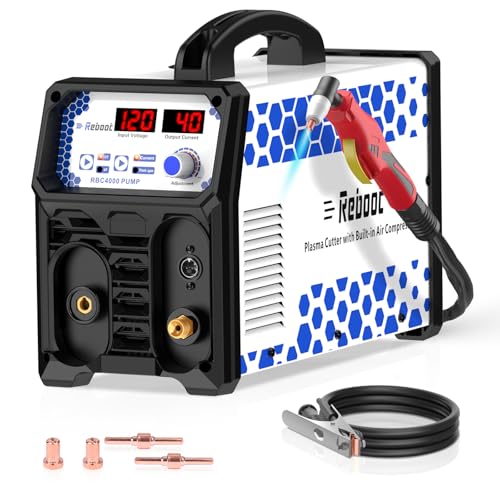
A 120V input specification changes where this cutter can be used. A buyer working from a home garage or small repair area may have access to a standard household circuit but no 220V outlet, making this Reboot more practical than the higher-input alternatives. Its built-in compressor keeps the setup compact, with no external tank humming beside the workbench.
The published figures are 3/8 inch for a clean cut and 3/5 inch for maximum cutting capacity. Those numbers describe different expectations. Clean cuts generally demand more controlled conditions, while maximum severance is a limit for separating material rather than a promise of the same edge quality. The 40A output is better aligned with lighter repair, sheet, and general fabrication work than prolonged thick-plate cutting.
Pros
- 120V input fits locations without a dedicated 220V circuit.
- Built-in air compressor keeps the equipment self-contained.
- Published 3/8 inch clean-cut rating gives buyers a useful reference point.
- 3/5 inch maximum-cut rating provides additional separation capacity.
- IGBT inverter format supports a compact machine design.
Cons
- 40A output offers less headroom than the 50A to 56A options.
- 120V operation may limit sustained heavy cutting compared with a 220V setup.
This is a sensible pick for occasional cutting from a standard outlet, especially where portability and simple air setup matter more than maximum output. A buyer planning to cut thick steel regularly should look toward the dual-voltage LOTOS or the higher-output ANDELI instead. Before purchase, verify circuit capacity, extension-cord requirements, and the latest manual instructions for the exact configuration.
To buy this product, click here.
4. FLARING 45A 240V Plasma Cutter : Best for 240V Garage Use

The FLARING is aimed at a setup with 240V power already available. Its published 45A output sits between the smaller Reboot and the more powerful models, while the integrated air pump removes the extra compressor that often occupies valuable floor space. The listing identifies a 3/8 inch clean-cut rating and a 5/8 inch maximum-cut rating, giving the buyer a clearer capacity picture than products with vague “heavy-duty” language.
Automatic pressure adjustment and overload protection are listed among its controls. Those features may simplify operation, but they do not remove the need to match the machine to the correct circuit, material, consumables, and cutting speed. The product information also identifies compatibility with steel, stainless steel, and aluminum, although it does not provide material-specific settings or guarantee identical results across those metals.
Pros
- 240V input is suited to a workshop circuit with higher available power.
- 45A output supports the stated 3/8 inch clean-cut rating.
- Built-in compressor eliminates a separate air unit.
- Automatic pressure adjustment may reduce manual air setup.
- Spare tips and electrodes are listed as included.
Cons
- 240V input is less convenient where only standard household power is available.
- The listing does not clearly provide a duty-cycle condition for its cutting ratings.
Choose the FLARING when a 240V outlet is already part of the workshop and the work falls within the published 45A class. It gives up the LOTOS’s dual-voltage flexibility and the ANDELI’s MMA function, but its simpler dedicated-cutting arrangement may be enough for metal preparation and repair. Buyers who move between locations should check whether the required power connection is practical before choosing it over a 120V model.
To buy this product, click here.
5. LOTOS Apex LTP5600CD : Best for Dual-Voltage Flexibility
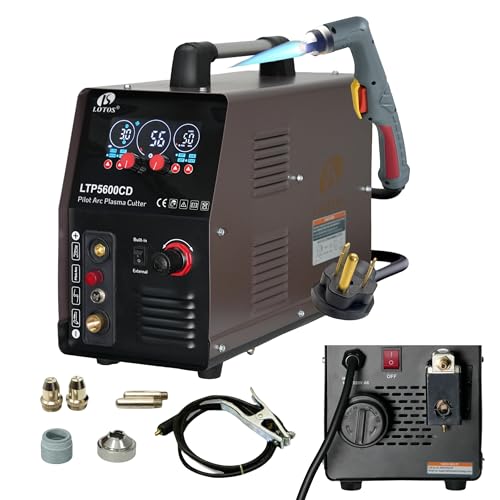
The LOTOS is the most adaptable choice for buyers who may work from both household power and a shop circuit. Its listing identifies automatic 110V/220V sensing, a built-in air compressor, and the option to connect an external compressor. That two-source arrangement matters because the internal pump favors mobility, while external air can support the higher published cutting envelope.
Drag-cut tracking is another meaningful distinction. The torch can be guided along a template or straightedge on thin sheet, which may help with long lines, ductwork, signs, or work where keeping a consistent hand distance is difficult. The listing states up to 1/2 inch cutting with internal air and higher figures with external air, including a 5/8 inch clean-cut claim and 3/4 inch severance claim under the stated configuration. Buyers should match those figures to the correct voltage and air source.
Pros
- 110V/220V operation supports household and shop power.
- Built-in and external air options allow portability or higher capacity.
- Drag-cut tracking can help guide straight or template-based cuts.
- Non-touch pilot arc is suited to coated, rusty, and expanded metal.
- Digital controls include pilot-arc and post-flow adjustments.
Cons
- The highest published cutting figures require external air and the appropriate power setup.
- More air and voltage controls may be unnecessary for occasional light cutting.
This is the best alternative to the ANDELI for a buyer who wants a machine that can grow with the workspace. It costs some simplicity because the operator must understand which air source and voltage apply to each rating, yet that flexibility is valuable for a garage that may later gain a larger compressor. Buyers focused on basic 120V cutting can save space and complexity with the Reboot 40A.
To buy this product, click here.
6. HansnokTech 45A Plasma Cutter : Best for 120V Feature Flexibility

The HansnokTech combines a 120V input with a 45A output and an internal compressor, placing it between the compact household-power Reboot and the more shop-oriented 220V choices. Its listing gives a 3/8 inch clean-cut rating and a 5/8 inch maximum-cut rating. That combination may suit repair work where the available circuit matters more than chasing the largest amperage number.
Two operating modes, 2T and 4T, are listed. Two-touch operation keeps the trigger active while it is held, while four-touch operation can reduce finger fatigue during a longer cut. The product information also identifies automatic pressure adjustment, overload protection, and an upgraded cooling system, although it does not provide a duty-cycle condition that would show how long the machine can sustain its rated output.
Pros
- 120V input broadens use in garages and small work areas.
- 45A output is higher than the 40A Reboot option.
- Built-in compressor avoids separate air equipment.
- 2T and 4T controls provide different trigger-use options.
- Published ratings include both clean-cut and maximum-cut figures.
Cons
- The listing does not clearly state a duty cycle tied to the 45A output.
- It lacks the LOTOS’s stated 110V/220V and external-air flexibility.
The HansnokTech is a reasonable middle choice for a 120V setup that needs more output than the smallest machine. Its limitation is documented depth rather than a clearly stated missing feature. If repeated heavy cutting is planned, the 240V FLARING, HZXVOGEN, or ANDELI gives a more suitable power direction. For occasional sheet and repair work, the compact built-in-air design is easier to justify.
To buy this product, click here.
7. H HZXVOGEN HVC6000Pro 50A : Best for External-Air Expansion

The H HZXVOGEN combines an internal compressor with the ability to accept an external compressor, giving it a useful two-stage setup. A buyer can start with self-contained cutting and later connect shop air if the work demands more sustained airflow. The listing identifies 220V operation, 50A output, a 5/16 inch ideal clean-cut thickness, and a 5/8 inch maximum thickness at 50A and 240V.
Those figures illustrate why clean-cut and maximum-cut language deserves attention. The ideal clean-cut number is substantially below the maximum separation figure, so this model should be selected for its operating flexibility rather than treated as a guaranteed 5/8 inch precision cutter. Non-touch starting, air testing, post-flow, and 2T/4T controls add useful operating adjustments, while the stated 60% duty cycle is meaningful only under the conditions attached to the manufacturer’s rating.
Pros
- Built-in compressor supports use without a separate air source.
- External-compressor capability provides a path for shop-air expansion.
- 50A output sits above the 40A and 45A household-oriented models.
- Non-touch pilot arc suits rough or coated material.
- 2T/4T, air-test, and post-flow functions add operating control.
Cons
- 220V operation limits use where only standard household power is available.
- The stated 5/8 inch maximum cut should not be confused with the 5/16 inch ideal clean cut.
This model makes sense for a 220V workspace where external air may become useful later. It offers a stronger upgrade path than a permanently self-contained 120V cutter, though it requires more deliberate setup and accurate interpretation of the ratings. Buyers who need maximum portability without a 220V circuit should look at the Lincoln or Reboot options instead.
To buy this product, click here.
8. SONNLER 50A 2-in-1 Plasma Cutter : Best for Cutting and MMA Welding

The SONNLER earns attention by combining plasma cutting and MMA arc welding in one 220V machine. That combination can be useful in a repair setup where the same power source may need to separate damaged metal and then join replacement material. Its built-in compressor keeps the cutting side self-contained, while the 15A to 40A cutting range listed by the product information places it below the headline 50A label in actual stated cutting output.
The listing identifies a 1/3 inch clean-cut rating and a 3/5 inch maximum-cut rating, plus adjustable gas delay from 5 to 15 seconds. Gas delay keeps airflow moving after the arc stops, which can help cool consumables and clear the cut, but it does not replace correct torch distance or material preparation. The machine’s over-current, underload, and temperature controls add protection features without guaranteeing performance outside the documented operating conditions.
Pros
- Combines plasma cutting and MMA welding in one machine.
- Built-in compressor reduces equipment and hose requirements.
- Gas-delay adjustment is listed from 5 to 15 seconds.
- Digital display makes current and operating information easier to read.
- Published clean-cut and maximum-cut ratings clarify its intended range.
Cons
- The stated 15A to 40A cutting output is below the 50A headline description.
- 220V input is less flexible than the 120V models.
Pick the SONNLER when MMA welding is a genuine part of the plan and the 220V circuit is already available. A dedicated cutter offers a simpler comparison, while the ANDELI provides a higher stated cutting output and more detailed cutting controls. The SONNLER’s appeal is equipment consolidation, especially for repair work where cutting and joining happen at the same station.
To buy this product, click here.
9. Lincoln Tomahawk 30 Air : Best Premium Portable Option

The Lincoln Tomahawk 30 Air takes a different approach from the higher-amperage machines above. Its internal compressor is paired with continuous output control, touch starting, rapid arc re-strike, front-panel purge control, and a parts-in-place system. Those details focus on controlled operation and portability rather than a large advertised cut number, which may suit field work where an external compressor is unavailable.
Rapid arc re-strike is particularly relevant for expanded metal and interrupted cuts because the arc can restart across gaps. The front-panel purge control allows airflow adjustment without initiating the plasma arc, while the listed swirling-air design is intended to help cool the electrode and tip. The supplied product information does not include a clean-cut or severance thickness figure, so buyers should consult the current Lincoln documentation before matching it to a specific material thickness.
Pros
- Internal compressor supports operation without external shop air.
- Continuous output control allows adjustment for different material thicknesses.
- Rapid arc re-strike is suited to gaps and expanded metal.
- Front-panel purge control separates airflow setup from arc initiation.
- Parts-in-place detection checks torch and consumable installation.
Cons
- The supplied information does not provide clean-cut or severance ratings.
- Its premium positioning may be difficult to justify for occasional light cutting.
This is the premium alternative for buyers who prioritize a portable internal-air system and more deliberate torch-management features. It should not be selected by comparing its unspecified thickness rating directly with the 55A ANDELI or 50A HZXVOGEN. Check the current manufacturer documentation for output, duty cycle, and material limits, then choose it if those figures align with the work and the control features matter more than maximum advertised amperage.
To buy this product, click here.
Buying Guide: How to Choose a Plasma Cutter With Built-In Air Compressor
Match Input Voltage to the Available Circuit
A 120V plasma cutter is easier to place in a garage with standard household outlets, but the available circuit still matters. A 220V model may provide a stronger path for higher output, while a dual-voltage unit such as the LOTOS can move between both environments. Do not assume a machine works on both voltages unless the exact product documentation states it.
Separate Clean-Cut Ratings From Maximum Severance
A clean-cut rating describes a more usable edge under stated conditions. Maximum severance describes the ability to separate thicker material, often with slower travel, more dross, or a rougher edge. A listing that says 5/8 inch maximum cut should not be read as a 5/8 inch production-quality cut.
Check Whether External Air Is Supported
An internal compressor provides mobility, but it may have less airflow capacity than a larger shop compressor. Models such as the LOTOS and H HZXVOGEN can accept external air, giving buyers a way to move from occasional portable work to more sustained cutting. Confirm whether the external compressor connection is supported and whether the higher rating depends on that connection.
Choose Non-Contact Starting for Rough Stock
A non-contact pilot arc can start above painted, rusty, or uneven metal without requiring the nozzle to drag across the surface. This may reduce tip contact during work on expanded metal or coated stock. The feature does not eliminate the need for correct standoff, consumables, and surface preparation.
Look at the Controls That Affect Real Cuts
Useful controls include air testing, post-flow, 2T/4T trigger modes, output adjustment, and error displays. A digital screen can make current or pressure information easier to monitor, while 4T operation may reduce finger pressure during longer cuts. More controls add flexibility, but they also make the manual more important.
Decide Whether MMA Welding Adds Real Value
The ANDELI and SONNLER combine cutting with MMA welding. That can reduce the number of machines in a repair setup, but it also means buying a multi-function unit rather than a dedicated cutter. If cutting is the only task, a dedicated model may offer a simpler control layout and a clearer comparison of cutting specifications.
Verify Consumables and Electrical Requirements
Plasma cutters depend on compatible electrodes, tips, cups, and torch parts. Included consumables are useful for starting, but replacements should be available for the exact torch. Before use, follow the manufacturer’s requirements for grounding, ventilation, protective equipment, circuit capacity, and machine setup.
Best Plasma Cutter With Built-In Air Compressor FAQ
Does a built-in compressor eliminate the need for external air?
Usually, the built-in compressor is intended to let the cutter operate without a separate air source. Some models also support an external compressor, which may provide more airflow for higher or more sustained cutting. Check the specific manual because external-air compatibility and connection requirements differ.
Is a 120V plasma cutter suitable for thick metal?
A 120V model can cut useful thicknesses, but its output and sustained performance may be more limited than a 220V machine. The Reboot 40A listing gives a 3/8 inch clean-cut figure and a 3/5 inch maximum-cut figure. Treat those as published ratings under stated conditions rather than universal results.
What is the difference between a clean cut and a maximum cut?
A clean cut is the more useful figure for work where edge quality and reduced cleanup matter. Maximum cut is the thickest material the machine is listed as capable of separating, often with slower travel and a rougher edge. Compare both figures before choosing a machine for plate or structural stock.
Is non-HF starting important?
Non-HF blowback starting may reduce electromagnetic interference compared with high-frequency starting methods. It can be useful near sensitive electronics or equipment. The specific starting method does not determine every aspect of cut quality, so also compare output, air control, torch design, and input power.
Can these plasma cutters cut aluminum?
Plasma cutting can be used on conductive metals, and several listings identify aluminum among the supported materials. That statement does not guarantee the same thickness, edge quality, or settings as steel. Verify the product manual and use the correct consumables and operating procedure for aluminum.
Is a plasma cutter with a built-in compressor better than a separate compressor setup?
It is more convenient for mobile work and small spaces because fewer components are required. A separate compressor can provide greater air capacity for sustained cutting and may support a wider range of tools. The LOTOS offers both options, making it a useful choice for buyers whose setup may change over time.
Do MMA-capable plasma cutters replace a dedicated welder?
They can provide MMA welding capability for compatible repair tasks, but buyers should compare the documented welding output, included leads, electrode support, and duty-cycle information. A multi-function cutter may reduce equipment count, while a dedicated welder can offer controls and accessories better matched to frequent welding.
Final Verdict
The ANDELI 55A is the strongest overall choice in this group because it combines built-in air with higher stated output, non-HF starting, non-contact pilot arc, digital monitoring, grid-cutting automation, and MMA capability. Its thickness figures still depend on voltage, air source, and operating conditions, but the feature mix gives it broader usefulness than a basic self-contained 120V cutter. It is the better fit for a buyer who wants one machine for varied repair and fabrication tasks.
The LOTOS Apex LTP5600CD is the strongest alternative for dual-voltage flexibility and a future external-air setup. The Reboot 40A makes more sense for lighter work from a standard outlet, while the Lincoln Tomahawk 30 Air is the premium option for buyers who prioritize portable operation and torch-control features over a clearly listed high-amperage rating. Match the final choice to the circuit, material thickness, air requirements, and whether MMA welding is genuinely part of the job.
