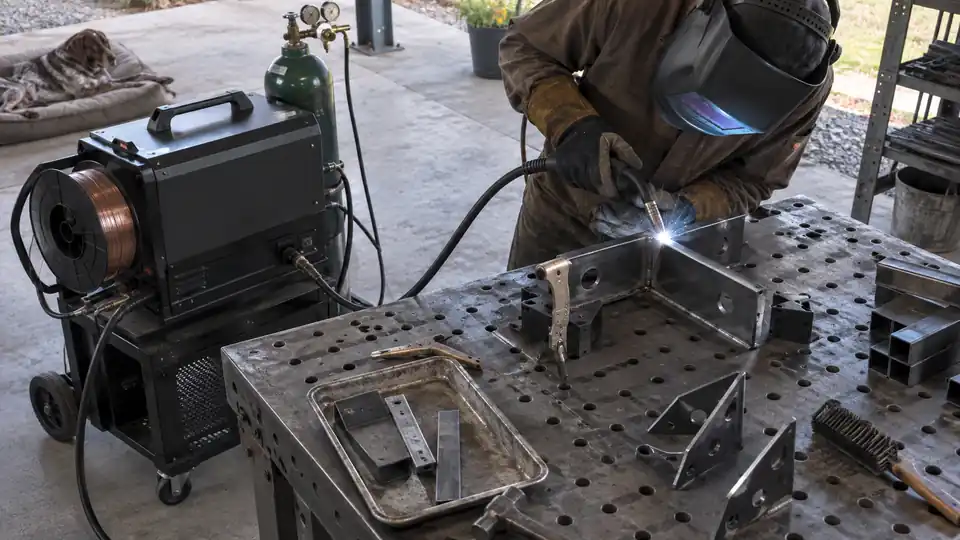
A 220V MIG welder gives a workshop more usable electrical headroom than a 110V-only machine, particularly for thicker steel, longer welds, and demanding wire-feed settings. The strongest options in this group also accept 110V input, so they can move between a dedicated 220V circuit and a standard household outlet when the job calls for it. The real decision involves more than the largest amperage printed on the case. Wire compatibility, spool capacity, duty cycle, control layout, aluminum support, and included equipment can change how practical a machine feels from one project to the next.
A common buying mistake is treating every multi-process machine as an equally capable MIG welder. A unit may offer Lift TIG without including the torch, or advertise aluminum welding while requiring a separately purchased spool gun. Some models provide a higher output rating but have fewer documented controls or a smaller wire spool compartment. For most buyers, the YESWELDER MIG-205DS PRO offers the strongest balance because it combines dual-voltage input, a documented 200-amp output, gas and flux-core MIG, spool-gun compatibility, manual controls, and synergic setup.
The products below range from compact machines for occasional repair work to larger multi-process units with aluminum and cutting capability. The ranking gives extra weight to genuine 220V MIG usefulness, practical wire handling, process flexibility, and the clarity of the published specifications. A 220V connection can improve available output, but the machine still needs suitable wire, shielding gas where applicable, correct polarity, and a circuit that meets the manufacturer’s requirements.
Quick Answer
- Best Overall: YESWELDER MIG-205DS PRO, with 200-amp output, dual-voltage input, and spool-gun MIG support.
- Best Premium: ARCCAPTAIN MIG250, offering a broader control set and six operating functions.
- Best Multi-Function Option: FEMEROL Plasma Cutter Welder Combo, for buyers who also need plasma cutting and HF TIG.
- Best Portable Option: BESTMIG 165S, with a 12.5-pound chassis, dual-voltage input, and a 60% listed duty cycle.
Best 220V MIG Welder Comparison Table
| Product | Best For | MIG Capability | 220V-Relevant Details |
|---|---|---|---|
| YESWELDER MIG-205DS PRO | Best overall balance | Gas, flux-core, spool-gun MIG | 200A, 110V/220V, manual and synergic control |
| ARCCAPTAIN MIG250 | Higher-output work | Gas, gasless, spool-gun MIG | 250A, 110V/220V, spot and crater controls |
| ARCCAPTAIN MIG200 | Preset storage and flexibility | Gas, gasless, spool-gun compatible MIG | 200A, 110V/220V, 10 memory settings |
| FEMEROL Plasma Cutter Welder Combo | Welding and cutting | Gas and flux-core MIG | 200A, 110V/220V, plasma and HF TIG |
| BESTMIG 165S | Portable 220V MIG work | Gas and flux-core MIG | 165A, 110V/220V, 60% listed duty cycle |
| ARCCAPTAIN 165A MIG | Compact general repairs | Gas and flux-core MIG | 165A, 110V/220V, 12.8 pounds |
| YESWELDER 160A MIG | Larger spool flexibility | Gas and flux-core MIG | 160A, 110V/220V, accepts 2-pound and 10-pound spools |
| FEMEROL 250A MIG | Budget aluminum compatibility | Gas, gasless, spool-gun compatible MIG | 250A claim, 110V/220V, six functions |
| ANDELI 135A MIG | Lightweight flux-core work | Flux-core MIG with pulse | 135A, 110V/220V, 9.04 pounds |
The detailed reviews explain which machines make the best use of a 220V circuit, where their published capabilities differ, and which trade-offs deserve attention before ordering.
1. YESWELDER MIG-205DS PRO: Best Overall

The MIG-205DS PRO earns the top position because its documented configuration fits the central 220V MIG requirement unusually well. It supports gas MIG, flux-core MIG, Stick, Lift TIG, and spool-gun aluminum MIG, while the listing identifies a 200-amp output and 110V/220V input. That combination gives a buyer room to start with ordinary steel fabrication and move into thicker material or aluminum work without immediately replacing the machine.
Its synergic control links wire-feed speed with a recommended voltage, which can simplify initial setup, while manual adjustment remains available for users who want to tune the arc independently. The published wire-feed range runs from 58 to 858 inches per minute, and voltage fine-tuning is available within a stated plus-or-minus 3V range. The spool gun and Lift TIG torch are optional, so the broader process list should be read as compatibility rather than a complete accessory package.
Pros
- Supports 110V and 220V input.
- Offers 200-amp output for a broader range of steel work.
- Supports gas MIG, flux-core MIG, Stick, Lift TIG, and spool-gun MIG.
- Provides both synergic and manual MIG control.
- Voltage fine-tuning and digital current display aid setup adjustments.
Cons
- Spool gun and Lift TIG torch must be purchased separately.
- The listing does not provide a documented duty-cycle figure in the supplied specifications.
This model makes the most sense for someone who expects a 220V circuit to become the main power source but still wants 110V flexibility. The aluminum function is useful only after adding the compatible spool gun, and buyers focused solely on steel may prefer a smaller, lighter unit. Compared with the 160A machines, its higher output and spool-gun path provide a more convincing reason to install or use 220V power.
To buy this product, click here.
2. ARCCAPTAIN MIG250: Best Premium

With a listed 250-amp maximum and six operating functions, the MIG250 is aimed at buyers who want more headroom than a compact 160A or 165A machine provides. Its modes include gas MIG, gasless MIG, Lift TIG, Stick, spot welding, and spool-gun operation. The 110V/220V design is especially relevant here because the larger output claim is more useful when the unit is connected to the higher-voltage supply identified by the manufacturer.
The control package is more detailed than the smaller ARCCAPTAIN models. Adaptive crater, burn-back adjustment, and pre-flow and post-flow settings give users more ways to shape the start and finish of a weld. Synergic MIG can recommend current and wire-feed settings based on wire diameter and gas selection, while manual MIG allows more direct control. The spool gun and Lift TIG torch are extra purchases, so the machine’s versatility carries an accessory cost.
Pros
- Lists a 250-amp maximum output.
- Supports 110V and 220V input.
- Includes gas MIG, gasless MIG, Stick, Lift TIG, spot, and spool-gun functions.
- Offers crater, burn-back, pre-flow, and post-flow adjustments.
- Includes a gas hose, MIG torch, ground clamp, and wire-feed rollers.
Cons
- Lift TIG torch and spool gun are optional rather than included.
- The larger capability may be unnecessary for occasional thin-steel repairs.
This is the stronger choice for a buyer who expects longer sessions, thicker steel, or a broader fabrication setup and is comfortable paying for more control. The advertised output should not be treated as a universal thickness guarantee, since material, joint design, settings, and technique still determine the result. Buyers who need a lighter machine for roadside or farm repairs may find the 165A class easier to carry.
To buy this product, click here.
3. ARCCAPTAIN MIG200: Best for Preset Flexibility

The MIG200 occupies a useful middle position. Its listed 200-amp output, dual-voltage input, and support for gas MIG, flux-core MIG, Stick, Lift TIG, spot welding, and optional spool-gun use give it more range than a basic wire welder. It accepts several solid and flux-core wire sizes, while the listing also identifies compatibility with .035-inch and .040-inch aluminum wire, with some rollers sold separately.
Preset storage is the feature that most clearly separates this model from the simpler machines. The product information states that it can store 10 groups of parameter data for each welding mode. That can reduce repeated setup work when a workshop moves between familiar materials or wire sizes. Buyers should still verify the exact roller and gun requirements before planning aluminum work, since the spool gun and TIG torch are not included.
Pros
- Supports 110V and 220V input.
- Lists 200-amp output with gas and flux-core MIG modes.
- Provides optional spool-gun compatibility for aluminum MIG.
- Stores up to 10 parameter groups for each welding mode.
- Includes pre-flow, post-flow, burn-back, crater, and 2T/4T functions.
Cons
- Spool gun and TIG torch are not included.
- Some wire rollers, including .023-inch and .040-inch versions, must be purchased separately.
The MIG200 suits a workshop where repeatable setup matters more than minimum weight. It gives up some simplicity compared with the 160A units, but the memory settings and broader wire support can matter during recurring repair or fabrication jobs. A buyer who only runs .030-inch or .035-inch steel wire may gain little from the extra accessory path.
To buy this product, click here.
4. FEMEROL Plasma Cutter Welder Combo: Best for Welding and Cutting

A combined welder and plasma cutter can make sense for a fabrication area where cutting plate and joining parts happen side by side. This FEMEROL unit supports gas MIG, flux-core MIG, Stick, spot welding, HF TIG, and plasma cutting, with 110V/220V input. The listing identifies a 200-amp welding output and a plasma clean-cut claim of 10 mm under 220V, with a separate maximum severance figure of 16 mm.
Its HF TIG function is a meaningful distinction. High-frequency start begins the TIG arc without touching the tungsten to the workpiece, unlike Lift TIG, although the listing’s TIG capability is described for low-carbon steel and stainless steel rather than AC aluminum TIG. The package includes MIG and plasma torches, a TIG torch, air filter regulator, gas hose, and consumables, which makes the initial setup broader than machines that merely support optional accessories.
Pros
- Combines MIG, flux-core, Stick, spot, HF TIG, and plasma cutting.
- Supports 110V and 220V input.
- Lists a 200-amp welding output.
- Includes MIG, plasma, and TIG torches.
- Separates clean-cut and severance cutting claims.
Cons
- Plasma cutting requires a suitable compressed-air supply.
- Its broader function set may add complexity for buyers who need MIG only.
This machine is best suited to a workshop that genuinely needs both cutting and welding. It ranks below the YESWELDER MIG-205DS PRO for a pure 220V MIG purchase because part of its cost and setup is tied to plasma and HF TIG. Buyers should also keep the 10 mm clean-cut figure separate from the 16 mm severance claim rather than treating both as routine cutting capacity.
To buy this product, click here.
5. BESTMIG 165S: Best Portable Option

At a listed 12.5 pounds, the BESTMIG 165S is considerably easier to move than the larger 200A and 250A machines. It still supports 110V and 220V input, gas MIG, gasless flux-core MIG, Lift TIG, and Stick. The published 165A output and 60% duty cycle place it in a useful range for repair work and moderate fabrication, particularly when a 220V connection is available.
Synergic mode automatically recommends voltage and wire-feed speed from the selected amperage, while manual mode allows independent adjustment. The machine also provides plus-or-minus 3V fine-tuning, 2T and 4T trigger modes, and a digital display. A 220V connection is strongly recommended in the product information for achieving the full 165A output, which makes its dual-voltage design more than a convenience feature.
Pros
- Weighs a listed 12.5 pounds.
- Supports 110V and 220V input.
- Lists a 60% duty cycle and 165A output.
- Includes synergic and manual MIG modes.
- Provides 2T, 4T, Stick hot start, arc force, and anti-stick functions.
Cons
- Lift TIG torch is not included.
- Its 165A ceiling gives less headroom than the 200A and 250A machines.
This model fits a mobile repair setup where carrying weight matters as much as peak output. The included helmet and gloves may reduce initial equipment shopping, though their presence does not replace checking the machine’s operating instructions and selecting suitable PPE. A buyer planning repeated thick-material work may prefer the YESWELDER or ARCCAPTAIN models with higher listed output.
To buy this product, click here.
6. ARCCAPTAIN 165A MIG: Best Compact General-Repair Welder

The ARCCAPTAIN 165A focuses on the features that matter for routine steel repairs without moving into the larger chassis class. It supports gas MIG, flux-core MIG, Stick, and Lift TIG, accepts 110V or 220V input, and lists a 60% duty cycle. The manufacturer-style product information identifies mild-steel work up to 3/16 inch, though actual results depend on joint preparation, wire, settings, and technique.
Its 12.8-pound weight and shoulder strap make it practical for moving between a garage, trailer, or outdoor repair location. The machine uses synergic and manual MIG controls, and 2T/4T operation allows a choice between trigger-held welding and latching for longer runs. The internal spool is limited to a 2-pound spool, a meaningful restriction compared with the YESWELDER 160A, which accepts 2-pound and 10-pound spools.
Pros
- Supports gas MIG, flux-core MIG, Stick, and Lift TIG.
- Accepts 110V and 220V input.
- Lists 165A output and a 60% duty cycle.
- Weighs 12.8 pounds and includes a shoulder strap.
- Includes a MIG torch, ground clamp, electrode holder, rollers, and flux-core wire.
Cons
- Accepts only a 2-pound wire spool.
- Lift TIG torch must be purchased separately.
This machine makes sense for occasional repairs where portability and a ready-to-use package matter more than large-spool convenience. The 220V input can provide access to its higher operating range, while 110V remains available for lighter work. Buyers running long welds or consuming wire quickly may find the 2-pound spool limit more restrictive than the output rating suggests.
To buy this product, click here.
7. YESWELDER 160A MIG: Best for Larger Spools

The YESWELDER 160A is less powerful on paper than the 200A and 250A machines, but it answers a practical concern that compact welders often overlook. The listing states that it accepts both 2-pound and 10-pound spools of .030-inch and .035-inch solid or flux-core wire. That larger-spool compatibility can reduce interruptions during a long project and gives the machine a more conventional workshop role.
It supports gas MIG, flux-core MIG, Stick, and Lift TIG, with 110V/220V input and compatibility with common 6010, 6011, 6013, and 7018 electrodes in Stick mode. Synergic control recommends voltage and wire-feed settings from the selected material thickness or amperage, while manual control remains available. At a listed 19.4 pounds, it is heavier than the compact BESTMIG and ARCCAPTAIN units but still has a carrying handle.
Pros
- Accepts both 2-pound and 10-pound wire spools.
- Supports 110V and 220V input.
- Offers gas MIG, flux-core MIG, Stick, and Lift TIG modes.
- Lists compatibility with several common Stick electrodes.
- Provides synergic and manual MIG control.
Cons
- Its 160A output gives less headroom than the higher-output options.
- At 19.4 pounds, it is less convenient to carry than the compact models.
This is the better fit for a fixed garage or workshop where spool capacity has more value than minimum weight. The larger spool option can be a quiet advantage during repeated fabrication, while dual-voltage input keeps the machine adaptable to different circuits. Buyers who weld only short seams or prioritize outdoor portability may prefer a lighter 165A unit.
To buy this product, click here.
8. FEMEROL 250A MIG: Best Budget Aluminum-Compatible Option

The FEMEROL 250A stands out because its product information describes two aluminum MIG paths: a Teflon wire-feed tube or a compatible spool gun. It also supports gas MIG, gasless flux-core MIG, Stick, Lift TIG, and spot welding, with 110V/220V input. That is a broad feature list for a machine positioned below the larger premium options, although the spool gun and TIG torch are not included.
Synergic control recommends current and wire-feed speed after the user selects wire diameter and gas material, while the machine accepts several solid, flux-core, and aluminum wire sizes. The listing claims it can weld mild steel plate up to 14.0 mm, but that should be read as a published product claim rather than a universal result. Material type, joint design, power source, preparation, consumables, and settings all affect practical thickness.
Pros
- Supports 110V and 220V input.
- Offers gas MIG, flux-core MIG, Stick, Lift TIG, and spot modes.
- Lists two aluminum MIG approaches.
- Accepts several solid, flux-core, and aluminum wire sizes.
- Provides synergic control for initial MIG setup.
Cons
- Spool gun and TIG torch are sold separately.
- The published 250A and thickness claims need to be matched to the actual circuit and welding conditions.
This model suits buyers who want an affordable route into aluminum MIG and understand that compatibility does not mean every accessory is in the carton. It offers more material flexibility than the steel-focused compact machines, though the documentation supplied here provides less detail about duty cycle and aluminum setup than the higher-ranked models. Confirm the current accessory requirements before planning a specific aluminum project.
To buy this product, click here.
9. ANDELI 135A MIG: Best Lightweight Flux-Core Option
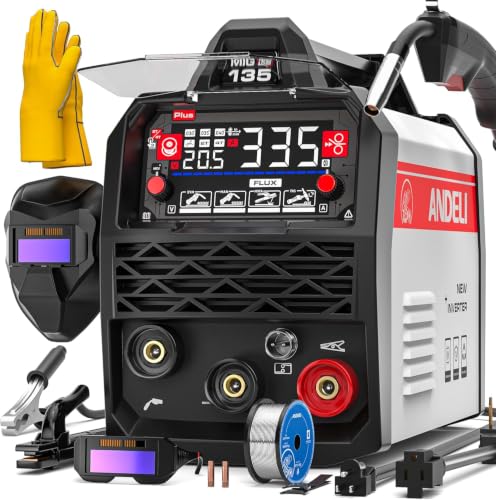
The ANDELI is the lightest machine in this selection at a listed 9.04 pounds, making it attractive for small repair kits and jobs where equipment has to travel. Its main MIG emphasis is gasless flux-core welding with pulse functionality, plus Lift TIG and Stick. The machine supports 110V and 220V input and accepts .030-inch, .035-inch, and .040-inch flux-core wire.
Pulse and adjustable inductance give the operator more control over arc behavior than a very basic flux-core box. The product information describes automatic parameter adjustment through synergic control and includes 2T and 4T trigger modes. It also lists a 4.1-inch LED display and includes a welding torch, electrode holder, gasless wire, adapter, helmet or goggles, and gloves, although buyers should inspect the exact package configuration shown with the current listing.
Pros
- Weighs a listed 9.04 pounds.
- Supports 110V and 220V input.
- Provides pulse flux-core and adjustable inductance.
- Accepts .030-inch, .035-inch, and .040-inch flux-core wire.
- Includes a large 4.1-inch LED display and several starter accessories.
Cons
- Its 135A output is below every other ranked option here.
- The product information emphasizes flux-core MIG rather than conventional gas MIG.
This is a sensible choice for light outdoor repair work where gasless operation and low carrying weight matter more than maximum output. A 220V connection may improve its available operating range, but it remains a 135A-class machine and should not be selected for the same workload as the MIG250 or MIG-205DS PRO. Buyers who want shielding-gas MIG or larger steel capacity should move higher in the ranking.
To buy this product, click here.
Buying Guide For A 220V MIG Welder
Match Input Voltage to the Available Circuit
A machine labeled 110V/220V can work across more than one electrical setup, but it does not mean the machine produces its full advertised output on both inputs. The BESTMIG 165S specifically recommends 220V for its full 165A output, which illustrates why the power source matters. Check the manufacturer’s instructions for circuit requirements, plug configuration, and the correct voltage-switching procedure before connecting the welder.
Look Beyond Maximum Amperage
Higher amperage can provide more headroom, yet the number alone does not establish what a machine can weld continuously. Duty cycle must be considered alongside output amperage and test conditions. A compact 165A machine may be a better fit for short repairs and transport, while a 200A or 250A model may make more sense for longer seams or thicker material. Published thickness claims should be treated as reference points rather than guarantees.
Choose Gas MIG, Flux-Core, or Both
Gas MIG uses shielding gas and solid wire, while flux-core wire can provide a gasless setup when the machine and wire are configured correctly. Gasless flux-core can be useful outdoors, where wind can disturb shielding gas, but it produces slag that must be removed and may require different polarity. A machine supporting both approaches gives more flexibility, provided it includes the correct rollers, leads, and instructions.
Spool-Gun Compatibility Is Not Inclusion
Aluminum MIG requires suitable wire handling, and a spool gun can help keep soft aluminum wire from feeding through a long gun liner. Several machines here support a spool gun, but the accessory is optional. The FEMEROL 250A also describes a Teflon liner approach. Confirm whether the required gun, rollers, liner, and contact tips are included before treating an aluminum claim as a ready-to-weld setup.
Synergic Control Versus Manual Control
Synergic MIG links recommended voltage and wire-feed settings to selected material, wire, or amperage values. That can make initial setup less intimidating, especially when moving between thicknesses. Manual control remains valuable for fine adjustments, unusual joints, and personal preferences. The strongest machines in this roundup provide both rather than forcing the buyer into one control style.
Check Accessory Details Before Ordering
A machine may support Lift TIG without including a TIG torch, and a spool-gun connector does not prove that a spool gun is in the box. Look for the exact contents of the selected configuration, including the MIG torch, ground clamp, electrode holder, regulator or gas hose, rollers, contact tips, and adapter. This small check can prevent a machine from sitting idle while a missing accessory is ordered.
Best 220V MIG Welder FAQ
Is a 220V MIG welder better than a 110V MIG welder?
A 220V connection can give a dual-voltage machine access to higher output or more demanding operating ranges, but the machine’s design still determines its capability. A 220V-only or dual-voltage unit is not automatically better for every project. Buyers should compare output, duty cycle, wire handling, and controls rather than voltage alone.
Can a 220V MIG welder run on 110V power?
Only when the machine is specifically listed as dual-voltage. The products in this roundup identify 110V/220V input, but a 220V-only welder should not be connected to 110V. Use the correct adapter or plug arrangement and follow the manufacturer’s instructions for switching voltage.
Can these MIG welders weld aluminum?
Generic MIG capability does not automatically mean aluminum capability. The YESWELDER MIG-205DS PRO, ARCCAPTAIN MIG250, ARCCAPTAIN MIG200, and FEMEROL 250A list spool-gun or aluminum-related support. In several cases, the spool gun is optional. Confirm the required gun, liner, rollers, wire size, and polarity before starting an aluminum project.
Is Lift TIG the same as HF TIG?
No. Lift TIG starts the arc by touching and lifting the tungsten from the workpiece, while HF TIG uses a high-frequency, non-contact start. The FEMEROL plasma cutter combo lists HF TIG. Most of the other multi-process machines here list Lift TIG, which is a different starting method and feature set.
What size wire should be used with a 220V MIG welder?
The correct wire depends on the material, thickness, process, and machine’s supported rollers and contact tips. The products reviewed here commonly list .030-inch and .035-inch wire, while some support .040-inch or larger sizes. Match the wire diameter to the machine documentation rather than assuming every listed diameter works with every included roller.
Does a higher amp rating mean the welder can handle thicker steel?
Higher output can provide more capacity, but thickness also depends on joint design, material, wire, shielding, settings, power input, and technique. A published thickness figure is a reference claim from the product information. It should not be treated as a guaranteed result for every weld or material.
What is the advantage of a larger wire spool?
A larger spool can reduce wire changes during longer fabrication jobs. The YESWELDER 160A lists compatibility with both 2-pound and 10-pound spools, while the ARCCAPTAIN 165A is limited to a 2-pound spool. A compact machine may be easier to carry, but a larger spool can be more convenient in a stationary workshop.
Final Verdict
The YESWELDER MIG-205DS PRO is the strongest overall choice for most buyers seeking a 220V MIG welder. Its 200-amp output, dual-voltage input, gas and flux-core MIG modes, manual and synergic controls, and spool-gun compatibility create a well-balanced package. The main limitation is that the spool gun and Lift TIG torch are optional, so the full multi-process capability requires additional equipment.
Buyers who need more output and broader control options should look at the ARCCAPTAIN MIG250, while the FEMEROL plasma cutter combo makes more sense for a workshop that also needs cutting and HF TIG. For a lighter repair setup, the BESTMIG 165S provides dual-voltage flexibility and a listed 60% duty cycle in a compact chassis. Match the machine to the available circuit, expected material thickness, wire spool size, and accessory budget before placing an order.
