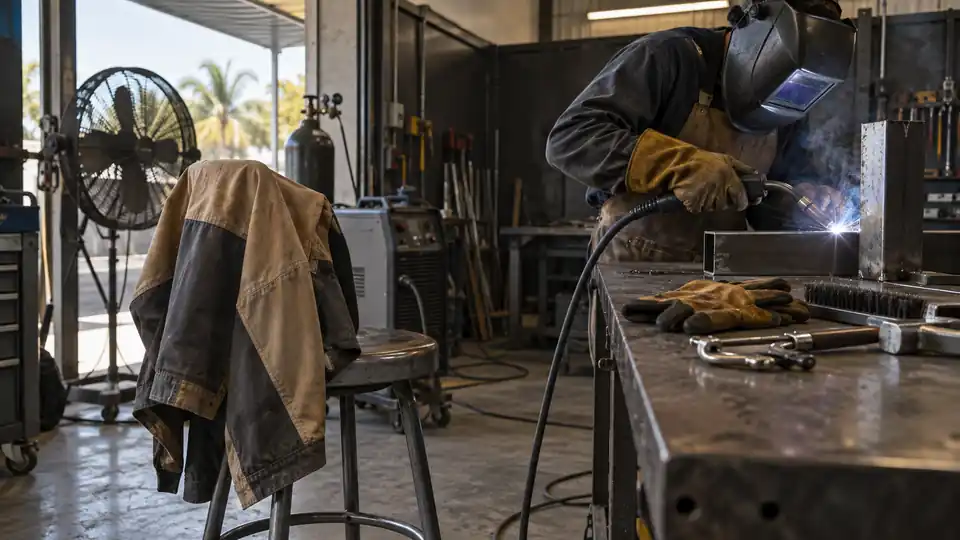
A summer welding jacket has to solve a tricky comfort problem. It needs enough coverage for sparks, spatter, and heat exposure, yet a heavy, stiff coat can turn a warm work area into a sweltering one. Lightweight cotton jackets are popular because they breathe more readily than leather, but fabric weight, collar design, cuff adjustment, ventilation, and fit still make a noticeable difference during a long session.
The lightest jacket is not automatically the best choice. A 9-ounce cotton shell may feel cooler, while an 11-ounce FR cotton model can offer more coverage for MIG work that produces heavier spatter. Buyers also commonly overlook sizing and sleeve closure. A jacket that pulls tight across the shoulders or leaves an open gap at the wrist can be uncomfortable and less useful, regardless of its fabric. For most summer work, the Miller Classic Cloth jacket offers the strongest balance of light fabric, coverage, fit information, and practical construction.
This comparison focuses on breathable FR cotton jackets suited to warm welding environments. Some favor ventilation, some provide heavier 11-ounce coverage, and others emphasize washable fabric, storage, or visibility. The right pick depends on whether your priority is TIG comfort, outdoor work, low-light visibility, frequent washing, or a roomier fit.
Quick Answer
- Best Overall: Miller Classic Cloth Welding Jacket, for balanced summer comfort and light-duty coverage.
- Best Ventilated Option: ARCCAPTAIN FR Welding Jacket with Vented Back, for buyers who place airflow high on the list.
- Best for Heavier Coverage: YESWELDER 11 oz FR Cotton Welding Jacket, for MIG and mixed-use work requiring a thicker cotton shell.
- Best for Long Shifts: MAGID SparkGuard Welding Jacket, with lightweight 9-ounce cotton sateen and documented ASTM D6413 compliance in the listing.
Best Welding Jacket For Summer Comparison Table
| Product | Best For | Fabric | Summer-Relevant Feature |
|---|---|---|---|
| Miller Classic Cloth | Best Overall | 9 oz FR cotton | Lightweight shell and stand-up collar |
| ARCCAPTAIN Vented Back | Maximum airflow | 9.5 oz cotton | Breathable rear mesh panels |
| YESWELDER 11 oz | Heavier summer coverage | 11 oz FR cotton | Stand-up collar and adjustable cuffs |
| ARCCAPTAIN 11 oz | Outdoor and low-light work | 11 oz FR cotton | Reflective strips and four pockets |
| MAGID SparkGuard | Long shifts | 9 oz cotton sateen | Lightweight construction and wash claim |
| Lincoln Premium K2985-M | Washable comfort | 9 oz FR cotton | Flip-up collar and machine-wash claim |
| Black Stallion FN9-30C | Simple workwear | 9 oz treated cotton | Leather-reinforced snaps |
| Lincoln Electric KH808XL | Roomy XL fit | 9 oz cotton | Snap sleeves and inside pocket |
| Lincoln Electric KH808XXL | Larger frames | 9 oz cotton | XXL sizing and snap sleeves |
The detailed reviews explain how the fabric weight, ventilation, closures, and sizing differences affect warm-weather use.
1. Miller Classic Cloth Welding Jacket — Best Overall

The Miller Classic Cloth earns the top position because its 9-ounce pre-shrunk cotton construction targets the central summer trade-off directly. It is lighter than the 11-ounce options in this roundup, while still providing arm and torso coverage for light-duty welding. The listing also identifies reinforced stitching and finished hems, details that matter after repeated movement, washing, and contact with a busy workbench.
Fit information is unusually helpful here. The XL version is listed with a 54-inch chest, 20-inch shoulders, 34-inch sleeves, and a 30-inch torso, giving shoppers more than a vague letter size to work from. A Barracuda-style stand-up collar covers the neck, while fold-in sleeve snaps help close the wrist area. This combination suits TIG work and warm indoor sessions particularly well, although heavier MIG spatter may justify a thicker jacket.
Pros
- Lightweight 9-ounce FR cotton is suited to warm working conditions.
- Pre-shrunk fabric can make sizing more predictable than untreated cotton.
- Stand-up collar adds neck coverage without requiring a separate neck flap.
- Fold-in sleeve snaps help reduce open space around the wrists.
- Published XL measurements make fit selection easier.
Cons
- Light-duty construction offers less material thickness than the 11-ounce jackets.
- The listed XL version may not suit buyers who need a larger or more athletic cut.
This is the most balanced choice for summer TIG work, light fabrication, and users who want a familiar cotton jacket without moving into heavier fabric. It may be less suitable for jobs that routinely produce substantial molten spatter, where the extra coverage of an 11-ounce jacket has a practical advantage. Check the sleeve and chest measurements rather than relying on XL alone, since a loose fit can create gaps while a tight fit becomes miserable in the heat.
To buy this product, click here.
2. ARCCAPTAIN FR Welding Jacket with Vented Back — Best Ventilated Option
Airflow is the reason to choose this ARCCAPTAIN over a conventional cotton shell. Its 9.5-ounce fabric sits between the lightest 9-ounce jackets and the thicker 11-ounce models, while breathable mesh panels at the back are intended to let heat escape. That construction is especially relevant in a warm garage where a fan may move air across the back but cannot cool a fully closed jacket.
The listing also describes adjustable two-button cuffs, reinforced stitching, chest pockets with pen slots, and reflective tape. Those details make the jacket more adaptable for mixed workshop and outdoor use. The rear ventilation does create a trade-off, though. Buyers who regularly work in positions where the back is exposed to concentrated spatter should review the garment design and their task requirements carefully rather than treating ventilation as a substitute for complete protective coverage.
Pros
- Rear mesh panels provide a ventilation feature missing from the basic cotton jackets.
- 9.5-ounce cotton keeps the fabric below the weight of the heavier 11-ounce options.
- Two-button cuffs allow a closer wrist fit than fixed sleeves.
- Reflective tape can improve visibility around dim work areas.
- Available sizing is listed from S through 3XL.
Cons
- Mesh ventilation may be less suitable for tasks requiring maximum back coverage.
- The listing does not provide detailed garment measurements for every size in the supplied information.
Choose this model for hot workshops, occasional outdoor repairs, and users who feel overheated in fully closed jackets. The ventilation feature gives it a stronger summer-specific rationale than a standard 9-ounce coat. It is less compelling for heavy spatter work where fabric coverage matters more than airflow, but it remains a practical middle ground between the light Miller jacket and the more substantial 11-ounce designs.
To buy this product, click here.
3. YESWELDER 11 oz FR Cotton Welding Jacket — Best for Heavier Coverage

An 11-ounce cotton jacket will generally feel warmer than a 9-ounce alternative, but that extra fabric can make sense for buyers who split their time between TIG and MIG work. The YESWELDER listing identifies 310-gram FR cotton, a stand-up collar, adjustable cuffs, and coverage intended for TIG and MIG applications. In a summer roundup, it ranks below the lighter jackets for ventilation, yet above many basic options for buyers who need a little more material between their clothing and flying spatter.
Storage is another useful distinction. The jacket has a covered chest pocket and an arm pocket, giving small tools or marking equipment dedicated places rather than leaving them loose in a trouser pocket. The listing states that care may involve dry cleaning and washing cycles up to 165°F, so maintenance deserves attention before ordering. A garment that requires more careful cleaning may be less convenient for daily shop use than a jacket with clearly documented machine-washing instructions.
Pros
- 11-ounce FR cotton provides a thicker shell than the 9-ounce summer jackets.
- Stand-up collar extends coverage around the neck.
- Adjustable cuffs help close the wrist area.
- Covered chest and arm pockets add practical storage.
- The listing identifies NFPA 2112 certification.
Cons
- Heavier fabric may feel warmer during long sessions in high temperatures.
- Care instructions appear more restrictive than the machine-wash claim for the Lincoln Premium model.
This YESWELDER is a sensible pick for mixed MIG and TIG work where a lightweight jacket feels too thin, but a leather coat would be excessive for the task. It may not be the first choice for someone doing short, low-spatter TIG sessions in a poorly ventilated garage. Buyers should also confirm the exact care and sizing information on the current listing, especially if the jacket will be washed frequently.
To buy this product, click here.
4. ARCCAPTAIN 11 oz FR Cotton Welding Jacket — Best for Outdoor Visibility

This ARCCAPTAIN takes the heavier 11-ounce route and adds features aimed at work that moves beyond a bright, organized shop. Reflective strips are identified for low-light workshops and nighttime outdoor repairs, while four pockets include an inner pocket and a chest pocket with a pen holder. Those features do not make the jacket cooler, but they can make it more useful when visibility and carrying small tools matter alongside heat coverage.
The closure system is practical for workwear. Snap buttons can be opened without pulling a zipper, and the two-level cuffs allow a closer or looser wrist setting. The listing advises buyers with more developed upper-body measurements to size up when between sizes, since the fabric is non-stretch. That warning matters during summer work because a restrictive jacket traps heat and limits arm movement quickly.
Pros
- 11-ounce FR cotton offers more fabric thickness than lightweight 9-ounce options.
- Reflective strips suit dim workshops and outdoor repairs.
- Two-level cuffs allow adjustment around the wrists.
- Four pockets provide more storage than the basic single-pocket designs.
- Six listed sizes give buyers several fit points to compare.
Cons
- Thicker cotton is less summer-friendly than the 9-ounce jackets for extended heat exposure.
- Non-stretch fabric may feel restrictive if the selected size is too close to the body.
Pick this version when summer work extends into the evening, a darker outdoor area, or a shop where visibility is a real practical concern. It gives up some coolness compared with the vented ARCCAPTAIN and Miller, but gains storage, reflective details, and a more substantial shell. Use the garment measurements carefully, since the wrong size can erase much of the comfort advantage expected from cotton.
To buy this product, click here.
5. MAGID SparkGuard Welding Jacket — Best for Long Shifts
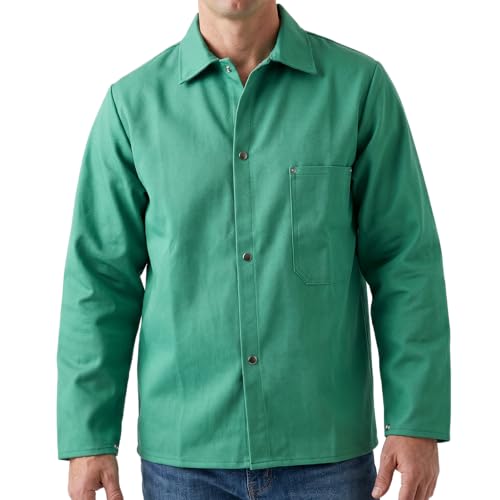
The MAGID SparkGuard is built around lightweight 9-ounce cotton sateen, which places it among the cooler choices for extended summer wear. Its 30-inch length provides torso coverage, while set-in snap sleeves and leather-reinforced metal snaps add structure at the closure points. The green color is also more visible than the navy and black jackets here, a small workplace benefit when supervisors or coworkers need to identify protective clothing quickly.
The product information states ASTM D6413 compliance and claims that the FR treatment remains effective through more than 50 industrial washes. Those are meaningful care details, although buyers should still follow the current garment instructions and workplace requirements. The lay-down collar is less enclosing than the stand-up collars on several alternatives, so it may feel less warm around the neck while providing a different level of coverage.
Pros
- Lightweight 9-ounce cotton sateen is suited to warm conditions.
- 30-inch length provides coverage across the torso.
- Leather-reinforced snaps add durability at the front and wrists.
- Green fabric improves visual identification on a busy jobsite.
- The listing identifies ASTM D6413 compliance and a 50-plus industrial wash claim.
Cons
- Lay-down collar provides less neck enclosure than a stand-up collar.
- The supplied product information identifies a men’s design, so fit should be checked carefully by other buyers.
This model makes the most sense for repeated wear where fabric weight and care routine matter more than extra pockets or reflective strips. It is a stronger warm-weather candidate than a heavy leather jacket, yet its collar and 9-ounce construction may be less suited to tasks producing substantial upper-chest or neck spatter. The visible green color is useful for identification, though buyers seeking a conventional black or navy appearance may prefer Lincoln, Miller, or Black Stallion.
To buy this product, click here.
6. Lincoln Premium K2985-M — Best Washable Comfort

Lincoln’s K2985-M uses 9-ounce FR cotton and is aimed at buyers who want a breathable shell with more detailed collar and care information. The flip-up collar can be positioned for added neck coverage, while chrome-plated metal snaps at the cuffs help close the forearm area. For summer work, the lightweight material and airflow-focused description are more relevant than the “premium” wording in the product title.
The listing states that the jacket is machine washable for up to 50 commercial cycles while retaining its flame-retardant properties, and it identifies ASTM D6413 compliance. Those claims give it a clear maintenance advantage over options whose care instructions are less specific. The supplied version is medium, however, so buyers with larger frames should not assume the same fit from this exact listing. A large jacket with identical construction may be a better match if the size is available.
Pros
- 9-ounce FR cotton supports cooler summer wear.
- Flip-up collar provides an adjustable neck-coverage option.
- Chrome-plated cuff snaps help close the wrists and forearms.
- Large inside pocket offers protected storage.
- The listing states ASTM D6413 compliance and a 50-cycle commercial wash claim.
Cons
- The reviewed listing is a medium, limiting its usefulness for larger frames.
- It lacks the rear mesh ventilation found on the ARCCAPTAIN vented model.
This is a good fit for buyers who wash workwear frequently and want a lightweight jacket with a configurable collar. It suits light to moderate summer welding where a 9-ounce cotton shell provides enough coverage. Those doing high-spatter MIG work may prefer the thicker YESWELDER or ARCCAPTAIN instead, while anyone ordering should verify that the available size matches their measurements rather than treating the medium label as universal.
To buy this product, click here.
7. Black Stallion FN9-30C — Best Simple Workwear

The Black Stallion FN9-30C keeps the design straightforward with 9-ounce treated cotton, a welder’s collar, six snap buttons, and a 30-inch length. That restrained layout can be useful for someone who does not need reflective tape, multiple pockets, or a vented back. In warm weather, fewer layers and a lighter shell can make the jacket easier to tolerate during short fabrication tasks.
Its small storage details are well targeted. A scribe pocket holds welding pencils, soapstone, or paint markers, while an inside pocket keeps smaller items closer to the torso. Leather reinforcement at the snaps adds protection around points that receive repeated pulling. The listing identifies the size as large, so the garment should be compared with actual measurements before purchase, particularly because cotton clothing can feel restrictive across the shoulders when reaching forward.
Pros
- 9-ounce treated cotton is appropriate for lighter summer coverage.
- 30-inch length protects the torso without the bulk of a longer coat.
- Welder’s collar adds neck coverage.
- Scribe pocket is useful for marking tools.
- Leather-reinforced snaps support repeated opening and closing.
Cons
- No rear ventilation feature is identified in the supplied product information.
- The large version offers less fit flexibility than products listed across a broader size range.
This jacket suits straightforward TIG and light fabrication work where a basic 9-ounce cotton garment covers the need. It gives up the wash documentation of the Lincoln Premium and the airflow engineering of the vented ARCCAPTAIN, but its pocket arrangement is more useful than a plain single-pocket jacket. Buyers working in very hot spaces should pair the garment choice with good ventilation and follow the welding process and PPE requirements for the task.
To buy this product, click here.
8. Lincoln Electric KH808XL — Best Roomy XL Option

The KH808XL follows a familiar summer-jacket formula: breathable cotton, 9-ounce flame-resistant material, snap sleeves, and an inside left pocket. Its main reason for inclusion is fit availability rather than extra ventilation or storage. For a buyer who needs an XL garment with a conventional black appearance, the simple configuration may be preferable to a more feature-heavy 11-ounce coat.
Snap sleeves create form-fitting cuffs that can help reduce openings around the wrists, while the inside pocket gives small items a protected place. The product information does not identify mesh panels, reflective strips, a flip-up collar, or a detailed wash-cycle claim. That makes the jacket easier to understand, but it also means buyers should not expect the specialized summer features found on the ARCCAPTAIN vented jacket or the maintenance detail listed for the Lincoln Premium.
Pros
- 9-ounce cotton is lighter than the 11-ounce alternatives.
- XL sizing suits buyers who need more room than standard large garments.
- Snap sleeves create a closer cuff at the wrists.
- Inside left pocket provides protected storage.
- Simple black design works across common shop environments.
Cons
- No dedicated ventilation panels are identified.
- The listing provides fewer care and construction details than several competing jackets.
Select the KH808XL for basic summer coverage when size and simplicity matter more than specialized airflow. It is a reasonable option for light welding and general shop work, but it does not offer the clearest advantage for extremely hot conditions. Buyers who need more room across the chest should compare this XL with the XXL version below, while those prioritizing cooling should look first at the vented ARCCAPTAIN or lighter Miller.
To buy this product, click here.
9. Lincoln Electric KH808XXL — Best for Larger Frames
The KH808XXL provides the same basic 9-ounce cotton approach as the XL version, but the larger size gives buyers with broader measurements another fit option. That distinction matters in summer because a jacket that is too tight across the shoulders can restrict movement and make heat feel more intense. The garment includes snap sleeves for form-fitting cuffs and an inside left pocket for small protected items.
This is a conventional cloth jacket rather than a ventilated design. No mesh back, reflective strip, or multi-pocket layout is identified in the supplied information, so its advantage is mainly straightforward coverage in a size that may be overlooked by standard listings. Buyers should still compare the current measurement chart, since a larger label does not guarantee the same sleeve length or torso proportion needed for comfortable welding positions.
Pros
- XXL sizing gives larger frames an option within a lightweight 9-ounce design.
- Cotton construction is more suitable for summer than heavier leather garments.
- Snap sleeves help close the wrist area.
- Inside left pocket provides basic protected storage.
- Simple design avoids unnecessary bulk and extra layers.
Cons
- No summer-specific rear ventilation feature is identified.
- It offers fewer documented features than the vented and multi-pocket alternatives.
The KH808XXL makes sense when fit is the deciding factor and the wearer wants a basic, lightweight black jacket. It ranks below the Miller and ventilated ARCCAPTAIN because those products provide a clearer summer-specific benefit, yet a jacket that fits properly is more useful than a theoretically cooler garment that restricts movement. Confirm chest, sleeve, and torso measurements before ordering, especially when layering over a shirt.
To buy this product, click here.
Buying Guide For The Best Welding Jacket For Summer
Fabric Weight Affects Heat And Coverage
Fabric weight is one of the clearest differences in this group. The 9-ounce Miller, Lincoln, Black Stallion, and MAGID jackets should generally feel less substantial than the 11-ounce YESWELDER and ARCCAPTAIN options. That can make the lighter garments more comfortable for TIG work or short indoor sessions, while the thicker versions may be preferable when MIG spatter is more frequent. Fabric weight is only one part of protection, so match it to the process, position, and spatter level rather than assuming the lightest jacket fits every job.
Look For Real Ventilation Features
A breathable cotton label does not necessarily mean the jacket has active airflow features. The ARCCAPTAIN vented model specifically identifies rear mesh panels, which gives it a more direct summer advantage than a standard cotton shell. Jackets without mesh can still work in warm areas, especially when the fabric is 9 ounces, but ventilation in the work area, shirt choice, and the jacket’s fit will affect comfort as much as the fiber itself.
Choose The Collar For The Work Position
Stand-up and flip-up collars provide more neck coverage than lay-down collars, but they may also feel warmer around the throat. The Miller, YESWELDER, and ARCCAPTAIN jackets use stand-up collar designs, while the Lincoln Premium uses a flip-up collar and the MAGID uses a lay-down collar. A buyer doing overhead or higher-spatter work may place more value on neck coverage, while a TIG user working in a cooler position may prefer less material around the neck.
Cuff Design Helps Close The Wrist
Sparks and spatter can enter through open sleeve ends, especially when the wearer reaches forward. Snap sleeves, fold-in snaps, and adjustable cuffs give more control than an open hem. The Miller uses fold-in sleeve snaps, Lincoln’s basic jackets use snap sleeves, and the two ARCCAPTAIN models identify adjustable cuffs. The closure should remain comfortable over the wrist and should not interfere with gloves.
Fit Matters More In Hot Weather
A close fit reduces loose fabric, but a jacket that binds at the shoulders or chest can make movement uncomfortable and trap heat. Use the manufacturer’s measurements where available. The Miller provides detailed XL dimensions, the ARCCAPTAIN 11-ounce model identifies six sizes, and the Lincoln listings distinguish XL from XXL. Leave enough room for the shirt or base layer you normally wear, while avoiding excessive looseness at the sleeves and collar.
Check Care Instructions Before Ordering
Summer work often means more frequent washing, so care information deserves attention. The Lincoln Premium listing states a machine-wash claim through 50 commercial cycles, while the YESWELDER information identifies dry cleaning and washing up to 165°F. FR garments should be maintained according to the current product instructions. Do not assume that ordinary fabric-softener use, high heat, or an unspecified cleaning method will preserve the listed properties.
Match Coverage To The Welding Process
A lightweight summer jacket can make sense for light TIG work, but MIG, flux-cored, cutting, and overhead positions may expose the wearer to more spatter. The products in this roundup are garments, not a substitute for the complete PPE and ventilation practices required by the worksite. Select fabric weight and coverage based on the actual task, then confirm the jacket’s documentation and your employer’s requirements.
Best Welding Jacket For Summer FAQ
Is A 9-Ounce Welding Jacket Cool Enough For Summer?
A 9-ounce cotton jacket is generally a lighter option than an 11-ounce or leather garment, so it may feel more comfortable in warm conditions. Cooling also depends on fit, airflow, collar design, the work position, and the welding process. The ARCCAPTAIN with rear mesh panels has a more direct ventilation feature than the standard 9-ounce jackets.
Is An 11-Ounce Welding Jacket Too Hot For Summer?
Not necessarily. An 11-ounce jacket may feel warmer, but the additional fabric can suit MIG or mixed welding where spatter coverage matters. The YESWELDER and ARCCAPTAIN 11-ounce models are reasonable choices when protection needs outweigh maximum airflow. For short TIG sessions in a hot shop, a 9-ounce jacket may be more comfortable.
Is Cotton Better Than Leather For Hot-Weather Welding?
Lightweight FR cotton is usually easier to wear in warm conditions than a heavier leather jacket, particularly for light-duty work. Leather and cotton have different coverage and durability characteristics, so cotton should not be treated as a universal replacement for leather. Follow the requirements for the welding process, spatter level, and workplace PPE program.
Does A Stand-Up Collar Make A Jacket Safer?
A stand-up collar provides additional fabric around the neck compared with a lay-down collar, but it does not guarantee protection. The benefit depends on the welding position, garment fit, and the rest of the protective equipment. Miller, YESWELDER, and ARCCAPTAIN use stand-up collar designs, while the Lincoln Premium offers a flip-up collar.
Can A Welding Jacket Be Machine Washed?
Care varies by product. The Lincoln Premium listing identifies machine washing through 50 commercial cycles, while the YESWELDER listing includes dry-cleaning guidance and a maximum washing temperature. Read the current care instructions for the exact model and avoid assuming that all FR cotton jackets can be cleaned in the same way.
Should A Summer Welding Jacket Fit Loosely?
The jacket should allow normal arm movement and accommodate the clothing worn underneath without hanging excessively loose. A tight shoulder area can restrict movement and feel hotter, while overly loose sleeves may create openings around gloves and cuffs. Use chest, shoulder, sleeve, and torso measurements when they are available.
Are Reflective Strips Useful On A Welding Jacket?
Reflective strips can improve visibility in dim workshops or outdoor work areas, as identified on the ARCCAPTAIN 11-ounce jacket. They do not replace appropriate lighting, high-visibility workwear requirements, or other PPE. Their value is greatest for work that continues around vehicles, equipment, or low-light areas.
Final Verdict
The Miller Classic Cloth is the strongest overall choice for a summer welding jacket because it balances a lightweight 9-ounce FR cotton shell with a stand-up collar, wrist closures, reinforced construction, and useful published sizing information. It is particularly well suited to light-duty welding and TIG work where staying cooler matters. The ARCCAPTAIN vented model is the better alternative for buyers who specifically want rear airflow, while the YESWELDER 11-ounce jacket makes more sense when thicker cotton coverage is worth the additional warmth.
For frequent washing, the Lincoln Premium offers the clearest documented care advantage in this selection. The MAGID SparkGuard is another sensible long-shift option because of its lightweight fabric and stated ASTM D6413 compliance, while the larger Lincoln sizes address fit needs that can outweigh extra features. Before ordering, match the jacket to the welding process, check the exact measurements, and follow the current garment instructions and workplace PPE requirements.
