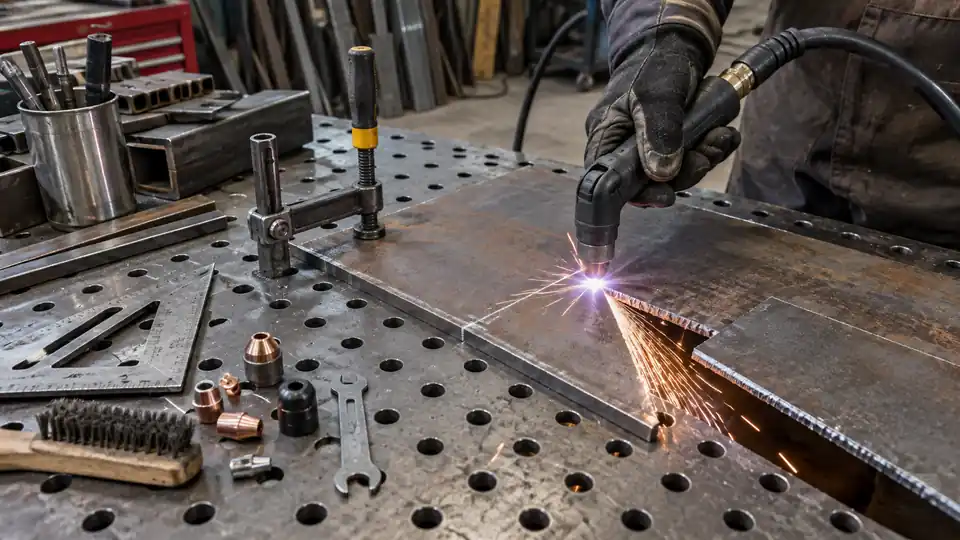
If you are learning how to choose a plasma cutter, start with the job rather than the biggest amperage number on the box. A machine for trimming rusty farm brackets, cutting clean slots in 1/8-inch sheet, and preparing heavy plate may need very different capabilities. The right choice depends on material thickness, cut quality, input power, compressed air, duty cycle, torch features, and how often the cutter will be moved around.
A plasma cutter uses an electric arc and compressed gas to melt and blow away electrically conductive metal. Steel, stainless steel, and aluminum are common examples. The difficult part of selecting a machine is separating useful capacity from optimistic headline specifications. A maximum severance cut may leave a rough, heavily tapered edge, while a recommended or clean-cut rating better reflects the thickness you can cut with a more usable finish.
Once you know your typical metal thickness and available power, compare the best plasma cutters for different jobs. If a suitable 110V circuit is your starting point, our 110V plasma cutter guide focuses on lower-voltage options; check each model’s clean-cut rating and air requirements.
Start With the Metal and Thickness You Actually Cut
Make a short list of the materials and thicknesses that will pass beneath the torch. A person cutting thin automotive panels needs a different tool from someone separating 1/2-inch plate for brackets. The arc may hiss sharply as it passes through light sheet, while thick steel demands slower travel, more heat, and greater attention to the machine’s output and air supply.
Plasma cutting is generally suited to electrically conductive metals, including mild steel, stainless steel, and aluminum. It does not cut wood, plastic, glass, or other nonconductive materials through the same process. Coatings, paint, rust, scale, and galvanized surfaces can affect the cut and may produce hazardous fumes, so surface preparation and ventilation still matter.
| Typical job requirement | What to examine | Why it matters |
|---|---|---|
| Thin sheet and light fabrication | Low-current control, drag-cutting support, clean-cut rating | Helps reduce excessive heat and makes straight, controlled cuts easier |
| Mixed shop repairs | Useful operating range, pilot arc, air requirements, duty cycle | Provides flexibility across different materials and work sessions |
| Heavy plate and repeated cutting | Output at the target thickness, duty cycle, input circuit, air delivery | Prevents a machine from being pushed beyond its practical capacity |
| Rusty or painted repair work | Pilot-arc behavior, torch consumable availability, ventilation needs | Helps maintain arc initiation and control around imperfect surfaces |
Clean cut, maximum cut, and severance cut are different
Manufacturers may list several thickness ratings. A clean or recommended cut generally describes a thickness the machine can cut with a more usable edge under stated conditions. A maximum or severance cut refers to the upper limit at which the machine can separate the metal, often with slower travel, more dross, and a rougher edge.
Suppose a project involves cutting flat bar for a gate. A cutter that can barely sever the bar may get through it, but the resulting edge could require grinding before fitting. If the same machine regularly cuts material near its maximum rating, the torch may spend more time at high output and the operator may need more cooling pauses. Choosing some capacity above your normal thickness can provide useful working room, provided the input circuit and air system can support the machine.
Match Amperage to Real Cutting Work
Amperage controls the heat available at the plasma arc. Higher output can help cut thicker material, while lower output is useful for thin sheet and detailed work. A machine with a broad usable range gives you more control over a toolbox full of jobs, from trimming a small steel tab with a quick buzz to cutting a longer plate edge with a deeper, steadier arc.
Peak amperage alone tells only part of the story. Two cutters with similar maximum output may differ in clean-cut performance, duty cycle, air demand, torch design, and behavior at lower settings. Read the manufacturer’s cut charts and manual for the exact model, then compare the ratings at the material thickness you expect to use most often.
Leave practical headroom
If your regular work involves 1/4-inch steel, selecting a cutter rated around that thickness may leave little margin for rust, imperfect technique, long cuts, or voltage variation. A modest reserve can help the machine handle normal shop surprises. That does not mean choosing the largest unit available. A high-output cutter may require more input power, more compressed air, a heavier torch, and more money spent on consumables.
A small repair shop may value a compact cutter that handles thin and medium material throughout the week. A fabrication area cutting repeated sections of plate may gain more from sustained output and duty cycle than from portability. The best amperage is the one that matches the work pattern, not the most dramatic number printed in large type.
Understand Duty Cycle Before Planning Long Cuts
Duty cycle describes how long a machine can operate within a stated test period at a stated output before it needs cooling time. The percentage must be read together with the amperage and test basis. A duty cycle measured at one output does not automatically apply at the machine’s maximum setting.
For a homeowner cutting a few brackets, short pauses may be barely noticeable. A worker cutting a stack of plate may hear the cooling fan run while the torch sits idle, and repeated thermal shutdowns can interrupt the job. Compare the duty-cycle information at the output and input conditions relevant to your work instead of comparing percentages in isolation.
Check Input Voltage and Electrical Requirements
Many plasma cutters are offered for 120-volt, 240-volt, or dual-voltage operation. Dual-voltage capability can make a machine more flexible, but it does not mean the cutter produces identical output on both supplies. Actual performance depends on machine design, available current, wiring, and the manufacturer’s stated requirements.
A portable cutter may be convenient for a trailer repair or outdoor gate project, while a larger shop unit may be better suited to a dedicated circuit near the fabrication table. Before buying, check the manual or specification sheet for input current, plug configuration, circuit requirements, and output limitations at each voltage. Any circuit or receptacle changes should follow the manufacturer’s requirements and applicable electrical codes.
Do not assume that a higher-voltage outlet automatically improves every cut. It can allow a compatible machine to operate within its intended higher-output range, but the cutter still needs the correct settings, suitable air, a sound work connection, and appropriate travel speed.
Evaluate the Compressed-Air System
Compressed air is part of the cutting system, not a minor accessory. The air stream constricts the plasma arc, clears molten metal from the cut, and helps protect the torch. A compressor that reaches the stated pressure but cannot maintain the required flow may let the first few inches look crisp before the arc weakens, sputters, or leaves heavy dross.
Check the manufacturer’s requirements for air pressure, flow, air quality, and connection size. Exact figures vary by model, so avoid selecting a compressor from a generic rule. A small portable compressor may suit occasional short cuts, while repeated cutting can demand a tank and pump combination that maintains airflow for the machine’s full operating cycle.
Keep moisture away from the torch
Water and oil in compressed air can contaminate consumables and affect arc stability. A drain, filter, dryer, or other air-treatment equipment may be appropriate, depending on the compressor and cutter instructions. On a humid day, moisture can collect in the airline while the compressor runs, turning an otherwise clean cut into a sputtering line with extra dross.
Place the compressor where it has adequate ventilation, drain it according to its instructions, and inspect the air path regularly. If a cutter behaves well at the start of a job and deteriorates as the tank cycles, inspect air delivery and moisture before assuming the power unit has failed.
Choose the Torch Features That Fit Your Work
Pilot arc
A pilot arc starts and maintains an arc path before the main cutting arc transfers fully to the workpiece. This feature can be useful across rusty, painted, or expanded metal surfaces because the torch may initiate without requiring the same direct contact used by a contact-start setup. Pilot-arc systems vary, so read the model’s documentation instead of assuming identical behavior across every machine.
For clean new sheet on a fabrication table, direct contact may be perfectly workable. For an old frame covered in flaky scale, a pilot arc can make starting the cut less frustrating and may reduce the need to drag the nozzle across rough material. It does not remove the need for proper standoff, consumable inspection, and safe work preparation.
Drag cutting and standoff cutting
Drag cutting allows the torch tip to contact the work surface while traveling, if the torch and consumables are intended for that method. It can help a beginner maintain a steady distance on thin sheet, where a floating torch may wander like a marker held too far above paper. Standoff cutting keeps the nozzle away from the metal and may be preferred for certain materials, thicknesses, or detailed cuts.
Check whether the torch includes the needed drag shield, stand-off guide, or other accessory. Compatible does not always mean included. Consumables may also differ between cutting methods, and a damaged shield or nozzle can change the arc shape and edge quality.
Consumable availability
Nozzle tips, electrodes, shields, and retaining components wear with use. A cutter may perform well on the first job, then leave a wandering arc after the nozzle opening enlarges or the electrode develops wear. Before buying, confirm that replacement consumables are available for the exact torch model and that the parts are reasonably practical to obtain.
Keep the torch lead long enough for your workspace, but remember that extra length can add weight and make storage less tidy. A repair cart may benefit from a flexible lead and compact torch, while a fixed cutting table may favor a heavier-duty torch arrangement with readily available replacement parts.
Compare Manual Cutting With CNC Plans
If you plan to use a plasma cutter on a CNC table, selection changes substantially. The cutter may need an appropriate interface, torch-start arrangement, arc-voltage control, and compatibility with the table’s control system. A machine suitable for hand cutting is not automatically ready for CNC operation.
For hand work, torch ergonomics, trigger placement, lead flexibility, and visibility around the shield may matter more. For a sign-making table cutting repeated shapes, machine-interface information and consumable life may matter more than a compact carry handle. Confirm compatibility with the table manufacturer and plasma-cutter documentation before treating a manual unit as a CNC-ready system.
Plan for Cut Quality, Kerf, and Dross
The plasma arc removes a narrow channel called the kerf. Kerf width affects layout, especially on brackets, tabs, and parts that must fit together. Travel speed, amperage, air condition, torch angle, material surface, and consumable condition all influence the final edge.
A straight edge on a thin coupon may look clean, while a long cut through thick, rusty plate develops taper and dross. Dross is resolidified metal attached to the lower edge. Some dross can be removed with a chisel, wire wheel, or grinder, but a machine operated within a more comfortable part of its rated range may reduce cleanup. The manufacturer’s cut charts provide a starting point, yet actual results still depend on setup and technique.
Use This Selection Process Before Buying
- List your normal materials. Write down whether you cut mild steel, stainless steel, aluminum, or other conductive metals.
- Record your common thickness. Separate everyday work from occasional maximum-thickness jobs.
- Set a practical cut target. Base the target on a usable clean cut rather than a last-resort severance cut.
- Check available power. Verify the shop, garage, trailer, or jobsite supply against the manufacturer’s input requirements.
- Confirm air delivery. Compare the cutter’s pressure and flow requirements with the compressor’s sustained capability and air quality.
- Review torch features. Decide whether pilot arc, drag cutting, a particular lead length, or CNC compatibility matters.
- Read the duty-cycle data. Match it to short repair cuts or repeated production-style work.
- Check consumables and service information. Make sure the exact torch parts and operating instructions are available.
- Leave room for technique and conditions. Rust, paint, long cuts, poor air, and awkward access can reduce practical performance.
Safety and Work Area Requirements
Plasma cutting produces intense light, heat, molten metal, sparks, noise, and fumes. Wear eye and face protection with suitable shade selection, flame-resistant clothing appropriate to the task, gloves, and hearing protection where needed. Clear combustible materials from the cutting area and provide ventilation or local fume extraction suited to the work.
Coated, painted, galvanized, or contaminated metal deserves extra caution because heating it can release hazardous substances. Ventilation does not make every coating harmless, and respiratory protection, if required by the work conditions, needs proper selection and fit. Follow the equipment manual, workplace procedures, and applicable safety guidance rather than treating a respirator as a replacement for source control.
A grounded work clamp, intact torch, dry air supply, and sound electrical connections all support more predictable operation. Never bypass safety systems or open energized equipment for an improvised repair. Faults involving internal electrical components should be handled through the manufacturer’s service information or a qualified technician.
The Practical Buying Decision
The best plasma cutter for occasional thin sheet may be compact, easy to power, and capable of controlled low-current work. A cutter for regular plate fabrication needs stronger attention to clean-cut capacity, duty cycle, air delivery, input power, and consumable cost. A unit for rusty outdoor repairs may gain value from a suitable pilot arc, while a CNC project requires a different compatibility check altogether.
Focus first on the thickness you routinely cut, then verify the clean-cut rating, air system, electrical supply, duty cycle, and torch features. Maximum amperage can help, but it should sit inside that larger picture. That approach makes how to choose a plasma cutter far less mysterious and helps prevent paying for capacity your workspace cannot use.
Frequently Asked Questions
Can a plasma cutter cut aluminum and stainless steel?
Most plasma cutters intended for metal cutting can be used on electrically conductive materials such as aluminum and stainless steel, provided the machine, torch, consumables, air supply, and settings are suitable. Confirm the exact model’s documentation, especially for thickness and cut-quality expectations.
Is a pilot arc worth paying for?
A pilot arc may be useful for rusty, painted, expanded, or uneven material because it can simplify arc initiation without relying on the same direct-contact method. Clean sheet work may not require it, so its value depends on the surfaces and locations you cut most often.
Should I choose a plasma cutter with the highest amperage?
Not automatically. Compare the clean-cut rating, maximum cut, duty cycle, input requirements, air demand, torch design, and lower-current control. A high-output machine may be a poor fit if your circuit or compressor cannot support it.
Can I use any air compressor with a plasma cutter?
No. The compressor must meet the cutter’s stated pressure and airflow requirements for sustained operation, and the air should be suitably clean and dry. A compressor that reaches pressure briefly may still fall short during a long cut.
What is the difference between maximum cut and clean cut?
A clean-cut rating describes a more usable edge under the manufacturer’s stated conditions. A maximum or severance rating describes the upper limit at which the machine can separate the metal, often with slower travel and more cleanup.
