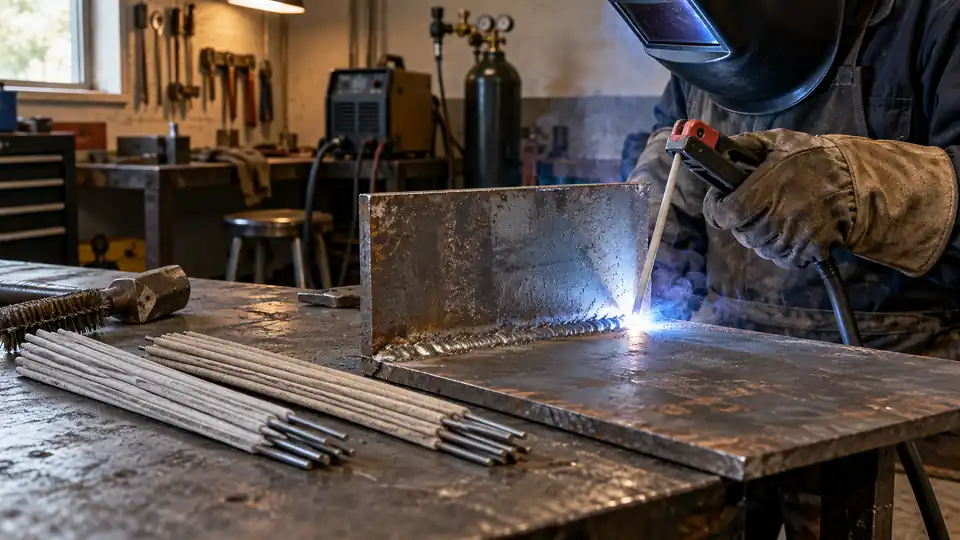
If you are comparing a 6011 vs 7018 welding rod, the central difference is electrode behavior. E6011 is valued for deep penetration, forceful arc action, and its ability to run on AC or DC in many welding machines. E7018 produces a smoother, quieter arc with a controlled puddle and is widely chosen for clean steel, structural work, and welds where low-hydrogen practice matters.
That distinction becomes obvious during a repair. A 6011 electrode can dig through light rust or mill scale and reach the root of a joint, while a 7018 rod usually feels calmer and lays down a fuller, cleaner bead on properly prepared metal. Neither electrode is universally superior. The better choice depends on the steel condition, joint design, welding position, machine output, and the quality requirements of the finished weld.
6011 vs 7018: Key Differences
| Practical factor | E6011 | E7018 |
|---|---|---|
| Electrode type | Cellulosic electrode with a forceful arc | Low-hydrogen electrode with iron powder in the coating |
| Typical arc behavior | Digging, fast-freezing, and penetrating | Smooth, stable, and comparatively soft |
| Penetration | Generally deep | Generally moderate, with a fuller weld deposit |
| Typical current | AC or DC, according to the electrode and machine instructions | Often DC electrode positive, with AC versions available |
| Steel condition | More tolerant of light surface contamination | Best results usually require clean, well-prepared steel |
| Slag and cleanup | Often lighter or more irregular slag that requires attention | Usually a substantial slag coating that must be removed between passes |
| Typical use | Repair work, root passes, outdoor work, and less-than-perfect surfaces | Structural fabrication, equipment repair, and clean steel applications |
| Storage sensitivity | Generally less demanding than low-hydrogen electrodes | Requires careful moisture control according to manufacturer instructions |
The numbers also communicate a strength classification. The “60” in E6011 identifies a minimum tensile-strength category of 60 ksi, while the “70” in E7018 identifies a 70 ksi category. That number does not tell you how easy the rod is to use, how deep it will penetrate, or whether it suits a particular joint. A higher classification number is not a universal instruction to choose 7018.
What E6011 Does Best
E6011 has a sharp, digging arc that can help the welder reach the bottom of a joint. That makes it useful for open-root joints, repair work, and steel with light rust, paint residue, or mill scale that cannot be completely removed. Surface preparation still matters, but E6011 is often more forgiving than a low-hydrogen electrode in a rough repair setting.
Picture a gate hinge that has cracked beside an old weld. The steel may be weathered, the joint may be awkward, and the work may happen outside where a shielding gas setup would be inconvenient. A properly selected 6011 rod can handle that kind of practical challenge, provided the welder removes loose contamination and controls heat so the thin surrounding metal does not burn away.
The arc can feel aggressive, with more visible digging and a faster-freezing puddle. That fast freeze helps with vertical-up and overhead work, where a slow, fluid puddle can sag. It also demands a steady hand. If the arc length grows too long or the rod angle wanders, the result may be spatter, an irregular bead, or trapped slag.
A 6011 rod often leaves a rougher-looking bead than 7018, especially in the hands of a newer welder. That appearance alone does not prove the weld is defective, but it does mean cleaning, fusion, bead shape, and visible discontinuities deserve close inspection. On thin sheet, its deep penetration can also create burn-through if amperage and travel speed are poorly matched.
What E7018 Does Best
E7018 is a low-hydrogen, iron-powder electrode. Its arc generally feels smoother, and its puddle tends to stay fluid enough for a controlled, attractive bead. The coating produces a substantial slag layer that helps shape and protect the weld as it cools, although that slag must be removed before adding another pass.
Consider a clean piece of mild-steel plate being joined for a bracket or frame. With the joint properly fitted and the rod kept dry, E7018 can provide a steady puddle that makes it easier to build a neat fillet or groove weld. The slower, more deliberate rhythm can feel almost luxurious after the punchy action of 6011, but poor starts and stops still show if technique slips.
Low-hydrogen practice matters because hydrogen entering the weld area can contribute to delayed cracking under certain conditions, especially in restrained joints and susceptible steels. E7018 does not erase that risk. The electrode must be stored, handled, and used according to the manufacturer’s instructions, and the joint still needs suitable preparation and welding procedure control.
A damp box of 7018 rods should not be treated like a fresh package. Moisture exposure can change the electrode’s low-hydrogen performance, so storage temperature, holding conditions, and any reconditioning guidance should come from the product documentation. The practical lesson is simple: 7018 rewards discipline, while casual storage can undermine the reason for choosing it.
Polarity and Machine Compatibility
Electrode classification gives useful direction, but the exact product label remains the final authority. Many E6011 electrodes are intended for AC or DC electrode-positive operation. E7018 electrodes are commonly used with DC electrode positive, while some versions are specifically formulated for AC. A machine that offers only one current type may therefore be a better match for one package of rods than another.
This matters in a garage repair. A small transformer machine with AC output may run an AC-rated 7018, but a package labeled for DC operation alone may start poorly or produce an unstable arc on that machine. A welder with DC output provides more electrode choices, yet the lead connections and polarity still need to match the consumable instructions.
Check the electrode package and the welder manual before striking an arc. Rod diameter, amperage range, current type, and polarity work together. Changing from a 1/8-inch rod to a smaller diameter changes the heat and deposition behavior, so copying a setting from another size can create a puddle that feels too cold, too hot, or impossible to control.
Which Rod Should You Choose?
Choose 6011 for penetration and imperfect surfaces
E6011 is often the practical choice for outdoor repairs, rusty farm equipment after reasonable cleaning, open-root joints, and situations where a forceful arc helps reach the joint bottom. It can also be useful for vertical and overhead work because the puddle freezes relatively quickly.
- Use it for repair jobs where the steel cannot be brought to a perfectly clean condition.
- Use it for root passes when the joint design calls for strong penetration and the procedure permits it.
- Use it when the machine and electrode package support the available AC or DC output.
- Watch thin material carefully because deep penetration can increase burn-through risk.
Choose 7018 for smooth deposits and low-hydrogen practice
E7018 is often a better fit for clean carbon-steel fabrication, structural components, thicker material, and welds that benefit from a smooth, controlled deposit. It is especially appropriate when the welding procedure specifies a low-hydrogen electrode and the required storage and handling controls can be maintained.
- Use it on clean steel with a joint fit-up that supports a controlled puddle.
- Use it where bead appearance, fill, and a smooth arc are valuable practical benefits.
- Use it for applications that specify a 70-class low-hydrogen electrode.
- Keep the rods protected from moisture and follow the manufacturer’s holding instructions.
A common repair sequence may use both electrodes. A welder might use 6011 for a root pass where penetration and gap control matter, then use 7018 for fill or cap passes when the procedure allows that combination. The correct sequence depends on the joint, base metal, code or procedure requirements, and the consumable manufacturer’s guidance. Mixing rods casually is poor practice, but using different electrodes for different passes can make technical sense.
Arc Feel, Slag, and Bead Appearance
The difference is easy to notice at the puddle. E6011 tends to produce a more forceful arc with a distinct digging sensation. Its slag may be thinner or less continuous, and the bead can show a more textured profile. That character helps with penetration, although it can punish a long arc and uneven travel speed.
E7018 generally produces a smoother arc and a more fluid puddle. Its slag often covers the bead thoroughly and may lift away cleanly after the weld cools enough for safe cleaning. A chipping hammer and wire brush still have work to do, especially between passes, since slag left in the joint can become an inclusion.
Neither rod should be judged by appearance alone. A shiny cap can hide poor fusion, and a rough 6011 bead can still be acceptable if the weld meets the applicable requirements. Check the joint preparation, fusion at the toes, crater fill, undercut, porosity, slag removal, and the procedure for the job rather than chasing cosmetic perfection.
Storage, Surface Preparation, and Technique
Surface condition changes the decision. Remove loose rust, paint, oil, moisture, and scale as far as practical, regardless of rod choice. E6011 can tolerate more surface imperfection, but contamination still creates fumes, porosity, and inconsistent arc behavior. A quick pass with a wire wheel may reveal a deeper problem that the arc would otherwise hide under a shower of sparks.
Storage separates the two electrodes most clearly. E7018 is a low-hydrogen rod, so moisture control is part of using the consumable correctly. Follow the manufacturer’s instructions for unopened packages, opened packages, holding ovens, and reconditioning. Do not assume every brand or formulation has identical requirements.
Technique also shifts between the rods. E6011 usually responds well to a short arc and controlled manipulation suited to the joint and position. E7018 is commonly run with a short arc as well, with deliberate travel and careful slag removal between passes. Excessive weaving can overheat the joint or trap slag, while moving too quickly can leave an undersized or poorly fused weld.
6011 vs 7018 for Common Welding Jobs
| Job condition | Rod that may fit better | Reason |
|---|---|---|
| Outdoor repair with light surface rust | E6011 | Forceful penetration and greater tolerance of less-than-perfect surfaces |
| Clean structural steel with a specified low-hydrogen procedure | E7018 | Low-hydrogen classification and controlled weld deposition |
| Open-root joint requiring strong penetration | Often E6011, if the procedure permits | Fast-freezing arc and digging penetration |
| Thin sheet or light tubing | Depends on thickness, joint, and procedure | Either rod can cause problems if the heat input is poorly controlled |
| AC-only machine | An AC-rated version of the selected electrode | Current compatibility depends on the exact product formulation |
| Rod storage exposed to humidity | Neither should be used casually | Moisture can affect arc behavior and weld quality, especially with 7018 |
Frequently Asked Questions
Is 7018 stronger than 6011?
E7018 belongs to a higher tensile-strength classification than E6011, represented by the “70” and “60” in their designations. Weld performance still depends on joint design, base metal, fit-up, procedure, technique, and inspection. A higher classification does not make 7018 the right rod for every repair.
Can 6011 and 7018 be used on the same project?
They can be used on the same project when the welding procedure and joint requirements support that combination. A common approach is using 6011 for penetration at the root and 7018 for later passes, but the correct sequence depends on the application. Follow the job specification and consumable documentation.
Which rod is easier for a beginner?
Neither is effortless. E6011 can start and penetrate effectively, but its aggressive arc and fast-freezing puddle may feel demanding. E7018 often has a smoother arc and easier bead control, but moisture-sensitive storage and slag removal add responsibility. Practice with the rod, diameter, and current type that match the actual machine and project.
Can E7018 weld rusty steel?
It can deposit metal on steel that is not perfectly clean, but rust, oil, paint, moisture, and scale can reduce weld quality. Clean the joint as thoroughly as practical before using E7018. Low-hydrogen performance depends on more than the letters printed on the package.
Which rod is better for vertical welding?
E6011’s fast-freezing puddle can make vertical and overhead work manageable, while E7018 is also used in those positions with suitable technique and a compatible classification. Position, rod diameter, amperage, joint fit-up, and the product’s position rating all matter.
The Practical Choice
Choose E6011 when penetration, outdoor repair work, AC compatibility, or less-than-perfect steel condition leads the decision. Choose E7018 when clean steel, smooth deposition, low-hydrogen practice, and a controlled structural-style weld are more important. Before starting, verify the exact electrode instructions, current and polarity requirements, rod condition, joint preparation, and any procedure governing the work.
The best answer in the 6011 vs 7018 welding rod comparison comes from the job rather than the rod number alone. One electrode reaches aggressively into a difficult joint. The other rewards clean preparation and careful handling with a smooth, substantial deposit. Matching that behavior to the repair is what produces a sounder result.
