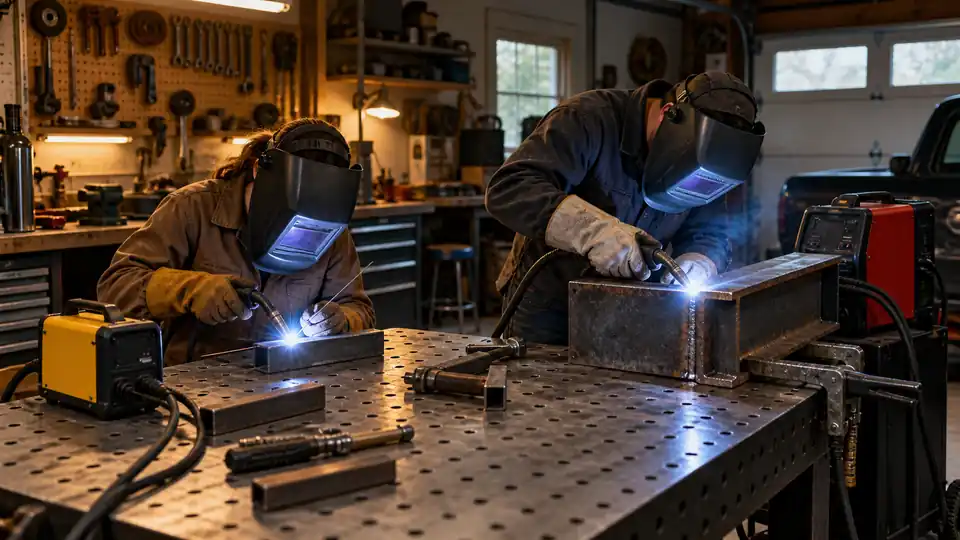
The choice between a 110V vs 220V welder usually comes down to available electrical power, the welding process, material thickness, and how long you need to weld before cooling pauses. A 110V machine can be convenient for garage repairs, light fabrication, and portability. A 220V machine generally gives the welder more electrical capacity for higher output and longer work cycles, provided the machine and circuit are properly matched.
The voltage rating does not tell the whole story. A well-designed 110V welder may be the smarter tool for thin steel and occasional repairs, while a 220V model may make more sense for heavier fabrication. The practical question is whether the machine can deliver the required output on the circuit available at your work area.
110V and 220V Welders: The Central Difference
A 110V welder draws power from a common household-style circuit. Product labels may also use 120V, depending on the electrical system and the manufacturer’s terminology. A 220V welder uses a higher-voltage circuit, often listed as 220V, 230V, or 240V. Those labels refer to nominal input categories, so the exact requirement must come from the machine manual and rating plate.
Higher input voltage can allow a machine to draw the power needed for greater welding output without demanding as much input current as a comparable machine operating at a lower voltage. That can give a 220V model more room for higher amperage, thicker material, or repeated welds. It does not automatically make every weld better, however. Wire size, polarity, material preparation, settings, technique, and machine design still shape the finished bead.
| Comparison point | 110V welder | 220V welder |
|---|---|---|
| Typical electrical access | Often compatible with common household-style receptacles, subject to the machine requirements | Requires a suitable higher-voltage circuit and receptacle |
| Portability | Usually convenient for garages, driveways, service calls, and temporary work areas | Can be portable, but the work area must provide the correct higher-voltage supply |
| Output headroom | Often more limited by available input power | Often provides more room for higher output, depending on machine design |
| Typical workload | Light repairs, thin material, small fabrication, and intermittent welding | Repeated welds, heavier fabrication, thicker material, and more demanding production work |
| Duty-cycle potential | May require more cooling pauses at higher settings | May support longer work periods, but the rated amperage and test conditions still matter |
| Electrical setup | Still requires a properly rated circuit, extension arrangement, and receptacle | May require a dedicated circuit or electrical work that follows local code and manufacturer requirements |
Think of the input voltage as part of the machine’s working envelope rather than a quality score. A compact 110V MIG welder can feel nimble while repairing a small bracket on a workbench. A 220V machine can feel far less restricted during a long fabrication session, but only if the available circuit and the machine’s output ratings support that workload.
How Input Voltage Changes Welding Performance
Available amperage and arc stability
Welding output requires electrical power. As output rises, the machine needs more input capacity to maintain the arc and run its internal components. A 110V unit may reach its useful operating limit sooner, especially during demanding MIG, flux-cored, or stick welding tasks. The arc can become harder to maintain near the machine’s limits, with reduced control over the weld pool.
A 220V model often has more electrical headroom, which can help it maintain a steadier arc at higher settings. That advantage matters during a repair involving a thicker joint, where a low-output machine may need several passes and frequent pauses. The exact result still depends on the machine’s rated output, input current, duty cycle, and process, so voltage alone cannot predict performance.
Duty cycle and cooling pauses
Duty cycle describes how long a welder can operate within a stated test period at a specified output before it needs to cool. The percentage must be read alongside the amperage and test basis. A rating at one output does not apply automatically at every other output, and ratings from different machines may use different conditions.
For a homeowner making two short tack welds on a gate latch, duty cycle may barely enter the decision. A person fabricating a frame with repeated beads may notice every cooling pause, especially if the 110V machine is being pushed near its upper range. A 220V welder may provide more useful capacity for that job, but its actual rating deserves a close look rather than a guess based on the plug alone.
Penetration and material thickness
Input voltage does not directly determine penetration. Welding current, arc voltage, travel speed, electrode or wire selection, joint design, and material preparation all affect how much heat enters the workpiece. Still, the input supply can limit how much output the machine can sustain, which affects the practical thickness range of the setup.
A 110V welder may suit thin sheet, small tubing, light brackets, and repair work where short welds are typical. A 220V model may be more suitable for heavier joints or repeated passes, provided its specifications support the selected process. Check the manufacturer’s output and material guidance for the exact model instead of treating every machine in a voltage category as identical.
Choosing by Welding Process
MIG and flux-cored welding
MIG welding, technically gas metal arc welding, uses a continuously fed wire. A 110V MIG machine can be convenient for automotive repairs, small fabrication projects, and light shop work. Its performance depends on wire diameter, wire feed speed, voltage adjustment, shielding gas, polarity, and the machine’s rated output.
Flux-cored welding uses a tubular wire that contains flux. Self-shielded flux-cored wire can be useful outdoors because it does not require an external shielding-gas bottle, although wind can still affect the weld area and fumes and cleanup differ from solid-wire MIG. A machine that supports flux core does not automatically offer the same behavior or settings as a solid-wire MIG setup.
For example, a person repairing a thin utility trailer in a garage may value a 110V wire welder that is easy to move beside the work. Someone fabricating heavier brackets throughout a long afternoon may prefer a 220V MIG or flux-cored machine because the added input capacity can reduce the need to operate at the edge of the welder’s range. Neither choice removes the need for correct wire, polarity, shielding, and preparation.
Stick welding
Stick welding, also called shielded metal arc welding, can work well for outdoor repairs and dirty or weathered steel when the electrode and settings suit the job. The power demand varies with electrode type, diameter, welding current, and machine design. A 110V stick welder may be useful for lighter repairs, while a 220V unit commonly offers more room for larger electrodes or longer welds.
Electrode selection remains central. A machine’s ability to operate from 220V does not mean every electrode is appropriate, and a 110V label does not automatically make a welder unsuitable for useful repair work. Read the output range, polarity options, and recommended electrode information together.
TIG welding
TIG welding uses a nonconsumable tungsten electrode and a separate filler rod when filler is needed. Input voltage can affect the available output and duty cycle, but the process has other requirements that deserve equal attention. A machine labeled TIG may offer lift-TIG capability without including a TIG torch, gas hose, foot pedal, or high-frequency start.
Aluminum TIG work requires AC capability. A 220V machine is not automatically an AC TIG welder, and a 110V machine is not automatically limited to steel. Check whether the model supports AC, the type of start provided, amperage control, torch connections, and the accessories supplied or sold separately.
When a 110V Welder Makes More Sense
A 110V model can be a practical choice when the work consists of short welds on relatively light material and the job site lacks a suitable higher-voltage circuit. It may also be useful for a mobile repair setup where carrying a compact machine matters more than sustaining high output. A receptacle that looks convenient still needs to meet the machine’s input and circuit requirements.
- Small brackets, tabs, stands, and light fixtures
- Thin-wall tubing and sheet metal within the machine’s documented range
- Short repair welds with cooling time between sections
- Garage or home projects where portability matters
- Occasional MIG, flux-cored, stick, or TIG work suited to the specific model
Consider a small repair table with a few short joints. A portable 110V machine may be ready near the bench without rearranging the shop’s electrical service. That convenience has real value, especially when the alternative is leaving the project unfinished because the machine cannot reach the work area or the required circuit is unavailable.
The trade-off appears when the work expands. Long beads, thicker joints, large electrodes, or repeated high-output passes can push a compact unit toward its limits. Cooling pauses and reduced output may turn a quick repair into a stop-and-start session with a stubborn rhythm.
When a 220V Welder Makes More Sense
A 220V machine is often the stronger fit for heavier fabrication, frequent welding, and work that requires more sustained output. The higher-voltage supply can give the machine greater electrical capacity, but the machine’s specifications still control the final result. A 220V welder with modest output is not automatically more capable than every 110V model.
- Repeated welds on thicker material
- Fabrication work that demands fewer cooling pauses
- Processes or settings that approach the upper end of a 110V machine’s range
- Regular use in a shop with a suitable higher-voltage circuit
- Projects where larger electrodes, wire sizes, or higher output may be required
A fabricator assembling several steel frames may spend more time waiting for a small machine to cool than actually moving the torch or electrode. A suitable 220V unit can provide more working headroom for that kind of schedule. It still needs correct settings and a properly rated circuit, so the plug is only the beginning of the evaluation.
The cost and installation side also matters. A higher-voltage machine may require a dedicated circuit, a suitable receptacle, or professional electrical work. Follow the manufacturer’s requirements and applicable electrical codes. Do not improvise wiring, defeat circuit protection, or assume an existing outlet is suitable because its shape appears compatible.
Dual-Voltage Welders: A Flexible Middle Path
A dual-voltage welder can operate from two input-voltage categories, commonly a lower household-style supply and a higher-voltage supply. This flexibility can be useful for mobile work, since the same machine may travel to a customer’s garage, a farm repair area, or a shop with a stronger circuit.
Dual-voltage does not mean full advertised output at both voltages. Many machines provide different output limits, duty-cycle ratings, or input-current requirements depending on the supply used. The manual may also specify different circuit requirements, plug arrangements, and performance limits.
Imagine a repair business carrying one machine between a home workshop and a fabrication shop. The lower-voltage connection may handle a small gate repair, while the higher-voltage connection may provide greater output for heavier work. That convenience is valuable only when the user checks the model’s ratings instead of assuming both power sources deliver identical performance.
What to Check Before Buying
Read the input and output specifications together
Start with the machine’s input voltage, required input current, rated welding output, and duty-cycle information. Output amperage by itself can be misleading. A machine may advertise a high maximum output that is available only briefly, while its continuous or duty-cycle rating describes a different working condition.
Look for the process modes as well. MIG, flux core, stick, and TIG support may have separate output ranges and requirements. A machine that supports one process at a useful level may offer another process only in a limited form.
Match the machine to the circuit
The receptacle, wiring, circuit protection, extension arrangement, and machine plug must all match the manufacturer’s requirements. Long or undersized extension cords can contribute to voltage drop and heating, which may affect machine performance and create a safety concern. Follow the manual and applicable electrical rules rather than selecting a cord or breaker by guesswork.
For a workshop with only standard lower-voltage receptacles, a 110V or dual-voltage machine may be more practical. A shop already equipped with a suitable higher-voltage circuit may gain more value from a 220V model. If the circuit needs modification, use qualified electrical help where required.
Think about the actual work pattern
Write down the material types, approximate thicknesses, process, electrode or wire choices, and typical weld length. A person welding a few small tabs each month has a different requirement from someone building trailers every week. This simple list often reveals whether portability or sustained output deserves priority.
Also account for where the work happens. A 220V machine sitting beside an unavailable receptacle is less useful than a properly matched 110V unit that can reach the repair area. A 110V machine that spends every session at its limit may create frustration that a higher-voltage model would avoid.
Common Misunderstandings About 110V and 220V
“220V always produces a stronger weld”
Weld strength comes from a sound joint, suitable penetration, correct consumables, proper settings, and good technique. A higher input voltage can support a machine with greater output capacity, but it does not repair poor fit-up or incorrect polarity. A carefully made weld from a properly matched 110V machine can be more reliable than a poorly set 220V machine.
“A 110V welder can weld only thin sheet”
Lower-voltage machines vary widely. Some are intended for light material, while others provide useful output for a broader range of repair work. The manufacturer’s specifications and recommended settings are more meaningful than the input label alone. Material thickness, joint design, process, and number of passes all affect the result.
“A higher-voltage outlet makes any welder more powerful”
A machine must be built to accept the higher input voltage. Plugging equipment into an incompatible supply can damage it and create a serious electrical hazard. A dual-voltage machine must also be configured as specified, with the correct plug and circuit arrangement.
“Maximum amperage tells me which machine is better”
Maximum amperage is one specification, not a complete performance description. Compare the output at the intended process, duty cycle at that output, input requirements, adjustment range, polarity, included accessories, and material guidance. A realistic operating range matters more than a single peak number printed on a box.
Frequently Asked Questions
Is a 220V welder better than a 110V welder?
Neither is universally better. A 220V model often suits higher-output and more frequent work, while a 110V model may be the better match for portability, light repairs, and locations without a suitable higher-voltage circuit. The machine’s output and duty-cycle ratings must match the job.
Can a 110V welder weld thick metal?
Some 110V welders can handle thicker material through appropriate joint preparation, settings, and multiple passes. The exact capability depends on the process, machine output, consumable, joint design, and material. Use the manufacturer’s guidance instead of relying on the input voltage alone.
Does a 220V welder use less electricity?
Higher voltage can reduce the input current needed for a given amount of electrical power, but total energy use depends on the machine, output, welding time, efficiency, and workload. A 220V rating does not automatically mean lower operating cost.
Can a dual-voltage welder produce the same output on 110V and 220V?
Usually, you should not assume that. Many dual-voltage machines have different output or duty-cycle limits on the two supplies. Check the exact manual and rating label for the operating limits at each voltage.
Do I need an electrician to install a 220V welder circuit?
Follow the equipment manual, local electrical codes, and the requirements in your area. Circuit changes can involve shock, fire, equipment-damage, and code-compliance risks, so qualified electrical assistance may be appropriate rather than improvised wiring.
The Practical Choice
Choose a 110V welder when accessible power, portability, and intermittent light-to-moderate work are the priorities. Choose a 220V welder when the job regularly demands higher output, repeated welds, or more operating headroom and a suitable circuit is available.
The best 110V vs 220V welder decision comes from matching the machine’s documented input, output, duty cycle, process support, and electrical requirements to the work in front of you. Voltage sets an important boundary, but the quality of the weld still depends on the complete setup.
