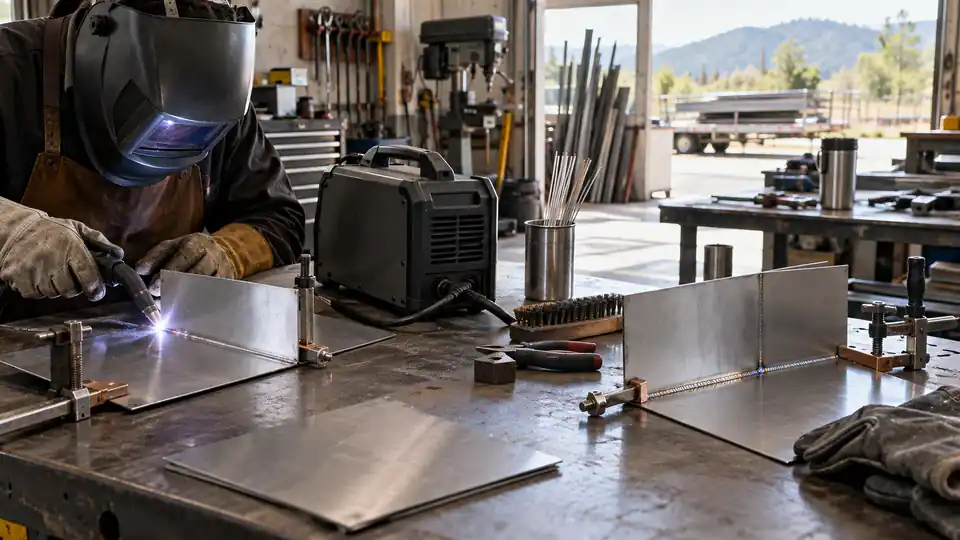
Thin metal rewards control more than brute force. A machine can advertise a high maximum amperage and still be a poor match for sheet metal if its low-end adjustment is coarse, its wire feed is difficult to tune, or its process puts too much heat into a small panel. For this type of work, MIG, flux-core, pulse MIG, and resistance spot welding each solve a slightly different problem.
The strongest choice depends on the job. A pulse or spot mode can help limit heat concentration on automotive panels, while a conventional MIG machine gives more flexibility for brackets, tubing, and general repairs. Buyers also need to separate genuine process capability from accessories that are merely compatible. A Lift TIG torch sold separately, for example, does not turn a basic wire-feed setup into a ready-to-use TIG system.
This guide weighs low-end control, input voltage, process support, portability, included equipment, and the limits stated in each product listing. The ARCCAPTAIN MIG205DP Pro leads the group for buyers who want the most control over thin material, while the SSimder offers a more accessible route to pulse and timed spot welding.
Quick Answer
- Best Overall: ARCCAPTAIN MIG205DP Pro for pulse control, dual-voltage flexibility, and dedicated spot-welding modes.
- Best for Automotive Panels: SSimder 5-in-1 MIG Welder because its listing specifically identifies pulse and timed spot functions for thin sheet metal.
- Best Established Brand: Lincoln Electric 90i MIG and Flux Core for straightforward 120V operation and a simple two-control layout.
- Best Budget Multi-Process Option: Futelo 160A MIG Welder for dual-voltage input, synergic adjustment, and four welding modes in a compact package.
Best Welder for Thin Metal Comparison Table
| Product | Best For | Thin-Metal Advantage | Input and Process |
|---|---|---|---|
| ARCCAPTAIN MIG205DP Pro | Best overall control | Single and double pulse, spot mode | 120V/240V, 8 modes |
| SSimder 5-in-1 MIG Welder | Automotive sheet metal | Pulse and timed spot welding | 110V/220V, 5 modes |
| Lincoln Electric 90i MIG and Flux Core | Simple 120V MIG work | Fine voltage adjustment | 120V, MIG and flux-core |
| ARCCAPTAIN 165A MIG Welder | Dual-voltage versatility | Synergic or manual MIG control | 110V/220V, 4 modes |
| Lincoln Electric 90i FC | Portable outdoor repairs | Simple flux-core setup | 120V, flux-core |
| Futelo 160A MIG Welder | Budget multi-process use | Synergic wire-feed adjustment | 110V/220V, 4 modes |
| ARCCAPTAIN 135A MIG Welder | Compact 110V setup | Thickness-based recommended settings | 110V, 3 modes |
| 145A MIG Stick Welder | Portable starter kit | Synergic MIG controls | 110V, 3 modes |
| Stark USA Portable Spot Welder | Resistance spot joints | Electrode pressure and timed contact | 110V, spot welding |
The detailed reviews below explain where each machine fits, where its thin-metal advantages end, and which trade-offs deserve attention before ordering.
1. ARCCAPTAIN MIG205DP Pro — Best Overall

Thin sheet metal is where pulse control earns its place. The ARCCAPTAIN MIG205DP Pro supports single-pulse and double-pulse MIG, giving buyers more ways to manage heat input than a basic flux-core machine. Its listing specifically positions single pulse for thin sheet repair and includes a separate spot-welding mode, so this machine addresses the central problem directly rather than relying on a high maximum amperage alone.
The dual-voltage design also gives it a wider operating envelope. A 120V circuit can handle lighter work, while 240V input is available when the project needs more output. The machine supports gas MIG, gasless flux-core, Stick, Lift TIG, spot welding, and spool-gun MIG, although the TIG torch and spool gun are sold separately. That range is useful for a workshop handling panels one day and heavier brackets the next, but the extensive controls may be more than a buyer needs for occasional repairs.
Pros
- Single and double pulse MIG modes are specifically suited to more controlled thin-metal work.
- Dedicated spot-welding mode adds a useful option for panels and short welds.
- 120V and 240V input supports both household circuits and higher-output workshop setups.
- Full-color LCD, synergic presets, and manual controls allow different levels of adjustment.
- Supports gas MIG, flux-core, Stick, Lift TIG, and spool-gun MIG in one machine.
Cons
- TIG torch and spool gun are compatible accessories rather than included equipment.
- The large process and parameter menu may be excessive for simple occasional sheet-metal work.
This is the strongest overall fit for buyers who expect thin metal to be one part of a broader welding routine. Pulse and spot modes address heat control more directly than a standard multi-process machine, while 120V/240V input prevents the unit from being tied to one power setup. Buyers who only need short 120V MIG repairs may prefer the simpler Lincoln 90i, but those wanting room to expand should give this model a close look.
To buy this product, click here.
2. SSimder 5-in-1 MIG Welder — Best for Automotive Panels

The SSimder earns this position because its published feature set speaks directly to thin sheet metal. Alongside flux-core MIG, Lift TIG, and Stick, it includes pulse MIG and timed spot welding. The listing identifies spot mode for auto-body panels, thin brackets, and exhaust hangers, where a concentrated weld can be preferable to a long continuous bead that spreads heat across a light panel.
Synergic control is another practical feature. It automatically matches current and wire speed according to the selected setup, reducing the number of adjustments needed during initial setup. The machine accepts 110V and 220V input, so it can move from a garage outlet to a workshop circuit, although its listing does not provide a detailed duty-cycle schedule for each voltage and amperage combination. A WP17V TIG torch is sold separately.
Pros
- Pulse MIG and timed spot modes directly target thin sheet-metal applications.
- Dual-voltage input offers flexibility between household and workshop circuits.
- Synergic control can simplify initial wire-feed and current selection.
- Flux-core operation allows gasless outdoor repairs.
- Includes a MIG torch, flux-core wire, electrode holder, ground clamp, and conversion cord.
Cons
- The WP17V TIG torch is sold separately.
- The available listing does not clearly detail duty-cycle conditions for each input setting.
This machine makes sense for someone focused on automotive-style panels but still wanting a general-purpose unit nearby. The spot function is the key distinction, while pulse MIG offers another way to moderate heat during a bead. Buyers should still verify settings, material thickness, and joint preparation before welding a visible panel, since no machine can remove the need for correct fit-up and technique.
To buy this product, click here.
3. Lincoln Electric 90i MIG and Flux Core — Best Established 120V Option

A simple control panel can be an advantage on thin metal, where constant small adjustments are often more useful than a deep menu of welding modes. The Lincoln Electric 90i MIG and Flux Core uses two knobs for wire speed and voltage, with infinite voltage adjustment for finer tuning. It accepts 120V input and supports both solid-wire MIG and flux-core welding, giving it more material and environment flexibility than a flux-core-only unit.
The listing identifies a published maximum thickness of 3/16 inch for solid MIG wire and 1/4 inch for flux-core wire. Those figures are application claims rather than guarantees for every joint, but they help place the machine in the light-duty category. At 15 pounds, with a shoulder strap and protective metal case, it is easier to move than many larger workshop machines. The trade-off is a narrower process range and no documented pulse or dedicated spot mode.
Pros
- Infinite voltage adjustment supports more precise tuning than fixed-output controls.
- Supports both solid-wire MIG and flux-core welding.
- 120V input fits common household workshop circuits.
- 15-pound inverter design includes a shoulder strap and protective metal case.
- Included gun, nozzle, contact tip, work cable, and clamp simplify initial setup.
Cons
- No documented pulse or dedicated spot-welding mode for specialized panel work.
- 120V-only input offers less flexibility than the dual-voltage machines here.
The Lincoln is a sensible choice for thin brackets, light tubing, and repair work where a straightforward MIG or flux-core process matters more than advanced waveform control. It ranks below the pulse-capable machines for delicate automotive panels, yet its simple adjustment layout may be easier to learn and repeat. Buyers who want one compact 120V machine without a long list of optional accessories may find its narrower scope reassuring.
To buy this product, click here.
4. ARCCAPTAIN 165A MIG Welder — Best Dual-Voltage Generalist

Thin-metal work often starts on a 110V circuit, then moves to a 220V setup as projects grow. The ARCCAPTAIN 165A accommodates both, with gas MIG, flux-core MIG, Lift TIG, and Stick modes. Its synergic MIG setting can recommend parameters based on plate thickness, voltage, and welding speed, while manual MIG adjustment remains available for users who prefer direct control.
The manufacturer or product listing identifies a 60% duty cycle and output up to 165A, but the available information does not attach that duty-cycle figure to every operating condition. Its 2T and 4T trigger modes are more useful for controlling short or extended welds than for thin-metal performance by themselves. The machine weighs 12.8 pounds and accepts only a 2-pound spool, a compact arrangement that keeps the package mobile but limits wire capacity.
Pros
- 110V/220V input supports changing power environments.
- Synergic and manual MIG modes accommodate different setup preferences.
- Gas MIG and flux-core MIG cover indoor and outdoor wire-feed work.
- Published specifications identify a 60% duty cycle and output up to 165A.
- 12.8-pound body includes a handle and shoulder strap for transport.
Cons
- Only a 2-pound wire spool fits the machine, requiring more frequent changes during longer work.
- The Lift TIG torch is sold separately, and Lift TIG is not the same as high-frequency TIG.
This model suits buyers who want a compact wire-feed machine with more power flexibility than the Lincoln 90i. Its synergic mode may shorten setup time, while manual controls leave room for adjustment when a recommended setting needs refinement. It is less specialized for thin panels than the pulse and spot models, but it covers a wider mix of repair tasks without becoming a large shop machine.
To buy this product, click here.
5. Lincoln Electric 90i FC — Best Portable Flux-Core Option

The flux-core-only version of Lincoln’s 90i focuses on mobility and uncomplicated setup. It runs from 120V input, weighs 15 pounds, and includes a shoulder strap plus a protective metal case. For a repair kit that may travel between a garage, a trailer, or a maintenance area, those details matter because the machine can be carried without building a larger cart around it.
Two controls govern wire speed and voltage, with infinite voltage adjustment for tuning the arc. The listing states that the machine can weld up to 1/4 inch, though the practical result depends on joint design, material, wire, preparation, and settings. Flux-core wire does not require shielding gas, which helps outdoors, but this model cannot provide the cleaner solid-wire MIG option found on the Lincoln 90i MIG and Flux Core.
Pros
- Flux-core operation avoids the need for a shielding-gas bottle.
- 120V input supports work where higher-voltage power is unavailable.
- 15-pound inverter body includes a shoulder strap and protective metal case.
- Infinite voltage adjustment gives more tuning range than fixed settings.
- Included welding gun, contact tip, work cable, and clamp support a basic setup.
Cons
- Flux-core-only operation provides less indoor process flexibility than a MIG and flux-core model.
- No documented pulse or spot mode for especially heat-sensitive sheet metal.
Choose this Lincoln when portability and gasless operation matter more than process variety. It can make sense for occasional repairs on light steel, especially where wind makes gas shielding inconvenient. For clean indoor sheet-metal work, the dual-process Lincoln 90i is the more flexible sibling, while the SSimder and ARCCAPTAIN MIG205DP offer more direct heat-control features.
To buy this product, click here.
6. Futelo 160A MIG Welder — Best Budget Multi-Process Option

The Futelo combines gas MIG, gasless flux-core, Stick, and Lift TIG in a 7.7-pound package. Its dual-voltage design and synergic control are the most relevant features for thin-metal buyers. Rather than requiring every voltage and wire-feed adjustment from the start, the system is intended to match settings according to the selected amperage, while the display shows the current output.
That light weight makes storage and transport easy, but it should not be mistaken for proof of a higher duty cycle or industrial endurance. The listing includes a MIG torch, gas hose, flux-core wire, ground clamp, electrode holder, contact tips, and other starter accessories. The Lift TIG torch is not included, so the TIG mode requires another purchase and should be viewed as an expansion path rather than a complete TIG package.
Pros
- 7.7-pound body is easy to carry and store in a small workspace.
- 110V/220V input expands installation flexibility.
- Synergic control can simplify initial MIG parameter selection.
- Four modes cover gas MIG, flux-core, Stick, and Lift TIG.
- Starter package includes a MIG torch, gas hose, wire, leads, and contact tips.
Cons
- Lift TIG requires a separately purchased torch.
- The available information does not clearly publish a duty-cycle schedule for thin-metal work.
This is a reasonable entry point for light repairs where low equipment weight and a broad process menu are priorities. The synergic controls may be useful for someone learning how wire speed and voltage interact, although thin panels still require careful travel speed and heat management. Buyers who want documented pulse or timed spot functions should move up to the SSimder rather than expecting a standard synergic mode to provide the same control.
To buy this product, click here.
7. ARCCAPTAIN 135A MIG Welder — Best Compact 110V Setup

For a small garage where a 110V outlet is the practical limit, the ARCCAPTAIN 135A keeps the setup compact at a listed 9.48 pounds. It combines gasless flux-core MIG, Stick, and Lift TIG, with a digital display and a mode that recommends wire speed and voltage based on wire size and metal thickness. That thickness-oriented adjustment is useful for a new operator who needs a starting point before making finer changes.
Manual adjustment remains available, including a small voltage fine-tuning range for MIG and hot-start and arc-force adjustments for Stick. The product listing also identifies over-current, overload, overheating, and over-voltage protection. Lift TIG is supported, but the torch is an extra purchase, and the machine does not offer gas MIG or a documented pulse mode, which limits its usefulness for the most heat-sensitive panels.
Pros
- 9.48-pound design includes a handle and shoulder strap.
- 110V input suits common household circuits.
- Thickness and wire-size selections provide recommended MIG settings.
- Manual fine adjustment remains available after the suggested setup.
- Supports flux-core MIG, Stick, and Lift TIG in one compact unit.
Cons
- Lift TIG torch is sold separately.
- No gas MIG or documented pulse and spot modes are listed.
This model fits light flux-core repairs and basic practice on thin steel where portability matters more than process range. Its display and recommended settings may reduce the initial guesswork, but they do not replace test pieces and careful heat control. Buyers working on clean automotive panels may prefer the SSimder’s spot mode, while those needing gas MIG should look toward the ARCCAPTAIN 165A or Futelo.
To buy this product, click here.
8. 145A MIG Stick Welder — Best Lightweight Starter Package
At a listed 7.16 pounds and with dimensions of 11.22 by 6 by 7 inches, this unnamed 145A unit is aimed at buyers who need a small machine that can move from a shelf to a work area quickly. Its three processes are flux-core MIG, Lift TIG, and Stick, while synergic control adjusts recommended voltage and current after the user selects the wire diameter and process. The display shows operating parameters without requiring the operator to rely on a printed chart alone.
The package includes a welding torch, gloves, wire brush, helmet, welding rods, and a small amount of welding wire. Those accessories reduce the number of initial purchases, but included protective equipment should still be checked for fit and suitability before use. There is no published pulse or spot function in the supplied information, so this machine is better suited to simple seams and light repairs than precision body-panel joining.
Pros
- 7.16-pound body is among the lightest machines in this comparison.
- Synergic control recommends settings based on wire diameter and process.
- Flux-core MIG, Lift TIG, and Stick cover three basic processes.
- 110V input supports operation from a common household circuit.
- Package includes a helmet, gloves, rods, wire, and basic welding accessories.
Cons
- No documented pulse or timed spot mode for heat-sensitive sheet metal.
- The generic product information does not clearly publish a duty-cycle schedule.
This compact package can suit occasional repair work where portability and included basics carry significant weight. Its process coverage is broader than a single-purpose flux-core machine, but the lack of documented advanced heat-control modes keeps it below the dedicated thin-panel choices. Check the included accessories carefully and plan on replacing or supplementing them if they do not match the requirements of the job.
To buy this product, click here.
9. Stark USA Portable Spot Welder — Best for Resistance Spot Joints
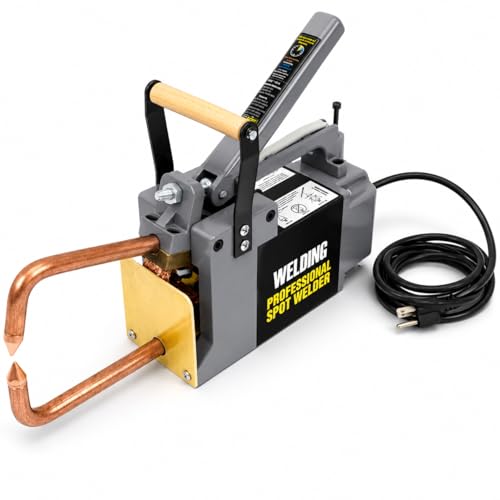
Resistance spot welding is a different answer to thin metal than MIG or flux-core. Instead of laying a continuous arc bead, this Stark USA unit uses opposing copper tips to join overlapping sheet sections. The listing identifies a 110V single-phase input, a 6-inch throat depth, and a maximum output current of 5,500A. Those figures describe a specialized spot-welding tool, not a general-purpose welder for seams, tubing, or open-edge joints.
The handheld tip-gun format keeps operation conceptually simple: place the sheets between the tips, apply pressure with the lever, and activate the weld. The approach can suit repeated spot joints on compatible sheet assemblies, such as some automotive or fabrication work. It cannot replace a MIG welder where the joint requires a continuous bead, and the listing does not provide a detailed schedule for material combinations or sheet thickness beyond identifying a 1/8-inch capacity.
Pros
- Dedicated resistance spot-welding design suits overlapping thin sheet joints.
- 110V single-phase input fits a common electrical setup.
- 6-inch throat depth provides reach into supported workpieces.
- Copper welding tips are identified as durable contact components.
- Handheld lever operation is more direct than setting up wire, gas, and a torch.
Cons
- Spot welding cannot create the continuous seams produced by MIG or flux-core machines.
- The available listing provides limited detail about material combinations and operating schedules.
This is the right type of tool only when the joint design calls for resistance spots. It may be more controlled than an arc process for overlapping panels, yet it is a poor substitute for the ARCCAPTAIN or Lincoln machines if the project includes brackets, open seams, or varied repair work. Buyers should confirm that the workpiece geometry fits the throat depth and that the materials are appropriate for spot welding before choosing this specialized option.
To buy this product, click here.
Buying Guide for Thin-Metal Welders
Low-End Control Matters on Thin Material
Thin metal can heat quickly, so a machine’s ability to make small adjustments matters more than its headline maximum output. Infinite voltage adjustment, manual wire-speed control, synergic settings, pulse modes, and timed spot functions each address control differently. The ARCCAPTAIN MIG205DP and SSimder go furthest by providing pulse or spot options, while the Lincoln 90i models rely on straightforward voltage and wire-speed tuning.
A high amperage number does not automatically mean better sheet-metal performance. The useful question is whether the machine gives you a manageable way to place enough heat into the joint without quickly enlarging the affected area.
Pulse and Spot Welding Solve Different Problems
Pulse MIG alternates the welding current in a controlled pattern, which can help manage heat and metal transfer when configured correctly. Spot welding uses pressure and electrical resistance between contact tips, so it is aimed at overlapping sheets rather than continuous seams. The SSimder lists timed spot welding for panels, while the ARCCAPTAIN MIG205DP combines spot, single-pulse, and double-pulse modes.
Neither feature removes the need for clean material, sound fit-up, and suitable settings. They simply give the operator more process choices than a basic wire-feed machine.
Match Input Voltage to the Available Circuit
A 120V-only welder is easier to place in a home workspace, but its operating range is tied to that circuit. Dual-voltage machines such as the ARCCAPTAIN 165A, Futelo, SSimder, and MIG205DP can move between 120V and 240V power. Before changing voltage settings, follow the product instructions and ensure the machine is switched off as directed.
Dual-voltage capability also does not mean the same output is available on both inputs. Check the manufacturer’s documentation for current limits, duty cycle, and recommended circuit requirements before planning a demanding project.
Gas MIG, Flux-Core, and Lift TIG Are Different Setups
Solid-wire MIG uses shielding gas and can be a useful choice for clean indoor sheet metal. Flux-core wire can work without a gas bottle, which is convenient outdoors, but it produces a different arc and cleanup routine. Lift TIG starts the arc by touching and lifting the tungsten, and it is not the same as high-frequency TIG. It also does not establish AC TIG capability for aluminum.
Read the accessory list carefully. A machine may support a TIG torch or spool gun while requiring that accessory to be purchased separately.
Check Spool Size and Included Equipment
The ARCCAPTAIN 165A holds a 2-pound spool, which keeps its chassis compact but may require more frequent spool changes. Other machines include small amounts of wire or starter consumables. A package that includes a torch, ground clamp, roller, or gas hose can reduce setup friction, while a compatible accessory that is not included changes the real cost and preparation required.
Keep Thickness Claims in Context
Published thickness figures are useful for comparing product positioning, but they are not universal guarantees. Material type, joint design, surface preparation, wire or electrode selection, input power, settings, and travel technique all affect the result. A listed maximum should not be treated as the ideal working thickness for every thin-metal joint.
Best Welder for Thin Metal FAQ
Is MIG or flux-core better for thin metal?
Solid-wire MIG is often easier to control indoors on clean sheet metal because it uses shielding gas and can produce a less obstructed view of the joint. Flux-core is useful where gas is inconvenient or wind is present, but the exact result depends on wire type, polarity, settings, and material preparation. A machine that supports both gives you more flexibility than a flux-core-only model.
Does higher amperage make a welder better for thin sheet metal?
No. Thin material often benefits from controllable low-end settings rather than maximum output. Pulse, spot modes, fine voltage adjustment, and manageable wire-speed controls can matter more than a large peak-amperage number. Higher output becomes useful when the same machine must also handle thicker stock, but it does not automatically improve thin-panel work.
Is pulse MIG necessary for automotive sheet metal?
It is not required for every project, but it can give the operator another way to manage heat and metal transfer. The SSimder and ARCCAPTAIN MIG205DP list pulse-related modes for thin work, while conventional MIG machines can still be used with suitable settings and technique. Timed spot welding is a separate feature and should not be confused with pulse MIG.
Can a Lift TIG welder weld aluminum?
Lift TIG by itself does not establish aluminum capability. Aluminum TIG generally requires AC output, and the products in this comparison do not identify AC TIG capability in their supplied information. A machine that supports Lift TIG should be treated as a DC TIG option unless the manufacturer specifically documents AC TIG.
Do these welders work from a normal household outlet?
Several models list 110V or 120V input, including the Lincoln 90i machines, ARCCAPTAIN 135A, 145A MIG Stick unit, and Stark spot welder. Dual-voltage machines can also use a 220V or 240V circuit, but the correct outlet, circuit capacity, and operating limits must be confirmed in the current documentation. Do not assume that every advertised output level is available from a household circuit.
Which product is best for continuous seams instead of spot joints?
A MIG or flux-core machine is the better category for continuous seams. The Lincoln 90i MIG and Flux Core offers both solid-wire MIG and flux-core operation, while the ARCCAPTAIN 165A and Futelo provide additional processes. The Stark USA unit is intended for resistance spot joints and should not be selected as a replacement for a wire-feed welder.
Are the TIG torches included with these multi-process welders?
Not always. The ARCCAPTAIN 135A, ARCCAPTAIN 165A, Futelo, and SSimder listings identify Lift TIG support while stating that the compatible torch must be purchased separately. Check the exact package contents for the ASIN and configuration you plan to order.
Final Verdict
The ARCCAPTAIN MIG205DP Pro is the strongest overall choice for thin metal because its documented feature set addresses heat control directly. Single-pulse, double-pulse, and spot modes provide more specialized options than a conventional MIG or flux-core machine, while 120V/240V input and several additional processes make it useful beyond panel work. Its complexity and separate TIG torch and spool-gun requirements are genuine trade-offs.
For a lower-cost path to thin-panel features, the SSimder 5-in-1 is the more focused alternative because its listing specifically identifies pulse and timed spot welding. Buyers who prefer a simpler established 120V machine should choose the Lincoln Electric 90i MIG and Flux Core, while the Futelo offers a lightweight dual-voltage package with synergic adjustment. Match the final choice to the joint type, available circuit, desired process, and accessory requirements rather than selecting by amperage alone.
