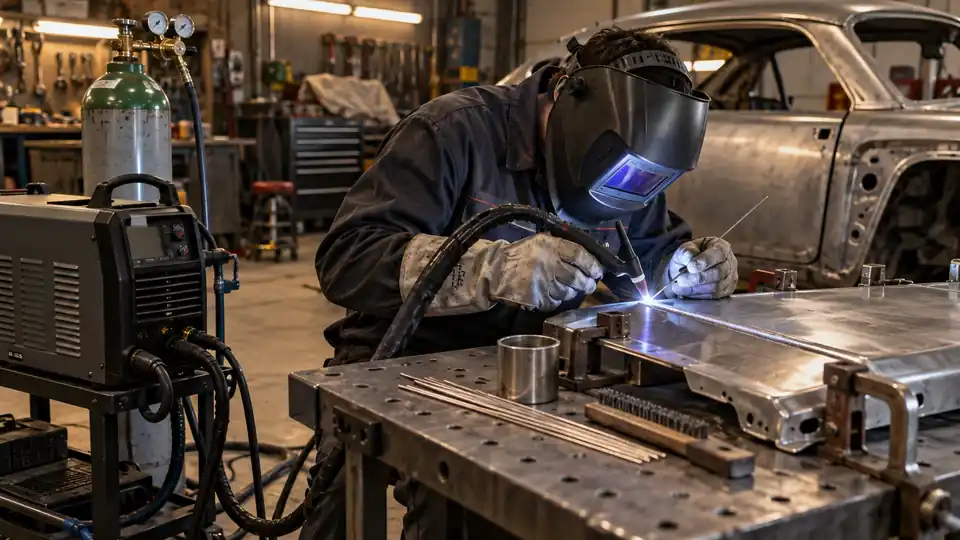
A TIG welder under $1,000 can cover very different jobs, from clean stainless-steel work to aluminum fabrication, thin sheet metal, repair work, and occasional Stick welding. The headline amperage is only one part of the decision. AC or DC output, arc-start method, pulse control, input voltage, foot-pedal support, and included equipment often matter more than a large number printed on the front panel.
Buyers frequently choose by maximum amperage alone and then discover that the machine lacks AC TIG, requires a separate torch, or offers Lift TIG when they expected high-frequency starting. Aluminum is the clearest dividing line. A DC TIG machine can suit steel, stainless steel, copper, and similar materials, but aluminum requires AC TIG capability. For broad material coverage, the YESWELDER TIG-200P ACDC offers the most complete feature balance in this group.
The comparison below weighs process capability, power flexibility, controls, portability, accessory requirements, and documented limitations. Some machines favor aluminum and advanced adjustment, while others make more sense for steel, stainless work, or a lower-cost setup.
Quick Answer
- Best Overall: YESWELDER TIG-200P ACDC, for AC/DC TIG, pulse modes, dual voltage, and broad material coverage.
- Best Feature Balance: Weldpro 200A AC/DC TIG, with an included foot pedal, AC/DC pulse, and a listed 40% duty cycle at 200A.
- Best for Aluminum on a Lower Budget: Sunstac 250A AC/DC TIG, with AC TIG, pulse functions, and 110V/220V input.
- Best DC TIG Value: ARCCAPTAIN TIG 205P Pro, for steel, stainless steel, thin material, and detailed DC pulse adjustment.
Best TIG Welder Under $1,000 Comparison Table
| Product | Best For | TIG Output | Key Features |
|---|---|---|---|
| YESWELDER TIG-200P ACDC | Best overall | AC/DC, up to 200A | Pulse, spot, dual voltage |
| Weldpro 200A AC/DC | Foot-pedal control | AC/DC, up to 200A | Included pedal, 5 modes |
| Sunstac 250A AC/DC | Aluminum on a budget | AC/DC, up to 250A | Pulse, spot, dual voltage |
| YESWELDER TIG-205P | Portable steel TIG | DC pulse, up to 200A | HF start, Stick, 10.7 lb |
| ARCCAPTAIN TIG 205P Pro | DC pulse control | DC TIG, up to 205A | App control, 120V/240V |
| ARCCAPTAIN TIG200P | Portable DC TIG | DC TIG, up to 200A | HF, Lift, pulse, spot |
| ARCCAPTAIN 200A TIG | Basic HF TIG and Stick | DC TIG, up to 200A | Post-gas, downslope, 2T/4T |
| S7 200A TIG | Simple dual-voltage setup | DC TIG, up to 200A | TIG and Stick, compact body |
| ARCCAPTAIN 200A Stick/Lift TIG | Portable Lift TIG and Stick | Lift TIG, up to 200A | 110V/220V, torch included |
The detailed reviews explain where each machine fits, where its limitations matter, and which features justify choosing it over a simpler alternative.
1. YESWELDER TIG-200P ACDC Best Overall

The YESWELDER TIG-200P ACDC earns the top position because it covers the widest range of common TIG requirements without leaving out the major material distinction. Its AC TIG mode is intended for aluminum, while DC TIG handles steel and stainless steel. The listing also identifies AC pulse, DC pulse, spot welding, Stick, and mixed TIG modes, giving the machine more flexibility than the DC-only options in this roundup.
Dual-voltage input allows the machine to work with 110V or 220V power, and high-frequency starting avoids touching the tungsten to the workpiece during arc initiation. The published weight is about 16.47 pounds, which is manageable for a garage or small workshop. A five-pin foot-pedal interface is available, but the pedal is not identified as included, so buyers should check the current package before ordering.
Pros
- AC and DC TIG support covers aluminum, steel, and stainless steel
- AC and DC pulse modes provide additional heat-control options
- 110V/220V input suits household and workshop power setups
- High-frequency arc starting reduces the need for tungsten contact
- Includes Stick, spot, and multiple TIG operating modes
Cons
- Foot pedal support is listed, but the pedal is not included in the supplied product information
- More controls may require extra setup time than a basic DC TIG machine
This is the strongest choice for someone who wants one machine for aluminum and steel without moving into a higher price tier. Buyers who work exclusively with stainless steel may spend less on a DC TIG model and gain little from AC controls. For mixed material work, though, the YESWELDER offers the most useful combination of capability and flexibility in this selection.
To buy this product, click here.
2. Weldpro 200A AC/DC TIG Best for Included Foot Pedal
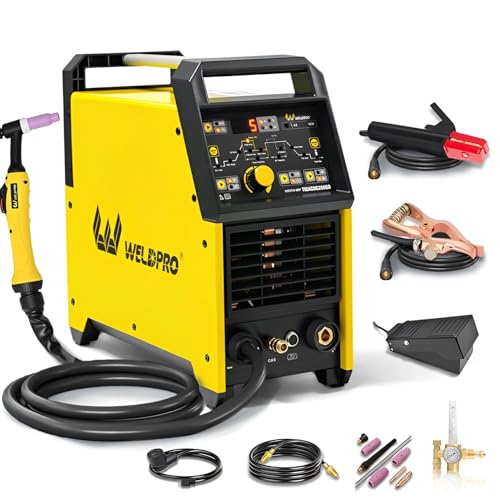
For buyers who want hands-free amperage adjustment without adding another accessory, the Weldpro 200A AC/DC TIG has a clear advantage. The supplied product information identifies an included rocker-style foot pedal, TIG torch, gas hose, flow meter, tungsten electrodes, and other torch consumables. That makes the package more immediately complete than machines that list pedal compatibility only.
Its five operating modes include AC TIG, DC TIG, AC pulse, DC pulse, and Stick. Adjustable AC balance and frequency are particularly relevant to aluminum work, while the listed pulse range of 0.5 to 200 Hz gives room for controlling heat input on thinner material. The manufacturer listing specifies a 40% duty cycle at full 200A output, so the machine is better suited to intermittent welding than long uninterrupted runs at maximum current.
Pros
- AC/DC TIG supports aluminum and ferrous materials
- Foot pedal is identified as included
- AC balance, AC frequency, and pulse settings are adjustable
- Dual-voltage input supports 110V and 220V supplies
- Accessory package includes torch, flow equipment, tungsten, and consumables
Cons
- 40% duty cycle at 200A limits continuous full-output welding
- Its larger feature set may be more than needed for steel-only TIG work
The Weldpro makes more sense than a bare-machine option for buyers who want to begin with a functioning TIG setup rather than assemble the gas and torch hardware separately. It is a strong alternative to the YESWELDER for aluminum projects where foot-pedal control matters. Buyers who mainly use 110V power should still confirm the expected output and duty-cycle conditions for that input.
To buy this product, click here.
3. Sunstac 250A AC/DC TIG Best for Aluminum on a Lower Budget

The Sunstac 250A AC/DC TIG targets buyers who need aluminum capability but want a lower-cost route into AC TIG. The listing describes high-frequency AC and DC TIG, pulsed AC and DC, AC and DC spot modes, and Stick welding. That collection puts it much closer to a full-purpose AC/DC machine than the DC-only welders ranked below it.
The advertised maximum is 250A, with 110V/220V input and published aluminum thickness figures of 4 mm at 110V and 6 mm at 220V. Those figures are listing claims rather than guarantees for every joint, since results depend on preparation, settings, material, and technique. The foot pedal is supported but identified as optional, and the listing warns that AC current measurement can be inaccurate or inconsistent, a limitation buyers should take seriously.
Pros
- AC TIG capability is suitable for aluminum-focused work
- Supports AC/DC pulse, spot TIG, and Stick modes
- 110V/220V input provides power-source flexibility
- LCD display presents welding parameters clearly
- Published aluminum capacity is higher at 220V than at 110V
Cons
- Foot pedal is not included according to the supplied information
- The listing acknowledges inaccurate AC current measurement and inconsistent AC balance
This machine is best suited to buyers who place AC aluminum capability above polished documentation or included accessories. It can be a sensible alternative to the more expensive AC/DC choices, but the AC measurement warning makes it harder to recommend as the overall pick. Confirm the current seller support and return terms before purchase, especially if AC precision is central to the work.
To buy this product, click here.
4. YESWELDER TIG-205P Best Portable DC TIG

At approximately 10.7 pounds, the YESWELDER TIG-205P is easier to move between a garage, bench, and occasional outdoor repair location than the heavier AC/DC units. Its automatic 110V/220V input detection adds flexibility, while high-frequency starting gives it a more refined TIG setup than Lift TIG machines that require tungsten contact to begin the arc.
The machine combines DC TIG, pulse TIG, and Stick welding, with adjustable pulse frequency, duty cycle, and current. That combination is useful for stainless steel, mild steel, and thinner work where heat control matters. The important boundary is aluminum. The product information specifically states that this model cannot weld aluminum, so it should not be selected as a substitute for an AC TIG machine.
Pros
- Lightweight 10.7-pound design is convenient to transport
- High-frequency TIG starting avoids scratch or lift initiation
- Pulse controls support heat management on thinner material
- Automatic 110V/220V input detection simplifies power setup
- Stick mode includes hot start, arc force, and anti-stick functions
Cons
- DC-only TIG output is unsuitable for aluminum
- Foot pedal is supported through an interface but is not identified as included
This is a strong fit for steel and stainless work where portability matters more than AC capability. It is also a better technical choice than a very basic Lift TIG machine for buyers who want pulse adjustment and non-contact starting. Anyone planning aluminum projects should move up to an AC/DC model instead.
To buy this product, click here.
5. ARCCAPTAIN TIG 205P Pro Best for App-Assisted DC Controls

The ARCCAPTAIN TIG 205P Pro takes a different approach to machine control by adding app connectivity. The product information describes remote monitoring, mode selection, parameter adjustment, preset recall, error-code analysis, and access to help content through the app. For a user who likes saving settings or adjusting parameters from a phone, that is a meaningful distinction from the conventional front-panel machines here.
Its documented welding modes include DC TIG, pulse TIG, Lift TIG, spot TIG, and MMA. Controls cover post-flow, downslope, spot time, pulse frequency, duty cycle, peak current, and base current. It accepts 120V or 240V input, but it is DC output only and therefore cannot weld aluminum through AC TIG. A compatible five-pin foot pedal is supported, though the pedal is not included.
Pros
- App supports parameter adjustment, monitoring, and preset recall
- DC pulse controls include peak current, base current, frequency, and duty cycle
- 120V/240V input suits different workshop circuits
- Includes DC TIG, Lift TIG, spot TIG, and Stick modes
- Foot-pedal compatibility allows hands-free current control with an added pedal
Cons
- DC-only output does not support aluminum TIG
- Foot pedal is compatible but not included
This model suits steel and stainless work where detailed settings and digital control are priorities. Its app functions are more relevant to repeat setups than to someone who wants a simple knob-and-display machine. Buyers working with aluminum should choose an AC/DC welder instead, regardless of the app features.
To buy this product, click here.
6. ARCCAPTAIN TIG200P Best Portable DC Pulse TIG

The ARCCAPTAIN TIG200P keeps the focus on DC TIG while adding more operating modes than a basic two-process machine. It supports HF TIG, Lift TIG, pulse TIG, spot TIG, and Stick, which gives buyers several ways to approach steel, stainless steel, copper, and similar materials. The listed weight is 10.25 pounds, and the included handle and shoulder strap make transport practical for occasional movement between work areas.
Its control set includes pulse frequency, start, base, and peak current, plus post-gas, downslope, end current, and 2T/4T operation. Those adjustments can help separate a precision-oriented machine from a simple current-control unit. Dual-voltage input is supported, and foot-pedal operation is available in 2T TIG modes, but the supplied information does not identify a pedal as included.
Pros
- Combines HF, Lift, pulse, and spot TIG in one machine
- Dual-voltage input supports 110V and 220V operation
- Pulse controls include start, base, peak, frequency, and duty cycle settings
- 10.25-pound body with handle and shoulder strap supports portability
- Stick mode includes adjustable hot start and arc force
Cons
- DC-only TIG output is not suitable for aluminum
- Foot-pedal support is limited to compatible accessories that are not identified as included
This is a practical choice for someone who wants a compact machine with more TIG adjustment than the basic S7 or Lift TIG models. It gives up AC capability in exchange for a portable DC control package. For steel and stainless work, that trade-off can make sense, while mixed-material users should look higher in the ranking.
To buy this product, click here.
7. ARCCAPTAIN 200A TIG Best Basic HF TIG and Stick

The ARCCAPTAIN 200A TIG is a straightforward option for steel and stainless work where high-frequency starting matters but extensive pulse programming does not. Its TIG and Stick modes cover two useful processes, and the machine offers post-gas adjustment, downslope control, and 2T/4T trigger operation. Post-gas continues shielding after the arc stops, which supports tungsten and weld-area protection according to the product description.
The machine accepts 110V or 220V input and weighs less than 12 pounds according to the listing. Stick controls include hot start, arc force, and anti-stick, making the second process more useful for outdoor or thicker-material work. This model does not list AC TIG, pulse TIG, or aluminum capability, so its lower position reflects a narrower range rather than a lack of relevance.
Pros
- High-frequency arc starting supports non-contact TIG ignition
- 110V/220V input offers circuit flexibility
- Adjustable post-gas and downslope settings are included
- 2T and 4T modes support short and longer weld sequences
- Stick mode includes hot start, arc force, and anti-stick
Cons
- No AC TIG or aluminum capability is identified
- Pulse control is not listed
Choose this unit over a Lift TIG machine if non-contact starting is a priority and the projects center on steel or stainless steel. The simpler control set may be easier to navigate than a highly adjustable pulse machine. Buyers who need aluminum, thin-material pulse control, or foot-pedal operation will find the AC/DC and pulse models more suitable.
To buy this product, click here.
8. S7 200A TIG Best Simple Dual-Voltage Setup

The S7 200A TIG keeps the feature set narrow: DC TIG and Stick welding in a compact inverter package. That simplicity can suit a garage setup where the priority is basic TIG work on mild steel or stainless steel rather than pulse programming, AC balance, or app-based control. A digital current display gives the operator a clearer reference than an unmarked dial.
Its 110V/220V input is useful for moving between a household circuit and a workshop supply. The product information identifies compatibility with standard TIG consumables, including tungsten, ceramic cups, and collets, but it does not clearly specify that a TIG torch is included. Buyers should factor in the torch, gas equipment, and other required components when comparing the overall setup.
Pros
- Supports both DC TIG and Stick welding
- 110V/220V input works across common power setups
- Simple controls reduce the number of settings to learn
- Digital current display helps with repeatable adjustments
- Compact inverter design saves bench and storage space
Cons
- No AC TIG or aluminum capability is identified
- The product information lists compatible consumables but does not clearly confirm a TIG torch is included
The S7 is best for basic steel and stainless projects where a low-complexity machine is more useful than a long list of modes. It ranks below the HF and pulse models because the documentation describes a simpler TIG package. Confirm the accessory bundle before ordering, since a bare machine can require additional setup equipment.
To buy this product, click here.
9. ARCCAPTAIN 200A Stick/Lift TIG Best Portable Lift TIG

At about 7.2 pounds, the ARCCAPTAIN 200A Stick/Lift TIG is the lightest machine in this selection with a documented TIG torch included. Its 110V/220V input and shoulder strap make it appealing for maintenance work, storage in a small vehicle, or a workshop where the welder is moved frequently. The TIG process is Lift TIG, so arc initiation differs from the non-contact HF systems ranked above.
The machine combines Lift TIG with Stick welding and offers adjustable hot start, arc force, and anti-stick. Synergic control can match current and voltage after an electrode diameter is selected, while manual current adjustment remains available. This is a sensible compact repair machine, but the supplied information does not identify pulse, AC TIG, or aluminum capability.
Pros
- Very light 7.2-pound design supports frequent transport
- 110V/220V input suits household and workshop power
- Lift TIG torch is identified as included
- Stick mode supports common 6010, 6011, 6013, and 7018 electrodes according to the listing
- Adjustable hot start, arc force, and anti-stick aid Stick operation
Cons
- Lift TIG requires contact-based arc initiation rather than HF starting
- No AC TIG, pulse TIG, or aluminum capability is identified
This model is a reasonable pick for portable repair work where Stick welding may be used as often as TIG. Its low weight and included torch reduce setup friction, while its Lift TIG design keeps the TIG feature more basic. Buyers pursuing clean aluminum work or delicate thin-material control should choose an AC/DC pulse machine instead.
To buy this product, click here.
Buying Guide for the Best TIG Welder Under $1,000
AC TIG Matters for Aluminum
AC TIG is the key feature for aluminum. The alternating current helps manage the oxide layer on aluminum, while DC TIG is generally aimed at steel, stainless steel, and similar conductive metals. The YESWELDER TIG-200P ACDC, Weldpro, and Sunstac are the appropriate choices here for buyers who specifically plan to weld aluminum. A DC-only machine should not be treated as an aluminum TIG welder simply because it advertises TIG capability.
HF Start and Lift TIG Are Different
High-frequency starting initiates the arc without touching the tungsten to the workpiece. Lift TIG begins when the tungsten contacts the metal and is then lifted away. HF start is often more appealing for clean, controlled starts, while Lift TIG can be adequate for basic repair work. The ARCCAPTAIN Stick/Lift TIG is compact and practical, but its starting method is less advanced than the HF machines in this roundup.
Pulse Control Helps Manage Heat
Pulse TIG alternates between higher peak current and lower background current. This can help limit heat input on thinner material and gives the operator another way to shape the weld cycle. Pulse is useful, but a machine with pulse does not automatically offer better results. The control range, low-end behavior, torch setup, material preparation, and operator settings still affect the weld.
Match Input Voltage to the Available Circuit
Dual-voltage machines can work across 110V and 220V supplies, but output and duty-cycle conditions can vary with input. A household outlet may be convenient for lighter work, while a 220V circuit generally gives a machine more room for higher-output operation. Check the manual and electrical requirements rather than assuming the maximum advertised amperage is available on every circuit.
Foot-Pedal Support Does Not Mean a Pedal Is Included
A foot pedal can provide live amperage adjustment during a TIG weld, which is useful for changing heat as joint conditions shift. Several machines in this roundup list pedal compatibility without including the pedal. The Weldpro is different because its supplied information identifies a rocker-style pedal in the accessory package. Confirm the exact bundle before ordering.
Check What Is Included for a Complete Setup
A TIG welder may require a torch, regulator or flow meter, gas hose, tungsten, collets, cups, ground clamp, and shielding gas equipment. Product listings often mix included accessories with compatible options. A lower-cost machine can become less economical if the torch or gas hardware must be purchased separately, especially when comparing it with a package such as the Weldpro.
Do Not Choose by Maximum Amperage Alone
Higher output can help with thicker material, but it is not automatically the most useful feature. Low-end control, AC adjustment, pulse behavior, arc starting, duty cycle, and power availability may matter more for thin sheet, stainless steel, or detailed aluminum work. A 200A machine with suitable controls can be a better fit than a higher-rated unit with limited process capability.
Best TIG Welder Under $1,000 FAQ
What is the best TIG welder under $1,000 for aluminum?
The YESWELDER TIG-200P ACDC is the strongest overall choice because it combines AC/DC TIG, pulse modes, dual-voltage input, and Stick capability. The Weldpro and Sunstac also support AC TIG and may suit buyers who place greater emphasis on an included accessory package or a lower-cost AC/DC setup.
Can a DC TIG welder weld aluminum?
A DC-only TIG machine should not be selected for conventional aluminum TIG work. Aluminum capability in this roundup is tied to AC TIG, which is available on the YESWELDER TIG-200P ACDC, Weldpro, and Sunstac models.
Is HF start better than Lift TIG?
HF start begins the arc without tungsten contact, while Lift TIG uses contact and lift-off. HF start can reduce the chance of tungsten contamination during initiation and is generally the more capable feature for precision TIG work. Lift TIG can still suit basic repair projects where portability and lower equipment complexity matter more.
Do all of these welders include a TIG torch?
No. The ARCCAPTAIN 200A Stick/Lift TIG lists an included Lift TIG torch, and the Weldpro lists a TIG torch in its accessory package. Other products identify torch compatibility or support without clearly confirming that the torch is included. Check the current package contents before ordering.
Is a foot pedal included with the best TIG welders under $1,000?
Not necessarily. The Weldpro product information identifies an included rocker-style foot pedal. The YESWELDER TIG-200P ACDC, Sunstac, and several ARCCAPTAIN models list foot-pedal interfaces or compatibility, but the pedal is not identified as included in the supplied information.
Which TIG welder is best for stainless steel?
DC TIG is suitable for stainless steel, so several machines can handle this material. The YESWELDER TIG-205P, ARCCAPTAIN TIG 205P Pro, and ARCCAPTAIN TIG200P are particularly relevant because they combine DC TIG with pulse controls. The better choice depends on whether portability, app control, or a more conventional front-panel layout matters most.
Is 200 amps enough for most TIG projects?
A 200A rating covers many repair, fabrication, stainless, and aluminum applications, but actual capacity depends on input voltage, duty cycle, material, joint design, and settings. A machine may reach its advertised maximum only under specific power and operating conditions. Review the manual before planning sustained work at full output.
Final Verdict
The YESWELDER TIG-200P ACDC is the strongest overall choice among these nine machines because it addresses the broadest range of TIG work. AC and DC output cover aluminum, steel, and stainless steel, while pulse, spot, Stick, dual-voltage input, and HF starting give it useful flexibility. Its foot-pedal interface is helpful, although the pedal should be confirmed separately because it is not identified as included.
The Weldpro is the better alternative for buyers who want an included pedal and a more complete accessory package. The Sunstac suits aluminum-focused buyers who want AC/DC capability at a lower position in the range, while the YESWELDER TIG-205P and ARCCAPTAIN TIG200P are better matches for portable DC work. Match the machine to the materials, available circuit, starting method, and included equipment before choosing the highest amperage number.
