A first TIG welder can either make the learning curve feel manageable or bury a new operator under settings, missing accessories, and confusing process labels. For beginners, the useful questions are more specific than maximum amperage. Does the machine use high-frequency starting or lift starting? Is it DC TIG for steel and stainless, or AC/DC TIG for aluminum as well? Does the package include a torch, gas hardware, and a way to control current?
A high output rating is easy to notice, but low-end control, a readable panel, sensible controls, and the correct input voltage often matter more for early projects. A 200-amp machine with AC, pulse, and a foot pedal offers room to grow, although its extra controls can feel like a cockpit compared with a basic DC TIG unit. A compact lift-TIG machine may cost less and travel easily, but it requires the tungsten to touch the work before the arc starts, which is less forgiving than high-frequency ignition.
This comparison favors machines that genuinely support TIG welding, with special attention to beginner-friendly operation and honest accessory requirements. The YESWELDER TIG-205P earns the strongest overall position because it combines high-frequency DC TIG, pulse controls, dual-voltage input, a clear display, and a relatively simple process layout. Buyers who need aluminum capability should look higher in the list, while those who want the lowest-complexity entry point may prefer a lift-TIG model.
Quick Answer
- Best Overall: YESWELDER TIG-205P, a portable dual-voltage DC TIG and pulse machine with high-frequency start.
- Best for Aluminum: Weldpro 200A AC/DC TIG Welder, with AC balance, frequency, pulse controls, and an included foot pedal.
- Best Simple TIG and Stick Option: ARCCAPTAIN 200A TIG/Stick Welder, with high-frequency TIG starting and a relatively focused control set.
- Best Portable Budget Option: ARCCAPTAIN 200A Stick/Lift TIG Welder, a 7.2-pound machine with a torch included.
Best TIG Welder for Beginners Comparison Table
| Product | Best For | TIG Type | Input and Standout Feature |
|---|---|---|---|
| YESWELDER TIG-205P | Best Overall | DC TIG with pulse | 110V/220V, HF start, 200A |
| ARCCAPTAIN 200A TIG/Stick | Focused TIG and Stick work | DC TIG | 110V/220V, HF start, post-gas |
| Weldpro 200A AC/DC TIG | Aluminum and long-term growth | AC/DC TIG with pulse | 110V/220V, foot pedal included |
| YESWELDER TIG-200P ACDC | AC/DC versatility | AC/DC TIG with pulse | 110V/220V, HF start, 200A |
| Sunstac 250A AC/DC TIG | Higher advertised output | AC/DC TIG with pulse | 110V/220V, 250A |
| ARCCAPTAIN 200A Lift TIG | Portability and simple controls | Lift TIG | 110V/220V, 7.2 pounds |
| YESWELDER 160A MIG Welder | Multi-process flexibility | Lift TIG | 110V/220V, MIG, Flux Core, Stick |
| ARCCAPTAIN 165A MIG Welder | MIG-first buyers needing TIG | Lift TIG | 110V/220V, 60% listed duty cycle |
| TOOLIOM 135A Stick Welder | Basic 110V lift TIG | Lift TIG | 110V, torch and rods included |
The detailed reviews explain which machines make TIG setup easier, which features are genuinely useful, and where each option gives something up.
1. YESWELDER TIG-205P — Best Overall

The TIG-205P is the strongest match for a beginner who specifically wants to learn TIG rather than simply own a machine that happens to support it. Its core process is DC TIG, with high-frequency non-contact arc starting, pulse controls, and a 110V/220V input system that automatically senses the available voltage. HF start matters because the tungsten does not need to touch the workpiece to establish the arc, reducing one source of contamination and awkward starts for a new operator.
The control set has room for progression without requiring an AC aluminum interface. Pulse TIG allows the operator to adjust pulse frequency, duty cycle, and current, which can help manage heat on thinner steel or stainless material once the basic arc is understood. The 10.7-pound chassis, large LED display, memory function, and 2T, 4T, and spot modes also make it easier to move, read, and revisit settings. The listing specifically states that this model cannot weld aluminum, so its natural territory is steel, stainless steel, and similar DC-TIG work.
Pros
- High-frequency, non-contact arc starting simplifies TIG ignition.
- Automatic 110V/220V input sensing suits home outlets and workshop circuits.
- Pulse controls give beginners a path toward better heat management.
- Large LED display and memory function make settings easier to monitor and repeat.
- Lightweight 10.7-pound design is easier to store and transport.
Cons
- DC-only TIG cannot weld aluminum.
- The listing does not state that a foot pedal is included, although a five-pin interface is provided.
This machine makes the most sense for someone learning TIG on mild steel or stainless who wants HF starting and useful controls without immediately stepping into AC TIG complexity. It is less suitable for a buyer whose first serious project involves aluminum, where AC capability is a fundamental requirement rather than an optional extra. Compared with the lift-TIG options below, it offers a more forgiving starting method and a more TIG-centered interface.
To buy this product, click here.
2. ARCCAPTAIN 200A TIG/Stick Welder — Best Focused TIG and Stick Option

A focused two-process layout can be easier to understand than a machine with MIG, flux-core, Stick, and TIG menus competing for attention. This ARCCAPTAIN supports DC TIG and Stick, with high-frequency arc starting for TIG. That combination makes it relevant to a new operator working with mild steel or stainless steel who wants TIG for cleaner, more controlled joints and Stick for outdoor or thicker-material work.
Its documented controls are practical rather than flashy. Post-gas can be adjusted from one to ten seconds, down-slope from zero to ten seconds, and 2T or 4T trigger operation is available. Post-gas continues shielding after the arc stops, helping protect the hot tungsten and weld area. The machine weighs less than 12 pounds and accepts 110V or 220V input, so it offers more circuit flexibility than a 110V-only starter machine without becoming a large shop unit.
Pros
- High-frequency TIG starting avoids a scratch-start ignition.
- 110V/220V input supports different workshop power arrangements.
- Adjustable post-gas and down-slope provide useful TIG control.
- Stick mode adds a practical option for outdoor or thicker steel work.
- Large LED display and carrying strap support easier setup and transport.
Cons
- DC TIG does not provide AC aluminum capability.
- The two-process design offers less MIG flexibility than multi-process machines.
This is a sensible choice for a beginner who wants to spend time learning TIG controls instead of navigating a broad multi-process platform. It has more relevant TIG functions than the basic lift-TIG machines, while remaining less elaborate than an AC/DC pulse unit. Buyers who expect aluminum work or want a foot-pedal-driven current adjustment should move to one of the AC/DC options.
To buy this product, click here.
3. Weldpro 200A AC/DC TIG Welder — Best for Aluminum
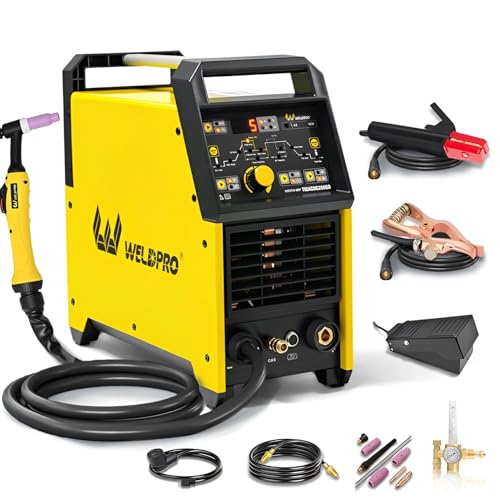
For a beginner who already knows aluminum belongs in the plan, AC/DC capability changes the purchase more than another increment of maximum amperage. The Weldpro provides high-frequency AC TIG, DC TIG, AC and DC pulse modes, and Stick welding in one machine. Its published controls include adjustable AC balance and frequency, which are the kinds of settings required to tailor the arc for aluminum rather than simply hoping a DC TIG mode will handle it.
The included accessory package is also unusually relevant to a first setup. The listing identifies a TIG torch, rocker-style foot pedal, gas hose and flow meter, tungsten electrodes, ceramic nozzles, collets, and back caps. The foot pedal allows current adjustment while welding, a useful feature for heat-sensitive joints and changing joint positions. Its 110V/220V automatic input detection adds flexibility, while the 40% duty cycle at the listed 200-amp output should be read alongside actual material thickness, voltage, and welding conditions rather than treated as a universal work-rate guarantee.
Pros
- AC and DC TIG cover aluminum, steel, and stainless-steel applications.
- High-frequency starting supports non-contact arc ignition.
- AC balance, frequency, and pulse settings allow meaningful process adjustment.
- Foot pedal and TIG torch are identified as included accessories.
- Automatic 110V/220V input detection reduces manual voltage setup.
Cons
- The broader control set may take longer to learn than a basic DC TIG machine.
- Its higher feature level is unnecessary for buyers who will weld only steel or stainless.
This is the stronger long-term purchase for someone who expects to move from basic steel practice into aluminum, thin sheet, or more controlled TIG work. It costs more than a simple DC or lift-TIG machine and asks the operator to understand more settings, but those controls have a clear purpose. A buyer who wants the simplest first arc should choose the YESWELDER TIG-205P instead.
To buy this product, click here.
4. YESWELDER TIG-200P ACDC — Best Versatile AC/DC Alternative

The TIG-200P ACDC is aimed at a learner who wants one machine for steel, stainless, and aluminum without moving immediately into a larger shop-oriented chassis. It supports AC TIG, DC TIG, AC pulse, DC pulse, Stick, mixed TIG, and spot welding, with high-frequency starting and a stated 200-amp maximum. The inclusion of multiple AC waveforms gives the user more ways to shape aluminum work, although the number of modes also means more time spent learning what each adjustment changes.
At 16.47 pounds, it is heavier than the DC-only TIG-205P but remains manageable for storage and occasional transport. The machine uses automatic 110V/220V sensing, has a large LED display, and includes a memory function that restores settings after power-off. Aluminum capability is listed up to 1/8 inch, but published thickness figures depend on material, joint design, preparation, available power, and settings. The five-pin foot-pedal interface is useful, although the listing describes the pedal as compatible rather than included.
Pros
- AC/DC TIG supports aluminum as well as steel and stainless steel.
- High-frequency ignition provides non-contact arc starting.
- AC and DC pulse modes give control over heat input and thin material.
- Automatic dual-voltage sensing works across common power setups.
- Memory function and large LED display simplify repeated setup.
Cons
- The foot pedal is not identified as included in the listing.
- Its seven-mode layout may be more complex than necessary for basic practice.
Choose this model when aluminum is a genuine possibility and the buyer values a compact, feature-rich platform. It sits between the simpler DC machines and the more accessory-complete Weldpro, with a useful mix of AC and pulse functions. For someone welding only mild steel, paying for AC modes adds controls that may remain unused.
To buy this product, click here.
5. Sunstac 250A AC/DC TIG Welder — Best Higher-Output AC/DC Option

The Sunstac brings a higher advertised output and a broad AC/DC TIG feature set to buyers who expect their projects to grow beyond light practice coupons. It supports high-frequency AC and DC TIG, pulsed AC and DC, spot modes, and Stick welding. Dual-voltage input gives it flexibility between household and workshop circuits, while the LCD screen is intended to make the settings easier to read through a helmet.
AC operation makes this machine materially different from the DC-only choices. It is listed for aluminum and other metals, with published aluminum thickness figures at 110V and 220V. The listing also states that AC current measurement can be inaccurate and that inconsistent AC balance may affect measured current. That qualification matters for a beginner because the machine offers useful capability, but its AC behavior deserves careful confirmation through current documentation and setup before it becomes the main aluminum machine.
Pros
- AC/DC TIG supports aluminum and ferrous-metal work.
- High-frequency AC and DC starting reduce the need for contact ignition.
- Pulse and spot modes expand control for thin or heat-sensitive material.
- 110V/220V input supports different electrical setups.
- LCD display and parameter memory aid repeated setup.
Cons
- The listing acknowledges inaccurate AC current measurement and inconsistent AC balance.
- The foot pedal is described as optional rather than included.
This option suits a buyer who wants broad AC/DC functionality and is prepared to verify settings rather than expect a simple plug-and-weld experience. It ranks below the Weldpro and YESWELDER AC/DC models because the documented AC measurement caveat is significant for someone still learning. Buyers who primarily need dependable DC TIG can avoid that extra complexity with a simpler machine.
To buy this product, click here.
6. ARCCAPTAIN 200A Stick/Lift TIG Welder — Best Portable Budget Option

At 7.2 pounds, this ARCCAPTAIN is the easiest machine in the comparison to carry from a storage shelf to a garage, vehicle, or outdoor repair area. It supports Stick and lift TIG on 110V or 220V input, and the package includes an upgraded lift-TIG torch. Synergic control can match current and voltage after the electrode diameter is selected, while manual adjustment remains available for someone who wants to refine the arc.
Lift TIG is different from high-frequency TIG. The tungsten briefly contacts the workpiece during ignition, then lifts away to establish the arc. That approach keeps the machine compact and affordable, but it demands more care than HF starting because the tungsten can become contaminated if the starting motion is poorly controlled. Adjustable hot start, arc force, and anti-stick are more relevant to its Stick mode than to TIG, yet they make the machine useful for a new operator learning both processes.
Pros
- Very low 7.2-pound weight makes transport and storage easy.
- 110V/220V input offers power flexibility.
- Lift-TIG torch is identified as included.
- Synergic control can reduce initial Stick setup decisions.
- Adjustable hot start, arc force, and anti-stick support Stick welding.
Cons
- Lift TIG is less forgiving for beginners than high-frequency starting.
- It does not provide AC TIG for aluminum.
This is a practical entry point for someone who values portability and wants TIG as a secondary process beside Stick. It is less compelling for a buyer whose main goal is polished TIG practice, where HF ignition and post-flow controls provide a more focused learning platform. Its small size is the feature to buy, while its lift-start method is the trade-off to accept.
To buy this product, click here.
7. YESWELDER 160A MIG Welder — Best Multi-Process Flexibility

The YESWELDER 160A is primarily a MIG and Stick machine, but its Lift TIG mode gives a beginner a way to explore TIG without buying a second power source. It supports gas MIG, flux-core MIG, Stick, and Lift TIG, with 110V/220V input and a listed 160-amp output. Synergic control can recommend voltage and wire-feed speed based on selected thickness or amperage, which may be useful for someone who expects to spend as much time learning MIG as TIG.
The machine accepts 2-pound and 10-pound spools of .030-inch and .035-inch wire, a broader wire-storage arrangement than the smaller MIG models in this group. Its 19.4-pound weight is still portable, although it is considerably heavier than the dedicated lift-TIG ARCCAPTAIN. TIG capability requires an extra lift-TIG torch, so the advertised process count should not be mistaken for a complete TIG setup in the box.
Pros
- Supports gas MIG, flux-core MIG, Stick, and Lift TIG.
- Dual-voltage input works across common power environments.
- Synergic and manual MIG controls serve different learning stages.
- Accepts both 2-pound and 10-pound wire spools.
- LED display and carrying handle simplify setup and movement.
Cons
- Lift-TIG torch must be purchased separately.
- At 19.4 pounds, it is heavier than the dedicated TIG options.
This machine makes sense for a beginner who wants a general fabrication platform and sees TIG as an occasional skill rather than the central process. Its MIG controls may be easier to use for larger general repairs, while Lift TIG remains available for cleaner work. Someone specifically searching for the smoothest TIG learning experience should choose a dedicated HF or AC/DC TIG model instead.
To buy this product, click here.
8. ARCCAPTAIN 165A MIG Welder — Best for MIG-First Buyers

This ARCCAPTAIN is another multi-process machine where TIG is useful but secondary. It offers gas MIG, flux-core MIG, Stick, and Lift TIG, with a 165-amp output and dual-voltage input. The documented 60% duty cycle is associated with the product listing, but buyers should confirm the amperage and test conditions before comparing that figure directly with other machines.
Its 12.8-pound weight is easier to manage than the YESWELDER 160A, and the package includes a MIG torch, ground clamp, electrode holder, rollers, contact tips, and a small flux-core spool. The WP-17V TIG torch is sold separately. A two-pound maximum spool capacity also limits wire-storage convenience compared with the YESWELDER, but the smaller footprint can suit a compact garage setup where MIG is the daily process.
Pros
- Supports gas MIG, flux-core MIG, Stick, and Lift TIG.
- 110V/220V input provides setup flexibility.
- Lower weight improves portability compared with larger multi-process units.
- Synergic and manual MIG adjustments are available.
- Package includes core MIG and Stick hardware plus flux-core wire.
Cons
- WP-17V TIG torch must be purchased separately.
- Two-pound spool capacity is more limited than the YESWELDER 160A.
Pick this model if MIG will handle most projects and TIG is an occasional extension rather than the reason for the purchase. The smaller spool capacity and missing TIG torch weaken its position for a dedicated TIG beginner, but the 12.8-pound chassis and dual-voltage design make it a useful general-purpose alternative. Buyers seeking TIG-specific controls should step up to the dedicated machines ranked above.
To buy this product, click here.
9. TOOLIOM 135A Stick Welder — Best Basic 110V Lift TIG Kit

The TOOLIOM takes a straightforward route into TIG by pairing a 110V Stick welder with lift-TIG capability. The package identifies a lift-TIG torch, E6013 rods, and welding gloves as included, which gives a new operator a more complete starting bundle than machines that merely list TIG compatibility. Its compact design and adjustable shoulder strap also suit occasional movement between a home work area and a storage space.
VRD, hot start, and arc force are listed among the controls. Those features mainly support Stick operation, where easier arc initiation and reduced electrode sticking can make practice less frustrating. The TIG side remains basic: it is DC lift TIG, not HF TIG or AC TIG, and the 110V-only input limits power flexibility. The clear LCD display helps with settings, but it does not replace the need to set shielding gas, tungsten, polarity, and technique correctly.
Pros
- Lift-TIG torch is included in the kit.
- Standard 110V input suits a household outlet.
- VRD, hot start, and arc force support Stick setup.
- E6013 rods and gloves are identified as included.
- Shoulder strap and compact chassis improve portability.
Cons
- Lift TIG is less forgiving than HF TIG for a first-time operator.
- 110V-only input and 135A output provide less flexibility than the dual-voltage options.
This is best suited to a buyer who wants a low-complexity Stick machine with a genuine path into basic DC TIG. It is a weaker choice for someone who already knows TIG will be the primary process, since the higher-ranked dedicated machines provide HF starting and more TIG-specific adjustment. The included torch and simple 110V setup remain useful advantages for occasional practice.
To buy this product, click here.
Buying Guide for the Best TIG Welder for Beginners
Start With the Metal You Expect to Weld
DC TIG is appropriate for many steel and stainless-steel projects. Aluminum requires AC TIG, so a machine such as the YESWELDER TIG-205P or ARCCAPTAIN 200A TIG/Stick Welder should not be selected for aluminum simply because both support TIG. AC changes the process requirements, including the controls used to manage oxide removal and arc behavior.
High-Frequency Start Versus Lift TIG
High-frequency starting establishes the arc without touching the tungsten to the workpiece. That is generally easier for a new operator to manage and can reduce contamination during ignition. Lift TIG starts with contact followed by lifting, which keeps the machine simpler and often less costly, but it demands more deliberate technique. The ARCCAPTAIN 200A Lift TIG and TOOLIOM are reasonable for basic entry-level use, while the TIG-205P offers the more beginner-friendly start method.
Do Not Confuse TIG Support With a Complete TIG Setup
A multi-process welder may list Lift TIG while requiring a separate torch. The YESWELDER 160A and ARCCAPTAIN 165A both fall into this category. Check whether the package includes the torch, gas hose, flow meter or regulator, ground lead, and any foot control you expect to use. Compatible does not mean included.
Choose Pulse for a Reason
Pulse TIG alternates between higher and lower current according to adjustable settings. It can help manage heat input on thin material, but it also adds controls that a new operator must learn. Pulse is useful after the basic arc, torch movement, filler addition, and shielding-gas technique are understood. It should be treated as a growth feature rather than a substitute for correct setup.
Match the Input to the Available Circuit
A 110V machine is convenient for a home outlet, while dual-voltage input allows more flexibility when a 220V circuit is available. Automatic voltage sensing can simplify setup, but the user still needs the correct plug, circuit capacity, and manufacturer instructions. Maximum output is often more attainable on 220V than on 110V, so read output claims alongside the input condition.
Look at the Control Layout
A large display, memory function, clearly labeled current controls, and accessible trigger modes can reduce setup friction. A machine with AC balance, AC frequency, pulse frequency, upslope, downslope, 2T, 4T, and spot modes offers more control, but a beginner may need time to understand each setting. The best first machine is usually the one that provides the required capability without burying the basic controls.
Best TIG Welder for Beginners FAQ
What Type of TIG Welder Is Easiest for a Beginner?
A DC TIG machine with high-frequency starting and a clear control panel is generally the simplest focused option for steel and stainless steel. High-frequency starting avoids the tungsten contact used by lift TIG. A machine with AC/DC capability may be the better first purchase if aluminum is part of the plan, although it requires learning more settings.
Can a DC TIG Welder Weld Aluminum?
A conventional DC-only TIG machine should not be treated as an aluminum TIG welder. Aluminum TIG generally requires AC capability. The YESWELDER TIG-205P is specifically identified as unable to weld aluminum, while the Weldpro, YESWELDER TIG-200P ACDC, and Sunstac models list AC TIG support.
Is Lift TIG Good for Learning?
Lift TIG can be a reasonable starting point for basic steel work, especially when portability and a lower-complexity control panel matter. The tungsten touches the workpiece during ignition and then lifts away, so the operator must control that motion carefully. High-frequency TIG is usually more forgiving during starts.
Do Beginners Need a Foot Pedal?
A foot pedal is useful for adjusting current while the torch remains in position, particularly on aluminum, thin sheet, and changing joint conditions. It is not required for every beginner project. Check the exact package because some machines provide a foot-pedal interface while others include the pedal, and those are different arrangements.
Should a Beginner Buy a Multi-Process Welder?
A multi-process model makes sense if MIG or Stick will be used regularly alongside TIG. It can reduce the need for separate machines, but TIG may be a secondary feature and the torch may be optional. Buyers whose main goal is learning TIG will usually get a clearer process layout from a dedicated TIG machine.
What Accessories Are Needed for TIG Welding?
A TIG setup generally requires a TIG torch, ground connection, shielding-gas equipment, tungsten, collets, a ceramic cup, and suitable personal protective equipment. The exact package varies. A listing that says a machine supports TIG does not confirm that the torch, regulator, gas hose, or foot pedal is included.
Is 200 Amps Too Much for a Beginner?
A 200-amp rating is not automatically excessive. It describes the upper output range, while the usefulness of the machine also depends on low-end control, input voltage, duty cycle, and the material being welded. A beginner may use only a small portion of that range during early practice, but extra output can provide room for thicker work later.
Final Verdict
The YESWELDER TIG-205P is the strongest overall choice for a beginner who plans to learn DC TIG on steel or stainless steel. High-frequency starting removes one avoidable obstacle, dual-voltage input suits different work areas, and pulse controls provide a sensible path toward more controlled thin-material work. Its aluminum limitation is clear, so it should not be selected for an aluminum-first project.
For aluminum and broader long-term capability, the Weldpro 200A AC/DC TIG Welder is the more complete alternative because it lists AC and DC controls, pulse functions, a torch, and a foot pedal in its package. The ARCCAPTAIN 200A TIG/Stick Welder is a practical middle ground for focused DC TIG and Stick work, while the lightweight ARCCAPTAIN 200A Lift TIG machine makes more sense for simple portable jobs. Before ordering, match the machine to the metal, confirm the available circuit, and verify every included accessory in the current listing.
