
A first flux-core welder can make a small repair feel surprisingly complicated. Wire diameter, polarity, voltage, wire speed, shielding gas, and material thickness all appear on the same page, while a large amperage number can make a compact machine seem more capable than it may be in practice. For beginners, the better choice is usually a welder that simplifies setup, runs from an available household circuit, and provides enough adjustment for thin steel and routine repairs.
Flux-cored welding is attractive because self-shielded wire avoids a gas cylinder and is practical outdoors, but the process still produces smoke, slag, and spatter. Synergic controls can suggest a starting point for wire speed and voltage, yet they do not replace correct polarity, clean material, suitable wire, ventilation, and safe technique. A compact 110V machine may suit occasional projects, while a dual-voltage model makes more sense for buyers who expect heavier work or access to a 220V circuit. The YESWELDER 160A earns the strongest overall position here because it combines beginner-oriented controls with dual-voltage flexibility and several welding modes.
This comparison weighs setup simplicity, flux-core compatibility, input flexibility, portability, included equipment, and the limitations that matter after the first few practice beads. Some products favor a low learning curve, while others trade simplicity for more output or broader process support.
Quick Answer
- Best Overall: YESWELDER 160A MIG Welder, for beginners who want synergic controls, dual-voltage input, and room to grow.
- Best for Simple Small Jobs: Lincoln Electric Weld-Pak 90i FC, with a straightforward two-knob layout and protective metal case.
- Best Budget Option: Futelo 145A MIG Welder, a very light 110V machine with automatic parameter suggestions and a broad accessory bundle.
- Best Ready-to-Weld Kit: BESTMIG FLUX-135, which includes a helmet and gloves alongside its welding hardware.
Best Flux Core Welder for Beginners Comparison Table
| Product | Best For | Input and Output | Beginner-Relevant Feature |
|---|---|---|---|
| YESWELDER 160A | Best overall | 110V/220V, 160A | Synergic and manual controls |
| Lincoln Electric Weld-Pak 90i FC | Simple small repairs | 120V, 90A class | Two-knob operation |
| YESWELDER 135A | Portable multi-process use | 110V, 135A | Synergic control and micro-adjustment |
| ARCCAPTAIN MIG145 Pro | Compact guided setup | 120V, 145A | Synergic control and app support |
| ANDELI 135A Pulse | Feature-rich learning setup | 110V/220V, 135A | Pulse, inductance, and digital controls |
| Futelo 145A | Lowest-cost portable setup | 110V, 145A | Automatic wire and voltage adjustment |
| BESTMIG FLUX-135 | Ready-to-weld bundle | 110V, 135A | Helmet and gloves included |
| AZZUNO 130A | Basic home projects | 110V, 130A | Simple synergic controls |
| ARCCAPTAIN 135A MIG135 | Manual adjustment practice | 110V, 135A | Ten-speed wire-feed control |
The detailed reviews below separate the machines by setup style, power flexibility, portability, and included equipment.
1. YESWELDER 160A MIG Welder, Best Overall

The YESWELDER 160A is the most balanced match for a beginner who wants to start with gasless flux-core welding without quickly outgrowing the machine. Its synergic mode links selected wire or material settings with recommended voltage and wire-feed values, reducing the number of adjustments a new user has to make at once. Manual voltage and wire-speed controls remain available, so the machine can continue to teach the relationship between those settings as experience develops.
Its biggest practical advantage is dual-voltage input. The machine is listed for both 110V and 220V operation, which gives buyers more flexibility than the 110V-only models in this group. It supports .030 and .035 wire, 2-pound and 10-pound spools, Stick welding, and Lift TIG, although the Lift TIG torch must be purchased separately. At 19.4 pounds, it is heavier than the ultracompact machines, but that extra size is a reasonable trade for broader power options and a more adaptable workshop setup.
Pros
- Supports both 110V and 220V input.
- Synergic controls provide a useful starting point for voltage and wire speed.
- Accepts 2-pound and 10-pound spools of compatible wire.
- Supports flux-core, gas MIG, Stick, and Lift TIG modes.
- Manual controls allow adjustment beyond the automatic recommendations.
Cons
- At 19.4 pounds, it is less convenient to carry than the smaller 110V machines.
- The Lift TIG torch is optional rather than included.
This is the strongest choice for someone who expects to move from small household repairs into more varied metalwork. A buyer who only needs occasional thin-steel repairs may find its extra controls and heavier body unnecessary, while someone with access to 220V power gets a useful path toward more demanding work. Confirm the required outlet, plug arrangement, and included accessories for the selected configuration before ordering.
To buy this product, click here.
2. Lincoln Electric Weld-Pak 90i FC, Best for Simple Small Jobs

Some beginners need a machine that does fewer things clearly rather than a multi-process unit with a crowded control panel. The Lincoln Electric Weld-Pak 90i FC takes that route. Its two-knob layout separates wire speed and voltage, giving the operator a direct way to learn the basic relationship between the controls without navigating several welding modes.
The 120V input suits a typical home workshop, and the 15-pound inverter design is light enough for occasional movement. The product includes a welding gun, nozzle, contact tip, work cable, and clamp, while its protective metal case adds a layer of physical protection during storage or transport. The listing positions it for small jobs and identifies welding capacity up to 1/4 inch, but actual results depend on joint design, material preparation, wire, settings, and available power.
Pros
- Simple two-knob control layout reduces setup complexity.
- 120V input suits common household power arrangements.
- Protective metal case helps shield the machine during transport and storage.
- Shoulder strap and 15-pound weight support mobile use.
- Includes the primary gun, cable, clamp, nozzle, and contact tip components.
Cons
- Single-voltage operation offers less flexibility than the dual-voltage models.
- Its simpler flux-core focus provides fewer process options for future projects.
The Weld-Pak 90i makes sense for a person who wants to practice flux-core welding, handle small repairs, and avoid paying for modes they may never use. It ranks below the YESWELDER 160A because it gives up output range and process flexibility, but the simpler controls may be easier to understand during the first sessions. Check the current manual for the correct wire and polarity setup before starting.
To buy this product, click here.
3. YESWELDER 135A MIG Welder, Best Portable Multi-Process Option

At 11.4 pounds, this YESWELDER is easier to carry from a garage to a driveway than the heavier dual-voltage units. Its 110V input keeps the setup straightforward, while 135A output and gasless flux-core capability cover the type of thin and moderate steel work commonly associated with a first welder. The listing identifies a published mild-steel thickness of up to 3/32 inch, which should be treated as a specification claim rather than a guarantee for every joint.
Synergic control is the main beginner-oriented feature. The machine recommends voltage based on wire-feed selection, and its voltage micro-adjustment gives the operator room to fine-tune the arc after learning the basic settings. The package also identifies .030 and .035 flux-core wire, Stick welding, and Lift TIG support, although a separate Lift TIG torch is required. Extra wire is listed as included, which can reduce the number of purchases needed before practice begins.
Pros
- 11.4-pound body and carrying handle support easy transport.
- Synergic controls offer a guided starting point.
- Voltage micro-adjustment allows incremental arc tuning.
- Supports gasless flux-core, Stick, and Lift TIG modes.
- Compatible .030 and .035 wire and extra flux-core wire are identified in the listing.
Cons
- 110V-only input limits flexibility for higher-demand work.
- Lift TIG requires a separately purchased torch.
This model suits someone who values portability and wants more than a single-purpose wire feeder. It is more compact than the YESWELDER 160A, but the trade-off is the lack of 220V operation. Buyers mainly practicing flux-core on smaller steel parts may appreciate that balance, while those planning longer welding sessions or thicker material should look closely at the power and duty-cycle information for the intended setup.
To buy this product, click here.
4. ARCCAPTAIN MIG145 Pro, Best for Guided Setup and Portability

The ARCCAPTAIN MIG145 Pro places guided setup at the center of its design. The listing says the operator selects wire diameter and material thickness, after which the machine recommends current and wire-feed settings. That can make the initial setup less intimidating for someone who has not yet learned how voltage, feed speed, and wire size interact.
Its 9.5-pound weight and shoulder strap make it one of the easier machines here to move around a property. The machine supports gasless MIG, Stick, and Lift TIG, with the TIG torch sold separately. A large LED display is easier to read than small analog markings, and app control may appeal to users who want to save or adjust settings remotely. The app feature adds convenience, though it also introduces a layer of technology that a buyer seeking the simplest possible machine may not need.
Pros
- Synergic control links wire and material selections with recommended settings.
- 9.5-pound weight and shoulder strap support mobile repairs.
- Large LED display improves setting visibility.
- Provides flux-core, Stick, and Lift TIG modes.
- App control offers remote adjustment and setting storage.
Cons
- 120V operation provides less input flexibility than dual-voltage alternatives.
- Lift TIG torch is sold separately.
This is a sensible fit for a beginner who values compact size and guided controls, especially when the machine may move between indoor and outdoor work areas. The app is a differentiator rather than a requirement, and buyers who prefer physical controls may favor the Lincoln or AZZUNO instead. Its 145A rating should be read alongside the available circuit and material requirements rather than treated as a universal thickness guarantee.
To buy this product, click here.
5. ANDELI 135A Pulse MIG Welder, Best for Advanced Controls
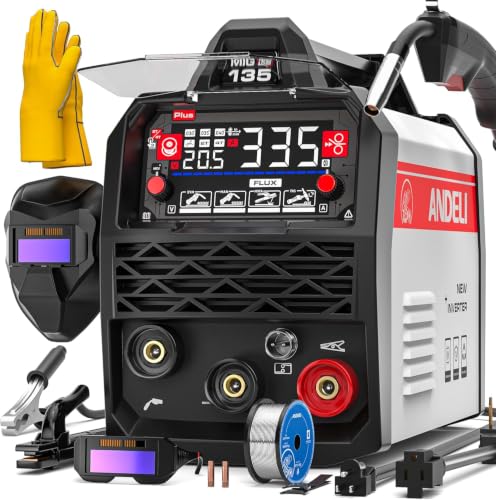
The ANDELI brings more adjustment range than a basic beginner machine. It supports gasless MIG, pulse flux-core operation, Lift TIG, and Stick, while the listing identifies 110V and 220V input. Pulse and adjustable inductance can give the operator more ways to influence arc behavior, although those controls add learning steps instead of removing them.
Its 9.04-pound body keeps portability high, and the 4.1-inch display is larger than the screens used on many compact welders. The machine is listed for .030, .035, and .040 flux-core wire, and the package includes a welding torch, electrode holder, adapter, wire, and protective accessories. The Lift TIG torch remains a separate purchase. The listing also mentions a helmet and gloves, but buyers should inspect the current product images and configuration details to confirm exactly which face protection is included.
Pros
- 110V/220V input offers more power-setup flexibility.
- Pulse flux-core mode and inductance control provide additional arc adjustments.
- Supports .030, .035, and .040 flux-core wire.
- Light 9.04-pound design suits mobile use.
- Large protected display and included welding accessories support easier setup.
Cons
- More controls may create a steeper learning curve than a simple two-knob machine.
- Lift TIG torch is sold separately, and protective-accessory details should be confirmed by configuration.
The ANDELI makes more sense for a technically curious beginner who wants room to explore arc settings and has a reason to use 220V power later. A person who wants to plug in, choose a wire setting, and practice without extra controls may find it less approachable than the Lincoln or Futelo. Its broad feature list is useful only when the operator understands which adjustment changes which part of the arc.
To buy this product, click here.
6. Futelo 145A MIG Welder, Best Budget Portable Option
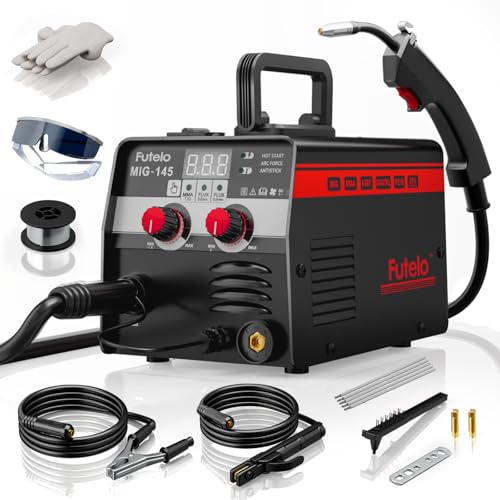
The Futelo is aimed at buyers who want a small 110V machine with a broad bundle of basic accessories. Its listed weight is 7.5 pounds, making it the lightest welder in this selection. That low weight can be handy when the machine must move from a garage shelf to a work area, although portability does not tell us how long the unit can operate continuously or how it performs under demanding loads.
Its synergic control allows selection of .030 or .035 wire or an amperage value, then recommends voltage and wire speed. The product information also identifies a suggested metal thickness, a bright LED display, and support for carbon and stainless steel. The box is listed with a MIG torch, ground clamp, electrode holder, rods, flux-core wire, contact tips, safety goggles, gloves, and a chipping hammer. The TIG torch is not included, so Lift TIG support should not be confused with a complete TIG setup.
Pros
- 7.5-pound design is easy to carry with one hand.
- Synergic settings suggest voltage and wire speed for a starting point.
- Includes a MIG torch, ground clamp, electrode holder, wire, rods, and tips.
- LED display shows operating information clearly.
- 110V input suits small home and outdoor repair setups.
Cons
- 110V-only operation limits power flexibility.
- Lift TIG torch is not included.
For a first machine used on short practice sessions, small brackets, and household repairs, the Futelo offers a practical entry package. It gives up the dual-voltage flexibility of the YESWELDER 160A and the established two-knob simplicity of the Lincoln, but its low weight and included equipment may matter more to a buyer starting from zero. Inspect the included safety equipment carefully and use appropriate ventilation and protective procedures regardless of the bundle.
To buy this product, click here.
7. BESTMIG FLUX-135, Best Ready-to-Weld Kit
The BESTMIG FLUX-135 stands out because the package addresses several items a new operator may otherwise need to buy separately. The listing identifies an auto-darkening helmet, leather gloves, ground clamp, electrode holder, and welding torch alongside the 135A machine. That makes the package convenient for someone assembling a first setup, although protective equipment still needs to be checked for fit, condition, and suitability before use.
For welding functions, the unit supports gasless flux-core, Lift TIG, and Stick. It accepts flux-core wire from .030 to .040 inch, and its digital control system is described as automatically adjusting voltage and wire speed from the selected settings. The TIG torch is specifically excluded, so its three-process label does not mean every process is ready to use from the box. At 110V, it is aimed at accessible power rather than maximum electrical flexibility.
Pros
- Includes an auto-darkening helmet and leather gloves.
- Supports gasless flux-core, Stick, and Lift TIG modes.
- Accepts .030 to .040 flux-core wire.
- Automatic parameter adjustment reduces initial setup work.
- 135A output and 110V input suit small workshop projects.
Cons
- Lift TIG torch is not included.
- 110V-only input offers less flexibility than dual-voltage models.
This package suits a person who needs the machine and several basic accessories in one order. It ranks below the more adaptable YESWELDER 160A because it lacks 220V input, while the included helmet and gloves give it a practical advantage over bare-machine packages. Buyers who already own suitable PPE may prefer to spend their budget on a machine with broader electrical flexibility instead.
To buy this product, click here.
8. AZZUNO 130A Flux Core Welder, Best Basic Home Option

The AZZUNO keeps the core setup familiar: a 110V wire-feed machine, a voltage control, a wire-speed adjustment, and synergic operation that changes recommended values when amperage or thickness is selected. That combination gives a new user some guidance without removing the ability to make manual corrections. The 8.6-pound body and carrying handle also make it suitable for short-distance movement around a home workspace.
The listing identifies 130A output, compatibility with 2.2-pound rolls, and included .030 flux-core wire. It also includes a MIG torch, ground clamp, brush and hammer, and two contact tips. The package is more limited than the accessory-heavy BESTMIG bundle, and the machine does not offer the dual-voltage flexibility found in the YESWELDER 160A or ANDELI. For small projects where 110V power is already available, that simpler configuration may be entirely reasonable.
Pros
- Synergic control provides recommended voltage and wire-feed settings.
- 8.6-pound body supports easy movement around a home workspace.
- Includes a MIG torch, ground clamp, wire, contact tips, and cleaning tool.
- 110V input fits common household power arrangements.
- Manual voltage and wire-speed controls remain available.
Cons
- Single-voltage operation limits future power options.
- Smaller 2.2-pound spool capacity offers less wire than machines supporting 10-pound spools.
The AZZUNO is a straightforward choice for occasional repairs and practice on suitable steel. It does not offer the process depth of the ANDELI or the electrical flexibility of the top-ranked YESWELDER, but its controls and compact format keep the basic task clear. Confirm wire compatibility and polarity in the manual, then match the settings to the material rather than relying on the maximum amperage label alone.
To buy this product, click here.
9. ARCCAPTAIN 135A MIG135, Best for Manual Adjustment Practice

The ARCCAPTAIN MIG135 combines beginner guidance with more manual adjustment than some compact alternatives. Its synergic mode recommends voltage and wire speed after the operator selects wire size and material thickness, while manual controls allow fine voltage adjustment. The listing also identifies hot-start and arc-force settings for Stick mode, giving the machine a useful teaching path beyond flux-core welding.
At 9.48 pounds, it remains easy to transport, and the shoulder strap adds another option for carrying it to an outdoor repair area. The 110V machine supports gasless MIG, Stick, and Lift TIG, with a separate torch required for TIG. Its product information references carbon steel, stainless steel, and thicker steel, but those material claims should be evaluated alongside the actual wire, settings, joint, and available power. The display and protective functions round out a practical compact setup.
Pros
- Synergic control recommends settings based on wire and material selections.
- Manual voltage adjustment supports gradual skill development.
- Stick mode includes adjustable hot-start and arc-force settings.
- 9.48-pound weight and shoulder strap support portability.
- Large digital display and listed overload protection simplify monitoring.
Cons
- 110V-only input limits flexibility for larger work.
- Lift TIG torch must be purchased separately.
This model fits a beginner who wants automatic starting guidance but expects to experiment with manual adjustments later. It gives up the dual-voltage capability of the YESWELDER 160A and the pulse controls of the ANDELI, yet its Stick adjustments make it more instructive than a strictly basic wire feeder. Choose it for compact repair work and learning, not as a substitute for a higher-output shop machine.
To buy this product, click here.
Buying Guide
Synergic Control Can Reduce the First Setup Hurdle
Synergic control links related settings so the machine can recommend a starting combination of wire speed, voltage, amperage, wire diameter, or material thickness. That is useful for a new operator staring at a machine for the first time, but it remains a starting point. Surface condition, joint design, wire polarity, travel speed, and material thickness can still require adjustment.
A basic machine with manual controls can teach the same relationships more directly, while a guided machine may help a beginner produce a usable starting arc sooner. The best choice depends on whether the priority is a shorter setup process or a simpler control panel.
Match the Input Voltage to the Available Circuit
A 110V welder is convenient for home use because it can work with a common household outlet, subject to the circuit requirements in the manual. Dual-voltage models such as the YESWELDER 160A and ANDELI offer more flexibility when a suitable 220V circuit is available, but the buyer must still confirm the correct plug, circuit capacity, and installation requirements.
Higher advertised amperage does not automatically mean a machine will deliver that output in every power situation. Input voltage, extension-cord use, duty cycle, and operating conditions all affect what the equipment can realistically do.
Check Wire Diameter and Spool Size
Flux-core machines commonly support .030 and .035 wire, while some models in this group also identify .040 compatibility. Use the diameter recommended for the machine, material, and project. A machine that accepts a larger spool may require fewer reloads during extended work, while a compact 2.2-pound spool is easier to handle and may be sufficient for occasional repairs.
Read the polarity instructions carefully. Self-shielded flux-core wire often uses a different polarity arrangement from solid-wire gas MIG, and the correct setup depends on the wire and machine documentation.
Do Not Treat Lift TIG as a Complete TIG Setup
Several machines support Lift TIG, but that does not mean they include a TIG torch or provide AC TIG capability. Lift TIG starts the arc by touching and lifting the tungsten rather than using high-frequency start. The models listed here should not be selected for aluminum TIG work unless the exact machine documentation confirms the required AC capability and accessories.
A separate torch, gas equipment, and other components may be necessary. A product that supports a process is different from a package that is ready for that process immediately.
Read Thickness Ratings as Starting Guidance
Published thickness figures depend on material type, joint design, preparation, wire, polarity, settings, power, and operator technique. A listing that identifies a maximum thickness does not guarantee a single-pass result on every piece of steel. Beginners usually benefit from practicing on clean material of manageable thickness before attempting structural or safety-critical repairs.
Plan for Ventilation and Protective Equipment
Self-shielded flux-core welding avoids a gas cylinder, but it still creates welding fumes and slag. Use the machine according to its manual, maintain suitable ventilation, wear appropriate eye and skin protection, and keep flammable materials away from the work area. An included helmet or pair of gloves does not replace checking fit, condition, shade settings, and the wider safety requirements of the job.
Best Flux Core Welder for Beginners FAQ
Is flux-core welding suitable for a beginner?
It can be a practical starting process because self-shielded wire does not require a shielding-gas cylinder. The operator still needs to learn polarity, wire selection, travel speed, arc length, slag removal, ventilation, and safe work practices. A machine with synergic controls may simplify the first settings, but practice remains necessary.
Should a beginner choose a 110V or dual-voltage welder?
A 110V machine suits buyers who have access only to a standard household circuit and plan to handle small repairs. Dual-voltage equipment provides more flexibility when a suitable 220V circuit is available and may make more sense for future expansion. Check the machine manual and electrical requirements rather than assuming any outlet can support the advertised output.
Does a higher amperage rating mean the welder is better?
No. Maximum amperage is only one part of the decision. Beginner suitability also depends on low-end control, wire compatibility, setup guidance, input power, duty cycle, portability, and included equipment. A lower-output machine with clearer controls may be more useful for small work than a higher-output model with settings the operator does not yet understand.
Can these flux-core welders use solid MIG wire?
Only use solid wire if the exact model documentation identifies gas MIG support and the necessary equipment is available. Some machines in this roundup support both gas and gasless MIG, while others are described mainly around self-shielded flux-core wire. Solid wire generally requires shielding gas and the correct polarity and setup.
Can a Lift TIG welder weld aluminum?
Lift TIG capability alone does not establish aluminum capability. Aluminum TIG commonly requires AC output, while many compact multi-process machines provide DC Lift TIG only. Confirm AC/DC specifications, torch requirements, and accessory compatibility in the exact product documentation before choosing a machine for aluminum.
What accessories does a beginner need besides the welder?
The required setup depends on the selected machine and wire. Common needs include compatible flux-core wire, a suitable welding helmet, gloves, protective clothing, eye protection for cleaning or grinding, and tools for removing slag. A machine that includes a helmet or gloves may reduce initial purchases, but inspect the supplied equipment and follow the manual’s requirements.
Is a compact welder better for learning?
Compact size makes storage and transport easier, but it does not automatically make the controls clearer or the arc more capable. A small machine with synergic settings and a readable display may suit a beginner who moves between work areas. A slightly heavier machine may be the better choice if it adds dual-voltage input, larger spools, or more useful manual adjustment.
Final Verdict
The YESWELDER 160A is the strongest overall pick for a beginner who wants a flux-core machine that can remain useful after the first few projects. Its synergic controls provide a guided starting point, while manual adjustment, dual-voltage input, larger spool support, and multiple welding modes give it more room to grow than the simpler 110V options. The main trade-off is its greater weight and the need to purchase a Lift TIG torch separately.
The Lincoln Electric Weld-Pak 90i FC is the better fit for small jobs where a simple two-knob interface matters more than process range. The Futelo 145A is a practical lower-cost portable option with a broad accessory bundle, while the BESTMIG FLUX-135 is useful for someone who needs a helmet and gloves included. Match the final choice to the available circuit, intended material thickness, wire size, portability needs, and willingness to learn manual adjustments.
