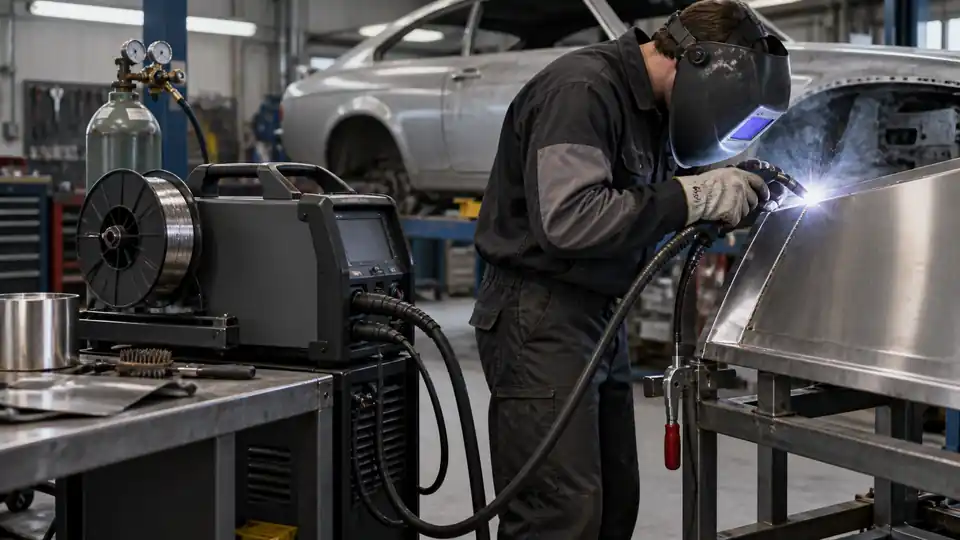
Stainless steel exposes weak points in a MIG setup quickly. Poor wire selection can leave excessive spatter, shielding gas affects arc behavior, and a machine that looks capable on paper may still lack the control needed for thinner stainless sheet. The right choice depends on more than advertised amperage. Process support, wire diameter, input voltage, gas or gasless operation, and compatibility with the stainless grade all matter.
The strongest machine in this selection is the VEVOR 200A Synergic MIG Welder because it supports gas MIG, flux-core MIG, Stick, and Lift TIG while accepting both 110V and 220V input. The remaining products are stainless MIG wires, so they serve a different part of the setup. That distinction matters: a welder supplies the arc and controls, while the wire determines the filler-metal classification and shielding method.
For 304 and related austenitic stainless steels, ER308L and E308LFC-O are the main classifications represented here. Solid ER308L wire requires external shielding gas, while stainless flux-core wire is intended for gasless operation. The comparison below separates those choices so you can match the machine, wire, power source, and working environment before placing an order.
Quick Answer
- Best Overall Machine: VEVOR 200A Synergic MIG Welder, for buyers who need a stainless-capable MIG platform with dual-voltage input and multiple processes.
- Best Solid Wire: YESWELDER ER308L Stainless MIG Wire, a 0.030-inch solid wire for gas-shielded welding of common stainless grades.
- Best for Larger Workloads: PGN ER308L Stainless MIG Wire, because its 10-pound spool reduces spool changes during longer projects.
- Best Gasless Option: YESWELDER E308LFC-O Stainless Flux-Core Wire, for outdoor or mobile work where shielding gas is inconvenient.
Best MIG Welder For Stainless Steel Comparison Table
| Product | Best For | Product Type | Key Specification |
|---|---|---|---|
| VEVOR 200A Synergic MIG Welder | Best overall machine | Multi-process welder | 110V/220V, 200A, gas MIG and flux-core |
| YESWELDER ER308L Stainless MIG Wire | Gas-shielded 304 stainless | Solid MIG wire | 0.030 inch, 2-pound spool |
| PGN ER308L Stainless MIG Wire | Longer production runs | Solid MIG wire | 0.035 inch, 10-pound spool |
| Blue Demon 308LSi Stainless Wire | Cosmetic weld appearance | Solid MIG wire | 0.030 inch, 10-pound spool |
| YESWELDER E308LFC-O Flux-Core Wire | Outdoor gasless work | Flux-core MIG wire | 0.030 inch, 2-pound spool |
| SONNLER E308LFC-O Flux-Core Wire | Gasless 0.035-inch welding | Flux-core MIG wire | 0.035 inch, 2-pound spool |
| ARCCAPTAIN E308LFC-O Flux-Core Wire | All-position gasless work | Flux-core MIG wire | 0.035 inch, 2-pound spool |
| Rumvita E308LFC-O Flux-Core Wire | Compact gasless setup | Flux-core MIG wire | 0.030 inch, 2-pound spool |
The detailed sections explain where the machine and each stainless wire fit, along with the limitations that may affect your setup.
1. VEVOR 200A Synergic MIG Welder, Best Overall Machine

The VEVOR is the only complete welding machine in this selection, and its relevance is straightforward. It supports gas MIG for solid stainless wire, gasless flux-core MIG, Stick, and Lift TIG. That process range gives a buyer room to use ER308L solid wire in a controlled indoor setup or switch to self-shielded stainless flux-core wire where carrying a gas cylinder is impractical.
Its 110V/220V input is useful for workshops with different circuits. The listing also identifies synergic control, which can link wire diameter and voltage settings instead of requiring every parameter to be adjusted independently. The 200A output claim and compatibility with 0.030-inch and 0.040-inch wire provide a reasonable match for the products listed here, although actual stainless results still depend on preparation, polarity, gas, settings, and joint design.
Pros
- Supports gas MIG and gasless flux-core MIG
- Accepts both 110V and 220V input according to the listing
- Synergic controls can simplify initial wire and voltage adjustments
- Also provides Stick and Lift TIG functions
- Accepts 0.030-inch and 0.040-inch wire sizes
Cons
- The listing states that the Lift TIG torch is not included
- The published product information does not provide detailed duty-cycle conditions
This machine makes the most sense for someone building a flexible stainless setup rather than buying wire alone. Its dual-voltage design gives it more placement flexibility than a single-input machine, while the separate gas MIG and flux-core modes help match the process to the work area. Buyers focused exclusively on stainless production may prefer a machine with more detailed documentation about duty cycle and stainless-specific parameters.
To buy this product, click here.
2. YESWELDER ER308L Stainless MIG Wire, Best Solid Wire

For gas-shielded stainless MIG work, this YESWELDER spool uses ER308L solid wire in a 0.030-inch diameter. The low-carbon classification is intended to reduce the risk of intergranular carbide precipitation, a material concern that can affect corrosion resistance in stainless welds. The listing identifies compatibility with 304, 304L, 308, 308L, 321, and 347 stainless steels.
The smaller diameter is a practical fit for lighter stainless work where controlling heat input matters. The listing recommends 100% argon or argon/helium blends, so this wire belongs in a properly configured gas MIG setup rather than a gasless machine mode. Its 2-pound spool is easier to handle than a 10-pound spool, though it will require more frequent replacement during long runs.
Pros
- ER308L classification suits several common austenitic stainless grades
- 0.030-inch diameter supports more controlled wire placement than larger wire
- Low-carbon formulation is intended to support corrosion resistance
- Listed for use with 100% argon or argon/helium blends
- ABS spool construction is intended to resist transport damage
Cons
- Requires external shielding gas and a compatible gas MIG setup
- The 2-pound spool offers less capacity than the larger solid-wire options
This is a sensible starting wire for a VEVOR-style machine used with gas MIG and stainless grades near the 304 family. It is less suitable for a buyer who needs gasless operation or expects to weld continuously for long periods. Match the wire diameter to the machine’s drive-roll and liner setup before ordering.
To buy this product, click here.
3. PGN ER308L Stainless MIG Wire, Best for Larger Workloads

PGN takes the same broad ER308L approach and packages it on a 10-pound spool with a 0.035-inch diameter. That format is aimed at buyers who expect longer welding sessions and want fewer spool changes. The listing identifies 304, 304L, 308, 308L, 321, and 347 stainless as compatible materials and recommends argon or argon/helium shielding.
The larger spool is useful only if the machine can physically accept it and the wire-feed system is configured for 0.035-inch wire. A 10-pound spool also adds weight and occupies more space, so it is better suited to a stationary workshop than a compact mobile setup. The low-carbon formulation gives it the same basic stainless-focused rationale as the smaller YESWELDER solid wire.
Pros
- 10-pound spool reduces interruptions during longer projects
- ER308L wire is listed for several common stainless grades
- 0.035-inch diameter suits machines configured for larger MIG wire
- Recommended shielding gas is clearly identified
- Low-carbon formulation is intended to reduce carbide precipitation concerns
Cons
- Requires gas MIG equipment and suitable shielding gas
- Larger spool size may not fit compact welders or portable wire compartments
Choose PGN over a 2-pound spool when steady material flow matters more than compact storage. It is a consumable choice, not a replacement for a welder, and its usefulness depends on the machine’s spool compartment, drive rolls, liner, and settings. Buyers working on small repairs may find the larger spool unnecessarily cumbersome.
To buy this product, click here.
4. Blue Demon 308LSi Stainless Wire, Best for Cosmetic Appearance

Blue Demon’s 308LSi wire is a solid stainless MIG consumable intended primarily for 304 and 308 grades. The listing emphasizes smooth welds and a clean cosmetic appearance, which makes this option relevant when bead presentation matters alongside basic joining. It uses a 0.030-inch diameter and comes on a 10-pound spool.
The AWS A5.9 reference and DCEP current identification provide useful setup information, although the machine still needs to be configured according to its manual and the wire manufacturer’s instructions. The combination of small wire diameter and large spool capacity sits between light-gauge control and longer production intervals. It is a better fit for a workshop machine than a small portable unit with limited spool clearance.
Pros
- 308LSi classification is aimed primarily at 304 and 308 stainless
- 0.030-inch diameter supports controlled solid-wire MIG work
- 10-pound spool provides more consumable capacity
- Listing identifies AWS A5.9 and DCEP operation
- Positioned for smooth weld appearance
Cons
- Material coverage is narrower in the listing than the ER308L alternatives
- The 10-pound spool requires sufficient machine capacity and stable storage
This wire suits a gas MIG setup where visible weld appearance is a priority and the work centers on 304 or 308 stainless. It is less compelling for a buyer who needs a smaller spool, broader listed grade coverage, or gasless operation. Confirm that the machine uses DCEP and accepts the spool dimensions before installation.
To buy this product, click here.
5. YESWELDER E308LFC-O Stainless Flux-Core Wire, Best Gasless Option

This YESWELDER wire changes the setup from gas MIG to self-shielded flux-core MIG. Its E308LFC-O classification and internal flux are intended to provide shielding during welding, which can be useful outdoors or in locations where wind makes external gas protection difficult. The listing identifies use with 304, 304L, 308, 308L, 321, and 347 stainless steels.
The 0.030-inch diameter and 2-pound spool keep the package relatively compact. The listing also describes all-position use, including vertical and overhead work, although actual results depend on settings, joint preparation, technique, and machine compatibility. Gasless wire does not mean setup-free. Polarity, drive-roll selection, wire tension, and slag removal still need attention.
Pros
- Self-shielded design avoids an external gas cylinder
- 0.030-inch diameter fits lighter wire-feed configurations
- Listed for all-position welding
- Compatible with several common austenitic stainless grades
- Compact 2-pound spool is convenient for mobile setups
Cons
- Flux-core welding creates slag that must be managed after welding
- Gasless operation may produce a different finish from properly shielded solid wire MIG
This is the strongest match here for a portable or outdoor stainless setup that cannot rely on shielding gas. Choose solid ER308L instead where a cleaner gas-shielded process and reduced post-weld cleanup are more important. Check the welder’s polarity requirements before feeding this wire.
To buy this product, click here.
6. SONNLER E308LFC-O Stainless Flux-Core Wire, Best 0.035-Inch Gasless Wire

SONNLER uses the E308LFC-O classification in a larger 0.035-inch diameter. That difference matters because a machine set up for 0.035-inch wire needs suitable drive rolls, liner clearance, and feed settings. The listing states that the wire is gasless and identifies compatibility with stainless grades including 304, 304L, 308, 308L, 321, and 347.
Each 2-pound spool is described as vacuum packed and moisture protected. That packaging is useful for flux-core wire because storage condition can affect consumable handling. The listing also highlights slag coverage and low spatter on clean metal, but those descriptions should be treated as product claims rather than a substitute for correct setup and surface preparation.
Pros
- Self-shielded E308LFC-O design does not require external gas
- 0.035-inch diameter suits compatible larger-wire MIG setups
- Listed for several common stainless grades
- Vacuum packaging helps limit moisture exposure during storage
- 2-pound spool is manageable for smaller jobs
Cons
- Requires a machine configured for 0.035-inch flux-core wire
- Gasless flux-core produces slag and may require more cleanup than solid wire
SONNLER is a reasonable fit when a machine accepts 0.035-inch wire and the work area favors gasless operation. It should not be selected solely because the listing says it fits all MIG welders. Confirm the specific machine’s wire diameter range and polarity instructions first, especially with compact machines.
To buy this product, click here.
7. ARCCAPTAIN E308LFC-O Stainless Flux-Core Wire, Best All-Position Gasless Wire

ARCCAPTAIN’s stainless flux-core wire uses the same E308LFC-O family as the other gasless options, with a 0.035-inch diameter and 2-pound spool. Its internal flux is intended to stabilize the arc and provide shielding without a separate gas bottle. The listing identifies use across 304, 304L, 308, 308L, 321, and 347 stainless grades.
The product is listed for all-position welding and is marketed as compatible with several MIG welder brands. Compatibility claims still need to be checked against the actual machine, since wire size, polarity, drive-roll profile, and feed-path setup vary. Vacuum-packed storage is a practical detail for a consumable that may spend time in a workshop cabinet before use.
Pros
- Gasless design suits outdoor and mobile welding
- 0.035-inch wire supports compatible larger-wire machines
- Listed for all-position stainless welding
- Broad listed compatibility with common austenitic stainless grades
- Vacuum-packed 2-pound spool helps with storage
Cons
- Requires correct polarity and machine setup for self-shielded wire
- Its 0.035-inch size is less suitable for machines configured only for 0.030-inch wire
ARCCAPTAIN is worth comparing with the SONNLER option when the machine already uses 0.035-inch flux-core wire. The two products serve a similar role, so the deciding factors may be current listing details, spool availability, and whether the machine’s operating instructions support the wire. Buyers wanting a gas-shielded finish should move to a solid ER308L product instead.
To buy this product, click here.
8. Rumvita E308LFC-O Stainless Flux-Core Wire, Best Compact Gasless Spool

Rumvita offers E308LFC-O flux-core wire in a 0.030-inch diameter on a 2-pound spool. That combination is aimed at welders configured for smaller wire who still need gasless stainless capability. The listing identifies use with 304, 304L, 308, 308L, 321, and 347 stainless steels and describes the wire as suitable for all-position welding.
The smaller diameter may be easier to match with compact wire-feed systems than the 0.035-inch products above, but the machine’s manual remains the deciding reference. Vacuum packaging helps protect the spool during storage, while the self-shielded design avoids the cylinder, regulator, and hose required for solid-wire gas MIG. Slag management remains part of the process.
Pros
- 0.030-inch diameter fits compatible smaller-wire MIG machines
- Self-shielded design eliminates external shielding gas
- Listed for several common stainless grades
- Suitable for all-position welding according to the listing
- Compact 2-pound spool supports mobile use
Cons
- Gasless flux-core requires slag removal and suitable polarity
- Smaller spool capacity means more frequent replacement during extended work
Rumvita is the closest match here for a compact machine that accepts 0.030-inch stainless flux-core wire. It gives up spool capacity compared with larger packages, but that can be useful when the welder has a small compartment or the work involves short repair sessions. Confirm the exact wire-feed settings before starting on a finished stainless component.
To buy this product, click here.
Buying Guide For A MIG Welder And Stainless Steel Wire
Match Solid Wire to Shielding Gas
Solid ER308L and 308LSi wire require external shielding gas. The YESWELDER, PGN, and Blue Demon products belong in a gas MIG setup, with the listings identifying argon or argon/helium blends for the solid-wire choices. A regulator, hose, correct gas flow, and protection from drafts all affect the process, so buying solid wire without planning the gas side leaves the setup incomplete.
Use Flux-Core Wire Where Gasless Operation Helps
E308LFC-O wire contains flux that provides shielding during welding, which makes it more practical for outdoor or mobile work. It also creates slag, so the finished weld requires a different cleanup routine from solid-wire MIG. Gasless operation is convenient, but it does not remove the need to confirm polarity, drive-roll compatibility, wire diameter, and machine settings.
Choose the Correct Wire Diameter
The 0.030-inch and 0.035-inch products are not interchangeable by assumption. The machine needs the appropriate drive rolls, liner, contact tip, and feed settings for the selected diameter. The VEVOR listing identifies compatibility with both sizes, while a different machine may support only one. Check the manual before installing a new spool.
Understand ER308L and E308LFC-O
ER308L identifies a solid stainless MIG wire classification, while E308LFC-O identifies a flux-cored stainless wire classification. Both are represented here for several common stainless grades, but they use different welding setups. The filler classification should be matched to the base metal and the manufacturer’s recommendations rather than selected by diameter alone.
Do Not Buy by Maximum Amperage Alone
The VEVOR’s listed 200A output is useful context, but maximum amperage does not describe low-end control, duty cycle conditions, wire-feed consistency, or the quality of every stainless weld. Thin stainless often benefits from controlled heat input and appropriate settings. Joint preparation, fit-up, travel speed, shielding, and surface cleanliness remain central to the result.
Check Accessories and Process Claims
A machine may support several processes without including every torch or accessory. The VEVOR listing specifically states that the Lift TIG torch is not included. Gas MIG also requires equipment beyond the welder itself, while flux-core operation requires suitable wire and polarity. Treat compatible, supported, and included as separate claims.
Best MIG Welder For Stainless Steel FAQ
Can Any MIG Welder Weld Stainless Steel?
A MIG machine needs a suitable stainless wire, compatible wire diameter, correct polarity, and the appropriate shielding method. A machine that supports solid-wire gas MIG can use stainless ER308L wire when the rest of the setup is configured correctly. Generic MIG capability alone does not identify the correct wire or settings.
Is Solid Stainless MIG Wire Better Than Stainless Flux-Core Wire?
Neither is automatically better for every setup. Solid wire with shielding gas is often the more appropriate direction where controlled indoor welding and reduced slag are priorities. Stainless flux-core wire is more convenient where gas cylinders are impractical or wind makes external shielding difficult.
What Gas Is Used with ER308L Stainless MIG Wire?
The product listings for the solid ER308L options identify 100% argon or argon/helium blends. Follow the wire manufacturer’s guidance and the machine’s operating instructions. Gas selection, flow, torch position, and draft control all affect shielding.
Can the VEVOR Welder Use Both Solid and Flux-Core Stainless Wire?
The listing identifies support for gas solid wire and flux-core wire, including 0.030-inch and 0.040-inch sizes. The product information also describes gas MIG and gasless MIG modes. Confirm the machine’s current manual for polarity, drive-roll setup, and the correct operating procedure for the selected wire.
Is 308L Wire Suitable for 304 Stainless Steel?
The listings for the ER308L and E308LFC-O products identify 304 and 304L among the compatible stainless grades. The correct filler still depends on the base material, joint requirements, service conditions, and applicable welding guidance. Confirm the material classification before work where corrosion resistance or service conditions are critical.
Does Stainless Flux-Core Wire Need Shielding Gas?
The E308LFC-O products in this selection are listed as self-shielded and gasless. They use internal flux rather than an external gas cylinder for shielding. They still require a compatible MIG machine and correct polarity, and the resulting slag must be removed after welding.
Can a 10-Pound Stainless Wire Spool Fit Any MIG Welder?
No. The machine must have enough physical space for the spool and a wire-feed system configured for its diameter. The PGN and Blue Demon products use 10-pound spools, while several other options use 2-pound spools. Check the machine’s spool capacity and drive-system requirements before ordering.
Final Verdict
The VEVOR 200A Synergic MIG Welder is the strongest overall choice in this selection because it is the complete machine and supports the two stainless MIG approaches represented here. Its 110V/220V input, gas MIG and flux-core modes, synergic controls, and additional Stick and Lift TIG functions give it broader setup flexibility than a single-purpose wire product. The missing Lift TIG torch and limited published duty-cycle detail remain meaningful trade-offs.
For the consumable side, YESWELDER ER308L is the most balanced solid-wire choice for gas-shielded work on listed stainless grades, while PGN and Blue Demon make more sense for buyers who need a 10-pound spool. YESWELDER E308LFC-O is the better gasless direction for outdoor or mobile work. Match the machine, wire classification, diameter, shielding method, polarity, and stainless grade before ordering, then confirm the current product documentation for the exact configuration.
