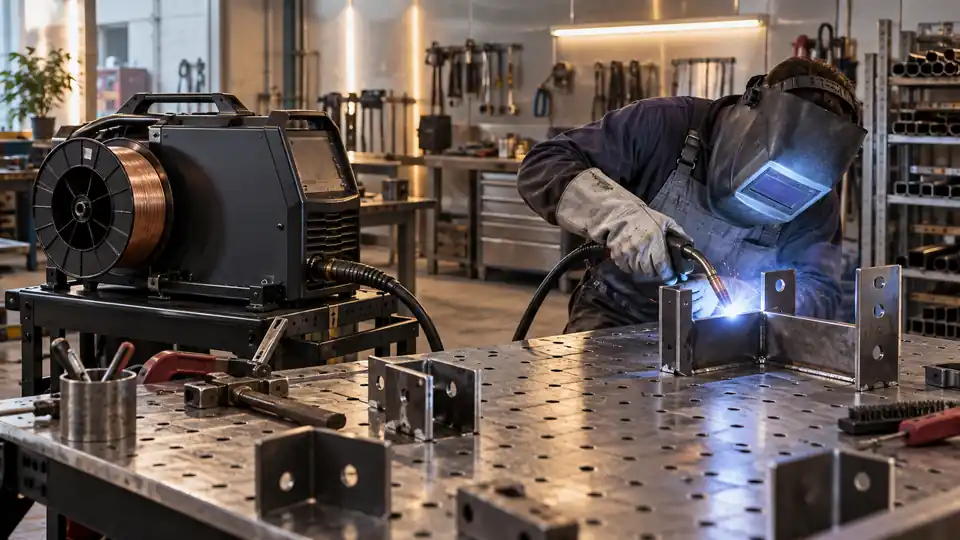
A good MIG welder has to match the metal, power available, wire system, and kind of work you actually plan to do. A compact 110V flux-core machine may be the right tool for occasional repairs, while a dual-voltage unit with gas MIG, manual controls, and spool-gun support makes more sense for a workshop handling steel, stainless, and aluminum. The highest advertised amperage does not automatically make a machine the better choice.
The biggest dividing line in this group is process control. Synergic controls can simplify setup by pairing wire speed and voltage recommendations, while manual adjustment gives experienced users more room to tune the arc. Buyers should also check whether a TIG torch or spool gun is included, because compatibility alone does not mean the accessory arrives in the box. For most buyers seeking a balanced MIG machine, the YESWELDER MIG-205DS PRO offers the broadest practical mix of dual-voltage input, gas MIG, flux-core MIG, and optional spool-gun aluminum capability.
This comparison weighs MIG capability first, then looks at voltage flexibility, process support, wire handling, portability, controls, and accessory requirements. The choices range from small 110V machines for light repairs to higher-output models with more advanced aluminum and multiprocess functions.
Quick Answer
- Best Overall: YESWELDER MIG-205DS PRO, a dual-voltage machine with gas MIG, flux-core MIG, Stick, Lift TIG, and spool-gun support.
- Best for Aluminum: ARCCAPTAIN MIG250DP, which adds single-pulse and double-pulse MIG modes plus aluminum-focused rollers and liner.
- Best Portable Option: ARCCAPTAIN MIG165, weighing about 12.8 pounds and supporting 110V or 220V input.
- Best Budget-Oriented Choice: YESWELDER 160A MIG Welder, with dual-voltage operation and support for both 2-pound and 10-pound spools.
Best MIG Welder Comparison Table
| Product | Best For | Input And Output | Key MIG Feature |
|---|---|---|---|
| YESWELDER MIG-205DS PRO | Best Overall | 110V/220V, up to 200A | Spool-gun MIG support |
| ARCCAPTAIN MIG250DP | Aluminum and pulse MIG | 110V/220V, up to 250A | Double-pulse MIG |
| ARCCAPTAIN MIG250 | High-output multiprocess use | 110V/220V, up to 250A | Gas, flux-core, spot, and spool-gun support |
| ARCCAPTAIN MIG200 | Preset control and general fabrication | 110V/220V, up to 200A | Ten stored settings |
| ARCCAPTAIN MIG205MP | Welding and plasma cutting | 120V/240V, up to 205A | Integrated plasma cutter |
| BESTMIG 165S | Portable dual-voltage work | 110V/220V, up to 165A | Synergic and manual modes |
| ARCCAPTAIN MIG165 | Compact general repairs | 110V/220V, up to 165A | 2T/4T trigger modes |
| YESWELDER 160A | Value and larger spools | 110V/220V, up to 160A | 2-pound and 10-pound spool support |
| BESTMIG MIG145 | Entry-level dual-voltage setup | 110V/220V, up to 145A | Included helmet and gloves |
The detailed reviews below explain where each machine fits, what its specifications mean, and which limitations deserve attention before ordering.
1. YESWELDER MIG-205DS PRO, Best Overall

The MIG-205DS PRO earns the top position because it covers the core MIG use cases without forcing buyers into a single input voltage. It supports 110V and 220V operation, gas MIG, gasless flux-core MIG, Stick, and Lift TIG. Its published output reaches 200 amps, giving it more headroom than the compact 135A and 145A machines for thicker steel, although actual results depend on circuit capacity, material preparation, wire, and settings.
Its most meaningful feature for MIG buyers is support for a spool gun for aluminum. The spool gun is an additional purchase, so this is not an out-of-box aluminum MIG package. Still, the combination of dual voltage, synergic and manual MIG control, and a stated wire-feed range from 58 to 858 inches per minute gives this model more adjustment flexibility than the smaller entry-level options. Synergic control recommends a voltage as wire speed changes, while the manual mode leaves room for finer tuning.
Pros
- Supports 110V and 220V input.
- Combines gas MIG, flux-core MIG, Stick, and Lift TIG.
- Supports spool-gun MIG for aluminum.
- Offers both synergic and manual MIG control.
- Up to 200A output provides more capacity for heavier work than compact models.
Cons
- Spool gun and Lift TIG torch are sold separately.
- Higher output and broader controls add cost and complexity compared with small 110V machines.
This machine makes the most sense for a workshop that expects to move between thin steel, heavier fabrication, flux-core outdoor work, and occasional aluminum. Buyers who only need light 110V repairs may not benefit from the extra process range. Its strongest advantage is balance, since it offers meaningful MIG flexibility without moving into the specialized plasma and pulse controls of the more expensive ARCCAPTAIN models.
To buy this product, click here.
2. ARCCAPTAIN MIG250DP, Best for Aluminum and Pulse MIG

Pulse control changes the reason to choose this machine. The MIG250DP supports conventional and double-pulse MIG, with controls for background level, frequency, and duty cycle. Those settings give experienced users more control over heat input and bead appearance, particularly in aluminum and other applications where arc behavior matters more than simple maximum amperage.
The listing also identifies gas MIG, gasless flux-core MIG, Stick, spot welding, Lift TIG, and spool-gun MIG support. Aluminum accessories are better addressed here than on the basic machines because the package includes a graphene liner and U-shaped rollers for .035 to .040-inch aluminum wire. The spool gun and Lift TIG torch remain separate purchases, and the full 250A output requires 220V input according to the listing.
Pros
- Offers single-pulse and double-pulse MIG modes.
- Supports 110V and 220V operation.
- Includes aluminum-oriented liner and U-shaped rollers.
- Provides manual adjustment for wire speed, voltage, burn-back, and inductance.
- Supports gas MIG, flux-core MIG, Stick, spot welding, and Lift TIG.
Cons
- Spool gun and Lift TIG torch are sold separately.
- Advanced pulse controls may be unnecessary for basic steel repairs.
This is the stronger selection for buyers who specifically expect to work with aluminum and can make use of pulse parameters. Someone welding mild steel with ordinary solid wire may find the MIG-205DS PRO easier to justify, while aluminum-focused users gain a more specialized control set here. Confirm the current accessory bundle before ordering because the listing distinguishes included aluminum components from optional torches and spool guns.
To buy this product, click here.
3. ARCCAPTAIN MIG250, Best High-Output Option

The MIG250 focuses on broad process coverage and output rather than pulse welding. Its six listed functions include gas MIG, gasless MIG, Lift TIG, MMA Stick, spot welding, and spool-gun support. With up to 250 amps and dual-voltage input, it is positioned above compact workshop machines for buyers who expect heavier fabrication or want more reserve capacity.
Synergic MIG automatically matches recommended current and wire-feed speed based on wire and gas selections, while manual MIG allows independent adjustment. The package includes a 10-foot MIG torch, ground clamp, Stick holder, gas hose, contact tips, and wire-feed rollers. The spool gun and Lift TIG torch are not included, so the machine’s advertised process range should be understood as supported capability rather than a complete accessory package.
Pros
- Up to 250A output with 110V and 220V input.
- Supports gas MIG and gasless flux-core MIG.
- Includes synergic and manual MIG modes.
- Provides spot welding and optional spool-gun support.
- Includes a MIG torch, gas hose, ground clamp, and Stick holder.
Cons
- Spool gun and Lift TIG torch require separate purchases.
- Its larger output range is more than many light repair projects require.
Choose this model over the pulse version if straightforward high-output MIG and multiprocess support matter more than specialized aluminum arc control. It may suit a fixed workshop better than a machine that must travel frequently. Buyers using a standard household circuit should verify the required input and understand that higher output is constrained by available power.
To buy this product, click here.
4. ARCCAPTAIN MIG200, Best for Preset Settings

The MIG200 sits between compact multiprocess welders and the larger 250A machines. It supports gas and solid-wire MIG, flux-core MIG, Stick, spot welding, Lift TIG, and an optional spool gun. The listing identifies compatibility with .023, .030, and .035-inch solid wire, plus .030 and .035-inch flux-core wire, which gives it useful flexibility for lighter sheet work and general steel fabrication.
Ten stored settings can make repeated jobs easier to restart, especially when a workshop alternates between common wire sizes or materials. Pre-flow, post-flow, burn-back, adaptive crater, and 2T/4T functions add control beyond the smallest machines. The TIG torch and spool gun are not included, and .023-inch and .040-inch rollers require separate purchases, so buyers should match the intended wire to the supplied hardware.
Pros
- Supports 110V and 220V input.
- Accepts several solid-wire and flux-core wire diameters.
- Stores up to ten parameter groups.
- Includes burn-back, crater, pre-flow, and post-flow adjustments.
- Supports optional spool-gun aluminum MIG.
Cons
- Spool gun and TIG torch are not included.
- Some wire sizes require separately purchased rollers.
This model is a sensible middle ground for buyers who value repeatable setup more than advanced pulse control. It offers more process and wire-management flexibility than the 160A and 165A choices, while remaining less specialized than the plasma combination machine. Check the roller configuration before choosing a less common wire diameter.
To buy this product, click here.
5. ARCCAPTAIN MIG205MP, Best Welding and Plasma Combination

A MIG welder with an integrated plasma cutter can be useful where fabrication and material preparation happen side by side. The MIG205MP supports gas MIG, gasless MIG, DC HF TIG, DC Lift TIG, Stick, spot welding, cleaning, and plasma cutting. Its MIG range is listed as 30A to 205A, while the cutter is listed with a quality cutting figure of 10 mm and a maximum figure of 18 mm. Those figures are product claims, and actual cutting depends on air supply, material, speed, and setup.
The machine also adds app control, saved parameter memories, synergic settings, and manual adjustments for MIG inductance, burn-back, and welding speed. HF TIG is a meaningful distinction from Lift TIG, but this remains DC TIG, not AC TIG. The included accessory configuration should be checked carefully because the listing describes torch compatibility and foot-pedal compatibility without making every accessory part of the standard package.
Pros
- Combines MIG welding and plasma cutting in one machine.
- Supports 120V and 240V input.
- Offers DC HF TIG and DC Lift TIG modes.
- Provides app-based adjustment and memory functions.
- Lists a 60% duty cycle and a MIG range up to 205A.
Cons
- More expensive and complex than a dedicated MIG machine.
- DC TIG does not provide AC TIG capability for aluminum TIG work.
This choice fits a workshop that needs cutting as often as welding. A buyer focused solely on MIG may gain better value from the YESWELDER MIG-205DS PRO or ARCCAPTAIN MIG200. Buyers who need plasma cutting, stored settings, and HF TIG in the same enclosure can accept the additional controls and setup requirements.
To buy this product, click here.
6. BESTMIG 165S, Best Portable Dual-Voltage Option

At about 12.5 pounds, the BESTMIG 165S is easier to carry between a garage, trailer, or outdoor repair area than the larger 200A and 250A machines. It supports gas MIG, gasless flux-core MIG, Lift TIG, and Stick, with 110V and 220V input. The manufacturer listing identifies a 60% duty cycle and up to 165A output, with 220V recommended for maximum output and penetration.
Its synergic mode matches voltage and wire-feed recommendations to selected amperage, while manual mode lets users work independently with voltage and current. The 2T and 4T trigger settings are useful distinctions: 2T suits ordinary trigger operation, while 4T can reduce the need to hold the trigger during longer welds. A helmet and gloves are listed in the package, but the TIG torch is not.
Pros
- Supports 110V and 220V input.
- Low weight and shoulder strap support mobile work.
- Offers gas MIG, flux-core MIG, Lift TIG, and Stick.
- Includes synergic and manual control modes.
- Provides 2T and 4T trigger operation.
Cons
- 220V is recommended for its full stated output.
- Lift TIG torch is not included.
This machine is a strong fit for buyers who carry equipment to different work areas and need more flexibility than a 110V-only unit. Its output and duty-cycle claims place it above the smallest models, while its compact body keeps transport manageable. A fixed workshop with frequent thick-steel work may be better served by a heavier 200A or 250A machine.
To buy this product, click here.
7. ARCCAPTAIN MIG165, Best Compact General-Repair Machine

The MIG165 provides a compact route into gas MIG, flux-core MIG, Lift TIG, and Stick. Its 110V/220V input gives it more power flexibility than the small single-voltage machines, and the listing states a 60% duty cycle with output up to 165A. A 12.8-pound body, carrying handle, and shoulder strap make it practical for repairs that move from a shop bench to an outdoor work area.
The 2T and 4T controls add useful trigger flexibility, while synergic and manual MIG modes let the user choose between guided setup and independent adjustment. The supplied wire capacity is limited to a 2-pound spool, which keeps the machine compact but creates more frequent spool changes than the YESWELDER 160A, which accepts 2-pound and 10-pound spools. The WP-17V TIG torch is optional.
Pros
- Supports both 110V and 220V operation.
- Offers gas MIG, flux-core MIG, Lift TIG, and Stick.
- Compact 12.8-pound design supports transport.
- Includes 2T and 4T trigger modes.
- Includes a 2-pound flux-core spool and basic welding leads.
Cons
- Wire compartment accepts only a 2-pound spool.
- WP-17V TIG torch must be purchased separately.
The MIG165 makes sense for mobile repair work where compact storage matters more than long uninterrupted wire runs. It is more flexible than a basic 110V flux-core machine, though the small spool limit matters for repetitive fabrication. Buyers who expect to use larger spools should move up to a machine with a larger wire compartment.
To buy this product, click here.
8. YESWELDER 160A MIG Welder, Best for Larger Spools

The YESWELDER 160A distinguishes itself through wire capacity rather than maximum output. It accepts both 2-pound and 10-pound spools of .030 and .035-inch solid or flux-core wire, giving frequent users fewer interruptions than machines limited to compact spools. It supports gas MIG, flux-core MIG, Stick, and Lift TIG, with 110V and 220V input.
Synergic control recommends voltage and wire speed as the selected thickness or amperage changes, while manual control permits independent adjustment. At about 19.4 pounds, it is heavier than the 12-pound class machines, but that added size may be acceptable in a workshop where the machine stays near the welding table. The Lift TIG torch is an extra purchase, and the listing does not include a spool-gun aluminum setup.
Pros
- Supports 110V and 220V input.
- Accepts both 2-pound and 10-pound spools.
- Handles gas MIG, flux-core MIG, Stick, and Lift TIG.
- Offers synergic and manual MIG controls.
- Supports common .030 and .035-inch wire sizes.
Cons
- Heavier than the most portable machines in this comparison.
- Lift TIG torch is sold separately, and spool-gun support is not listed.
This model is a practical choice for a workshop that uses enough wire to make spool capacity matter. It gives up some portability compared with the BESTMIG 165S and ARCCAPTAIN MIG165, but the larger spool option can make repetitive steel work less fussy. Aluminum-focused buyers should choose a machine with documented spool-gun support instead.
To buy this product, click here.
9. BESTMIG MIG145, Best Entry-Level Dual-Voltage Kit

The MIG145 is aimed at buyers who want a small multiprocess machine with a broad starter package. It supports gas and gasless MIG, Stick, and Lift TIG, along with 110V and 220V input. The listing identifies a 145A maximum output and compatibility with .030 to .040-inch flux-core wire, while solid-wire operation is identified at .030 inch.
Synergic control changes recommended voltage and wire speed as current or wire selection changes, and manual adjustment remains available for users who want more control. The package lists a MIG torch, gas tube and connector, solid and flux-core wire, an auto-darkening helmet, gloves, and basic tools. The TIG torch is specifically excluded, so Lift TIG is a supported process rather than a complete out-of-box TIG setup.
Pros
- Supports 110V and 220V input.
- Handles gas MIG, flux-core MIG, Stick, and Lift TIG.
- Includes an auto-darkening helmet and gloves.
- Offers synergic and manual control.
- Includes solid wire, flux-core wire, gas hardware, and basic accessories.
Cons
- TIG torch is not included.
- Lower output than the 160A, 165A, 200A, and 250A alternatives.
This package suits a first setup where included MIG accessories matter and the planned work is relatively light. It gives more input flexibility than the 110V-only entry models, though its lower output leaves less headroom for thicker material. Buyers who already own a helmet and gloves may prefer the stronger controls or larger spool capacity of another machine in this roundup.
To buy this product, click here.
Buying Guide
Gas MIG Versus Flux-Core MIG
Gas MIG uses shielding gas with solid wire and can produce a cleaner, more controlled process in a suitable indoor setup. Flux-core wire generates its own shielding and is more practical outdoors or where wind would disturb a gas shield. A machine that supports both gives more flexibility, but the wire, polarity, liner, and setup must match the selected process.
Match Input Voltage to the Available Circuit
A 110V welder is easier to use in a typical household garage, while 220V input can provide more output headroom when the electrical installation supports it. Dual-voltage machines offer flexibility, but they do not guarantee maximum output on a 110V circuit. Check the machine’s manual, plug arrangement, breaker requirements, and extension-cord guidance before installation.
Understand Synergic and Manual Controls
Synergic control recommends related voltage and wire-feed settings from a selected current, wire size, or material thickness. This can reduce initial setup work. Manual control matters when a recommendation needs adjustment for joint design, fit-up, wire type, or personal preference. The strongest machines in this roundup provide both rather than forcing one operating style.
Spool-Gun Compatibility Is Not Inclusion
A spool gun places the wire spool near the gun, reducing the distance soft aluminum wire must travel through the feeder. That can make aluminum MIG more practical, but the welder must support the accessory and the spool gun must be purchased or included. The YESWELDER MIG-205DS PRO, ARCCAPTAIN MIG200, and ARCCAPTAIN MIG250 list spool-gun support, while the relevant accessories are separate.
Read Output and Duty Cycle Together
Maximum amperage describes the upper end of the published range, not the thickness every user can weld continuously. Duty cycle must be tied to a stated amperage and operating condition. Material type, joint design, wire diameter, shielding, preparation, and technique also affect results. A 200A machine may be more useful than a 250A model if its controls and power requirements better match the work.
Check Spool Capacity
A compact machine that accepts only a 2-pound spool can be convenient to carry, but it may require more frequent changes during longer projects. The YESWELDER 160A accepts 2-pound and 10-pound spools, while the ARCCAPTAIN MIG165 is limited to a 2-pound spool. That difference matters more for repeated fabrication than for occasional short repairs.
Best MIG Welder FAQ
Is a 110V MIG welder enough for home repairs?
A 110V machine can suit light repairs, thin steel, small brackets, and short fabrication tasks when its published output and duty cycle match the job. It offers easier access to household power, but it generally provides less output headroom than the same type of machine connected to 220V. Check the manufacturer’s thickness and input requirements rather than relying on the amperage label alone.
What is the difference between gas MIG and flux-core welding?
Gas MIG uses shielding gas supplied through a regulator and hose, usually with solid wire. Flux-core welding uses a flux-filled wire that provides shielding during the arc. Gas MIG can be cleaner in a protected indoor environment, while self-shielded flux-core is often more practical outdoors because it does not depend on a separate gas shield.
Can these MIG welders weld aluminum?
Generic MIG capability does not automatically mean aluminum capability. Aluminum MIG usually requires suitable wire-feed components and a spool gun or another compatible feeding arrangement. The YESWELDER MIG-205DS PRO and ARCCAPTAIN MIG200 list spool-gun support, but the spool gun is separate. Pulse MIG models such as the ARCCAPTAIN MIG250DP offer additional aluminum-oriented control.
Does Lift TIG mean AC TIG?
No. Lift TIG describes how the arc starts, while AC or DC describes the welding current. The machines in this comparison list Lift TIG, but that does not establish AC TIG capability. Buyers seeking TIG welding on aluminum should verify that the exact machine provides the required AC function.
Is a higher amperage rating always better?
No. Higher output may help with thicker material, but it can require a 220V circuit and may add cost, weight, and control complexity. For thin sheet metal, low-end control and suitable wire settings can matter more than the largest number on the front panel.
Which machine is easiest to carry?
The ARCCAPTAIN MIG165 weighs about 12.8 pounds, and the BESTMIG 165S is listed at about 12.5 pounds. Both support 110V and 220V input. The right portable choice also depends on spool capacity, included leads, available power, and whether the machine needs to support gas equipment or heavier work.
Do these welders include TIG torches?
Several products support Lift TIG while listing the TIG torch as a separate purchase. The YESWELDER MIG-205DS PRO, ARCCAPTAIN MIG165, BESTMIG 165S, YESWELDER 160A, and BESTMIG MIG145 should therefore be treated as MIG machines with optional Lift TIG capability, not complete TIG kits.
Final Verdict
The YESWELDER MIG-205DS PRO is the strongest overall choice because it balances the features that matter most in a general MIG machine. Its 110V/220V input, gas and flux-core MIG support, Stick and Lift TIG modes, synergic and manual controls, and optional spool-gun compatibility give it broader practical coverage than the smaller machines without requiring the specialized pulse and plasma functions of the premium alternatives.
Choose the ARCCAPTAIN MIG250DP if aluminum and pulse MIG justify its more advanced controls. The ARCCAPTAIN MIG200 and MIG250 suit buyers who want higher output and stored or adjustable MIG functions, while the BESTMIG 165S and ARCCAPTAIN MIG165 are easier to carry. For a lower-cost dual-voltage setup, the YESWELDER 160A remains attractive because it accepts larger spools. Match the machine to the available circuit, wire system, material, and accessory budget before focusing on the maximum amperage.
