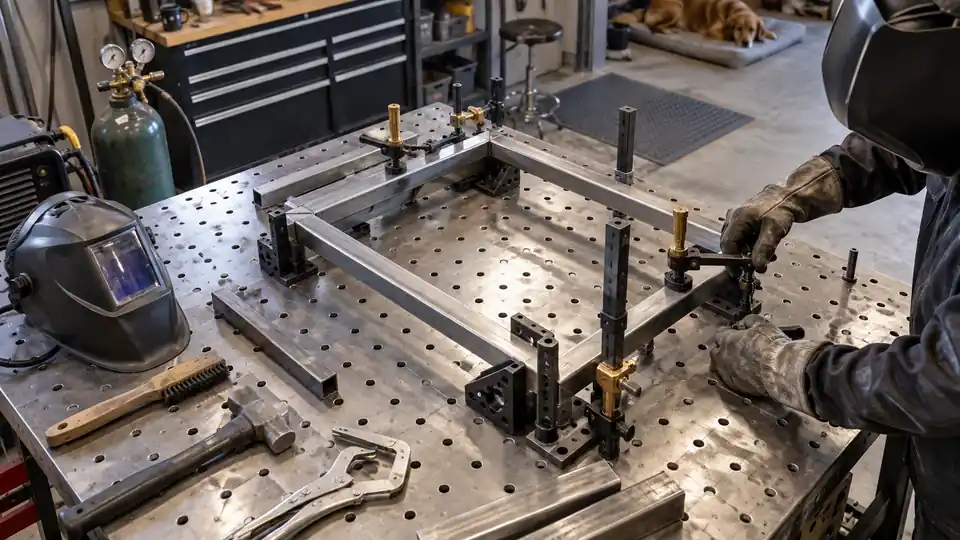
A welding table has one job that matters above everything else: give the workpiece a stable, repeatable place to sit while you fit, clamp, tack, and weld. The best welding table for a compact garage may be a folding model with adjustable height, while a busy workshop may benefit more from a rigid cart with locking casters, a large fixture-hole pattern, and useful storage underneath.
Headline load capacity can be misleading if the table is awkward to fixture or difficult to keep stationary. Hole diameter, hole spacing, tabletop size, height adjustment, wheel design, and included clamps affect daily use far more than a large number printed on the product page. A table rated for 1,200 pounds may suit heavy assemblies, but a smaller table with guide rails and tilt adjustment can be more useful for compact parts and awkward angles.
This comparison weighs those practical differences across nine tables. The VEVOR 36-by-18-inch model with lockable casters earns the overall position because it combines a high stated load capacity with mobility, 5/8-inch fixture holes, and under-table storage. Other options make more sense for folding storage, maximum tabletop space, height adjustment, or a fit-up kit.
Quick Answer
- Best Overall: VEVOR 36″ x 18″ Welding Table for a mobile workshop table with 1,200-pound stated capacity, lockable casters, and 5/8-inch holes.
- Best for Folding Storage: WORKESS Folding Welding Table for a 42-by-21-inch surface, seven height settings, and a compact folded profile.
- Best for Large Workpieces: VEVOR 40″ x 24″ Welding Table for generous tabletop space, 216 fixture holes, wheels, and two storage levels.
- Best for Fit-Up Work: Klutch Steel Welding Table for its 4 mm steel top, 16 mm hole pattern, and included 24-piece fit-up kit.
Best Welding Table Comparison Table
| Product | Best For | Tabletop | Capacity and Fixture System |
|---|---|---|---|
| VEVOR 36″ x 18″ | Best Overall | 36″ x 18″ | 1,200 lb, 94 5/8″ holes, locking casters |
| WORKESS Folding Table | Folding storage | 42″ x 21″ | 1,000 lb, 0.8″ holes, seven height levels |
| VEVOR 40″ x 24″ | Large workpieces | 40″ x 24″ | 800 lb static, 216 5/8″ holes, four wheels |
| CAMMOO 36″ x 18″ | Heavy loads and mobility | 36″ x 18″ | 1,200 lb, 94 5/8″ holes, casters and glides |
| Goplus Portable Table | Adjustable portable work | 42″ x 21″ | 1,000 lb, 0.7″ holes, two bar clamps |
| VEVOR Foldable 44″ Table | Long folding surface | 44″ x 21″ | 500 lb, 0.63″ holes, four height levels |
| Klutch Steel Table | Fit-up work | 36″ x 24″ | 600 lb, 16 mm holes, 24-piece kit |
| VEVOR 36″ x 24″ | Stationary stability | 36″ x 24″ | 800 lb, 0.63″ holes, adjustable foot pads |
| VEVOR Foldable Tilt Table | Angled and small-part work | 30″ x 20″ | 400 lb, three tilt angles, guide rails |
The detailed reviews below explain how each table handles fixture compatibility, storage, movement, height, and heavier assemblies.
1. VEVOR 36″ x 18″ Welding Table, Best Overall

The VEVOR 36-by-18-inch table offers a useful balance for a garage or workshop where the table may need to move between a wall, a vehicle, and a welding area. Its listing states a 1,200-pound load capacity, while the 36-by-18-inch top keeps the footprint narrower than the 40-by-24-inch VEVOR model. That combination suits users who need substantial support without giving up too much floor space.
Fixturing is handled by 94 5/8-inch holes and four tool slots. The hole size matches a common class of welding clamps, although compatibility should still be checked against the exact clamps in your collection. Locking casters allow the cart to move, then hold its position during layout. The listing also identifies a tool tray and a built-in handle, useful details when clamps, pliers, and measuring tools tend to spread across the floor.
Pros
- Stated 1,200-pound load capacity supports substantial assemblies.
- 94 5/8-inch fixture holes provide multiple clamping positions.
- Lockable casters combine mobility with a stationary setup.
- Tool slots and an under-table tray help keep accessories nearby.
- 36-by-18-inch dimensions fit more easily in compact work areas than larger tables.
Cons
- The 18-inch front-to-back depth gives less room than 24-inch-deep tables.
- The listing does not specify the exact included clamp assortment.
This model makes the most sense for someone who wants a mobile welding cart with a high stated capacity and a conventional 5/8-inch fixture pattern. A larger fixed surface may suit wide frames better, while buyers who fold their table after every project may prefer WORKESS or Goplus. For mixed garage work, though, the combination of casters, storage, and fixture holes is unusually practical.
To buy this product, click here.
2. WORKESS Folding Welding Table, Best for Folding Storage

WORKESS focuses on a problem that many garage users know well: a welding table can be useful for hours and inconvenient for the rest of the week. The legs fold under the 42-by-21-inch top, and the listing states a folded height of about 3.7 inches. Handles add another practical touch for carrying or sliding the table into storage once the steel has cooled and the tools are cleared away.
Seven height levels span approximately 27.7 to 36.6 inches, giving more adjustment than the four-level VEVOR foldable table. The 1,000-pound stated capacity and galvanized 14-gauge top make it suitable for heavier assemblies on paper, while 0.8-inch holes and slots offer several fixture locations. Four locking hooks are included for added retention, although the larger hole size may require attention when choosing clamps.
Pros
- 42-by-21-inch surface provides useful room for frames and brackets.
- Seven height settings cover seated and standing work positions.
- Folds to a compact profile for garage or vehicle storage.
- Stated 1,000-pound capacity suits heavier workpieces.
- Galvanized top and powder-coated frame are intended to resist corrosion.
Cons
- 0.8-inch holes may not match every 5/8-inch fixture accessory.
- Folding construction may be less convenient than a rigid cart for permanent shop use.
WORKESS is a strong choice for a shared garage where the table must disappear between projects. Its height range is especially useful when one job involves seated detail work and the next involves standing layout. Buyers who want the most common 5/8-inch clamp ecosystem may prefer the VEVOR 1200-pound table instead.
To buy this product, click here.
3. VEVOR 40″ x 24″ Welding Table, Best for Large Workpieces

A wide top changes the working rhythm of a table. Instead of constantly shifting a long bracket or partially assembled frame, the 40-by-24-inch VEVOR gives the workpiece more room to stay supported. Its listing states an 800-pound static capacity and a 600-pound dynamic capacity, an important distinction because a table can carry a resting load differently from a moving or repositioned assembly.
The 216 5/8-inch holes are the most extensive fixture pattern in this group, giving clamps more placement options across the surface. Four wheels, two with brakes, make relocation easier, and the double-layer storage board adds space for tools and supplies. The trade-off is a larger footprint than compact 30-by-20-inch tables, so a crowded garage should be measured before ordering.
Pros
- 40-by-24-inch tabletop supports larger layouts and assemblies.
- 216 5/8-inch holes provide a dense fixture pattern.
- Double-layer storage board creates room for workshop accessories.
- Four wheels make repositioning easier.
- Two braked wheels help hold the cart in place after movement.
Cons
- Stated dynamic capacity is lower than its static capacity.
- Larger dimensions require more floor space than compact folding tables.
This is the table to favor when surface area and fixture coverage matter more than compact storage. It suits larger brackets, frames, and repair assemblies that feel cramped on an 18-inch-deep top. A folding table remains easier to transport, and the 24-inch depth may be excessive for small-part work.
To buy this product, click here.
4. CAMMOO 36″ x 18″ Welding Table, Best for Heavy Loads and Mobility

CAMMOO takes a compact cart format and gives it a 1,200-pound stated capacity. The 36-by-18-inch tabletop is similar in working area to the overall VEVOR pick, but the product information highlights reinforced 3.5 mm legs and a 2.8 mm tabletop. Those thickness figures provide useful context for buyers comparing light portable stands with more substantial cart-style tables.
Ninety-four 5/8-inch mounting holes and four tool slots cover ordinary fixture work, while 3-inch swivel casters provide movement. The listing also mentions four fixed glides, allowing the table to rest on feet during precision work rather than relying only on wheels. Pre-assembled wheels and a no-tools setup may reduce initial assembly, although the table still has the same 18-inch depth limitation found on other compact carts.
Pros
- Stated 1,200-pound capacity in a compact 36-by-18-inch format.
- Reinforced legs and a 2.8 mm tabletop are clearly identified in the listing.
- 5/8-inch holes support widely used fixture sizes.
- Casters and fixed glides allow movement followed by a more stable setup.
- Dual-sided tool tray keeps small accessories off the tabletop.
Cons
- 18-inch depth limits room for broad assemblies.
- The listing does not provide a detailed dynamic-load condition for the capacity claim.
CAMMOO is a sensible alternative to the VEVOR 1200-pound cart for buyers who place more emphasis on stated material thickness and a glide-supported setup. It is less suitable for large frames than a 24-inch-deep table. Check the caster and glide arrangement against the floor surface in your shop before relying on frequent movement.
To buy this product, click here.
5. Goplus Portable Welding Table, Best for Adjustable Portable Work

The Goplus table combines a 42-by-21-inch work surface with a folding frame, handle, and seven height levels. The adjustment range runs from approximately 27.7 to 36.7 inches, so the table can accommodate different working positions without requiring a permanent stand. That flexibility is useful when the same surface handles low assembly work one day and taller layout work the next.
Its 1,000-pound stated capacity is paired with triangular support and anti-slip foot pads. Two bar clamps are listed as included, which gives the table a more ready-to-use fixture setup than products that provide holes and slots alone. The 0.7-inch holes are larger than standard 5/8-inch holes, so buyers should confirm clamp fit rather than assuming every existing fixture will seat correctly.
Pros
- 42-by-21-inch surface gives useful room without reaching full 24-inch depth.
- Seven height levels offer broad positioning flexibility.
- Folding frame and carry handle support transport and storage.
- Two bar clamps are identified as included.
- Triangular support and anti-slip feet address stability during layout.
Cons
- 0.7-inch holes may require different fixtures than a 5/8-inch system.
- Folding tables can take more setup than a permanently positioned cart.
Goplus fits buyers who need a reasonably large surface that can be carried or stored after the work is done. The included bar clamps are useful for basic restraint, while the height range is broader than many fixed tables. For a permanent fixture-heavy station, the VEVOR 40-inch table offers a denser hole pattern and more storage.
To buy this product, click here.
6. VEVOR Foldable 44″ Welding Table, Best for a Long Folding Surface

At 44 inches long and 21 inches deep, this VEVOR table gives long workpieces more support than compact 30-inch models while retaining foldable legs. The listing states four height positions from 29.5 to 36.5 inches. That range is narrower than the seven-position WORKESS and Goplus tables, but it still provides useful adjustment for seated and standing tasks.
The table uses 0.63-inch fixture holes spaced 2 inches apart, along with six tool slots. A stated 500-pound capacity places it below the heavier carts in this roundup, so its appeal comes from length, storage, and portability rather than maximum load. The tabletop and legs are described as arriving largely assembled, which may be helpful when a table needs to be put into service quickly.
Pros
- 44-inch length supports long brackets, rails, and assemblies.
- Foldable legs simplify storage between projects.
- Four height levels cover common seated and standing positions.
- 0.63-inch holes spaced 2 inches apart support fixture placement.
- Six tool slots provide convenient access to frequently used hand tools.
Cons
- Stated 500-pound capacity is lower than the other full-size options here.
- Four height positions provide less adjustment than seven-level folding tables.
This model suits a garage where length matters but heavy assemblies are occasional. It can hold a long piece without the full footprint of a fixed 24-inch-deep table. Users regularly handling dense or very heavy components should step up to a 1,000- or 1,200-pound table instead.
To buy this product, click here.
7. Klutch Steel Welding Table, Best for Fit-Up Work

The Klutch table stands apart through its 24-piece metal fit-up kit. Rather than supplying a bare surface and leaving the buyer to gather every positioning tool, this package is aimed at layout and alignment work from the start. The 4 mm steel top and 2 mm frame provide more material detail than many listings in this group, while the 36-by-24-inch footprint offers a broad working area.
Its 16 mm holes are spaced 2 inches apart, creating a fixture pattern suited to the included fit-up tools and compatible accessories. The table can be used as a stand-alone station or placed on a workbench, which adds flexibility for a small shop. The 600-pound stated capacity is lower than the mobile 1,000- and 1,200-pound carts, so this table is better understood as a fit-up-focused station than a heavy-load cart.
Pros
- Includes a 24-piece metal fit-up tool kit.
- 4 mm tabletop thickness is clearly identified.
- 16 mm holes are arranged on a 2-inch spacing pattern.
- 36-by-24-inch surface provides substantial room for layout.
- Can be configured as a stand-alone or benchtop table.
Cons
- Stated 600-pound capacity is below the larger mobile carts.
- The table does not provide the same built-in mobility as wheeled models.
Choose Klutch when clamps and fit-up hardware are central to the purchase rather than an afterthought. Its broad surface and included kit can reduce the need to source a separate starter collection. A wheeled table is a better match for frequent relocation, and buyers with existing 5/8-inch fixtures should verify compatibility with the 16 mm hole system.
To buy this product, click here.
8. VEVOR 36″ x 24″ Welding Table, Best for Stationary Stability

Some welding setups benefit from staying put. This VEVOR model uses a 36-by-24-inch top with four adjustable anti-slip foot pads instead of casters, giving it a straightforward stationary format. The pads can compensate for an uneven floor, a practical feature when a table rocks slightly during layout or clamping.
The listing states an 800-pound load capacity and identifies 0.63-inch holes spaced 2 inches apart. That hole size is close to 5/8 inch, but exact fit should be checked against the chosen fixtures. Compared with the mobile 36-by-18-inch VEVOR table, this model gives six more inches of depth and trades relocation convenience for foot-supported stability.
Pros
- 36-by-24-inch top gives more depth for broad assemblies.
- Adjustable anti-slip foot pads help level the table on uneven floors.
- Stated 800-pound capacity supports substantial workpieces.
- 0.63-inch holes are spaced 2 inches apart for repeatable fixture placement.
- Fixed design avoids wheel movement during stationary layout.
Cons
- No wheels are listed, so relocation requires lifting or repositioning the table.
- The 0.63-inch hole size may not match every nominal 5/8-inch clamp without verification.
This table makes sense for a dedicated corner where stability and depth matter more than mobility. It offers a larger working envelope than the mobile 18-inch-deep carts, while the foot pads provide a way to address an imperfect floor. Choose a wheeled model instead if the table must regularly move around a garage.
To buy this product, click here.
9. VEVOR Foldable Tilt Welding Table, Best for Angled and Small-Part Work

The tilt mechanism is the defining feature here. The 30-by-20-inch tabletop can be positioned at 0, 30, or 90 degrees, and the height adjusts from 25 to 32 inches. That arrangement can make a small bracket, repair piece, or awkward edge easier to position than it would be on a fixed horizontal table.
Three long 1.1-by-22-inch slots accept clamps across the surface, while three retractable vertical guide rails can serve as stops, edge guides, or clamping points. The stated 400-pound capacity is modest, so this table belongs at the lighter end of the roundup. Two legs with wheels assist movement, but the compact top and lower capacity limit its suitability for large, heavy assemblies.
Pros
- Three tilt positions support angled and vertical work.
- Retractable guide rails provide stops and edge references.
- Height adjusts from 25 to 32 inches.
- Three long slots allow flexible clamp positioning.
- Compact 30-by-20-inch footprint suits smaller work areas.
Cons
- Stated 400-pound capacity is lower than the other selected tables.
- 1.1-inch slots are a different fixture approach from standard 5/8-inch hole patterns.
Pick this table for versatility of orientation rather than raw capacity. The tilt and guide-rail system may be more useful than a dense hole pattern for small parts, repair pieces, and work that is difficult to reach horizontally. For large frames or heavy assemblies, the VEVOR 40-inch or 1,200-pound cart is a more suitable foundation.
To buy this product, click here.
Buying Guide
Match Tabletop Size to the Workpiece
A 30-by-20-inch surface can be convenient for brackets, small repairs, and compact assemblies, but long rails or frames may overhang quickly. The 40-by-24-inch VEVOR offers considerably more support area, while 42-by-21-inch tables split the difference with useful length and a narrower depth. Measure the largest parts you expect to build, then leave room for clamps, squares, and a welding lead.
Read Load Capacity Carefully
Published capacity is a useful comparison point, but the number needs context. The VEVOR 40-inch table separates static and dynamic capacity, listing 800 pounds static and 600 pounds dynamic. A heavy object sitting still places different demands on the frame than an assembly being shifted, clamped, or rolled. Treat capacity as a ceiling, not a target, and confirm the manufacturer’s conditions before loading the table heavily.
Check Hole Diameter and Spacing
Fixture holes are valuable only when your clamps fit them. Several tables use 5/8-inch or approximately 0.63-inch holes, while WORKESS lists 0.8-inch holes, Goplus lists 0.7-inch holes, and Klutch uses 16 mm holes. Hole spacing also affects how finely you can position a stop. If you already own clamps, compare their shank diameter with the table’s documented pattern before ordering.
Decide Between Casters, Feet, and Folding Legs
Locking casters make a table easier to move, but a fixed foot or glide system can feel more settled in a permanent position. The VEVOR 36-by-18-inch cart combines casters with brakes, while the VEVOR 36-by-24-inch model uses adjustable anti-slip feet. Folding legs help a table disappear behind a door or under storage, although setup and repositioning may take more effort than rolling a cart into place.
Height Adjustment Changes Comfort and Access
Adjustable height helps accommodate seated detail work, standing layout, and different users. WORKESS and Goplus offer seven levels, while the VEVOR 44-inch table offers four. A table that is too low can make repeated layout work uncomfortable, while excessive height can make clamping and torch access awkward. Look at the full adjustment range rather than the number of settings alone.
Storage and Included Hardware Matter
Tool trays, hooks, and slots keep clamps and pliers close to the work surface. The VEVOR 40-inch model offers a double-layer storage board and hooks, while CAMMOO includes a dual-sided tray. Klutch takes a different approach by including a 24-piece fit-up kit. Accessories listed as compatible are not necessarily included, so confirm exactly what arrives with the table.
Best Welding Table FAQ
What size welding table is useful for general workshop work?
A 36-by-18-inch or 36-by-24-inch table covers many small and medium fabrication tasks. The deeper 24-inch format gives more support for broad assemblies, while an 18-inch-deep table saves floor space. Buyers working with long frames may prefer a 40- or 42-inch-long surface.
Are 5/8-inch fixture holes standard?
5/8-inch holes are common among the tables in this comparison, but they are not universal. Some products use 0.7-inch, 0.8-inch, 1.1-inch slots, or 16 mm holes. Check the actual table specification and compare it with the clamps you already own.
Is a folding welding table stable enough for fabrication?
A folding table can be suitable for many garage and repair tasks when its legs are fully opened and its feet or locks are properly engaged. Fixed tables and wheeled carts may be preferable for repeated heavy work, especially if the folding model has a lower published capacity. Avoid treating folding convenience as proof of equal rigidity.
Do welding tables need wheels?
No. Wheels help when the table must move between storage and the work area, but adjustable feet can provide a more stationary setup. Lockable casters are the useful middle ground because they combine relocation with a braking mechanism. Always confirm that the wheels are locked before beginning layout or welding.
What does a welding table load rating mean?
It is the manufacturer’s stated maximum supported load under its specified conditions. Static load refers to weight resting on the table, while dynamic load accounts for movement or repositioning when that distinction is provided. The rating does not guarantee that every floor, caster, fastener, or fixture will perform identically under a heavy assembly.
Can galvanized or zinc-coated tabletops be used for welding?
A galvanized or zinc-coated surface requires careful attention because heating zinc-coated material can produce hazardous fumes. Follow the product documentation and appropriate welding safety procedures, including suitable ventilation and protective equipment. Do not assume a corrosion-resistant coating removes the need for preparation or safe work practices.
What is the advantage of a tilting welding table?
Tilting allows a workpiece to be positioned at an angle that may improve access to an edge, corner, or joint. The VEVOR tilt model offers 0, 30, and 90-degree positions plus retractable guide rails. This is useful for smaller or awkward parts, but a tilting table with a 400-pound rating is not a substitute for a higher-capacity table used with heavy assemblies.
Final Verdict
The VEVOR 36-by-18-inch table is the strongest overall choice because it combines a 1,200-pound stated capacity, 5/8-inch fixture holes, lockable casters, tool slots, and a tray in a relatively compact footprint. It gives a garage or small workshop more mobility than a fixed table without abandoning the fixture system needed for repeatable layout. Its 18-inch depth remains the main limitation, especially for wide frames.
WORKESS is the better alternative for folding storage and broad height adjustment, while the VEVOR 40-by-24-inch model makes more sense for larger workpieces and a dense 216-hole pattern. Klutch is the specialized pick for buyers who want an included fit-up kit, and the tilt-equipped VEVOR suits smaller parts that benefit from angled positioning. Before ordering, match the table’s hole size, depth, capacity, and movement system to the work already waiting in your shop.
