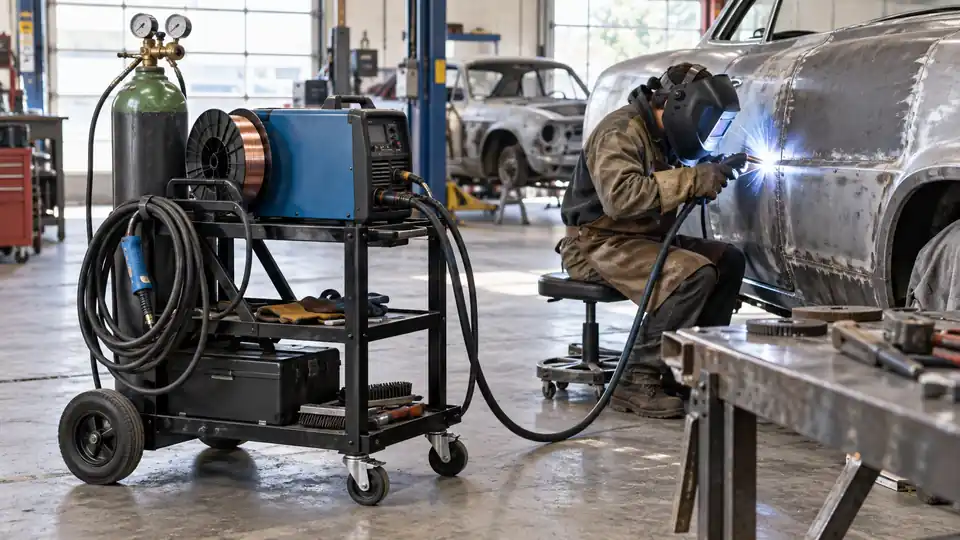
A MIG welder becomes much easier to live with once the machine, shielding-gas cylinder, gun, leads, helmet, wire, and hand tools have a proper home. Without a cart, the setup tends to spread across the floor like a small metalwork obstacle course. The best welding cart for a MIG welder should therefore do more than roll. It needs a stable machine platform, dependable cylinder restraint, useful storage, and wheels that suit the floor where the cart will actually move.
Capacity figures deserve some scrutiny. A cart rated for 400 pounds may offer excellent structural headroom, but that does not tell you whether its shelves fit your particular MIG machine or whether the cylinder compartment accepts the tank you use. A tilted top shelf can make controls easier to read, while drawers help keep contact tips, pliers, gloves, and magnets from disappearing into a cluttered tray. Buyers who move equipment often may favor large rear wheels, while a fixed shop setup may benefit more from drawers or a lockable cabinet.
This comparison weighs those practical differences rather than treating every three-tier cart as interchangeable. The VEVOR three-tier cart earns the strongest overall position because it combines high listed capacity, broad storage, two cylinder slots, and a useful sloped platform. The Weldpro model is a stronger fit for buyers who want larger shelves and a more structured layout, while the VEVOR lockable model suits a workspace where tool storage and cabinet security matter.
Quick Answer
- Best Overall: VEVOR 3-Tier Welding Cart for its 400-pound static capacity, 370-pound dynamic capacity, two cylinder slots, and three-level storage.
- Best Premium Option: Weldpro 3-Tier Heavy Duty Welding Cart for its large trays, 125 CF cylinder support, and broad accessory organization.
- Best for Secure Storage: VEVOR Welding Cart With Lockable Cabinet for its cabinet, two drawers, 350-pound static capacity, and 300-pound dynamic capacity.
- Best for Organized Tools: YESWELDER 2-Tier Welding Cart With 4 Drawers for its dedicated drawer storage and dual cylinder slots.
Best Welding Cart for MIG Welder Comparison Table
| Product | Best For | Storage Layout | Capacity and Cylinder Support |
|---|---|---|---|
| VEVOR 3-Tier Welding Cart | Best overall balance | Three trays, four brackets | 400 lb static, 370 lb dynamic, two slots |
| Weldpro 3-Tier Heavy Duty Cart | Large equipment setups | Three trays, brackets, hooks | 400 lb static, supports up to 125 CF cylinders |
| VEVOR Lockable Cabinet Cart | Secure tool storage | Open shelf, two drawers, cabinet | 350 lb static, 300 lb dynamic, two slots |
| YESWELDER 3-Tier Cart | Readable controls and compact storage | Three tilted and flat tiers | 260 lb, two cylinder slots |
| YESWELDER 4-Drawer Cart | Small-tool organization | Two tiers, four drawers | 245 lb, cylinders up to 10 inches |
| RCARTICH Large Welding Cart | Large shelf and storage box | Two shelves, bottom box, four brackets | 400 lb static, 350 lb dynamic |
| VEVOR 2-Tier 4-Drawer Cart | Drawer storage with lower cost | Two tiers, four drawers | 265 lb static, 220 lb dynamic, two slots |
| TOOLIOM 4-Drawer Welding Cart | Simple organized setup | Sloped shelf and four drawers | 245 lb, two cylinder chains |
| AQNIEGEP 3-Tier Welding Cart | Budget-oriented three-tier layout | Three tiers, hooks, cylinder rack | 400 lb static, two chains |
The detailed reviews below explain how each cart handles machine placement, cylinder restraint, tool storage, and movement around a MIG welding area.
1. VEVOR 3-Tier Welding Cart — Best Overall
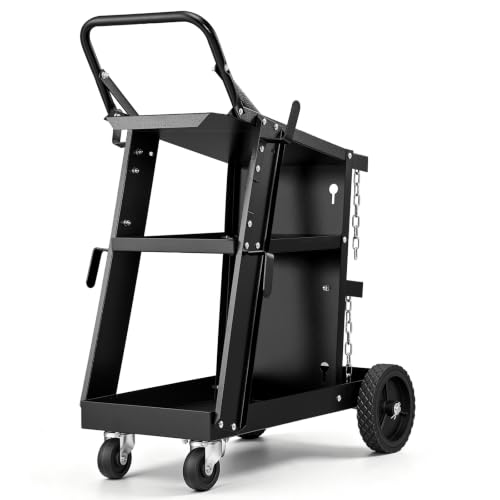
The VEVOR three-tier cart makes the strongest all-around case for a MIG setup because its layout addresses the usual pileup of equipment without becoming overly specialized. The listing gives it a 400-pound maximum static capacity and a 370-pound maximum dynamic capacity, providing substantial headroom for a welder, cylinder, leads, helmet, and stored accessories. Its upper and middle trays measure 11 by 18.1 inches, while the lower tray extends to 28 by 11.4 inches, so the bottom level is better suited to bulkier items such as a helmet, gloves, wire, or a welding jacket.
The sloped upper platform is useful when a MIG machine sits high enough that its controls would otherwise be viewed from below. Two front 2.9-inch swivel casters and two 7-inch rear wheels combine maneuverability with more stable rolling under load. The two cylinder slots and two stainless steel safety chains are particularly relevant for gas-shielded MIG work. Four side brackets give guns, pliers, and other tools a designated resting place, which can keep hot or dirty equipment off the shelves. Compared with the drawer carts below, this design favors open access and larger gear over small-item concealment.
Pros
- 400-pound static and 370-pound dynamic capacity provide generous load headroom.
- Three tiers separate the welder, accessories, and larger lower-shelf items.
- Two cylinder slots and two stainless steel safety chains support a more stable gas setup.
- Large rear wheels and front swivel casters suit movement across a workshop floor.
- Four side brackets keep guns, pliers, and similar tools within reach.
Cons
- Open shelves provide less protection and concealment than a drawer or cabinet design.
- The upper and middle trays are narrower than the large lower tray, so machine dimensions should be checked first.
This cart is the most balanced choice for a MIG operator who wants room for a gas cylinder, a standard-sized machine, and a practical spread of accessories. It also makes sense for buyers who prefer seeing their tools at a glance instead of opening drawers every few minutes. A cabinet-style option such as the VEVOR lockable model is a better match for valuable small tools or a shared workspace, while a compact drawer cart may fit more easily in a tight corner.
To buy this product, click here.
2. Weldpro 3-Tier Heavy Duty Welding Cart — Best Premium Option

The Weldpro cart is aimed at a more equipment-heavy arrangement. Its upper and middle trays measure 20.9 by 13 inches, and the lower tray measures 33.1 by 13.8 inches. Those dimensions give a MIG machine more lateral room than the narrower trays on several competing carts, while the long lower shelf can hold a helmet, gloves, wire, rods, and other bulky supplies without stacking everything on top of itself.
The listing specifies a 400-pound static capacity and two stainless steel chains for cylinders up to 125 CF. That cylinder claim should still be checked against the exact tank dimensions used in the workspace, but it gives this cart a clear advantage for larger gas setups. Four side brackets and two side hooks create separate locations for tools, cables, and tape measures. The cart is also identified as compatible with several Weldpro machines, including MMA75, 160GD, 200GD, CUT40H, 40NH, and 416GD. Buyers using another brand should focus on tray dimensions rather than assuming the custom layout will offer the same fit.
Pros
- Large upper, middle, and lower trays suit bigger MIG machines and accessory loads.
- 400-pound static capacity supports a substantial shop setup.
- Two safety chains are listed for cylinders up to 125 CF.
- Four brackets and two hooks create useful cable and tool organization.
- Three-tier layout keeps the lower shelf open for helmets and larger supplies.
Cons
- Its larger footprint may be less convenient in a crowded garage or narrow aisle.
- The custom compatibility claims are strongest for Weldpro equipment, so other machines require careful measurement.
Choose this cart when the MIG machine, cylinder, and accessories need more shelf area than a compact trolley can provide. It is especially compelling for a fixed workshop where the larger footprint is acceptable and a broad lower tray is more useful than enclosed drawers. Buyers with a small machine and limited floor space may get better day-to-day convenience from the VEVOR three-tier model.
To buy this product, click here.
3. VEVOR Welding Cart With Lockable Cabinet — Best for Secure Storage

Most welding carts are open shelving with a handle. This VEVOR model takes a different route by combining an open top, two drawers, and a lockable cabinet. That arrangement matters in a busy shop where contact tips, measuring tools, nozzles, gloves, and other small accessories tend to migrate. The cabinet measures 17.3 by 14 by 11.8 inches, while the upper tray measures 13.6 by 17.7 inches, giving a MIG machine a defined platform and a separate enclosed storage area beneath.
The cart is listed at 350 pounds static capacity and 300 pounds dynamic capacity. Those figures are lower than the 400-pound class carts, but they remain substantial for a typical MIG welder and gas cylinder arrangement. Two 2.9-inch front swivel casters and two 7-inch rear casters are paired with an anti-slip handle, a layout that should be easier to steer than small-wheel designs when the cart is loaded. Two gas cylinder slots and two safety chains are included in the listed design. The 1.0 mm steel plate specification adds useful construction context, although real load behavior still depends on assembly and floor conditions.
Pros
- Lockable cabinet offers enclosed storage for selected tools and supplies.
- Two drawers add separation for smaller welding accessories.
- 350-pound static and 300-pound dynamic capacities suit a substantial MIG setup.
- Upper tray size of 13.6 by 17.7 inches accommodates many standard machine footprints.
- Two cylinder slots and two safety chains support a gas-shielded configuration.
Cons
- Its 36.4-inch overall height and 36.2-inch length may consume more room than compact carts.
- Enclosed storage adds structure and weight compared with a simple open three-tier design.
This is the sensible pick for a workspace where the cart must serve as a mobile tool station rather than a bare machine stand. The cabinet is the feature that separates it from the VEVOR three-tier cart, especially when small parts need to stay away from dust or casual handling. Skip the extra structure if your priorities are maximum open shelf space and the lightest possible footprint.
To buy this product, click here.
4. YESWELDER 3-Tier Welding Cart — Best for Readable Controls

A MIG machine placed flat on a low shelf can force the operator to bend down to read settings. The YESWELDER three-tier cart addresses that annoyance with a tilted top platform, which brings the control panel and display into a more direct line of sight. The top tier measures 17.91 by 11.02 inches, the middle tier measures 15.35 by 11.02 inches, and the lower tier measures 27.95 by 15.43 inches. That stepped arrangement gives the cart useful separation without requiring a very wide chassis.
The product information lists a 260-pound capacity, two cylinder slots, and two stainless steel safety chains. Two 360-degree front swivel wheels and two heavy-duty rear wheels support movement across the workshop, while the three tiers provide places for a helmet, gloves, pliers, and other MIG supplies. It is identified as suitable for MIG, TIG, Stick, and plasma equipment, but that describes cart compatibility rather than welding-machine capability. Compared with the VEVOR 400-pound cart, this YESWELDER model gives up load headroom in exchange for a compact tilted-platform layout.
Pros
- Sloped top platform improves access to machine controls and display information.
- Three tiers provide separate areas for the welder and accessories.
- 260-pound capacity is suitable for many compact and mid-sized setups.
- Two cylinder slots and safety chains support gas-cylinder organization.
- Front swivel wheels provide directional flexibility in a confined workspace.
Cons
- Its 260-pound capacity is lower than the 400-pound options in this roundup.
- The 11.02-inch tray width may limit compatibility with wider machines.
This cart fits a buyer who values control visibility and a reasonably compact footprint more than maximum load capacity. It is a practical match for a smaller MIG welder, a helmet, hand tools, and a cylinder that fits the listed rack dimensions. Larger machines or heavily loaded shelves point toward the VEVOR or Weldpro three-tier designs instead.
To buy this product, click here.
5. YESWELDER 2-Tier Welding Cart With 4 Drawers — Best for Organized Tools

Four drawers change the daily rhythm of a welding cart. Instead of leaving pliers, magnets, gloves, and small consumables in a loose pile, the YESWELDER model gives those items separate compartments. Its top layer measures 11.3 by 17.7 inches, with a maximum placement width of 10.6 inches, while the middle layer measures 11.3 by 17.8 inches. Those dimensions make machine width the first compatibility check before ordering.
The cart is rated for 245 pounds and includes two reinforced cylinder slots with stainless steel safety chains. The listing says the slots accept cylinders up to 10 inches, which is useful information for buyers who already know their tank diameter. Two swivel casters and two rear wheels provide movement, while side hooks hold cables and cords. The four drawers are the main distinction from the open-shelf carts, but they also reduce the amount of uninterrupted shelf space available for bulky equipment. A MIG setup with many small accessories benefits most from this layout.
Pros
- Four drawers separate small tools and consumables from larger equipment.
- Top shelf provides a dedicated platform for a MIG machine.
- Two cylinder slots are listed for tanks up to 10 inches in diameter.
- Side hooks help keep cables and cords off the floor.
- 245-pound capacity covers many compact and mid-sized welding setups.
Cons
- The 10.6-inch maximum placement width may exclude wider MIG machines.
- 245-pound capacity provides less headroom than the larger three-tier carts.
Pick this design if the cart will double as an accessory organizer. Four drawers are especially useful where contact tips, pliers, gloves, and magnets need predictable storage, while the dual cylinder slots support a more involved gas arrangement. Buyers who store helmets, jackets, or large cases on the cart may prefer an open lower tray such as the one on the VEVOR three-tier model.
To buy this product, click here.
6. RCARTICH Large Welding Cart — Best for a Large Storage Box

The RCARTICH cart takes a broad, storage-first approach. Its overall dimensions are listed as 31 by 14.4 by 37.4 inches, with a 14 by 19-inch top frame and a lower storage box measuring 10.2 by 10.2 by 19.5 inches. That lower compartment is useful for long or awkward items that do not sit neatly on a flat tray, while the upper and middle levels leave space for a MIG machine and frequently used gear.
Its listed capacity reaches 400 pounds static and 350 pounds dynamic. Two stainless steel safety chains secure cylinders, and four side brackets provide locations for a torch, pliers, or other hand tools. The front wheels swivel 360 degrees, while the rear wheels are described as heavy-duty 6-inch directional wheels. This arrangement should feel more stable than four small casters when loaded, although it may require a little more planning when turning in a very tight corner. Compared with the YESWELDER drawer model, this cart favors large-item storage over compartmentalized small-tool organization.
Pros
- 400-pound static and 350-pound dynamic capacities support a substantial load.
- Large lower storage box accommodates helmets, tools, and longer supplies.
- 14 by 19-inch top frame gives many MIG machines a generous platform.
- Two safety chains provide dedicated cylinder restraint.
- Four side brackets keep frequently used tools accessible.
Cons
- The 37.4-inch overall height may be less convenient beneath low shelves or benches.
- Directional rear wheels may require more repositioning than four swivel casters in tight areas.
This cart makes sense for a garage or repair area where bulky equipment needs a defined place and the machine platform should not feel cramped. The storage box is the reason to choose it over a simpler open cart, especially for a helmet, gloves, rods, or cables that tend to slide around. A drawer-based model remains better for small parts that need individual compartments.
To buy this product, click here.
7. VEVOR 2-Tier 4-Drawer Welding Cart — Best Value Drawer Layout
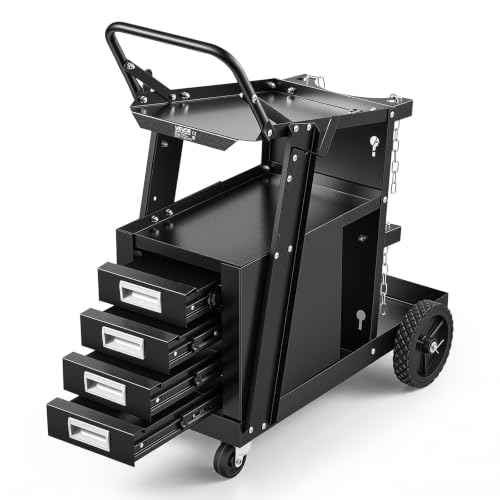
This VEVOR cart keeps the useful four-drawer concept while using a simpler two-tier arrangement. The upper tray measures 11 by 18 inches, and the lower tray measures 15.8 by 28 inches. That lower surface offers more room for a helmet or tool case than the narrow upper platform, while the drawers provide a place for the small items that otherwise rattle around during movement.
The listing gives the cart a 265-pound static capacity and a 220-pound dynamic capacity. Two cylinder slots and two stainless steel safety chains support gas-cylinder storage, and the top shelf is adjustable in angle so the machine panel can be viewed more easily. The 2.9-inch front swivel casters and 7-inch rear wheels are shared design cues with the larger VEVOR cart. The trade-off is clear: this model provides drawer organization and a generous lower tray, but it gives up the third tier and some capacity compared with the VEVOR three-tier option.
Pros
- Four drawers organize small MIG tools and consumables.
- Lower tray measures 15.8 by 28 inches for larger accessories.
- 265-pound static and 220-pound dynamic capacities suit many workshop setups.
- Two cylinder slots and stainless steel chains support gas-cylinder placement.
- Adjustable top angle helps make the machine panel easier to view.
Cons
- 220-pound dynamic capacity is below the larger VEVOR three-tier design.
- Two tiers provide less vertical separation for multiple large pieces of equipment.
The cart is a good fit for someone who wants drawers but does not need the bulk or higher capacity of a cabinet model. Its large lower shelf is useful for a helmet, wire box, or gloves, while the drawers handle small parts. Check the machine footprint carefully, since the 11 by 18-inch upper tray can be restrictive for a wide MIG unit.
To buy this product, click here.
8. TOOLIOM 4-Drawer Welding Cart — Best Simple Organizer

The TOOLIOM cart is built around a straightforward idea: put the MIG machine on a sloped upper shelf and keep smaller tools in four sliding drawers. That simplicity can be useful in a compact workspace where a large three-tier frame would feel excessive. The tilted shelf brings the machine controls upward and makes the display easier to read, while the drawers give welding pliers, gloves, magnets, and similar accessories a consistent storage location.
The product listing states a 245-pound maximum load capacity and identifies two universal front wheels plus two heavy-duty rear wheels. Two safety chains are placed at the rear for cylinder restraint. It is described as suitable for MIG, ARC, and plasma equipment, but the cart itself does not determine the welding process or machine output. Compared with the VEVOR four-drawer model, the TOOLIOM offers a similar organizational idea with fewer published dimensional details, so buyers should measure the machine base and cylinder before ordering.
Pros
- Four sliding drawers provide dedicated small-tool storage.
- Sloped top shelf improves access to machine controls.
- Two safety chains support cylinder placement.
- Front universal wheels assist directional changes.
- 245-pound capacity suits many compact MIG setups.
Cons
- The listing provides fewer shelf and drawer dimensions than several alternatives.
- Its 245-pound capacity leaves less load margin than the 350- to 400-pound carts.
This model is best for a buyer who values a simple, drawer-centered layout and already has a relatively compact MIG welder. It avoids the extra shelves and larger footprint of a heavy three-tier cart, but that also limits how much bulky equipment can be carried at once. Confirm the top shelf dimensions and cylinder fit before choosing it for a large machine or tank.
To buy this product, click here.
9. AQNIEGEP 3-Tier Welding Cart — Best Budget-Oriented Three-Tier Layout

The AQNIEGEP cart offers the familiar three-tier format in a compact 27.9 by 12.6 by 33.5-inch frame. Its upper shelf is angled, the lower section is wider than the top, and hooks on both sides provide a place for cables or hoses. That stepped structure is useful when the machine needs to sit above a helmet, gloves, and hand tools rather than sharing one crowded platform.
The listing states a 400-pound static capacity and identifies two safety chains for the cylinder rack. Four 2.8-inch wheels are described as silent universal wheels, giving the cart easy directional movement on a smooth workshop floor. The available information does not specify a dynamic load rating, so the 400-pound figure should be treated as a static rating rather than compared directly with products that publish both static and moving capacities. Compared with the VEVOR three-tier model, this cart offers a similar broad concept but less documented load detail and smaller wheels.
Pros
- Three storage levels separate the MIG machine from tools and supplies.
- Angled upper shelf improves machine-control visibility.
- 400-pound static capacity offers substantial listed support.
- Two cylinder safety chains help limit tank movement.
- Hooks on both sides provide basic cable and hose organization.
Cons
- The listing does not provide a dynamic load rating for moving the cart.
- Smaller 2.8-inch wheels may be less suitable for rough floors or heavy loads.
This is a reasonable choice for a budget-oriented three-tier setup that will mainly travel across a smooth garage or workshop floor. Its compact width can help in a narrow aisle, while the angled shelf and cylinder rack cover the basic needs of a gas-shielded MIG arrangement. Buyers who expect frequent movement over uneven flooring or want better-documented dynamic capacity should step up to the VEVOR or Weldpro options.
To buy this product, click here.
Buying Guide for the Best Welding Cart for MIG Welder
Match the Upper Shelf to the Welder Footprint
A cart can have plenty of total storage and still fail at the first step if the MIG machine overhangs the top platform. Measure the machine base, including feet, before comparing shelf dimensions. The VEVOR three-tier cart lists upper and middle trays at 11 by 18.1 inches, while the Weldpro model offers upper and middle trays measuring 20.9 by 13 inches. That difference is substantial for a wide machine or one with controls positioned near the edges.
Separate Static Capacity From Moving Capacity
Static capacity describes the listed load while the cart is stationary. Dynamic capacity relates to movement, which introduces rolling forces and uneven loading. A cart rated at 400 pounds static and 370 pounds dynamic, such as the VEVOR three-tier model, gives more useful information for a loaded setup than a product that publishes only one number. Add the welder, cylinder, wire, helmet, cables, and tools before deciding how much margin is appropriate.
Check Cylinder Diameter and Restraint Design
A gas cylinder should sit in a rack that matches its diameter and should be secured according to the cart instructions and applicable workplace procedures. Two safety chains can offer more positioning flexibility than one, but chain count does not replace checking the actual slot size. The YESWELDER four-drawer model lists cylinder slots for tanks up to 10 inches, while the Weldpro cart identifies support for cylinders up to 125 CF. Treat those descriptions as product information to verify against the exact tank in use.
Choose Open Shelves, Drawers, or a Cabinet
Open shelves make helmets, gloves, and wire boxes quick to grab. Drawers are better suited to small parts such as contact tips, pliers, magnets, and spare nozzles. A lockable cabinet adds enclosed storage for selected tools, but it also creates a larger and more structured cart. The VEVOR lockable model is the clearest choice for enclosed storage, while the four-drawer YESWELDER and TOOLIOM carts favor organization in a smaller footprint.
Pay Attention to Wheel Size and Floor Conditions
Small casters can be easy to turn on a smooth concrete floor but may catch on cracks, thresholds, or debris. Several carts here pair front swivel wheels with larger fixed rear wheels, creating a compromise between steering and stability. The VEVOR and Weldpro models list 7-inch rear wheels, while the AQNIEGEP cart lists 2.8-inch wheels. For a cart that will stay near one bench, small wheels may be sufficient. Frequent movement across rough flooring favors larger rear wheels.
Use the Sloped Platform as a Convenience Feature
An angled top shelf can make the MIG machine display and controls easier to view, particularly when the cart is positioned beside a workbench. It does not improve the welder’s output or change its process capability. The feature is most useful when the machine will remain on the cart during setup and adjustment. A flat shelf may be preferable if the welder is unusually tall, has a sensitive balance, or must be removed frequently.
Do Not Confuse Cart Compatibility With Welder Capability
A cart described as suitable for MIG, TIG, Stick, or plasma equipment is a storage product that can hold those machines. It does not give a MIG welder TIG output, aluminum capability, or a spool-gun connection. Check the welder separately for process support, input requirements, wire compatibility, and included accessories. The cart’s job is to make the equipment easier to organize and move.
Best Welding Cart for MIG Welder FAQ
What makes a welding cart suitable for a MIG welder?
A suitable cart should have a stable upper platform that fits the welder, a cylinder rack if shielding gas is used, restraint chains or straps, and enough space for the gun, lead, wire, helmet, and hand tools. A sloped top can make the control panel easier to read. The cart does not need every available feature if the machine and accessories fit securely.
How much weight capacity does a MIG welding cart need?
Add the weight of the welder, gas cylinder, wire, helmet, cables, and tools, then leave practical headroom rather than operating near the listed limit. Pay attention to both static and dynamic ratings. A cart may support a high load while parked but have a lower rating while rolling.
Should a MIG welding cart have two cylinder slots?
Two slots can be useful for setups that keep more than one cylinder available, but the main issue is whether the rack and chains fit the tank being used. A second slot also gives the cart more flexibility for different gas arrangements. It does not mean both cylinders should be transported without following the cart and cylinder-handling instructions.
Are drawers better than open shelves on a welding cart?
Drawers are better for small tools and consumables that can become buried in an open tray. Open shelves are more useful for helmets, jackets, wire boxes, and larger items. A cart with a cabinet provides additional enclosed storage, although it usually has a larger structure than a basic three-tier model.
Can a welding cart hold a spool gun?
A cart can store a spool gun or its cable if the shelves and brackets have room, but cart compatibility does not mean the MIG welder supports a spool gun. Check the welder documentation for spool-gun compatibility and whether the accessory is included or sold separately. The cart only provides transportation and storage.
Are large wheels important on a welding cart?
Large rear wheels can make a loaded cart easier to move across thresholds, rough concrete, and minor floor debris. Smaller wheels can work well on a smooth shop floor and may allow a compact frame. Frequent movement and a heavy cylinder generally favor larger rear wheels, while a mostly stationary setup may place more value on storage layout.
What should be measured before buying a welding cart?
Measure the welder’s width, depth, and base footprint. Measure the cylinder diameter, the available storage area, doorway or aisle width, and the height of nearby benches or shelves. Also check whether the listed shelf dimensions describe the usable interior space or the outside frame.
Final Verdict
The VEVOR 3-Tier Welding Cart is the strongest overall choice for most MIG setups in this group. Its 400-pound static and 370-pound dynamic ratings, two cylinder slots, sloped upper platform, three storage levels, and four side brackets create a useful balance between capacity and day-to-day access. It gives a buyer room to organize the machine, gas cylinder, helmet, cables, and tools without committing to the larger structure of a cabinet cart.
The Weldpro three-tier model is the better alternative for a larger machine or a setup that needs broad shelves and support for a larger cylinder configuration. The VEVOR lockable model makes more sense where drawers and enclosed storage matter, while the YESWELDER four-drawer cart suits a compact workspace full of small accessories. Before ordering, measure the MIG welder and cylinder, compare the moving capacity rather than relying on the largest headline number, and choose the storage layout that matches the way the equipment will actually be used.
