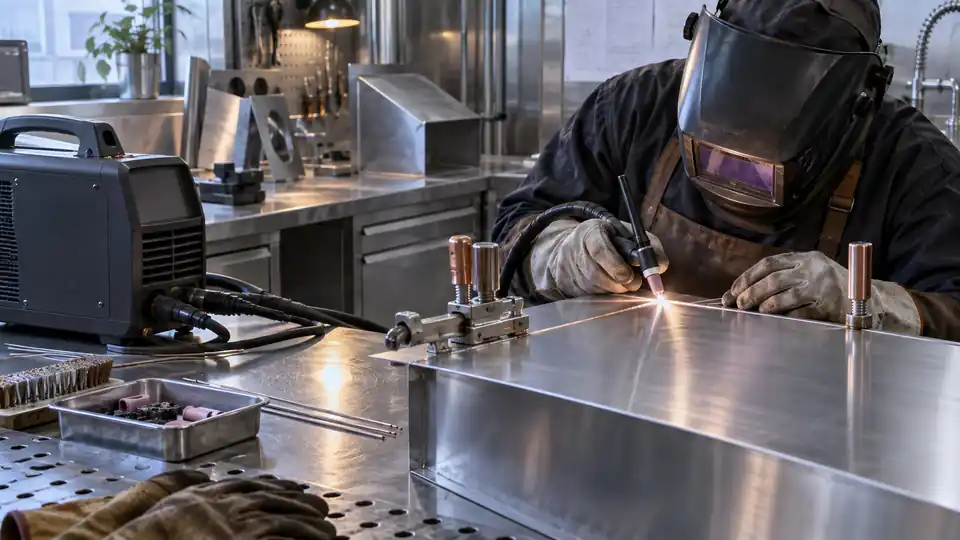
Sheet metal exposes a welder’s weak points quickly. Excess heat can burn through thin stock, poor wire control can leave a tall or uneven bead, and a machine that looks capable on paper may offer too little adjustment at the low end. For most light-gauge steel work, controllable MIG or flux-cored output is more useful than a large maximum-amperage figure. Resistance spot welding also has a place where overlapping panels need fast, localized joints.
The best welder for sheet metal depends on the material, joint style, available circuit, and whether you need a continuous bead or a series of spot welds. The ARCCAPTAIN 165A stands out as the strongest all-around option here because it combines 110V and 220V input, gas MIG, flux-core MIG, Stick, and Lift TIG in a compact machine. Buyers who need a dedicated panel-joining tool may prefer a spot welder, while those working on thin practice pieces may need accurate material measurement before choosing settings.
This comparison weighs process suitability, low-voltage flexibility, portability, documented thickness claims, included equipment, and the limitations that matter on thin steel. A few related sheet-metal products are also included for preparation and practice because the right material, gauge information, and test pieces can affect the result as much as the machine itself.
Quick Answer
- Best Overall: ARCCAPTAIN 165A MIG Welder, for buyers who want MIG, flux-core, Stick, and Lift TIG with dual-voltage input.
- Best for Portable MIG: Lincoln Electric 90i MIG and Flux-Core Weld-Pak, a 120V machine with solid-wire and flux-core support.
- Best for Dedicated Steel Spot Welding: 120V Portable Spot Welder, for overlapping steel or iron sheet up to the published 1/8-inch claim.
- Best for Controlled Practice: Hicarer 18-Gauge Mild Steel Sheets, useful for testing settings on thin cold-rolled steel.
Best Welder for Sheet Metal Comparison Table
| Product | Best For | Process or Use | Key Details |
|---|---|---|---|
| ARCCAPTAIN 165A MIG Welder | Best overall | MIG, flux-core, Stick, Lift TIG | 110V/220V, 165A, 12.8 lb |
| Lincoln Electric 90i MIG | Portable gas MIG and flux-core | MIG, flux-core | 120V, 15 lb, 2-control layout |
| Lincoln Electric 90i FC | Simple flux-core work | Flux-core | 120V, 15 lb, protective case |
| Stark USA Portable Spot Welder | 220V panel spot welding | Resistance spot welding | 2.5 kVA, 220V, replacement tips |
| 120V Portable Spot Welder | Steel and iron sheet | Resistance spot welding | 120V, copper tips, up to 1/8-inch claim |
| AWithZ Handheld Battery Spot Welder | Battery tabs and nickel strips | Low-power spot welding | 11 settings, automatic and manual modes |
| Hicarer 18-Gauge Mild Steel Sheets | Thin-steel practice and projects | Weldable sheet material | 1.2 mm, 9 x 12 inches, four pieces |
| Saker E6013 Welding Rods | Stick welding on low-carbon steel | Electrode consumable | 3/32-inch, AC and DC, 1 lb |
| A36 Steel Welding Coupons | Practice and test preparation | Practice plates | 3/8-inch thick, 3 x 7 inches, two pieces |
The detailed reviews explain where each option fits, what its published specifications mean, and which limitations deserve attention before ordering.
1. ARCCAPTAIN 165A MIG Welder — Best Overall

Thin sheet metal often benefits from a machine that can be adjusted around the job rather than one locked into a single process. The ARCCAPTAIN 165A supports gas MIG, flux-core MIG, Stick, and Lift TIG, giving it more useful range than the single-process machines in this roundup. Its 110V and 220V input options also make it easier to match the machine to a workshop circuit, although the voltage selector must be changed with the machine switched off and the fan stopped.
The listing identifies a 165A maximum output, a 60 percent rated duty cycle, and a stated mild-steel capability up to 3/16 inch. Those figures are more relevant to heavier work than typical thin sheet, but the machine’s synergic MIG mode, manual MIG adjustment, and LED display are the features that matter most here. The supplied 2-pound spool limit keeps the package compact, while the separate WP-17V TIG torch requirement means Lift TIG is supported but not ready from the box.
Pros
- Supports gas MIG, flux-core MIG, Stick, and Lift TIG.
- 110V and 220V input provides circuit flexibility.
- Synergic and manual MIG controls allow different setup approaches.
- 12.8-pound body with handle and shoulder strap is easier to move than larger shop machines.
- 2T and 4T trigger modes offer different ways to control longer or shorter welds.
Cons
- Lift TIG torch must be purchased separately.
- 2-pound spool capacity is limited for longer wire-feed sessions.
This is the strongest general recommendation for sheet-metal buyers who want one compact machine for panel repairs, brackets, light fabrication, and occasional Stick work. The dual-voltage design gives it an advantage over the 120V-only Lincoln models, while the process range is broader than a dedicated spot welder. Buyers who need fast overlapping-panel welds rather than continuous beads should choose a resistance spot machine instead.
To buy this product, click here.
2. Lincoln Electric 90i MIG and Flux-Core Weld-Pak — Best Portable MIG

A 120V machine can make sense for sheet-metal work where the available power is limited and the projects involve small repairs rather than long production runs. The Lincoln Electric 90i MIG and Flux-Core Weld-Pak supports solid MIG wire as well as flux-cored wire, with the listing stating a maximum thickness of 3/16 inch for solid MIG and 1/4 inch for flux-core. Those published limits should be treated as application claims, since results depend on joint design, settings, material, and preparation.
Its two-knob layout controls wire speed and voltage, which keeps the setup less cluttered than a multi-process machine. The 15-pound inverter unit includes a gun, nozzle, contact tip, work cable, and clamp, and the protective metal case and shoulder strap suit occasional movement between work areas. Compared with the ARCCAPTAIN, it gives up 220V flexibility and TIG or Stick capability, but the simpler process selection may be easier to manage for straightforward thin-steel MIG work.
Pros
- Supports both solid-wire MIG and flux-core welding.
- Operates from common 120V input power.
- Two-control layout keeps wire speed and voltage adjustments accessible.
- 15-pound inverter design includes a shoulder strap.
- Protective metal case helps shield the machine during transport.
Cons
- 120V-only input offers less flexibility than dual-voltage alternatives.
- Does not provide Stick or TIG process capability.
This Lincoln makes the most sense for buyers who want a recognizable, portable wire-feed setup for thin steel and small repair jobs. Its solid-wire MIG support is the key advantage over the flux-core-only 90i FC, particularly where shielding gas and a cleaner bead are preferred. It is less suitable for someone who expects to expand into several welding processes later.
To buy this product, click here.
3. Lincoln Electric 90i FC Flux-Core Weld-Pak — Best Simple Flux-Core Option

Flux-core welding can be useful when a sheet-metal project needs a portable setup without a gas bottle. The Lincoln Electric 90i FC is a 120V inverter machine with a stated ability to weld up to 1/4 inch, and its two-knob interface adjusts wire speed and voltage. For thin mild steel, the value of that layout is its straightforward control path, although flux-core wire can require more cleanup than gas-shielded MIG.
The machine weighs 15 pounds and includes a shoulder strap, welding gun, nozzle, contact tip, work cable, and clamp. Its protective metal case gives it a different practical emphasis from the ARCCAPTAIN, which offers more processes and dual-voltage operation. The Lincoln is narrower in capability, yet that narrower design may suit a small repair kit where the job calls for flux-core wire and basic controls rather than TIG or Stick functions.
Pros
- Uses 120V input power.
- Flux-core process avoids the need for external shielding gas.
- Infinite voltage adjustment allows finer tuning than fixed-step controls.
- 15-pound body and shoulder strap support mobile use.
- Includes the basic gun, work lead, clamp, nozzle, and contact tip.
Cons
- Does not support gas MIG, Stick, or TIG according to the listed configuration.
- Flux-core welding may leave slag and require more cleanup on visible sheet metal.
Choose this model for uncomplicated flux-core work on mild steel, especially where portability and 120V access matter more than process range. It ranks below the Lincoln 90i MIG because the gas MIG option can provide a cleaner approach for visible thin panels. Buyers who need the broadest future capability should look at the ARCCAPTAIN instead.
To buy this product, click here.
4. Stark USA Portable Spot Welder — Best 220V Panel Spot Welder

Resistance spot welding approaches sheet metal differently from MIG or flux-core welding. Instead of feeding a continuous bead, the tool clamps overlapping material between copper tips and applies electrical current at a localized point. The Stark USA model is a 220V handheld spot welder with a listed 2.5 kVA input capacity and maximum output claim of 6,750A, making it more relevant to panel joining and repeated spot welds than general-purpose bead welding.
The attached handle supports movement around a workpiece, and the lever-style operation is relatively direct: position the tips, apply pressure, and actuate the tool. The listing identifies replacement copper tips as included, which matters because tip wear and alignment influence repeatability. It is a poor substitute for a MIG machine where the project needs seams, edge repairs, or adjustable bead placement, but it can be a better match for overlapping sheet sections.
Pros
- Dedicated resistance spot-welding design for overlapping sheet metal.
- 220V input suits a compatible higher-power circuit.
- 2.5 kVA rated input capacity is listed.
- Handheld format supports positioning around larger panels.
- Replacement copper tips are included according to the listing.
Cons
- 220V input limits use in locations without a suitable circuit.
- Spot welding cannot replace a continuous MIG, TIG, or flux-core bead.
This machine is the specialized choice for sheet-metal assemblies that call for discrete resistance welds. It deserves attention from buyers working with overlapping panels, but the electrical requirements should be confirmed before ordering. For brackets, patch edges, or visible seams, the ARCCAPTAIN or Lincoln wire-feed machines offer a more adaptable approach.
To buy this product, click here.
5. 120V Portable Spot Welder — Best for Steel and Iron Sheet

For a small shop with standard household power, this 120V handheld spot welder offers a more accessible route to resistance welding than the Stark USA 220V model. The product information identifies steel and iron as the intended materials and publishes a capability claim up to 1/8 inch, or approximately 3.18 mm. It specifically excludes aluminum and stainless steel, so that limitation should shape the buying decision from the start.
The operating sequence uses a lever and copper tips rather than a menu of current settings. That can simplify repeated panel work, while the fixed application focus avoids the false assumption that every spot welder handles every metal. It remains a dedicated joining tool, not a replacement for a wire-feed machine, and the published thickness claim should be treated as dependent on material stack-up, fit-up, circuit conditions, and technique.
Pros
- Runs on listed 120V, 60Hz household power.
- Intended specifically for steel and iron sheet.
- Published capability extends up to 1/8 inch.
- Copper welding tips are included.
- Simple lever operation avoids complicated parameter menus.
Cons
- Not intended for aluminum or stainless steel.
- Spot-weld format is unsuitable for continuous seams and general bead work.
This is the more convenient spot-welding pick for steel-focused work where 120V access matters. It ranks below the ARCCAPTAIN for general sheet-metal versatility, yet it may be the better tool for a narrow panel-joining task. Check the material stack and circuit requirements carefully before treating the 1/8-inch figure as a universal result.
To buy this product, click here.
6. AWithZ Handheld Battery Spot Welder — Best for Nickel Battery Tabs
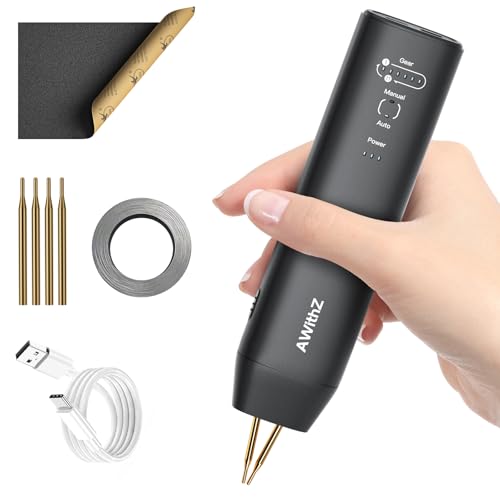
Sheet-metal welding is a broad term, and this compact device serves a very specific branch of it. The AWithZ handheld spot welder is intended for cylindrical battery cells such as 18650, 26650, and 36650, along with nickel strips and thin iron material. Its built-in power supply and integrated welding pen make it portable, but its narrow output purpose separates it sharply from the MIG and resistance machines above.
Eleven adjustable power levels, automatic and manual modes, and two-button operation give the operator a way to match output to different nickel-strip thicknesses. The listing associates lower settings with mobile-phone battery work and higher settings with 0.12 to 0.15 mm nickel plate. Overcharge, temperature, short-circuit, and low-cell-voltage protections are listed, but those features do not turn the tool into a general sheet-metal fabricator.
Pros
- Integrated battery and welding pen create a compact handheld package.
- Eleven output settings provide adjustment for small tab-welding tasks.
- Automatic and manual modes support different operating preferences.
- Designed for 18650, 26650, and 36650 battery projects.
- Includes nickel strip, charging cable, and manual.
Cons
- Its intended use is battery tabs and thin nickel material rather than structural sheet metal.
- Small integrated power system is not suited to continuous panel fabrication.
Choose this product for battery-pack work, where a conventional MIG torch would be far too large and hot. It should not be selected for automotive panels, brackets, or ordinary mild-steel sheet projects. The narrow application is its defining strength and its main limitation.
To buy this product, click here.
7. Hicarer 18-Gauge Mild Steel Sheets — Best Thin-Steel Practice Material

Thin sheet metal gives a welder very little room for excess heat, which makes consistent practice material useful. These Hicarer sheets are listed as cold-rolled mild steel in 18 gauge, approximately 0.05 inch or 1.2 mm thick, with each piece measuring about 9 by 12 inches. Four pieces provide enough material for test joints, fit-up experiments, and small fabrication projects without cutting down a large panel first.
The documented thickness is close to the kind of stock that exposes poor low-end control and excessive dwell time. That makes the sheets useful alongside a MIG or flux-core machine, though the product is material rather than a welding power source. The listing also warns that slight surface rust can occur during sea shipment, so surface preparation and inspection should be part of the setup before welding.
Pros
- 18-gauge, approximately 1.2 mm mild steel suits thin-sheet practice.
- Four sheets provide multiple opportunities for test joints.
- 9 x 12-inch size is manageable for small projects and coupons.
- Cold-rolled mild steel is listed as weldable.
- Flat stock can help compare settings on the same material thickness.
Cons
- This is weldable sheet material, not a welding machine.
- Surface rust may be present after shipping and can require preparation.
These sheets pair especially well with the ARCCAPTAIN or Lincoln machines when the goal is to set up thin steel before working on a finished panel. They also make the limitations of a machine easier to identify because burn-through, cold lap, and excessive buildup become visible quickly. Confirm the dimensions and inspect the surface before ordering for a specific project.
To buy this product, click here.
8. Saker E6013 Welding Rods — Best Stick Consumable for Light Steel Work

Stick welding is less commonly associated with very thin sheet than MIG, but electrode selection still matters where a Stick-capable machine is being used for light carbon-steel repairs. These Saker E6013 electrodes measure 3/32 inch and are listed for AC and DC current. The product information describes shallow penetration, easy arc starts, and all-position use, characteristics that can be useful when a project involves low-carbon steel and less-than-perfect fit-up.
The 2.5 mm diameter gives the operator a smaller electrode option than larger rods, although sheet-metal suitability still depends heavily on amperage control, joint design, and technique. A one-pound package is convenient for limited repairs or practice rather than extended fabrication. These rods work as consumables for a Stick welder, not as a substitute for the machine itself.
Pros
- 3/32-inch diameter offers a smaller electrode option for light work.
- Listed for both AC and DC welding current.
- E6013 formulation is intended for low-carbon steel.
- All-position classification supports flat and vertical applications.
- One-pound package suits limited repairs and practice.
Cons
- Electrodes require a compatible Stick welder and do not provide a power source.
- Stick welding generally offers less convenient low-heat control on thin sheet than wire-feed MIG.
These rods are a sensible accessory for someone who already owns a Stick-capable machine such as the ARCCAPTAIN and wants to work with low-carbon steel. They are less suitable as the first choice for delicate automotive-style panels, where a controllable wire-feed process is usually easier to manage. Storage and electrode condition also deserve attention before use.
To buy this product, click here.
9. A36 Steel Welding Coupons — Best Practice Plates

Practice plates are useful when a machine needs settings checked before a project begins, although these particular coupons are much thicker than typical sheet metal. The package contains two A36 steel plates measuring 3 by 7 inches and 3/8 inch thick. The listing identifies them for MIG, TIG, Stick, and flux-core practice, training, improvement, and test preparation.
The thickness makes these coupons better for checking arc behavior, starts, stops, and general technique than for simulating 18-gauge sheet. That distinction matters. A weld that looks acceptable on 3/8-inch plate does not prove that the same settings will avoid burn-through on thin stock, so these plates should be treated as a separate practice surface rather than a direct sheet-metal test.
Pros
- A36 steel is listed for MIG, TIG, Stick, and flux-core practice.
- Two 3 x 7-inch plates provide a compact practice format.
- 3/8-inch thickness supports work on heavier material.
- Useful for starts, stops, and position practice.
- Suitable for training and test preparation according to the listing.
Cons
- 3/8-inch plate does not closely simulate thin sheet-metal behavior.
- These are practice plates rather than a welding machine or consumable set.
Buy these coupons when you need a repeatable piece of steel for heavier practice or want to check a process before moving to project material. For sheet-metal setup specifically, the Hicarer 18-gauge sheets are a closer match. The coupons still have value beside a multi-process machine because they let the operator practice without sacrificing finished stock.
To buy this product, click here.
Buying Guide for the Best Welder for Sheet Metal
Low-End Control Matters on Thin Material
Thin steel can burn through before a large machine reaches its advertised upper limit. Look for adjustable voltage, wire speed, or current control that allows the arc to be reduced for the material. The ARCCAPTAIN offers manual and synergic MIG adjustment, while the Lincoln 90i machines use a simpler two-control arrangement. A higher maximum output does not automatically make a machine better for 18-gauge stock.
MIG, Flux-Core, and Spot Welding Serve Different Joints
Gas MIG is often attractive for visible sheet-metal work because it avoids the flux residue associated with self-shielded wire. Flux-core can be more convenient where a gas cylinder is impractical. Resistance spot welding is a different method entirely, best suited to overlapping panels and discrete weld points. Choose the process based on the joint, not simply the word “sheet metal” in a product title.
Match Input Voltage to the Available Circuit
The ARCCAPTAIN accepts 110V and 220V input, while both Lincoln 90i models are listed for 120V operation. The Stark spot welder is a 220V product, and the smaller dedicated spot welder is listed for 120V, 60Hz. Confirm the required circuit before ordering, particularly for a high-current resistance machine.
Do Not Assume TIG Means Aluminum Capability
The ARCCAPTAIN provides Lift TIG, but the listing does not identify it as AC TIG and says the WP-17V torch is sold separately. Lift TIG and AC TIG are different capabilities. Buyers planning to weld aluminum should confirm AC output and the necessary torch, controls, and accessories in the exact product documentation.
Check What the Package Actually Includes
The ARCCAPTAIN package lists a MIG torch, ground clamp, electrode holder, roller, flux-cored wire, nozzles, and brush hammer, but its TIG torch is separate. The Lincoln machines include their basic gun and work hardware. A product can support an accessory without including it, so check the package contents before comparing apparent value.
Use the Correct Test Material
Thick practice plate does not behave like thin sheet. The A36 coupons are 3/8 inch thick, while the Hicarer material is listed at approximately 1.2 mm. Use similar thickness and material for setup whenever possible, then account for fit-up, joint design, consumable diameter, and surface condition.
Best Welder for Sheet Metal FAQ
What type of welder is usually easiest to control on thin steel?
A MIG machine with adjustable voltage and wire speed is often the most practical starting point for thin mild steel. It provides a continuous wire electrode and can be configured for gas MIG or flux-core work. The exact result still depends on settings, wire size, shielding, fit-up, and operator technique.
Is the ARCCAPTAIN 165A suitable for sheet metal?
Its MIG and flux-core modes, adjustable controls, and 110V/220V input make it a strong fit for sheet-metal work. The listing states a mild-steel capability up to 3/16 inch, but that figure does not mean every thin-sheet joint should be welded at maximum output. Lower settings and suitable wire selection remain important.
Is a spot welder better than MIG for sheet metal?
It depends on the joint. A spot welder suits overlapping panels where discrete resistance welds are acceptable. MIG is more flexible for seams, brackets, edge repairs, and joints that require a visible continuous bead. The Stark and 120V portable spot welders are specialized tools rather than general-purpose replacements for a MIG machine.
Can a 120V welder handle sheet metal?
Yes, a 120V machine can be suitable for light sheet-metal work when its output range and controls match the material. The Lincoln 90i MIG and 90i FC are both listed for 120V operation. Results depend on circuit capacity, duty cycle, wire, joint preparation, and the thickness being joined.
Does Lift TIG allow aluminum welding?
Lift TIG alone does not establish aluminum capability. Aluminum TIG generally requires AC output, while Lift TIG describes the arc-start method. The ARCCAPTAIN listing identifies Lift TIG but does not establish AC TIG capability, so buyers should verify the exact documentation before planning aluminum work.
Are E6013 rods a good choice for thin sheet?
The Saker 3/32-inch E6013 rods are listed for low-carbon steel and AC or DC current, with shallow penetration. They may suit some light repairs when used with a controllable Stick machine, but MIG generally offers easier heat management on very thin sheet. The electrode diameter, amperage, joint design, and fit-up all affect the result.
What thickness should I use for practice?
Use practice material close to the thickness of the final project. The Hicarer sheets are listed at approximately 18 gauge, or 1.2 mm, making them more relevant to thin-sheet setup than the 3/8-inch A36 coupons. Thick coupons can still help with general arc practice, but they do not reproduce burn-through risk on light stock.
Final Verdict
The ARCCAPTAIN 165A is the strongest overall choice in this selection because it combines gas MIG, flux-core MIG, Stick, and Lift TIG with 110V and 220V input. Its 12.8-pound format, adjustable MIG modes, and small-spool design suit a buyer who wants one compact machine for varied steel work. The Lincoln Electric 90i MIG is the better alternative for a simpler 120V MIG and flux-core setup, while the Lincoln 90i FC is a narrower choice for flux-core work without shielding gas.
For overlapping steel panels, the 120V Portable Spot Welder or the 220V Stark USA model makes more sense than a bead welder, provided the material and circuit match the product’s stated limits. The Hicarer sheets are the most relevant practice material for thin stock, while the A36 coupons and Saker rods support different welding tasks rather than replacing a machine. Match the process to the joint, verify included accessories, and use test material close to the thickness of the finished work before committing to a visible panel.
