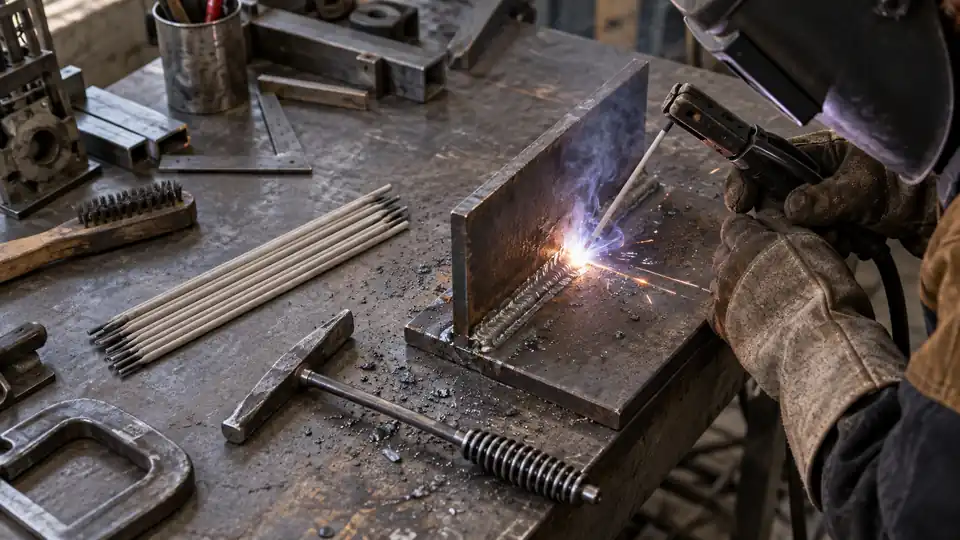
If you are asking what is stick welding, the short answer is that it is a manual arc welding process that uses a flux-coated, consumable electrode to join metal. Its technical name is shielded metal arc welding, or SMAW. As the rod touches the workpiece, an electric arc creates intense heat, melting the electrode and part of the base metal. The coating produces shielding gas and forms slag over the cooling weld, protecting the molten pool from atmospheric contamination.
A compact stick welder, a holder, a ground clamp, and a box of suitable electrodes can handle repairs far from a fabrication shop. That rugged simplicity explains why SMAW remains common for construction, maintenance, farm equipment, structural steel, and outdoor repair work, where wind can quickly disrupt a gas-shielded process.
How Stick Welding Works
Stick welding starts with an electrical circuit between the power source, electrode holder, electrode, workpiece, and ground lead. The welder strikes the rod against clean metal, then lifts it slightly to establish an arc. That arc melts the end of the electrode and a small area of the base metal, creating a shared molten pool that becomes the weld bead as it cools.
The electrode coating performs several jobs while it burns. It helps stabilize the arc, creates shielding gas around the weld, and leaves a layer of slag across the bead. The slag may look like a dull, glassy crust after cooling. It must be removed between passes and after welding so it does not become trapped in the joint.
Picture a repair on a steel gate after a windy afternoon. A solid-wire MIG setup may struggle if shielding gas blows away from the arc, while a properly selected stick electrode generates much of its own protection through the flux coating. That advantage has limits, since poor technique, contaminated metal, or an unsuitable electrode can still produce porosity, slag inclusions, or weak fusion.
What Equipment Does Stick Welding Require?
The equipment list is short, but every part affects the arc. A typical setup includes:
- Stick welder: The power source supplies welding current and may support AC, DC, or both.
- Electrode holder: This grips the coated rod and carries current to it.
- Work clamp and lead: The clamp completes the electrical circuit through the workpiece.
- Welding electrodes: Rod diameter, classification, coating, and current requirements must match the job.
- Safety equipment: A properly rated welding helmet, gloves, protective clothing, hearing protection where appropriate, and suitable footwear help protect against arc radiation, heat, sparks, and molten metal.
- Cleaning tools: A chipping hammer and wire brush are commonly used to remove slag and surface debris.
Unlike MIG or TIG welding, stick welding does not require a wire spool, shielding-gas cylinder, regulator, or gas hose. That makes the setup easier to carry through a muddy field or up a steel stairway, although the operator must pause to replace short electrodes as they are consumed.
Understanding Stick Welding Electrodes
A stick electrode is both the filler metal and the source of shielding materials. Its classification tells you useful information about its intended behavior. In a designation such as E7018, the “E” identifies an electrode, the first two digits indicate approximate tensile strength in thousands of pounds per square inch, the next digit relates to welding position, and the final digits describe coating and current characteristics under the applicable classification system.
That code matters at the workbench. A general-purpose electrode for light fabrication may behave very differently from a low-hydrogen electrode intended for applications where hydrogen control and procedure requirements are significant. Electrode selection should follow the base metal, joint, welding position, power source, and manufacturer guidance rather than the appearance of the number alone.
Common Electrode Types
- 6010: Often selected for deep penetration and root work, usually with a DC power source.
- 6011: Commonly used for repair work and dirty or rusty steel, with versions that can operate on AC or DC depending on the product.
- 6013: Often used for general fabrication and smoother-looking beads on suitable steel, with current requirements determined by the specific electrode.
- 7018: A low-hydrogen electrode frequently used for structural and general-purpose work. Storage and handling instructions matter because moisture pickup can affect performance.
Those categories are useful starting points, not universal rules. Two electrodes with similar numbers can still have different recommended currents, polarity options, storage instructions, and arc characteristics. Read the package or technical data sheet before striking an arc, especially with low-hydrogen products.
Where Stick Welding Works Well
SMAW earns its reputation through flexibility. A worker repairing a trailer frame outdoors can carry a relatively small machine and several electrode types without transporting a shielding-gas cylinder. A maintenance crew working around heavy steel structures can also reach awkward joints with a holder and a short rod, provided the electrical supply and work area are suitable.
The process is commonly used for:
- Structural steel and construction work
- Farm and agricultural equipment repairs
- Heavy equipment maintenance
- Outdoor steel fabrication
- Pipe and field welding applications
- General repair of carbon steel
- Some stainless steel and cast-iron repairs with suitable electrodes and procedures
Its portability becomes especially useful where hoses, cables, and gas cylinders would be cumbersome. A stick machine can also tolerate a rougher work environment than some wire-feed setups, but the metal still needs reasonable preparation. Paint, oil, rust, moisture, and galvanizing can affect weld quality and may create hazardous fumes, so surface condition and ventilation remain important.
Advantages and Limitations of Stick Welding
The strongest argument for stick welding is its independence from external shielding gas. Wind has less direct influence on the shielding produced by the flux, which makes SMAW practical outdoors. The equipment can be relatively simple, and a single machine may weld several steel types when paired with appropriate electrodes.
That convenience comes with trade-offs. Each rod has a limited usable length, so the operator must stop, remove the stub, install a new electrode, and restart the weld. Slag must also be cleaned away. For a long, repetitive seam, these interruptions can make stick welding slower than a wire-fed process.
| Characteristic | Practical effect in stick welding |
|---|---|
| Shielding method | Flux coating creates shielding gas and slag, so an external gas cylinder is generally unnecessary. |
| Consumable | A short coated rod supplies filler metal and must be replaced as it is consumed. |
| Outdoor use | Often practical in breezy conditions, although severe wind, contamination, and poor joint preparation can still damage weld quality. |
| Cleanup | Slag removal is required, especially between multiple passes. |
| Portability | The setup can be carried to remote repair locations more easily than a larger gas-based system. |
| Learning curve | Arc length, travel speed, rod angle, starts, stops, and slag control all require practice. |
Thin sheet can expose another limitation. The heat from a larger electrode or excessive amperage may burn through the material, while an undersized or poorly adjusted setup may fail to fuse the joint. Stick welding can handle many jobs, but the process is often more comfortable on medium and heavier steel than on very thin panels.
Stick Welding Compared With MIG, TIG, and Flux-Cored Welding
Stick welding, MIG welding, TIG welding, and flux-cored arc welding all use an electric arc, yet their filler and shielding arrangements differ. MIG, also called GMAW, feeds solid wire continuously through a gun and normally uses an external shielding gas. TIG, or GTAW, uses a nonconsumable tungsten electrode and generally gives the operator more control over the arc and filler metal. TIG setups require careful attention to shielding gas and torch technique.
Flux-cored arc welding, or FCAW, feeds a tubular wire containing flux. Some flux-cored wires are self-shielded, while others require external gas. That distinction matters because a machine capable of feeding flux-cored wire is not automatically configured for every FCAW application or for solid-wire MIG.
A repair technician might choose stick for a windy outdoor bracket, MIG for a long series of clean shop welds, or TIG for precise work on thin stainless tubing. The best process depends on material, thickness, joint position, production speed, appearance, available power, surface condition, and the operator’s control of the weld pool.
Basic Stick Welding Setup Considerations
Start with the electrode manufacturer’s guidance for current range, polarity, storage, and welding position. The machine must support the current type required by the electrode. Some rods are intended for DC, some can run on AC or DC, and polarity can affect penetration and arc behavior.
- Prepare the joint. Remove loose rust, paint, oil, moisture, and mill scale as appropriate. Coated metals require extra caution because heating coatings can produce hazardous fumes.
- Connect the leads. Attach the electrode holder and work lead according to the machine and electrode instructions. Make sure the work clamp contacts clean metal.
- Select a suitable electrode. Match its classification and diameter to the base metal, joint design, position, and machine output.
- Set a starting current. Use the electrode documentation as the starting point, then adjust methodically based on arc behavior and weld appearance.
- Strike and control the arc. Keep the arc length consistent, move at a steady speed, and maintain the recommended rod angle.
- Clean between passes. Chip and brush away slag before depositing another pass or inspecting the weld.
If the rod sticks repeatedly, the current may be too low, the arc may be too short, the work connection may be poor, or the electrode may be damp or unsuitable for the selected polarity. Changing several variables at once makes diagnosis harder. Adjust one factor, observe the result, and follow the product documentation.
Safety Factors That Matter
The arc produces intense visible, ultraviolet, and infrared radiation. Use a suitable welding helmet and protective clothing that covers exposed skin. Gloves should protect against heat and sharp edges while allowing enough control to hold the electrode and manipulate the work safely.
Fumes depend on the base metal, coatings, electrode, ventilation, and work environment. Use adequate general ventilation or local exhaust, and avoid welding on unknown containers or surfaces with hazardous coatings. Respiratory protection, where required, needs to be selected and fitted according to applicable safety guidance. A respirator does not replace effective ventilation or fume control.
Keep flammable materials away from sparks and hot metal, and allow recently welded parts to cool before handling them. Follow the welder manual, electrode instructions, workplace procedures, and applicable electrical and safety requirements. The simple equipment setup should never be mistaken for a low-risk one.
The Practical Takeaway
Stick welding is a manual SMAW process that uses a flux-coated consumable electrode to create the arc, add filler metal, and provide shielding through gas and slag. Its portable equipment and outdoor practicality make it a strong choice for repair, construction, maintenance, and heavier steel work.
Its limits are equally clear: rods require frequent replacement, slag requires cleanup, thin metal can be difficult, and electrode choice matters. Once you understand the relationship between the machine, polarity, electrode classification, joint preparation, and technique, the answer to what is stick welding becomes practical rather than merely definitional. It is a flexible arc process whose results depend on matching the rod and setup to the job.
Frequently Asked Questions
Is stick welding the same as arc welding?
Stick welding is one type of arc welding. The term arc welding covers several processes that use an electric arc, including SMAW, MIG, TIG, and flux-cored welding.
Does stick welding require shielding gas?
Typical stick welding does not require an external shielding-gas cylinder. The electrode coating produces shielding gas and slag as it burns. External gas may be required for other arc processes or specialized consumables.
Can stick welding be used on stainless steel or cast iron?
Yes, suitable electrodes exist for some stainless steel and cast-iron applications. The electrode, joint preparation, preheat or cooling practice, polarity, and procedure must match the material and repair. A general-purpose mild-steel rod should not be assumed suitable.
Can a beginner learn stick welding?
Yes, with proper instruction, safe equipment setup, and practice on suitable material. Maintaining a steady arc length and removing slag between passes take time to develop. A qualified instructor or reliable training resource can help prevent poor habits.
