
Choosing the best TIG tungsten starts with matching the electrode diameter and alloy to the job, rather than grabbing the first blue or red pack on the shelf. A 3/32-inch electrode gives a useful middle ground for many general TIG setups, while 1/16-inch tungsten is better suited to lower-current work and thinner material. A larger 1/8-inch electrode can tolerate more heat, but it may be unnecessary for delicate joints. The color band matters too, although color alone should never replace checking the product description and welding-machine requirements.
Two percent lanthanated tungsten is the most flexible choice in this selection because the listed products support AC and DC applications and are marketed for relatively easy arc starting. Red electrodes deserve closer attention. The supplied listings use inconsistent alloy descriptions for some red products, so buyers should verify the exact composition before relying on a color-code assumption. For a broad, documented option, the Midwest Tungsten Service 3/32-inch blue electrodes offer the strongest balance of application range and supporting documentation.
This comparison weighs diameter, alloy description, AC and DC suitability, packaging, documentation, and the amount of information available for each product. The best choice for a thin stainless project may be very different from the right electrode for higher-current aluminum work, so the rankings reflect distinct use cases rather than a simple price order.
Quick Answer
- Best Overall: Midwest Tungsten Service 2% Lanthanated 3/32-Inch, a well-documented AC/DC option with broad stated material compatibility.
- Best for General AC/DC Use: ARCCAPTAIN Blue 2% Lanthanated 3/32-Inch, with a common diameter and a wide listed application range.
- Best Budget-Oriented Small Diameter: YESWELDER Blue 2% Lanthanated 1/16-Inch, suited to lower-current TIG work where a smaller electrode makes more sense.
- Best for Higher-Current Work: Patriot 2% Lanthanated 1/8-Inch, a larger-diameter option for setups that call for more electrode capacity.
Best TIG Tungsten Comparison Table
| Product | Best For | Alloy and Diameter | AC/DC Position |
|---|---|---|---|
| Midwest Tungsten Service | Best overall | 2% lanthanated, 3/32-inch | AC and DC |
| ARCCAPTAIN Blue | General-purpose TIG | 2% lanthanated, 3/32-inch | AC and DC |
| YESWELDER Blue 3/32-Inch | Protected storage | 2% lanthanated, 3/32-inch | AC and DC |
| YESWELDER Purple | Rare-earth alternative | Purple rare-earth blend, 3/32-inch | Check machine and material fit |
| ARCCAPTAIN Red 3/32-Inch | DC-focused work | Red tip, 3/32-inch | DC listed |
| ARCCAPTAIN Red 1/16-Inch | Small-diameter DC work | Red tip, 1/16-inch | DC listed |
| YESWELDER Blue 1/16-Inch | Lower-current AC/DC TIG | 2% lanthanated, 1/16-inch | AC and DC |
| WelderElite Blue 1/16-Inch | Small tungsten with broad material claims | 2% lanthanated, 1/16-inch | AC and DC |
| Patriot Blue 1/8-Inch | Higher-current setups | 2% lanthanated, 1/8-inch | AC and DC |
The detailed reviews below explain how diameter, alloy labeling, storage, and documented application range affect the choice.
1. Midwest Tungsten Service 2% Lanthanated 3/32-Inch, Best Overall

The Midwest Tungsten Service blue 3/32-inch electrodes earn the top position because the supplied information covers the details that matter most for a general TIG purchase. They are identified as 2% lanthanated tungsten, sized at 3/32 inch, and listed for both AC and DC use. That combination fits a broad range of ordinary TIG work, from steel and stainless projects to applications involving aluminum alloys, copper, nickel, titanium, and magnesium.
The supporting documentation is another meaningful distinction. The listing identifies American Welding Society standard conformance and refers to a materials safety data sheet and certificate of conformance. Those documents do not prove arc performance by themselves, yet they give buyers more traceability than a sparse listing. A 3/32-inch diameter also avoids the extremes of a very fine electrode and a larger high-current rod, which makes this pack a sensible starting point for a general TIG drawer.
Pros
- 2% lanthanated tungsten is listed for AC and DC applications
- 3/32-inch diameter suits a broad middle range of TIG work
- Application information covers steel, stainless, aluminum, copper, nickel, titanium, and magnesium alloys
- Listing references a safety data sheet and certificate of conformance
- Product information identifies AWS standard conformance
Cons
- 3/32-inch may be too large for very low-current precision work
- The supplied information does not specify the exact current range for particular materials
This pack makes the most sense for buyers who want one documented electrode size for mixed AC and DC work. A dedicated thin-sheet setup may benefit from 1/16-inch tungsten, while higher-current work may call for 1/8-inch. For a general-purpose choice with unusually clear supporting information, this is the easiest recommendation to defend.
To buy this product, click here.
2. ARCCAPTAIN Blue 2% Lanthanated 3/32-Inch, Best General-Purpose Option

ARCCAPTAIN’s blue 3/32-inch tungsten follows the same broad-use formula that makes many lanthanated electrodes appealing. The listing identifies a 2% lanthanated alloy, a 3/32-inch by 7-inch size, and suitability for AC and DC applications. It also names a long list of alloys, including aluminum, magnesium, nickel, copper, titanium, and low-alloy steel.
For someone sorting through a crowded welding cart, the familiar blue color and middle-size diameter make this an easy product to identify and store. The listing also describes vacuum packaging intended to limit oxidation during storage. Claims about arc starts and burn-off should be read as manufacturer or listing claims rather than independent test results, but the documented configuration itself is well matched to general TIG use.
Pros
- 2% lanthanated composition is clearly identified
- 3/32-inch by 7-inch dimensions suit many general TIG setups
- Listed for both AC and DC applications
- Vacuum packaging supports longer storage before use
- Application list includes several common and specialty alloys
Cons
- The listing does not provide a detailed current range by material
- Buyers needing a very small or very large electrode must choose another diameter
This is a practical alternative to the Midwest pack for buyers who want a standard blue 3/32-inch electrode and broad AC/DC positioning. It ranks slightly lower because the available documentation is less detailed, not because the diameter or alloy is poorly matched. Confirm the product description against the current package before ordering, especially if a specific AWS document is required for workplace records.
To buy this product, click here.
3. YESWELDER Blue 2% Lanthanated 3/32-Inch, Best Storage Design

The YESWELDER blue 3/32-inch pack is aimed at the same everyday AC/DC TIG territory as the first two options, but its storage tube gives it a practical point of difference. The listing describes a sealed aluminum container with a gasketed lid and a dual-opening design. That matters when sharpened electrodes are carried in a toolbox, where loose tungsten can pick up dirt, moisture, or damage at the tip.
The electrode itself is identified as 2% lanthanated tungsten, 3/32 inch in diameter, and 7 inches long. The listed alloy is positioned for AC and DC work, while the color-coded packaging can make it easier to separate blue tungsten from red or purple alternatives. Packaging cannot compensate for incorrect grinding or unsuitable amperage, but it can reduce avoidable mix-ups in a busy workspace.
Pros
- 2% lanthanated tungsten is listed for AC and DC use
- 3/32-inch diameter is a useful general-purpose size
- Sealed aluminum tube offers more protection than loose storage
- Gasketed lid helps protect sharpened tips
- Color-coded packaging simplifies electrode identification
Cons
- The supplied information does not detail material-specific current limits
- The storage tube may matter less for buyers who already use a dedicated tungsten case
Choose this model when electrode storage is part of the buying decision. It is especially suited to a portable TIG kit that moves between benches or job areas. Buyers focused strictly on alloy documentation may prefer the Midwest option, while buyers who need lower-current work should look at one of the 1/16-inch products below.
To buy this product, click here.
4. YESWELDER Purple Rare-Earth 3/32-Inch, Best Non-Red Alternative

The purple YESWELDER electrode gives buyers a different alloy category without changing the familiar 3/32-inch diameter. Its listing describes a nonradioactive rare-earth blend comparable to E3 purple tungsten and presents it as an alternative to traditional red thorium-containing electrodes. The practical appeal is simple: someone who wants to avoid a red electrode can examine a purple option while keeping a common size.
Its limitations are mainly about the available information. The listing identifies AWS standard conformance and vacuum packaging, but it does not provide the same detailed AC and DC material list found on several blue products here. That makes the purple option more specialized from a documentation standpoint. It may suit a buyer already familiar with this alloy family, while a first-time purchaser seeking the least complicated choice may find 2% lanthanated tungsten easier to compare.
Pros
- Nonradioactive rare-earth blend is clearly identified
- 3/32-inch diameter fits many general TIG torch configurations
- Vacuum packaging supports protected storage
- Color coding helps separate it from blue and red electrodes
- Listing references AWS standard conformance
Cons
- The supplied listing gives less detail about AC and DC material applications
- Buyers wanting a widely documented 2% lanthanated option may prefer a blue product
This electrode is most appropriate for a buyer who specifically wants a purple rare-earth formulation and understands that color-coded alloy families can behave differently across applications. It should not be selected merely because purple sounds more advanced. Match it to the welding-machine manual and the material being welded, then compare the current listing before purchase.
To buy this product, click here.
5. ARCCAPTAIN Red 3/32-Inch, Best for DC-Oriented Selection

ARCCAPTAIN’s red 3/32-inch tungsten is positioned toward DC TIG work involving stainless steel, copper, nickel, titanium, and related alloys. The diameter is familiar and versatile enough for many general torch setups, while the listing emphasizes electrical conductivity and use at higher current on DC. For a steel or stainless-focused bench, that positioning may be more relevant than broad AC claims.
There is a documentation wrinkle that should not be ignored. The product title identifies WT20 and EWth-2, while the supplied feature text also refers to WL20 and EWLa-2, which are different alloy designations. Since the alloy affects how the electrode should be selected, buyers should verify the package and current manufacturer documentation rather than assuming the color tells the entire story.
Pros
- 3/32-inch size suits many general TIG torch collets
- Listing specifically emphasizes DC applications
- Applications include stainless steel, nickel, copper, and titanium alloys
- Vacuum packaging is intended to protect stored electrodes
- Useful option for buyers comparing red-tip alternatives
Cons
- Supplied alloy descriptions are inconsistent and should be verified
- Its listed DC focus makes it less straightforward for buyers seeking one AC/DC electrode
This product belongs on a shortlist for DC-focused work, particularly when the 3/32-inch diameter fits the machine settings. It is not the clearest choice for someone who wants uncomplicated alloy identification. Check the exact red-tip designation before ordering, and rely on the current documentation instead of treating the color band as a complete specification.
To buy this product, click here.
6. ARCCAPTAIN Red 1/16-Inch, Best Small Red Electrode

A 1/16-inch electrode changes the use case more than the color does. The smaller diameter is intended for lower-current TIG work, where a large tungsten can be unnecessarily cumbersome. ARCCAPTAIN lists this red version for DC applications involving stainless steel, copper, nickel, titanium, and similar alloys, giving it a clear place beside the larger 3/32-inch products.
The supplied information describes a 1/16-inch by 7-inch electrode and vacuum packaging. It also repeats alloy terminology that conflicts with the product title’s red designation, so the same verification warning applies here. A smaller electrode can be useful for thin sections and precise joints, but it has less thermal capacity than a larger diameter and should not be pushed beyond the limits specified by the torch and welding machine.
Pros
- 1/16-inch diameter suits lower-current TIG applications
- 7-inch length fits standard electrode holders listed for this size
- DC applications include stainless, copper, nickel, and titanium alloys
- Vacuum packaging supports storage protection
- Smaller diameter can provide a more appropriate scale for thin work
Cons
- Red alloy identification is inconsistent in the supplied product information
- Smaller diameter is less suitable for higher-current work
Pick this electrode when the job calls for a fine tungsten and the process is DC TIG. It makes less sense as a single all-purpose shop supply because many mixed AC/DC users will find 2% lanthanated blue tungsten easier to specify. Verify the alloy before ordering, particularly if a documented consumable specification is required.
To buy this product, click here.
7. YESWELDER Blue 2% Lanthanated 1/16-Inch, Best for Lower-Current AC/DC TIG

YESWELDER’s blue 1/16-inch electrodes are a more straightforward small-diameter choice than the red 1/16-inch alternative. The listing identifies 2% lanthanated tungsten and states that it performs in both AC and DC applications. That makes the pack easier to position for mixed work involving thin steel, stainless, or other lower-current tasks where a 3/32-inch electrode may be unnecessarily large.
The product is 7 inches long and vacuum packed, with color-coded packaging intended to reduce identification mistakes. Its lower-current role is the main reason to choose it, not a promise that a smaller electrode is automatically superior. Current limits still depend on the electrode, polarity, material, shielding, and machine settings, so buyers should use the welding equipment manufacturer’s recommendations.
Pros
- 2% lanthanated alloy is clearly identified
- 1/16-inch diameter suits lower-current work
- Listed for both AC and DC applications
- Vacuum packaging helps protect stored tungsten
- Color coding makes the electrode type easier to identify
Cons
- Lower diameter provides less capacity for high-current welding
- The supplied information does not give material-specific amperage guidance
This is the better fit for buyers who need fine control at modest current and want the flexibility of a blue AC/DC electrode. It is more broadly positioned than the ARCCAPTAIN red 1/16-inch, although both should be matched to the machine’s recommended settings. Keep a larger diameter available if the same torch will also handle heavier sections.
To buy this product, click here.
8. WelderElite Blue 2% Lanthanated 1/16-Inch, Best Small Tungsten for Broad Material Claims

WelderElite takes a similar small-diameter approach but provides a broad application list in the supplied information. The blue 2% lanthanated electrodes are identified as 1/16 inch by 7 inches and are listed for AC and DC welding. The product description names aluminum, magnesium, nickel, copper, titanium, low-alloy steel, and stainless steel, which gives buyers a clear sense of the intended range.
The listing also describes packaging intended to prevent damage and maintain storage quality. Those details are useful, although the available information does not establish how the packaging compares with a sealed metal tube. The main practical question is diameter. This electrode is suited to lower-current work, so a buyer handling thicker sections or sustained high heat should compare it with a 3/32-inch or 1/8-inch option.
Pros
- 2% lanthanated alloy and 1/16-inch diameter are clearly listed
- AC and DC suitability is stated
- Application list includes aluminum, stainless, titanium, and other alloys
- 7-inch length fits the listed product configuration
- Packaging is intended to limit storage damage and quality loss
Cons
- 1/16-inch diameter is limited for higher-current applications
- The supplied information provides fewer independent documentation details than the Midwest listing
This model is a reasonable alternative to the YESWELDER 1/16-inch for buyers who place more emphasis on the published material list. Its position is lower because the documentation is less detailed, not because the basic size and alloy are mismatched. Use it for appropriately scaled work, and avoid choosing a fine tungsten solely because it is easier to sharpen.
To buy this product, click here.
9. Patriot Blue 2% Lanthanated 1/8-Inch, Best for Higher-Current Setups
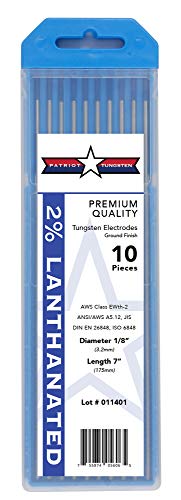
The Patriot blue electrode fills the large-diameter position in this roundup. It is identified as a 2% lanthanated WL20 electrode with a 1/8-inch diameter and a ten-electrode pack. Compared with the 1/16-inch products, that larger size is better aligned with setups that require greater electrode capacity, though the correct current range still depends on the welding machine, polarity, material, and torch configuration.
The trade-off is limited product information. The supplied listing confirms the alloy family, color, diameter, and pack format, but it does not provide the detailed AC/DC material list or supporting documentation found with the Midwest product. That makes Patriot a useful size-specific choice, rather than the strongest general recommendation. Buyers should also confirm that their torch collet and ceramic cup accommodate 1/8-inch tungsten.
Pros
- 1/8-inch diameter suits higher-current TIG setups
- 2% lanthanated WL20 alloy is identified
- Blue color makes the electrode family easy to recognize
- Ten-electrode pack supports continued shop use
- Provides a larger alternative to the 1/16-inch and 3/32-inch options
Cons
- Large diameter is unnecessary for many low-current jobs
- The supplied listing provides limited information about applications and documentation
Choose this product when the welding setup genuinely calls for 1/8-inch tungsten. It is a poor fit for delicate, low-current work where a smaller electrode offers more appropriate control. The Patriot pack is also less suitable for buyers who need a detailed material guide, so check the current product documentation before selecting it for a specific alloy or procedure.
To buy this product, click here.
Best TIG Tungsten Buying Guide
Choose Diameter Before Color
Diameter affects the usable current range and the scale of the joint. A 1/16-inch electrode is generally aimed at lower-current work, while 3/32-inch is a common middle option. The 1/8-inch Patriot electrode is better suited to setups that need a larger tungsten, but it can be excessive for thin material. Follow the welding-machine and torch manufacturer’s guidance rather than selecting the largest electrode by default.
Understand Lanthanated Tungsten
Two percent lanthanated tungsten appears throughout this roundup because it is widely positioned for AC and DC TIG applications. Blue products in the listings include both 1/16-inch and 3/32-inch sizes, letting buyers match the alloy family to different current requirements. Alloy descriptions should still be checked against the current package and documentation.
Do Not Assume Every Red Electrode Has the Same Composition
The red products here contain inconsistent alloy references in their supplied descriptions. One title identifies WT20 and EWth-2, while feature text uses WL20 and EWLa-2 terminology. Those designations should not be treated as interchangeable. Verify the exact alloy before selecting a red tungsten for a documented welding procedure.
Match AC or DC Use to the Job
Blue lanthanated options are listed for both AC and DC applications, making them easier to position as general-purpose electrodes. The red ARCCAPTAIN products are presented with a DC focus. AC and DC are process details, not interchangeable labels, so match the electrode to the polarity and material requirements in the welding-machine documentation.
Storage Protects the Prepared Tip
A tungsten electrode can be cleanly ground and then damaged by loose storage in a crowded toolbox. The YESWELDER 3/32-inch model uses a sealed aluminum tube and a gasketed lid, while several other products use vacuum packaging. Packaging does not determine arc quality, but it can help preserve clean, sharpened electrodes between sessions.
Check the Listing for Documentation
The Midwest product provides the strongest documentation references in this selection, including a certificate of conformance and materials safety data sheet references. Other products identify AWS standards in their listings, but the available detail varies. Buyers working under a shop procedure or purchasing specification should confirm the current documentation before ordering.
Best TIG Tungsten FAQ
What Size TIG Tungsten Should I Use?
The right size depends on welding current, material, polarity, torch configuration, and the machine manufacturer’s recommendations. The 1/16-inch products suit lower-current work, 3/32-inch is a common general-purpose size, and 1/8-inch is intended for setups requiring a larger electrode.
Is Blue Tungsten Suitable for AC and DC TIG?
The blue 2% lanthanated products in this roundup are listed for both AC and DC applications. That does not mean every blue electrode is suitable for every setting. Confirm the current range and polarity guidance for the exact product and welding machine.
Are Red and Blue Tungsten Interchangeable?
They should not be treated as interchangeable solely because they share a diameter. Their alloy descriptions and listed applications may differ. The red ARCCAPTAIN listings also contain inconsistent alloy references, so verify the exact composition before choosing one.
Is 3/32-Inch the Best General TIG Tungsten Size?
It is a practical middle-size option for many general TIG setups, which is why several leading products here use 3/32-inch tungsten. It is not automatically correct for every task. Thin, low-current work may call for 1/16-inch, while higher-current work may require 1/8-inch.
Can I Use These Electrodes for Aluminum?
Several blue products are explicitly listed for AC applications involving aluminum alloys. Aluminum TIG also requires a welding machine with suitable AC capability, correct settings, shielding gas, and appropriate torch equipment. A tungsten listing alone does not turn a DC-only TIG machine into an aluminum-capable setup.
Does AWS Conformance Guarantee Arc Performance?
A standards reference provides useful product information, but it is not a substitute for hands-on testing or a complete welding procedure. Check the exact documentation, alloy designation, diameter, and machine settings before relying on a product for a specific job.
Should Tungsten Be Stored in a Case?
Protected storage is sensible, particularly after electrodes have been sharpened. A sealed tube or suitable case can help keep tips clean and reduce damage. Vacuum packaging may also help preserve unused electrodes, but the electrode should still be inspected before use.
Final Verdict
The Midwest Tungsten Service 2% lanthanated 3/32-inch electrode is the strongest overall choice in this selection. Its middle-size diameter suits many general TIG setups, the listing supports AC and DC use, and the product information includes more documentation references than most alternatives. Those details make it easier to match the electrode to a mixed-material shop without relying on color alone.
ARCCAPTAIN and YESWELDER offer credible alternatives for general 3/32-inch use, while the YESWELDER and WelderElite 1/16-inch products make more sense for lower-current work. Choose the Patriot 1/8-inch option only when the torch and welding settings call for that larger size. For the red products, verify the exact alloy designation before ordering because the supplied descriptions are inconsistent. The best TIG tungsten is the one whose diameter, alloy, polarity, and documentation match the job in front of you.
