
Thin metal rewards control rather than brute force. A TIG welder that starts cleanly at low amperage, allows measured heat adjustment, and supports pulse operation can help reduce burn-through, distortion, and oversized weld beads on sheet metal, tubing, stainless steel, and other light-gauge work. The challenge is separating genuine TIG capability from machines that merely list Lift TIG as one of several secondary modes.
High output alone does not make a machine suitable for thin material. Low-end current control, high-frequency starting, pulse settings, foot-pedal compatibility, and the correct AC or DC configuration usually matter more. Buyers also need to check whether the TIG torch, gas hardware, and foot control are included. The Weldpro 200A AC/DC model leads this selection because it combines high-frequency AC and DC TIG, adjustable pulse, dual-voltage input, and an included foot pedal.
The remaining choices serve different priorities. Some provide dedicated DC TIG controls at a lower cost, while others add AC TIG for aluminum or combine TIG with MIG and plasma cutting. Lift TIG machines can be useful for occasional thin-steel work, but their starting method and included accessories are more limited. The comparison below weighs those differences instead of treating every multi-process label as equivalent.
Quick Answer
- Best Overall: Weldpro 200A AC/DC TIG Welder, for adjustable AC/DC pulse TIG, high-frequency starting, dual-voltage input, and an included foot pedal.
- Best Dedicated DC Option: ARCCAPTAIN DC TIG 200P, for stainless steel, mild steel, copper, and thin ferrous material.
- Best Aluminum Alternative: TOOLIOM TL-200TP ACDC PRO, for buyers who want AC/DC TIG and pulse controls without moving to a larger shop machine.
- Best Multi-Process Value: FEMEROL 6-in-1 Welder, for a compact setup that adds HF TIG to MIG, Stick, and plasma cutting.
Best TIG Welder for Thin Metal Comparison Table
| Product | Best For | TIG Capability | Input And Controls |
|---|---|---|---|
| Weldpro 200A AC/DC TIG | Best overall | AC/DC HF TIG, pulse, spot, Stick | 110V/220V, foot pedal included |
| ARCCAPTAIN DC TIG 200P | Thin steel and stainless | HF, Lift, pulse, spot TIG | 110V/220V, foot pedal compatible |
| TOOLIOM TL-200TP ACDC PRO | AC/DC flexibility | AC/DC pulse TIG, spot, Stick | 110V/220V, foot pedal compatible |
| Sunstac 250A AC/DC TIG | Higher advertised output | AC/DC pulse and spot TIG | 110V/220V, pedal sold separately |
| PUWU 6-in-1 Welder | TIG plus plasma cutting | HF TIG, Stick, MIG, plasma | 110V/220V, spool gun compatible |
| FEMEROL 6-in-1 Welder | Multi-process workshops | HF TIG, spot, Stick, MIG | 110V/220V, synergic or manual MIG |
| Futelo 160A 4-in-1 | Portable light fabrication | Lift TIG, MIG, flux-core, Stick | 110V/220V, TIG torch separate |
| SEESII 135A 3-in-1 | Basic portable TIG access | Lift TIG, flux-core, Stick | 110V, TIG torch separate |
| TOOLIOM 135A Stick Welder | Occasional Lift TIG | Lift TIG and Stick | 110V, TIG torch included |
Read on for the practical differences behind those table entries, especially the distinction between high-frequency TIG, Lift TIG, AC capability, and included accessories.
1. Weldpro 200A AC/DC TIG Welder — Best Overall
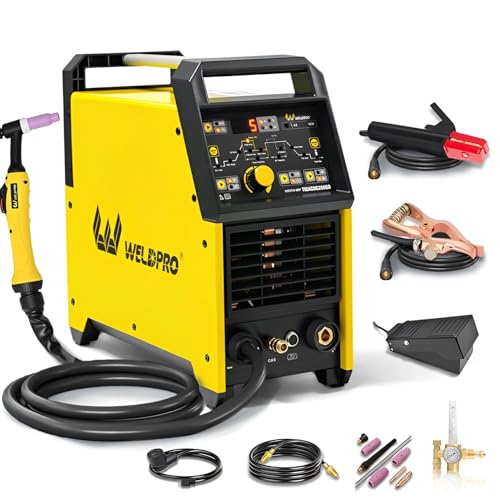
The Weldpro earns the top position because its documented feature set addresses the parts of thin-metal TIG work that matter most. It provides high-frequency AC and DC TIG, adjustable pulse from 0.5 to 200 Hz, AC balance and frequency adjustment, upslope and downslope controls, and 2T or 4T operation. Pulse can help manage heat input on light sheet, while high-frequency starting avoids touching the tungsten to the workpiece during arc initiation.
Its 110V/220V input also gives the machine more flexibility than a 110V-only unit. The included rocker-style foot pedal allows current changes during a weld, which can be useful as a joint heats up or when a thin edge begins to approach burn-through. The listing also includes the TIG torch, flow meter, gas hose, tungsten electrodes, and consumables, reducing the number of immediate setup purchases.
Pros
- AC and DC high-frequency TIG support nonferrous and ferrous materials.
- Adjustable pulse frequency is useful for controlling heat on thin work.
- Included foot pedal provides live amperage adjustment.
- 110V/220V operation suits household and higher-voltage circuits.
- Includes TIG torch, gas hardware, tungsten, and basic consumables.
Cons
- The 40% duty cycle is specified at the full 200A output, so extended high-current work requires attention to operating conditions.
- The broad control set may take longer to learn than a basic DC Lift TIG machine.
This is the strongest fit for buyers who want one machine for thin stainless or steel today and aluminum work later. It also makes more sense than the Lift TIG models if precise arc starting and foot-pedal control are priorities. Buyers focused only on occasional steel repairs may find its AC controls and larger feature set unnecessary.
To buy this product, click here.
2. ARCCAPTAIN DC TIG 200P — Best for Thin Steel

For thin mild steel, stainless steel, and copper, the ARCCAPTAIN DC 200P focuses its controls on the DC TIG process. It supports HF TIG, Lift TIG, pulse TIG, spot TIG, and Stick, with adjustable start current, base current, peak current, post-flow, downslope, and end current. That gives the operator more control over arc behavior than a basic Lift TIG attachment on a small multiprocess welder.
The dual-voltage design helps it fit both a standard household setup and a 220V circuit, while the documented 10.25-pound weight and shoulder strap make movement between work areas relatively manageable. The product listing says it supports a foot pedal in 2T TIG mode, although buyers should confirm whether the desired pedal is included with the selected configuration. Since this is a DC machine, it is aimed at steel and stainless rather than aluminum TIG.
Pros
- HF TIG reduces the need to touch tungsten to the workpiece.
- Pulse, spot, downslope, and post-flow controls suit detailed thin-metal work.
- 110V/220V input provides circuit flexibility.
- 10.25-pound chassis and shoulder strap support portable use.
- Hot Start and Arc Force add adjustment options in Stick mode.
Cons
- DC TIG does not provide AC capability for aluminum TIG.
- The listing identifies foot-pedal support, but the pedal is not clearly included.
This machine is a sensible choice for a steel-focused setup where controlled DC TIG matters more than aluminum capability. It ranks below the Weldpro because it gives up AC TIG and a clearly included foot pedal, but its dedicated TIG controls may be more relevant than extra MIG functions for stainless panels, brackets, and small tubing.
To buy this product, click here.
3. TOOLIOM TL-200TP ACDC PRO — Best AC/DC Alternative

Thin material work can shift from stainless steel to aluminum without warning, and the TOOLIOM TL-200TP is built around that broader material range. Its six modes include AC TIG, DC TIG, AC and DC pulsed TIG, Stick, and TIG spot welding. AC TIG matters for aluminum because it provides the process configuration needed for that material, while DC TIG remains suitable for steel and stainless.
The large digital display shows mode, voltage, and current, which can make parameter changes easier to track. A foot pedal is supported but sold separately, so the machine does not offer the same out-of-box control advantage as the Weldpro. The listing identifies aluminum thickness figures at 110V and 220V, but those values should be treated as published guidance rather than a guarantee for every joint, alloy, or setup.
Pros
- AC/DC TIG supports aluminum, stainless steel, and carbon steel applications.
- AC and DC pulse modes provide more heat-management options.
- TIG spot mode can suit short, controlled welds.
- 110V/220V input expands installation flexibility.
- Large display shows operating parameters clearly.
Cons
- Foot pedal compatibility does not mean a pedal is included.
- The listing provides less detail about the machine’s duty cycle than some alternatives.
The TOOLIOM is a strong match for a buyer who wants AC/DC TIG capability and expects to work across several thin metals. It is less compelling for someone who wants a complete TIG kit immediately, since the foot control must be sourced separately. Compared with the ARCCAPTAIN DC unit, its main advantage is aluminum capability rather than a narrower focus on steel.
To buy this product, click here.
4. Sunstac 250A AC/DC TIG Welder — Best for Broad Output Range

The Sunstac SS-250P/ACDC brings AC and DC TIG, pulse, spot modes, and Stick into a dual-voltage platform. Its advertised output reaches 250A, although thin-metal buyers should focus more on the ability to regulate the lower end and manage heat than on the maximum figure. Pulse and spot functions can be useful when a long, hot weld would risk distortion on light material.
The LCD screen and parameter-saving function are practical touches for repeated jobs. A saved setup can reduce the chore of rebuilding the same settings for similar work. The foot pedal is optional, and the listing specifically warns that AC current measurement may be inaccurate because of AC balance variation. That disclosure deserves attention from buyers who expect highly precise numerical feedback in AC mode.
Pros
- AC/DC TIG and pulse modes cover aluminum, steel, and stainless applications.
- Dual-voltage input supports different workshop circuits.
- LCD screen provides a clear view of settings.
- Parameter saving can simplify repeated work.
- Spot TIG adds another way to limit weld duration.
Cons
- Foot pedal control is not included according to the listing.
- The product information warns of inaccurate AC current measurement and inconsistent AC balance.
This model suits buyers who value AC/DC range and saved settings more than a ready-to-use pedal package. It can serve thin aluminum and steel work on paper, but the AC measurement warning makes it a less confident recommendation than the Weldpro or TOOLIOM for buyers who want predictable AC parameter feedback.
To buy this product, click here.
5. PUWU 6-in-1 Welder — Best with Plasma Cutting

The PUWU combines HF TIG with gas MIG, flux-core MIG, Stick, and plasma cutting. Its high-frequency TIG start is particularly relevant to thin metal because it begins the arc without requiring the tungsten to touch the workpiece. That can help reduce tungsten contamination and makes the machine more suitable for careful TIG work than a basic Lift TIG function.
Its 110V/220V operation gives the user different power options, while the listing identifies 20 to 50A plasma output and separate clean-cut and maximum severance figures. The machine weighs 25.5 pounds, so it is portable in the broad workshop sense but considerably heavier than the dedicated TIG units above. Spool-gun compatibility is listed for aluminum MIG, but the spool gun is sold separately, and that feature should not be confused with AC TIG capability.
Pros
- HF TIG is more suitable for controlled starts than basic Lift TIG.
- AC/DC input supports 110V and 220V setups.
- Combines TIG, MIG, Stick, and plasma cutting in one chassis.
- Separate clean-cut and severance ratings clarify plasma use.
- Synergic and manual MIG controls provide different setup approaches.
Cons
- The 25.5-pound weight is less convenient for frequent carrying.
- Spool gun compatibility does not include the spool gun.
Choose the PUWU if plasma cutting has a real place in the same workshop as thin-metal TIG. It is less focused than the Weldpro or ARCCAPTAIN, and its larger chassis may be excessive for a TIG-only setup. The HF TIG function keeps it relevant to this roundup, but its strongest value comes from combining several fabrication processes.
To buy this product, click here.
6. FEMEROL 6-in-1 Welder — Best Multi-Process Option

FEMEROL takes a similar broad-process approach, combining gas MIG, flux-core MIG, HF TIG, Stick, spot welding, and plasma cutting. For thin steel or stainless, the HF TIG mode is more relevant than its high advertised cutting capacity. The non-contact start can help preserve tungsten during repeated starts, while spot mode may suit short welds where limiting total heat is useful.
The machine includes a TIG torch with consumables, a plasma torch with consumables, an air filter regulator, and a gas hose. That accessory package is broader than the Lift TIG models, though the number of controls and processes may create a steeper learning curve. The listing identifies synergic and manual MIG modes, giving the user a simplified starting point or more direct adjustment, depending on the process.
Pros
- HF TIG supports non-contact arc initiation.
- Includes TIG and plasma torches with consumables.
- Gas and gasless MIG modes broaden material and setup options.
- 110V/220V adapter supports flexible power use.
- Synergic and manual MIG modes suit different levels of adjustment.
Cons
- The multi-process layout may be more involved than necessary for TIG-only work.
- The listing does not provide the same detailed thin-metal TIG control information as the dedicated TIG models.
This is a reasonable pick for a workshop that needs one machine for fabrication, repair, and occasional plasma cutting. It ranks below the dedicated TIG units because the published information emphasizes process range more than low-amperage TIG behavior. Buyers who mainly weld thin sheet should choose it for the added processes, not simply for the six-in-one label.
To buy this product, click here.
7. Futelo 160A 4-in-1 Welder — Best Lightweight Multi-Process Choice

At 7.7 pounds, the Futelo 160A is aimed at buyers who need to move a machine around a garage, vehicle, or small work area. It supports gas MIG, gasless flux-core, Stick, and Lift TIG, with a synergic control system that adjusts voltage and wire-feed speed around the selected amperage. That simplicity is more relevant to its MIG modes than its TIG function.
The Lift TIG capability gives the machine a route into cleaner work on steel and stainless, but the TIG torch must be purchased separately. Lift TIG requires the tungsten to contact the workpiece during starting, so it does not offer the same non-contact convenience as the HF TIG units above. Dual-voltage input is useful, although the product listing advises users to confirm the machine is off before changing voltage settings.
Pros
- 7.7-pound chassis is convenient for transport.
- Supports 110V and 220V input.
- Gas MIG, flux-core, Stick, and Lift TIG cover common repair processes.
- Synergic MIG control can reduce manual setup work.
- Includes MIG hardware, gas hose, electrode holder, and flux-core wire.
Cons
- Lift TIG torch must be purchased separately.
- Lift TIG is less suitable for delicate starts than HF TIG.
The Futelo makes sense for light fabrication where TIG is an occasional secondary process and portability matters more than fine TIG adjustment. It is a weaker choice for frequent thin-sheet TIG because it lacks the pulse and HF-start features found on the higher-ranked models. Its advantage is a compact, dual-voltage platform that also handles MIG and Stick work.
To buy this product, click here.
8. SEESII 135A 3-in-1 Welder — Best Basic Portable Option

The SEESII combines gasless flux-core, Stick, and Lift TIG in a 7.7-pound 110V package. Its low weight and included one-pound spool of flux-core wire make it easy to position for small repair work, while the Lift TIG mode provides a cleaner process option for compatible steel and stainless applications. The listing does not identify AC TIG, so aluminum TIG should not be assumed.
The machine’s documented current range is 30A to 135A, which places it below the 200A-class TIG machines in output but may be adequate for light-gauge projects within the published application range. The TIG torch is not included. That matters because the machine is ready for flux-core work more immediately than it is for TIG work, despite its three-process label.
Pros
- 7.7-pound design supports one-handed transport.
- 110V input suits standard household circuits.
- 30A to 135A output includes a lower stated range for light work.
- Includes flux-core torch, wire, ground clamp, and contact tips.
- Stick mode can be useful for outdoor repairs where shielding gas is inconvenient.
Cons
- Lift TIG torch is not included.
- No AC TIG or pulse TIG capability is identified in the listing.
This model is best treated as a portable flux-core and Stick machine with occasional Lift TIG access. It can suit a buyer who wants to experiment with TIG without purchasing a dedicated unit, but it lacks the arc-start and heat-control tools that make the top recommendations better for delicate thin metal. Its modest weight and household-voltage operation remain useful advantages.
To buy this product, click here.
9. TOOLIOM 135A Stick Welder — Best Occasional Lift TIG Pick

The TOOLIOM 135A is the simplest TIG-capable machine in this selection. It supports Stick and Lift TIG from a standard 110V circuit, and the package includes a Lift TIG torch, E6013 rods, and gloves. That included torch gives it a practical advantage over several multiprocess models that advertise Lift TIG but require an additional purchase before TIG work can begin.
Its VRD, Hot Start, and Arc Force functions are aimed primarily at Stick operation. Hot Start can help with arc initiation, while Arc Force and anti-stick functions address electrode behavior. Those features do not turn the machine into a pulse or HF TIG unit, so buyers should view its TIG mode as an occasional option for steel rather than a precision setup for repeated thin-sheet work.
Pros
- Lift TIG torch is included.
- 110V input works with standard household power.
- Compact chassis and shoulder strap support easy carrying.
- VRD, Hot Start, and Arc Force support Stick operation.
- LCD display provides a clearer view of operating data.
Cons
- Lift TIG lacks high-frequency starting and pulse control.
- 135A output and Stick-focused controls limit its range for demanding TIG work.
This is the budget-oriented choice for someone who wants a small Stick machine with genuine Lift TIG access and an included torch. It should be skipped by buyers who need adjustable pulse, AC TIG, foot-pedal control, or repeated work on very delicate material. Compared with the SEESII, it gives up flux-core and gains a more complete basic TIG package.
To buy this product, click here.
Buying Guide
Low-End Control Matters on Thin Material
Thin metal can heat quickly, so the useful question is not simply how high the machine can run. Look for a controllable lower amperage range, pulse settings, downslope adjustment, and a foot pedal or other way to reduce current as the joint warms. A 200A rating may be useful for thicker work, but it does not prove that the machine will be easy to control on light sheet.
High-Frequency TIG Versus Lift TIG
High-frequency TIG starts the arc without touching the tungsten to the workpiece. Lift TIG requires contact during starting, which can be workable for basic steel repairs but may increase the chance of tungsten contamination or an unwanted mark at the start point. For repeated thin-metal work, HF TIG is generally the more suitable configuration among the products reviewed here.
AC TIG Is Required for Aluminum TIG
DC TIG is appropriate for many steel and stainless applications. Aluminum TIG requires an AC-capable machine, such as the Weldpro, TOOLIOM TL-200TP, or Sunstac models in this roundup. A machine that lists Lift TIG or DC TIG should not be treated as an aluminum TIG welder without specific AC documentation.
Pulse Can Reduce Heat Input
Pulse alternates between higher peak current and lower background current. That gives the weld area time to cool during part of each cycle and can help limit total heat input, distortion, and burn-through. Pulse settings still require appropriate material preparation, filler, shielding gas, and technique, so the feature is an adjustment tool rather than a guarantee of a particular result.
Check Which Accessories Are Included
A listing may say that a machine supports a foot pedal, TIG torch, or spool gun without including that item. The Weldpro includes a TIG torch and foot pedal, while the TOOLIOM TL-200TP supports a pedal that is sold separately. The Futelo, SEESII, and ARCCAPTAIN Stick models also require careful accessory checking before purchase because their TIG capability depends on the correct torch or control hardware.
Match Input Voltage to the Available Circuit
A 110V machine can be convenient for a garage or home workspace, while 220V operation may provide more headroom for higher-output work. Dual-voltage machines offer more flexibility, but buyers should confirm the correct plug, adapter, circuit requirements, and voltage-switching procedure. Never change voltage settings while the machine is powered or operating.
Separate TIG Quality from Multi-Process Count
A six-in-one machine can be useful when plasma cutting, MIG, Stick, and TIG all belong in the same shop. It may also have more controls, greater weight, and less detailed TIG adjustment than a dedicated TIG unit. For thin metal, prioritize HF start, pulse, low-current behavior, AC or DC suitability, and included TIG hardware before counting the number of advertised processes.
Best TIG Welder for Thin Metal FAQ
What type of TIG welder is best for thin steel?
A DC TIG machine with high-frequency starting, adjustable pulse, and controlled low-amperage output is generally the strongest configuration for thin steel. The ARCCAPTAIN DC 200P is built around those controls, while the Weldpro adds AC capability for buyers who may also weld aluminum.
Is AC TIG necessary for thin stainless steel?
No. Stainless steel is commonly handled with DC TIG. AC TIG becomes relevant when aluminum or other materials that require alternating current are part of the plan. Buying an AC/DC machine can provide flexibility, but it is unnecessary if the work is limited to steel and stainless.
Is Lift TIG suitable for thin metal?
Lift TIG can weld thin steel and stainless when the settings, tungsten, shielding gas, and technique are appropriate. Its limitation is the contact-start method and the fact that many Lift TIG machines lack pulse, foot-pedal control, and detailed TIG adjustments. It is better suited to occasional light work than demanding precision applications.
Does a foot pedal matter for thin-metal TIG?
A foot pedal allows current changes during the weld. That can help compensate as the workpiece heats or allow the operator to reduce amperage near an edge. It is useful rather than mandatory, but buyers should confirm whether the machine includes the pedal or merely supports one.
Can a TIG welder also weld aluminum?
Only when it provides AC TIG capability. DC TIG, Lift TIG, and generic TIG labels do not establish aluminum capability. The Weldpro, TOOLIOM TL-200TP, and Sunstac models list AC/DC TIG, while the ARCCAPTAIN DC 200P is intended for DC materials such as steel and stainless.
Are the thickness ratings reliable for every project?
Published thickness figures are useful reference points rather than universal guarantees. Results depend on alloy, joint design, fit-up, preparation, shielding gas, tungsten, filler, input voltage, settings, and operator technique. Treat the listing’s rating as a guide and confirm the manufacturer’s current documentation for important work.
Should thin-metal buyers choose a multiprocess welder?
A multiprocess machine makes sense when MIG, Stick, plasma cutting, or other functions will receive regular use. A dedicated or TIG-focused machine usually gives a clearer path to pulse, HF starting, foot-pedal control, and detailed TIG adjustment. The right choice depends on whether TIG precision or broader workshop coverage matters more.
Final Verdict
The Weldpro 200A AC/DC TIG Welder is the strongest overall choice for thin metal because it combines the most relevant controls in one package. High-frequency AC and DC TIG, adjustable pulse, dual-voltage input, and an included foot pedal give it a broader working range than the Lift TIG models, while the included torch and gas hardware simplify setup. Its feature depth may be more than a steel-only user needs, but it provides room to work with stainless, mild steel, and aluminum.
The ARCCAPTAIN DC 200P is the better focused alternative for thin steel and stainless, particularly for buyers who do not need AC TIG. The TOOLIOM TL-200TP is another useful AC/DC option, while the FEMEROL or PUWU makes more sense when plasma cutting and MIG belong in the same workshop. Before ordering, verify the exact torch, pedal, regulator, plug, and voltage configuration. Those details can matter more to a smooth first setup than another increase in advertised amperage.
