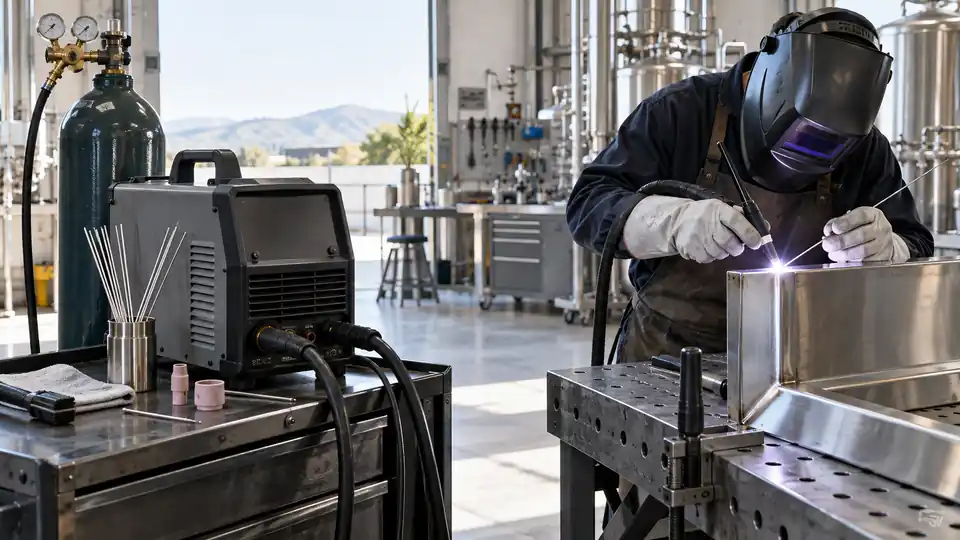
A TIG welder earns its place by giving you control over heat, arc starting, and the finished bead. That control matters on stainless steel, mild steel, thin sheet, and aluminum, where excessive heat can create distortion, burn-through, or a rough-looking joint. The best TIG welder for one setup may be a compact DC machine, while another buyer may need AC/DC output, pulse adjustment, dual-voltage input, and a foot pedal.
Peak amperage is only part of the decision. A machine must also match the material and available circuit. DC TIG handles steel and stainless steel, but aluminum requires AC TIG. High-frequency starting avoids touching the tungsten to the workpiece, while Lift TIG is a simpler contact-start method with fewer controls. Buyers also need to check whether the torch, regulator, ground clamp, and foot pedal are included or merely compatible.
This comparison favors machines with documented TIG capability, useful controls, and a clear application fit. The Weldpro 200A AC/DC model leads the group because it combines AC/DC TIG, pulse functions, dual-voltage input, high-frequency start, an included torch, and an included foot pedal. The Lincoln and PrimeWeld models offer strong alternatives for buyers who place greater value on established product lines or a more complete TIG-focused setup.
Quick Answer
- Best Overall: Weldpro 200A AC/DC TIG Welder for broad material coverage, pulse control, dual-voltage input, and included TIG accessories.
- Best for Aluminum: YESWELDER TIG-200P ACDC for AC/DC output, square-wave operation, pulse modes, and a compact 16.47-pound design.
- Best Premium Option: Lincoln Electric Square Wave 205 for buyers who prefer an established TIG-focused product line.
- Best Value DC TIG: ARCCAPTAIN TIG 205P Pro for stainless steel, mild steel, copper, and thin-metal work where AC aluminum capability is not required.
Best TIG Welder Comparison Table
| Product | Best For | TIG Type | Key Advantage |
|---|---|---|---|
| Weldpro 200A AC/DC | Best overall balance | AC/DC, pulse | Foot pedal and accessories included |
| YESWELDER TIG-200P ACDC | Aluminum and mixed materials | AC/DC, pulse | Square-wave AC and seven modes |
| PRIMEWELD TIG225X | Aluminum and steel | AC/DC, pulse | 225A output and CK torch |
| Sunstac 250A | Higher advertised output | AC/DC, pulse | 250A rating and spot modes |
| Lincoln Square Wave 205 | Dedicated TIG setup | TIG-focused | Established Square Wave platform |
| ARCCAPTAIN TIG 205P Pro | Portable DC TIG | DC, pulse | 120V/240V input and app control |
| ARCCAPTAIN 200A TIG | Simple steel and stainless work | DC TIG | HF start and TIG/Stick operation |
| YESWELDER TIG-205P | Budget pulse TIG | DC, pulse | Light 10.7-pound body |
| S7 200A TIG | Basic garage projects | DC TIG | 110V/220V input and simple controls |
The detailed reviews below explain where each machine fits, what its specifications mean, and which compromises deserve attention before ordering.
1. Weldpro 200A AC/DC TIG Welder: Best Overall
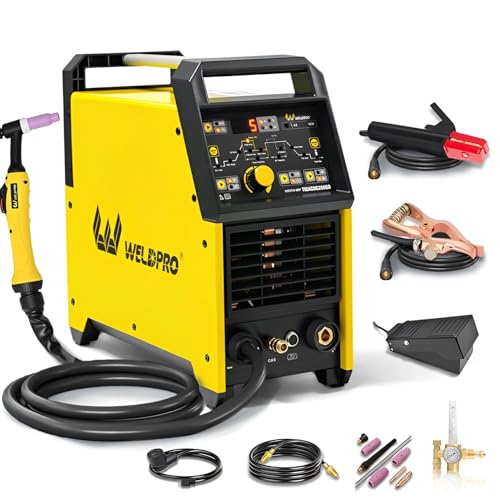
The Weldpro earns the top position through balance rather than a single oversized specification. Its five documented modes include high-frequency AC TIG, DC TIG, AC pulse TIG, DC pulse TIG, and Stick. That combination covers aluminum as well as steel and stainless steel, while dual-voltage input allows the machine to work from either a standard 110V outlet or a 220V supply.
Pulse frequency is adjustable from 0.5 to 200 Hz, with peak current, upslope, downslope, and 2T/4T controls. Those settings give the operator more control over heat input on thin material and longer welds. The included TIG torch, rocker-style foot pedal, gas hose, flow meter, tungsten electrodes, and consumables also reduce the number of separate pieces needed for a first setup. The listing specifies a 40% duty cycle at 200A, so extended welding at maximum output remains more limited than the broad process list might suggest.
Pros
- AC and DC TIG support steel, stainless steel, aluminum, and other suitable materials.
- High-frequency start avoids routine tungsten contact during arc initiation.
- Pulse frequency, upslope, downslope, and 2T/4T controls support more precise heat management.
- Dual-voltage input suits both household and higher-voltage workshop circuits.
- Foot pedal, TIG torch, flow meter, and basic consumables are listed as included.
Cons
- The 40% duty cycle at full 200A is less suited to long maximum-output welding sessions.
- The larger control set may require more setup time than a basic DC TIG machine.
This is the strongest general recommendation for buyers who want one machine for aluminum, steel, stainless steel, and occasional Stick work. The foot pedal is a meaningful advantage for changing amperage during a seam, while the AC controls give it a broader role than the DC-only options below. Buyers who mostly weld short steel joints may save space and money with a simpler machine, but the Weldpro makes more sense for a mixed-material workshop.
To buy this product, click here.
2. YESWELDER TIG-200P ACDC: Best for Aluminum

Aluminum work changes the buying decision because a DC-only TIG welder is not enough for the task. The YESWELDER TIG-200P provides AC and DC TIG, AC pulse and DC pulse, Stick, MIX TIG, and spot welding. Its documented square-wave, triangle-wave, and sine-wave AC options give the buyer more ways to shape the arc for aluminum than the DC machines in this roundup.
The machine is listed at up to 200A and supports automatic 110V/220V input, with high-frequency arc starting for non-contact ignition. The product information identifies aluminum capability up to 1/8 inch, although actual results depend on joint design, material, preparation, settings, and available power. At 16.47 pounds, it is easier to move than the heavier shop-oriented alternatives. A five-pin foot-pedal interface is available, but the pedal is not identified as included in the supplied listing.
Pros
- AC and DC TIG modes cover aluminum, steel, and stainless steel applications.
- Square-wave, triangle-wave, and sine-wave options provide useful AC control choices.
- AC pulse and DC pulse add heat-management options for thinner work.
- Automatic 110V/220V input improves compatibility across workshop circuits.
- At approximately 16.47 pounds, the machine is relatively portable for an AC/DC TIG unit.
Cons
- The foot pedal interface is listed, but a pedal is not clearly included.
- The seven-mode control layout may be more involved than necessary for basic steel TIG work.
This model is a strong fit for someone who expects aluminum to be part of the workload and wants a compact AC/DC platform. Compared with the Weldpro, it offers a similar broad process concept but requires closer attention to the accessory bundle. If the work is limited to stainless steel or mild steel, a DC TIG machine such as the ARCCAPTAIN TIG 205P can provide the needed process without paying for AC functions.
To buy this product, click here.
3. PRIMEWELD TIG225X: Best AC/DC TIG Package

The PRIMEWELD TIG225X takes a TIG-focused approach with AC/DC output, pulse control, and a listed 225A maximum. It is intended for aluminum, stainless steel, thinner metals, and Stick electrodes such as 7018 and 6013. That combination gives it a clear place between compact entry-level units and more expensive dedicated TIG systems.
A CK Worldwide 17-series Superflex torch, flex hose, CK DINSE connector, and foot-pedal control are identified in the product information. Those components matter because torch quality and cable flexibility affect setup convenience, while a pedal allows amperage changes during a weld. The listing also identifies 110V/220V operation and AC and pulse frequency up to 200 Hz. The published claims include material thickness figures, but those should be treated as application-dependent rather than universal guarantees.
Pros
- AC/DC TIG capability supports aluminum as well as steel and stainless steel.
- 225A output gives it a higher advertised ceiling than the 200A models here.
- Pulse and AC frequency controls support thinner material and heat management.
- CK Worldwide torch and Superflex hose provide a more specific accessory package.
- 110V/220V input gives the machine flexibility between home and workshop power.
Cons
- The larger TIG-focused package may be more than needed for occasional short welds.
- Published thickness claims still depend on material, joint preparation, settings, and power.
Choose the TIG225X if the included torch and foot control carry as much weight as the machine itself. It is especially appealing for buyers who want AC/DC TIG without building a torch package piece by piece. The Weldpro offers a broader stated accessory kit, while the YESWELDER TIG-200P is lighter, so the PRIMEWELD sits between those choices with a higher output rating and a recognizable CK torch package.
To buy this product, click here.
4. Sunstac 250A AC/DC TIG Welder: Best for Higher Advertised Output

The Sunstac SS-250P is aimed at buyers who want AC/DC TIG, pulse operation, spot modes, and a higher advertised output ceiling. Its listing identifies high-frequency AC and DC TIG, pulsed AC and DC TIG, AC and DC spot welding, and Stick operation. The additional modes can help separate a short reinforcement weld from a longer hand-controlled seam, although more modes also mean more settings to learn.
Dual-voltage 110V/220V operation makes the unit more adaptable than a 110V-only welder. The listing gives aluminum thickness figures of 5/32 inch at 110V and 6/25 inch at 220V, but those figures should be read as published product claims rather than guaranteed results for every joint. A foot pedal is supported, but the product information states that it is not included. The listing also warns that AC current measurement can be inaccurate and that AC balance may vary, a limitation worth taking seriously for buyers who depend on precise displayed readings.
Pros
- AC/DC TIG and pulse modes cover aluminum, steel, and stainless steel work.
- 250A advertised output provides a higher ceiling than the 200A alternatives.
- AC and DC spot modes add options for short controlled welds.
- Dual-voltage input works with 110V and 220V supplies.
- LCD display and parameter-saving function support repeat setups.
Cons
- The compatible foot pedal is listed as optional rather than included.
- The product information cautions that AC current measurement and AC balance may be inconsistent.
The Sunstac is best suited to buyers who want a feature-rich AC/DC machine and are prepared to verify settings carefully. Its 250A label is attractive, but the AC measurement warning makes it less straightforward than the Weldpro or PRIMEWELD for precision-focused work. Buyers who rarely weld aluminum may prefer a simpler DC machine with fewer AC-related variables.
To buy this product, click here.
5. Lincoln Electric Square Wave 205: Best Premium Option

The Lincoln Electric Square Wave 205 is the most premium-positioned machine in this selection and belongs to Lincoln’s Square Wave TIG family. Its supplied product information identifies it as a TIG welding power source, but it does not provide the same detailed feature list as the other products here. That means the model may appeal to buyers who prefer a dedicated TIG platform, while exact controls, included accessories, and power requirements should be confirmed in current Lincoln documentation before ordering.
A dedicated TIG machine can make more sense than a multi-process unit for a workshop centered on controlled TIG work. Still, the limited information attached to this listing makes direct comparison difficult. Buyers should verify whether the desired torch, foot pedal, regulator, and other accessories are part of the selected configuration. This is a case where product identity is clear, but configuration details deserve closer checking than the listing alone allows.
Pros
- Belongs to Lincoln Electric’s Square Wave TIG product family.
- Dedicated TIG positioning may suit buyers who do not need a multi-process machine.
- Model number K5613-1 identifies the listed configuration.
- Premium positioning gives buyers an alternative to compact multifunction units.
- Suitable for shoppers who prioritize a recognized TIG-focused platform.
Cons
- The supplied listing does not clearly specify output range, duty cycle, or included accessories.
- Buyers need to confirm AC/DC capability and configuration details before purchase.
This Lincoln is best for a buyer who values the Square Wave platform and is willing to verify the complete specification sheet. It is harder to recommend for shoppers comparing features line by line because the available listing is sparse. The Weldpro, YESWELDER, and PRIMEWELD models provide more visible configuration detail, while the Lincoln remains the choice for someone who places greater weight on the product family and dedicated TIG identity.
To buy this product, click here.
6. ARCCAPTAIN TIG 205P Pro: Best Value DC TIG

The ARCCAPTAIN TIG 205P Pro concentrates its capability on DC TIG, pulse TIG, Lift TIG, spot TIG, and Stick. It does not provide AC output, so it is unsuitable for aluminum TIG, but that limitation also keeps the machine focused for stainless steel, mild steel, copper, and other DC applications. A buyer who has no aluminum work may prefer this process mix over paying for AC controls that will remain unused.
Its adjustable settings include post-flow, downslope, spot time, interval time, pulse frequency, duty cycle, peak current, and base current. Those controls create a more detailed DC TIG setup than the simpler ARCCAPTAIN 200A model. The machine accepts 120V or 240V input and can connect to a five-pin foot pedal, although the pedal is listed as compatible rather than included. App control adds remote parameter adjustment and preset recall, which may be convenient, but it also introduces a phone-based layer that some workshop users will prefer to ignore.
Pros
- DC TIG, pulse TIG, Lift TIG, spot TIG, and Stick cover several steel-focused applications.
- 120V/240V input supports different workshop power arrangements.
- Detailed pulse and timing controls allow more precise DC TIG setup.
- App support provides parameter adjustment, preset recall, and error information.
- Five-pin foot-pedal compatibility allows hands-free current control.
Cons
- DC-only output does not support aluminum TIG.
- The foot pedal is compatible but not clearly included.
This is a sensible alternative to an AC/DC machine for stainless and mild steel work. Compared with the ARCCAPTAIN 200A, it offers more pulse and spot-related control, while the YESWELDER TIG-205P provides a similar DC-focused direction with a lighter body. Buyers who may add aluminum later should move up to an AC/DC model instead of treating this machine as a universal TIG solution.
To buy this product, click here.
7. ARCCAPTAIN 200A TIG Welder: Best Simple TIG and Stick Combination

The ARCCAPTAIN 200A takes a more straightforward route than the 205P Pro. It combines high-frequency DC TIG with Stick and provides up to 200A, making it a practical match for stainless steel and mild steel rather than aluminum. High-frequency starting helps initiate the arc without the tungsten-contact method associated with Lift TIG.
Post-flow can be adjusted from 1 to 10 seconds, and downslope can be adjusted from 0 to 10 seconds according to the supplied product information. Those controls help manage the end of a weld and protect the torch from abrupt heat changes. The machine also offers 2T and 4T trigger modes, a large LED display, dual-voltage 110V/220V input, and a listed weight below 12 pounds. Its simpler two-process design may be easier to navigate than the AC/DC units, although it gives up aluminum capability and advanced AC settings.
Pros
- High-frequency DC TIG start supports cleaner arc initiation than Lift TIG.
- TIG and Stick modes cover stainless steel, mild steel, and outdoor repair work.
- Adjustable post-flow and downslope provide useful end-of-weld control.
- 110V/220V input improves portability between household and workshop circuits.
- Listed weight below 12 pounds makes relocation easier.
Cons
- DC-only TIG does not support aluminum welding.
- The two-process design has fewer pulse and AC controls than the higher-ranked machines.
Pick this model for a compact steel-focused setup with HF start and Stick backup. It is more capable than a basic Lift TIG unit, yet less complicated than an AC/DC pulse machine. The ARCCAPTAIN TIG 205P makes more sense for buyers who want extensive pulse adjustment, while this 200A model suits someone who values clear core functions and modest transport weight.
To buy this product, click here.
8. YESWELDER TIG-205P: Best Budget Pulse TIG

The YESWELDER TIG-205P combines DC TIG, pulse TIG, and Stick in a compact 10.7-pound body. Its automatic 110V/220V input and high-frequency start make it more flexible than a basic 110V Lift TIG unit, while Hot Start, Arc Force, and Anti-Stick functions support its Stick mode. The listing specifically states that this machine cannot be used for aluminum welding, so its appropriate materials are steel, stainless steel, and similar DC TIG work.
Pulse settings include independent control of pulse frequency, duty cycle, and current. That matters for thin material because pulsing can help manage heat input, but pulse controls do not transform a DC welder into an aluminum machine. A five-pin foot-pedal interface is available for current control, but the pedal itself is not identified as included. Auto Memory can save settings between sessions, which is useful when a small workshop returns to the same material and joint configuration.
Pros
- DC TIG, pulse TIG, and Stick provide useful process coverage for steel work.
- High-frequency start avoids the limitations of contact-start TIG.
- Automatic 110V/220V input works across common power arrangements.
- At approximately 10.7 pounds, it is easy to carry and store.
- Pulse frequency, duty cycle, and current can be adjusted independently.
Cons
- The listing clearly states that it cannot weld aluminum.
- The compatible foot pedal is not clearly included with the machine.
This model is a good match for a budget-oriented DC TIG setup where portability and pulse control matter more than AC capability. It is lighter than the ARCCAPTAIN 205P and offers a similar material limitation. Buyers who need aluminum should skip this model and choose the YESWELDER TIG-200P ACDC or another confirmed AC/DC machine.
To buy this product, click here.
9. S7 200A TIG Welder: Best for Basic Garage Projects

The S7 200A is a compact DC TIG and Stick machine aimed at straightforward garage repairs, mild steel, stainless steel, and light fabrication. Its 110V/220V dual-voltage design gives it more placement flexibility than a single-voltage entry unit. Simple controls and a digital current display keep the basic adjustment process clear, although the available information does not identify high-frequency starting, pulse control, or a duty-cycle figure.
The machine is compatible with common TIG consumables such as tungsten electrodes, ceramic cups, and collets. Compatibility with consumables does not confirm that a complete TIG torch, regulator, or foot pedal is included, so the package contents should be checked carefully. Built-in overheat and overload protection are listed, but those features are operational safeguards rather than a replacement for suitable PPE, ventilation, electrical setup, and manufacturer instructions.
Pros
- DC TIG and Stick cover common steel and stainless-steel projects.
- 110V/220V input supports both household and workshop power.
- Simple controls may be easier to approach than a highly configurable AC/DC unit.
- Digital current display helps with basic output adjustment.
- Standard TIG consumable compatibility simplifies replacement sourcing.
Cons
- The available information does not clearly specify HF start, pulse control, or duty cycle.
- AC TIG and aluminum capability are not identified.
The S7 makes sense for occasional DC TIG and Stick work where the priority is a compact, simple machine rather than advanced arc control. It ranks below the YESWELDER and ARCCAPTAIN DC models because fewer important TIG specifications are published in the supplied information. Buyers should confirm what torch and gas-control equipment is included before assuming the machine is ready for a complete TIG setup.
To buy this product, click here.
Buying Guide
AC TIG Matters When Aluminum Is Part of the Plan
AC TIG is the meaningful dividing line between the aluminum-capable products and the steel-focused machines. The alternating current helps address aluminum’s oxide layer, while DC TIG is the normal choice for steel and stainless steel. A product that simply says TIG welder should not be assumed to support aluminum. The Weldpro, YESWELDER TIG-200P ACDC, PRIMEWELD, and Sunstac models explicitly identify AC/DC TIG capability. The DC-only ARCCAPTAIN and YESWELDER TIG-205P models do not.
High-Frequency Start Versus Lift TIG
High-frequency start initiates the arc without requiring the tungsten to touch the workpiece. That can reduce accidental tungsten contamination and make repeated starts easier. Lift TIG uses a contact-start method and may be sufficient for basic work, but it does not provide the same starting approach. The ARCCAPTAIN 205P and 200A, both YESWELDER TIG models, and the Weldpro identify high-frequency starting. The S7 listing does not clearly specify its starting method.
Pulse Helps Manage Heat, But It Does Not Add AC Capability
Pulse TIG alternates between higher and lower current according to adjustable settings. This can help manage heat on thinner material and gives the operator another way to shape the weld. Pulse is available on the Weldpro, YESWELDER TIG-200P ACDC, PRIMEWELD, Sunstac, ARCCAPTAIN 205P, and YESWELDER TIG-205P. A DC pulse machine remains a DC machine, so pulse does not make the YESWELDER TIG-205P suitable for aluminum.
Match Input Voltage to the Available Circuit
Dual-voltage input gives a machine more flexibility, but it does not mean the same output is available from both supplies. The listing identifies 110V/220V or 120V/240V operation on several models. Buyers should check the manual for the correct plug, breaker, input current, and output expectations before installation. A machine that fits the outlet but cannot deliver the needed current on that circuit may be less useful than its headline amperage suggests.
Check the Foot Pedal and Torch Bundle
A foot pedal allows current adjustment during a TIG weld, which can be useful around corners, at the end of a joint, or on changing material thickness. The Weldpro listing identifies a foot pedal as included, while the YESWELDER TIG-200P, Sunstac, ARCCAPTAIN 205P, ARCCAPTAIN 200A, and YESWELDER TIG-205P identify pedal interfaces or compatibility without clearly confirming that a pedal is in the box. Torch, regulator, gas hose, flow meter, and ground clamp contents also vary. Read the exact configuration rather than assuming a compatible accessory is supplied.
Use Duty Cycle as a Workload Guide
Duty cycle describes how long a machine can operate at a stated output under stated conditions before requiring a cooling period. It must be read alongside amperage and input voltage. The Weldpro listing gives a 40% duty cycle at full 200A, while many other supplied listings do not provide a comparable figure. A high maximum amperage does not automatically mean a machine can sustain that output for long welds.
Best TIG Welder FAQ
What is the best TIG welder for aluminum?
An AC/DC machine is required for aluminum TIG. Among these products, the Weldpro 200A, YESWELDER TIG-200P ACDC, PRIMEWELD TIG225X, and Sunstac 250A explicitly identify AC/DC TIG and aluminum capability. The YESWELDER TIG-205P and ARCCAPTAIN TIG 205P are DC-only and are not suitable for aluminum TIG.
Is a higher amperage rating always better for TIG welding?
No. Higher output can help with thicker material, but low-end control, AC settings, pulse functions, input power, and duty cycle may matter more for a particular job. A 200A AC/DC machine with useful controls may be a better fit than a higher-rated model with less complete accessory support or unclear operating specifications.
Is high-frequency TIG better than Lift TIG?
High-frequency TIG starts the arc without touching the tungsten to the workpiece. Lift TIG uses a controlled contact-start method. High-frequency start is often more convenient for precision TIG work and can reduce tungsten contamination, while Lift TIG can suit simpler equipment and applications where a contact start is acceptable.
Do TIG welders include a foot pedal?
Some do, but the product listing must be checked carefully. The Weldpro identifies an included rocker-style foot pedal. Several other machines list a five-pin foot-pedal interface or compatibility without clearly including the pedal. A compatible pedal and an included pedal are different purchasing conditions.
Can a DC TIG welder weld stainless steel?
Yes, DC TIG is suitable for stainless steel when the machine, shielding gas, tungsten, filler, and settings are appropriate. The ARCCAPTAIN TIG 205P, ARCCAPTAIN 200A, and YESWELDER TIG-205P are examples of DC-focused machines listed for stainless and mild steel work. They should not be treated as aluminum TIG machines.
What shielding gas does TIG welding normally use?
TIG welding commonly uses argon shielding gas, but the correct gas setup depends on the material, process, and manufacturer instructions. A TIG torch alone does not provide gas. Buyers should verify whether a regulator, flow meter, hose, and suitable gas connection are included before ordering.
Is a multi-process welder a good choice for TIG?
It can be, provided the machine offers the TIG features required for the work. AC/DC capability, high-frequency start, pulse, foot-pedal support, and included TIG hardware matter more than the number of advertised processes. Stick capability can be useful as a secondary function, but it should not distract from the TIG controls that determine the primary purchase.
Final Verdict
The Weldpro 200A AC/DC TIG Welder is the strongest overall choice in this group because it connects the most important pieces: AC and DC TIG, pulse adjustment, high-frequency start, dual-voltage input, Stick capability, an included TIG torch, and an included foot pedal. Its 40% duty cycle at full output is a real limitation for long maximum-amperage sessions, yet its combination of aluminum capability and practical accessories gives it the broadest fit.
Choose the YESWELDER TIG-200P ACDC or PRIMEWELD TIG225X if aluminum is central to the work and you want a different AC/DC package. The Lincoln Square Wave 205 suits buyers who prioritize a dedicated TIG platform and are prepared to confirm the full configuration. For stainless steel and mild steel without aluminum, the ARCCAPTAIN TIG 205P or YESWELDER TIG-205P offers a more focused DC option. Match the final choice to the material, circuit, accessory bundle, and expected workload rather than selecting by amperage alone.
