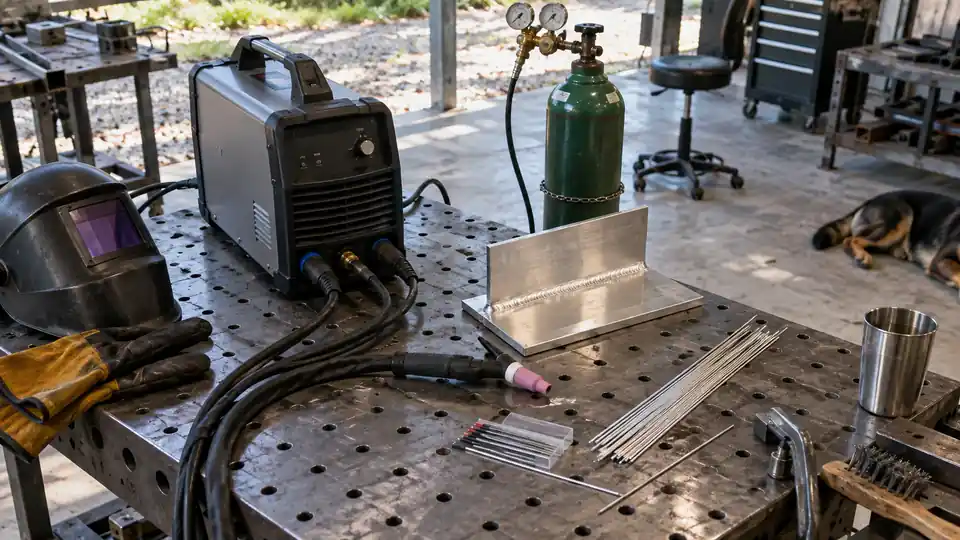
Aluminum exposes the difference between a basic TIG machine and a genuinely useful AC TIG setup. The process needs alternating current to help manage the oxide layer, high-frequency arc starting for clean ignition, and enough control over AC balance, frequency, pulse, and amperage to keep heat from running away on thin material. A welder that merely lists TIG support is not enough for this job. It needs documented AC TIG capability.
Peak amperage can be distracting. A 225-amp rating may look attractive, but low-end control, foot-pedal support, AC waveform adjustment, and the included torch or regulator often matter more for aluminum projects. Buyers also make costly assumptions about accessories. A machine may accept a foot pedal or spool gun without including one, and DC TIG capability does not mean the machine can weld aluminum effectively.
This comparison favors AC/DC TIG welders with pulse functions, high-frequency starting, dual-voltage flexibility, and useful aluminum controls. The Weldpro 200A AC/DC TIG Welder earns the strongest overall position because its adjustable AC settings, included foot pedal, dual-voltage input, and complete accessory kit create a well-rounded setup. Other models make more sense for buyers who prioritize waveform control, a lower purchase position, cold TIG, or a heavier-duty torch package.
Quick Answer
- Best Overall: Weldpro 200A AC/DC TIG Welder for its adjustable AC controls, included foot pedal, dual-voltage input, and broad accessory kit.
- Best for AC Waveform Control: Bestarc 215A AC/DC TIG Welder with square-wave AC pulse, memory storage, and adjustable post-gas.
- Best Premium Option: PRIMEWELD TIG225X with a CK Worldwide torch, pulse controls, and 225-amp output.
- Best for Thin Aluminum and Low Heat: AZZUNO 10-in-1 AC/DC TIG Welder with pulse, cold welding, and multiple AC waveform choices.
Best TIG Welder for Aluminum Comparison Table
| Product | Best For | Aluminum-Relevant Features | Input and Output |
|---|---|---|---|
| Weldpro 200A AC/DC TIG Welder | Best overall balance | Adjustable AC balance, frequency, and pulse | 110V/220V, up to 200A |
| Bestarc 215A AC/DC TIG Welder | AC waveform control | Square-wave AC pulse and memory storage | 110V/220V, up to 215A |
| PRIMEWELD TIG225X | Premium torch package | AC frequency, pulse, HF start, foot control | 110V/220V, up to 225A |
| AZZUNO 10-in-1 AC/DC TIG Welder | Thin material control | Cold TIG, AC/DC pulse, square, sine, and triangle wave | 110V/220V, up to 200A |
| YESWELDER TIG-200P ACDC | Portable aluminum setup | HF start, square-wave AC, pulse, spot TIG | 110V/220V, up to 200A |
| ANDELI 8-in-1 AC/DC TIG Welder | Cold TIG and controls | Pulse, cold, AC balance, torch remote control | 110V/220V, up to 200A |
| Sunstac 250A AC/DC TIG Welder | High advertised output | AC pulse, spot TIG, dual-voltage input | 110V/220V, up to 250A |
| AZZUNO 200A 6-in-1 AC/DC TIG Welder | Budget-oriented AC TIG | AC balance, frequency, pulse, spot TIG | 110V/220V, up to 200A |
| VEVOR 225A 6-in-1 TIG Welder | General-purpose aluminum work | AC TIG, AC pulse, HF start | 110V/220V, up to 225A |
The detailed reviews below explain how the machines differ in AC control, accessory support, portability, and practical aluminum suitability.
1. Weldpro 200A AC/DC TIG Welder – Best Overall
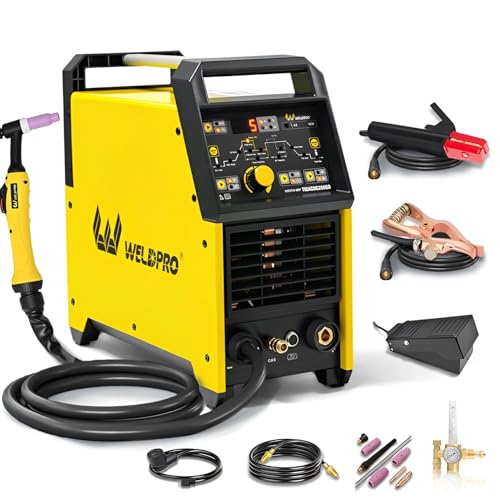
Aluminum work often becomes easier when the machine gives the operator meaningful control rather than a long list of modes. The Weldpro provides AC TIG, AC pulse TIG, DC TIG, DC pulse TIG, and Stick operation, with adjustable AC balance and frequency listed for aluminum work. Those controls affect how the arc cleans the oxide layer and how heat is distributed through the joint, so they are more relevant here than a simple process-count claim.
The included rocker-style foot pedal is a useful advantage. It permits amperage adjustment during a weld, which can help as an aluminum part heats up or as a joint changes shape. The machine also accepts either 110V or 220V input and automatically detects the supply, while its published 40 percent duty cycle is specified at the full 200-amp output. That combination makes it easier to move between a home circuit and a stronger workshop supply, although buyers should still confirm their circuit requirements.
Pros
- Supports AC TIG, AC pulse TIG, DC TIG, DC pulse TIG, and Stick operation.
- Adjustable AC balance, frequency, pulse, upslope, and downslope settings.
- Includes a TIG torch and rocker-style foot pedal.
- Automatic 110V/220V input detection adds setup flexibility.
- Published 40 percent duty cycle at full 200-amp output.
Cons
- The control set may take time to learn for buyers new to AC TIG.
- Its 200-amp ceiling is lower than the highest-output machines in this group.
This is the strongest fit for someone who wants a complete aluminum TIG setup without giving up dual-voltage flexibility or foot control. The included accessories reduce the number of separate purchases needed before setup, and the AC adjustments give it a stronger technical foundation than budget machines with fewer controls. Buyers who need maximum output above 200 amps may prefer the PRIMEWELD or Sunstac, while those focused on cold TIG should look toward AZZUNO or ANDELI.
To buy this product, click here.
2. Bestarc 215A AC/DC TIG Welder – Best for AC Waveform Control

The Bestarc earns its place through a particularly useful set of AC functions. Its listing identifies AC TIG, AC pulse TIG, and square-wave AC pulse TIG, alongside DC TIG, DC pulse TIG, and Stick. Square-wave operation can make the transition between cleaning and penetration more defined, which gives aluminum welders another way to shape the arc instead of relying on a single factory waveform.
Control continues after the arc starts. Adjustable post-gas from one to 15 seconds helps protect the heated tungsten and weld area after the current stops, while downslope can reduce the abrupt crater that appears at the end of a bead. The included foot switch, nine memory positions, dual-voltage input, and 215-amp maximum give it a strong feature balance. The listing does not provide a duty-cycle figure, so this model should not be ranked by output alone.
Pros
- Includes AC, AC pulse, and square-wave AC pulse modes.
- Supports adjustable post-gas from one to 15 seconds.
- Includes a foot switch and nine parameter memory positions.
- Offers dual-voltage 110V/220V operation.
- Provides 215 amps of listed maximum output.
Cons
- The product information does not clearly publish a duty-cycle figure.
- Its broader waveform and timing controls may feel complex during initial setup.
This model suits buyers who want to tune the arc more carefully for aluminum and thin material. It sits close to the Weldpro in capability, but its square-wave AC pulse and memory storage give it a different appeal. A buyer who frequently changes between saved material settings may appreciate that convenience, while someone who values a documented full-output duty cycle may lean toward the Weldpro instead.
To buy this product, click here.
3. PRIMEWELD TIG225X – Best Premium Torch Package

The PRIMEWELD TIG225X takes a more focused route than the multi-process models above. It is an AC/DC TIG and Stick welder with pulse, HF start, and foot-pedal control, and its listed 225-amp output gives it useful headroom for larger aluminum work. Its included CK Worldwide 17 Series Superflex torch and flexible hose are meaningful details because torch handling and cable flexibility affect how easily a long joint can be positioned.
The product information lists AC frequency and pulse frequency up to 200 hertz, along with 110V/220V operation. It also states that the machine can weld aluminum up to 1/4 inch, although published thickness figures depend on joint design, material preparation, settings, and available input power. Compared with the Weldpro and Bestarc, this model offers fewer highlighted process modes, yet its TIG-oriented package may appeal more to buyers who plan to spend most of their time on controlled TIG work.
Pros
- Provides AC/DC TIG, pulse, Stick, HF start, and foot-pedal control.
- Lists up to 225 amps of output.
- Includes a CK Worldwide 17 Series Superflex TIG torch.
- Supports 110V and 220V input.
- Lists AC and pulse frequency adjustment up to 200 hertz.
Cons
- It has fewer advertised process modes than several multi-process alternatives.
- The listing does not clearly provide a full duty-cycle comparison at each input voltage.
This is the better fit for buyers willing to spend more on a TIG-centered package and a recognized flexible torch. It may be excessive for occasional small aluminum repairs, particularly if the included torch quality matters less than a lower purchase position. For regular TIG work that includes aluminum, stainless steel, and thinner materials, the torch, HF start, and foot control make a more persuasive case than the raw amperage number alone.
To buy this product, click here.
4. AZZUNO 10-in-1 AC/DC TIG Welder – Best for Thin Material Control

Thin aluminum and stainless steel can punish a machine that feeds heat too aggressively. The AZZUNO ACDC-200L addresses that problem with AC and DC pulse, spot TIG, and a listed cold-welding function. Cold TIG is intended to reduce heat input, which can be useful around thin sections or cosmetic joints where distortion and burn-through are concerns. It does not remove the need for correct preparation and technique, but it gives the operator another lower-heat setting to evaluate.
Its AC section also lists square, sine, and triangle waveforms. That is a stronger control selection than a machine that offers AC TIG without waveform choices. The machine supports 110V and 220V input, stores up to 10 parameter sets, and weighs 18.5 pounds according to the product information. A 5K potentiometer foot pedal is supported but sold separately, so the apparent completeness of the package should not be confused with included foot control.
Pros
- Includes AC/DC TIG, AC/DC pulse, spot TIG, and cold welding functions.
- Lists square, sine, and triangle AC waveforms.
- Supports 110V and 220V input.
- Stores up to 10 custom parameter sets.
- Includes TIG torch, regulator, hose, ground clamp, and basic consumables.
Cons
- The compatible foot pedal is sold separately.
- Its 18.5-pound weight is higher than some compact alternatives.
This model makes sense for thin aluminum projects where heat management deserves more attention than maximum output. Its cold function and waveform choices separate it from the simpler 200-amp machines, while memory storage helps if the same material settings are used repeatedly. Buyers who want foot-operated amperage control in the box should choose the Weldpro or Bestarc instead.
To buy this product, click here.
5. YESWELDER TIG-200P ACDC – Best Portable Option

At approximately 16.47 pounds, the YESWELDER TIG-200P is easier to move and store than the larger machines in this group. That matters for a garage where the welder needs to share a shelf with other tools, or for a setup that moves between work areas. Portability does not come from sacrificing aluminum capability here. The listing identifies AC TIG, DC TIG, AC and DC pulse, spot welding, and high-frequency non-contact start.
Automatic 110V/220V sensing reduces one setup step, while the large LED display and memory function make common settings easier to revisit. Its square-wave AC mode is specifically positioned for aluminum work, with a published aluminum thickness figure up to 1/8 inch. The five-pin foot-pedal connection is present, but a pedal is not identified as included, so buyers should budget for that accessory if variable amperage control is important.
Pros
- Weighs approximately 16.47 pounds for easier transport.
- Supports AC/DC TIG, AC/DC pulse, spot TIG, and Stick.
- Uses high-frequency non-contact arc starting.
- Automatically senses 110V or 220V input.
- Includes square-wave AC and a memory function.
Cons
- The five-pin foot pedal is supported but not listed as included.
- The published aluminum thickness figure is limited to up to 1/8 inch.
This is a sensible choice for a buyer who needs AC TIG capability in a compact chassis and expects to move the machine occasionally. It gives up some of the accessory completeness found with Weldpro, yet its weight and automatic voltage sensing simplify transport and setup. A heavier shop setup or thicker aluminum work may justify the PRIMEWELD or Sunstac instead.
To buy this product, click here.
6. ANDELI 8-in-1 AC/DC TIG Welder – Best for Cold TIG and Torch Controls
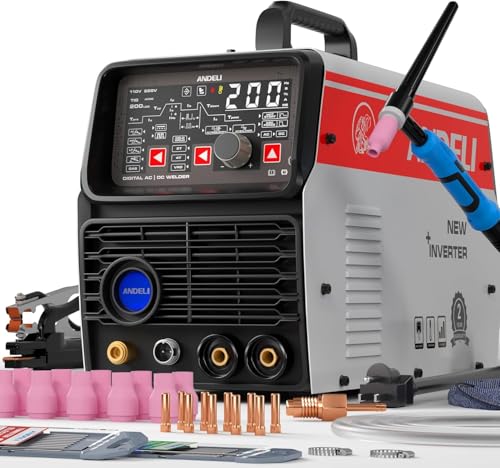
ANDELI combines aluminum-focused AC TIG with several low-heat and remote-control features. Its eight listed functions include AC TIG, AC pulse TIG, DC TIG, DC pulse TIG, Lift TIG, cold welding, spot welding, and Stick. That broad menu is useful for a workshop that shifts between aluminum, stainless steel, carbon steel, and titanium, although more modes also mean more settings to understand.
The included torch has a built-in remote-control button for amperage adjustment, which differs from a separate foot pedal. That arrangement may help in a tight work area where foot positioning is awkward. The five-inch display, adjustable AC balance, pulse frequency, peak and base current, and included tungsten electrodes add practical value. A two-year warranty is listed, but warranty terms should be confirmed against the current manufacturer documentation before purchase.
Pros
- Supports AC/DC TIG, pulse, cold, spot, Lift TIG, and Stick modes.
- Includes a torch with a built-in remote-control button.
- Provides adjustable AC balance and pulse controls.
- Includes tungsten electrodes and multiple torch consumables.
- Lists 110V/220V input and a two-year warranty.
Cons
- It offers many controls that may require a longer setup familiarization period.
- The listed 200-amp output is below the 225-amp and 250-amp options here.
ANDELI is a strong alternative for buyers who want cold welding and amperage adjustment from the torch rather than a conventional foot pedal. That distinction could matter during long seams or awkwardly positioned joints. It ranks below the Weldpro because the Weldpro includes a more conventional foot pedal and publishes a full-output duty-cycle figure, but ANDELI is more appealing for thin, heat-sensitive work.
To buy this product, click here.
7. Sunstac 250A AC/DC TIG Welder – Best for Advertised Output

The Sunstac carries the highest advertised maximum output among the selected AC/DC TIG machines. It supports high-frequency AC and DC TIG, pulsed AC and DC, AC and DC spot TIG, and Stick, with 110V/220V input. For a buyer who expects aluminum work to extend beyond small decorative parts, the listing’s stated capacity of 4 mm at 110V and 6 mm at 220V provides a useful reference, although real results depend on joint design, material, settings, and preparation.
An LCD screen displays parameters, and the machine stores previous settings for later recall. The product supports 2T, 4T, and spot TIG modes. One limitation deserves attention before purchase: the listing itself warns that current measurement in AC mode can be inaccurate and that AC balance may produce variation in measured current. That disclosure does not automatically rule out the machine, but it makes careful verification and a clear return policy more important.
Pros
- Lists up to 250 amps of AC/DC TIG output.
- Supports AC/DC pulse, spot TIG, HF start, and Stick.
- Offers dual-voltage 110V/220V operation.
- Provides 2T, 4T, and spot TIG modes.
- Lists aluminum capacity figures for both input voltages.
Cons
- The product listing warns that AC current measurement may be inaccurate.
- The foot pedal is described as compatible but not included.
This machine has a clear appeal for buyers who prioritize advertised output and aluminum thickness capacity. Its ranking is restrained by the manufacturer or seller disclosure about AC measurement and balance variation, an issue that matters more for controlled aluminum TIG than for casual Stick use. Buyers who prefer fewer uncertainties may select the Weldpro or Bestarc, while those who need maximum listed amperage may still find the Sunstac relevant.
To buy this product, click here.
8. AZZUNO 200A 6-in-1 AC/DC TIG Welder – Best Budget-Oriented AC TIG

The six-in-one AZZUNO focuses on delivering core AC TIG controls in a lower-cost configuration. Its modes include AC TIG, AC pulse TIG, DC TIG, DC pulse TIG, spot TIG, and Stick. The product information also lists adjustment for pre-flow, initial current, upslope, peak current, base current, downslope, crater current, post-flow, AC frequency, AC balance, pulse duty, and pulse frequency. That is a substantial control list for buyers who need to tune heat and arc behavior rather than use a fixed aluminum setting.
The machine weighs 17 pounds and measures 14.5 by 6.7 by 9 inches according to the listing. It includes a WP-26 torch, regulator and hose, ground clamp, electrode holder, tungsten electrodes, and several ceramic nozzles and collets. A foot pedal is sold separately, with the listing recommending an AZZUNO pedal for compatibility. This model offers more included setup hardware than some similarly positioned machines, but its accessory package does not provide hands-free amperage control out of the box.
Pros
- Provides AC/DC TIG, AC/DC pulse, spot TIG, and Stick.
- Lists adjustable AC balance and AC frequency.
- Includes torch, regulator, hose, tungsten, nozzles, and collets.
- Stores previous welding parameters automatically.
- Compact 17-pound body supports easier movement.
Cons
- The compatible foot pedal is sold separately.
- It offers 200 amps rather than the higher output listed by several alternatives.
This AZZUNO is a reasonable entry point for aluminum TIG buyers who want broad manual control without moving into the more expensive models. It is especially practical for someone who already owns a suitable foot pedal or plans to operate from the torch controls. Buyers who need an included pedal should spend more on Weldpro or Bestarc, while thin-material specialists may prefer the 10-in-1 AZZUNO with cold TIG.
To buy this product, click here.
9. VEVOR 225A 6-in-1 TIG Welder – Best for General-Purpose Aluminum Work

The VEVOR provides the core aluminum TIG functions many buyers need: AC TIG, DC TIG, AC pulse TIG, DC pulse TIG, spot TIG, and Stick. High-frequency starting is listed, so the arc can begin without touching the tungsten to the workpiece. Its dual-voltage input and large LED display also suit a mixed home and workshop setup, while the stated 225-amp maximum gives it more output headroom than the 200-amp machines.
The listing identifies a 1/4-inch aluminum welding figure and includes protection functions such as overcurrent, overvoltage, overload, and overheat protection. It also mentions compatibility with spool guns, but this is a TIG-focused roundup, and a compatible accessory should not be confused with an included TIG torch or included spool gun. The product information does not clearly detail AC balance, AC frequency, or foot-pedal inclusion, which limits how precisely it can be compared with the control-heavy models above.
Pros
- Supports AC/DC TIG, AC/DC pulse, spot TIG, and Stick.
- Lists high-frequency non-contact arc starting.
- Offers 110V/220V dual-voltage operation.
- Provides up to 225 amps of listed output.
- Includes multiple electrical protection functions.
Cons
- The available listing does not clearly detail AC balance or AC frequency adjustment.
- Spool-gun compatibility does not mean a spool gun is included.
The VEVOR makes sense for buyers who want a broad AC/DC TIG and Stick machine with 225 amps of listed output and dual-voltage flexibility. It is less compelling for someone who expects detailed AC waveform tuning or included foot control, because those points are not clearly documented in the available product information. The Weldpro, Bestarc, and AZZUNO models provide a clearer picture of their aluminum-specific controls.
To buy this product, click here.
How to Choose the Best TIG Welder for Aluminum
AC TIG Matters More Than Generic TIG Support
Aluminum normally calls for AC TIG because alternating current helps disrupt the oxide layer on the surface. A machine that offers DC TIG or Lift TIG alone should not be treated as an aluminum TIG solution simply because the listing uses the word TIG. The products in this roundup list AC TIG directly, which is the relevant process capability.
AC Balance and Frequency Affect Arc Behavior
AC balance changes the relationship between cleaning action and penetration. More cleaning can help manage oxide, while more penetration can place additional heat into the joint. AC frequency changes the character of the arc and can help tailor the weld to the joint and material. Bestarc, Weldpro, AZZUNO, ANDELI, and the 10-in-1 AZZUNO provide the clearest published evidence of these adjustments.
Pulse Helps Manage Heat on Thin Aluminum
Pulse alternates between higher peak current and lower base current. That can reduce average heat input and make thin sections easier to control, although pulse settings still need to match material thickness, travel speed, tungsten choice, and filler technique. A pulse button alone does not guarantee better welds. The value comes from having adjustable pulse frequency, duty cycle, or peak and base current.
HF Start Is Different From Lift TIG
High-frequency start initiates the arc without touching the tungsten to the workpiece. That can reduce the chance of tungsten contamination at startup. Lift TIG requires contact before lifting the torch, so it is a different starting method. Buyers focused on aluminum should favor machines that explicitly list HF AC TIG, such as the Weldpro, Bestarc, YESWELDER, Sunstac, and VEVOR.
Foot Pedal Inclusion Changes the Setup
A foot pedal allows live amperage adjustment as the joint heats or the torch position changes. Weldpro and Bestarc list a foot control in the package. YESWELDER, AZZUNO, and Sunstac identify pedal compatibility, but the pedal is not listed as included. ANDELI uses a torch-mounted remote button, which offers a different form of control.
Match Input Voltage to the Available Circuit
Dual-voltage operation can make a machine easier to use across a household garage and a workshop with 220V service. It does not mean the welder will produce identical output on both inputs. Output, duty cycle, and circuit requirements can vary with voltage, so buyers should verify the manual and electrical requirements before connecting the machine.
Read Aluminum Thickness Claims Carefully
Published thickness figures are reference points, not universal promises. Joint design, alloy, fit-up, tungsten, shielding gas, amperage, travel speed, and power supply all affect the result. A machine listed for 1/4-inch aluminum may be appropriate for some joint conditions but unsuitable for others. Use thickness claims to narrow the field, then confirm the settings and duty-cycle information for the exact model.
Best TIG Welder for Aluminum FAQ
What Type of TIG Welder Is Best for Aluminum?
An AC/DC TIG welder with high-frequency start, adjustable AC balance, and useful amperage control is the appropriate configuration for aluminum. Pulse, AC frequency, waveform selection, and a foot pedal can add control, especially on thin or heat-sensitive material.
Can a DC TIG Welder Weld Aluminum?
DC TIG alone is generally not the correct configuration for conventional aluminum TIG work. The machines in this roundup are selected because their product information specifically identifies AC TIG, rather than relying on generic DC TIG support.
Is a Foot Pedal Necessary for Aluminum TIG?
A foot pedal is not mandatory, but it can make amperage changes easier during a weld. Aluminum parts often absorb heat as welding continues, so live current adjustment can help maintain control. Weldpro and Bestarc include foot controls, while several other models require a separately purchased pedal.
Is More Amperage Better for Aluminum?
More amperage can provide additional capacity for thicker material, but it does not automatically improve thin aluminum work. Low-end control, AC settings, pulse adjustment, torch quality, and duty cycle may matter more for small parts and sheet material.
Does Pulse TIG Make Aluminum Welding Easier?
Pulse can help manage average heat input and reduce distortion on thinner material. Its usefulness depends on correct pulse frequency, peak current, base current, and duty-cycle settings. A fixed or poorly documented pulse function offers less control than a machine with adjustable parameters.
Do These Machines Include an Argon Regulator?
Package contents vary. Weldpro, AZZUNO, ANDELI, and several other listings identify a regulator and hose as included. A compatible torch, pedal, or spool gun may be optional on another model, so confirm the exact package attached to the current listing before ordering.
Can These TIG Welders Also Weld Steel?
Yes. AC TIG is used for aluminum, while DC TIG is generally used for materials such as steel and stainless steel. Most machines here also list Stick operation, giving them additional utility beyond aluminum TIG.
Final Verdict
The Weldpro 200A AC/DC TIG Welder is the strongest overall choice for aluminum because it combines the features that matter most in a practical setup. Its AC balance, frequency, and pulse controls provide meaningful adjustment, the included foot pedal supports live amperage changes, and automatic 110V/220V input detection adds flexibility. The published full-output duty-cycle figure also gives buyers more information than several competing listings.
Bestarc is the strongest alternative for buyers who value square-wave AC pulse, memory storage, and adjustable post-gas. PRIMEWELD deserves attention from buyers willing to pay more for a CK Worldwide torch package and TIG-focused design. For thin, heat-sensitive material, AZZUNO’s cold TIG model and ANDELI’s cold-welding functions offer useful alternatives. Match the final choice to the aluminum thickness, available circuit, need for foot control, and level of AC adjustment you expect to use.
