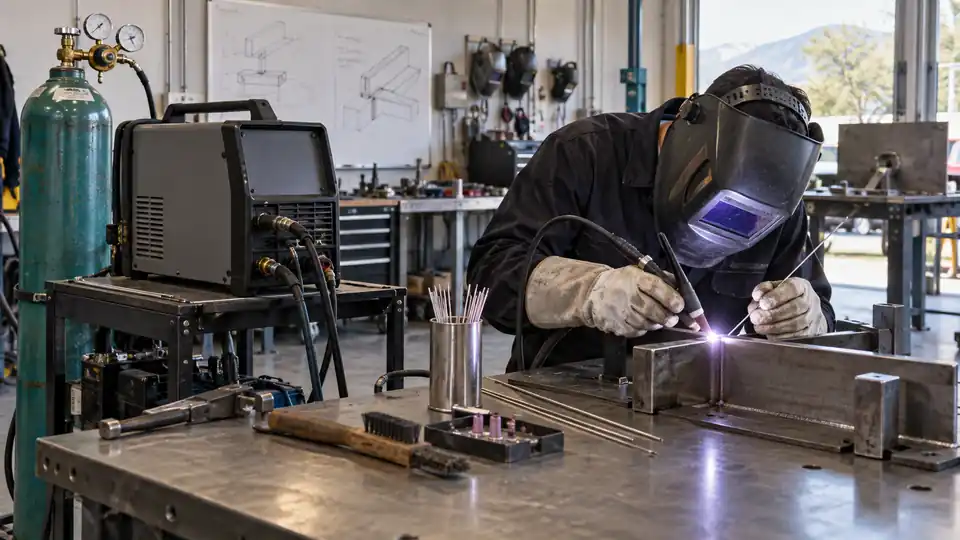
An AC/DC TIG welder earns its place when a single machine needs to handle aluminum and steel without forcing the buyer into separate power sources. AC TIG provides the arc behavior needed for aluminum, while DC TIG suits stainless steel, carbon steel, copper, and other conductive metals. The strongest choices also add high-frequency starting, pulse control, adjustable AC balance, dual-voltage input, and a foot-pedal connection. Those details matter more than a large amperage number printed on the front panel.
Buyers can easily overvalue maximum output and overlook control range, included accessories, or the difference between a foot-pedal interface and an included pedal. A 225-amp machine may be a poor fit for a garage with only 120V power, while a 200-amp model with adjustable AC settings may be more useful for thin aluminum and stainless work. The Weldpro 200A AC/DC TIG Welder stands out as the strongest overall balance here because its listing combines dual-voltage operation, high-frequency AC and DC TIG, pulse adjustment, a documented full-output duty-cycle figure, and an included foot pedal.
These nine machines serve different priorities. Some favor portable dual-voltage operation, some provide a more complete control set, and others are better suited to buyers who want a recognized brand or a supplied TIG torch and pedal. The comparison below weighs those distinctions rather than treating every AC/DC label as proof of equal capability.
Quick Answer
- Best Overall: Weldpro 200A AC/DC TIG Welder, for its combination of dual-voltage input, adjustable pulse controls, included pedal, and accessory package.
- Best Premium Option: PRIMEWELD TIG225X, with 225 amps, AC/DC pulse capability, a CK Worldwide torch, and 110V/220V operation.
- Best Portable Choice: YESWELDER TIG-200P ACDC, with a documented weight of about 16.5 pounds and automatic dual-voltage sensing.
- Best for Detailed Parameter Control: Bestarc 215A AC/DC TIG Welder, which stores up to nine parameter sets and includes a foot switch.
Best AC/DC TIG Welder Comparison Table
| Product | Best For | Input and Output | Standout Feature |
|---|---|---|---|
| Weldpro 200A AC/DC TIG Welder | Best overall balance | 110V/220V, up to 200A | Included foot pedal and adjustable pulse |
| PRIMEWELD TIG225X | Premium TIG setup | 110V/220V, up to 225A | CK Worldwide torch and 200 Hz controls |
| YESWELDER TIG-200P ACDC | Portable operation | 110V/220V, up to 200A | About 16.5 lb and auto-sensing input |
| Bestarc 215A AC/DC TIG Welder | Saved settings and remote control | 110V/220V, up to 215A | Foot switch included and nine memory sets |
| Sunstac 250A AC/DC TIG Welder | High advertised output | 110V/220V, up to 250A | AC/DC pulse, spot modes, and LCD |
| TOOLIOM TL-200TP ACDC PRO | Budget dual-voltage versatility | 110V/220V, up to 200A | Six welding modes and square-wave AC |
| AZZUNO 200A AC/DC TIG Welder | Fine parameter adjustment | Dual-voltage, up to 200A | Broad pulse, slope, and AC controls |
| VEVOR 225A 6-in-1 TIG Welder | Multi-process workshop use | 110V/220V, up to 225A | AC/DC pulse, Stick, spot, and HF start |
| Lincoln Electric Square Wave 205 | Brand-focused buyers | Output details require confirmation | Square Wave TIG platform |
The detailed reviews explain where each machine fits, what its specifications mean, and which compromises deserve attention before ordering.
1. Weldpro 200A AC/DC TIG Welder : Best Overall
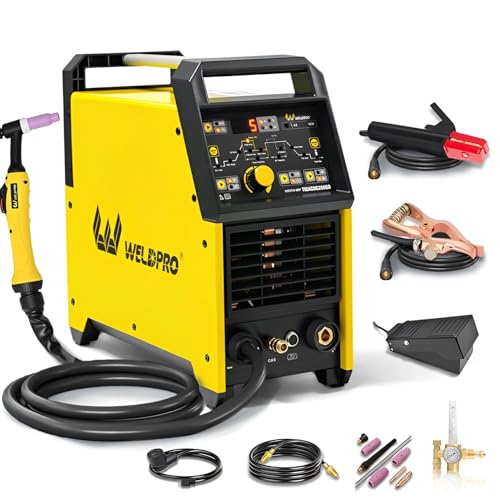
The Weldpro 200A earns the top position by covering the features that most directly affect AC/DC TIG work without relying on a single headline specification. It supports high-frequency AC TIG, DC TIG, AC pulse, DC pulse, and Stick welding, so the same machine can move from aluminum to stainless steel or carbon steel. Its dual-voltage input automatically detects 110V or 220V power, which is useful for a garage setup that may later move to a dedicated circuit.
Pulse frequency is adjustable from 0.5 to 200 Hz, while the listing also identifies peak current, upslope, downslope, and 2T/4T controls. That combination gives the operator more ways to manage heat on thin sections than a basic AC/DC unit. A 40% duty cycle at the full 200A output is published, although duty-cycle figures should be read alongside the stated amperage and actual input conditions. The included TIG torch, rocker-style foot pedal, regulator, hose, tungsten, and consumables make the package easier to start with than machines that merely provide pedal compatibility.
Pros
- Supports high-frequency AC TIG, DC TIG, AC pulse, DC pulse, and Stick.
- Automatic 110V/220V input detection expands placement flexibility.
- Includes a rocker-style foot pedal rather than requiring a separate purchase.
- Adjustable pulse frequency, upslope, downslope, and 2T/4T trigger modes.
- Accessory kit includes a TIG torch, regulator, gas hose, tungsten, and consumables.
Cons
- The published 40% duty cycle applies at full 200A output, not every operating setting.
- Its broad control set may require more setup time than a simpler DC-only machine.
This model makes the most sense for someone who wants one AC/DC TIG machine for aluminum and steel, while retaining Stick capability for less delicate work. It also suits buyers who prefer a ready-to-configure package instead of assembling a torch, regulator, pedal, and small accessories separately. Buyers focused on a very established premium brand may prefer the Lincoln, while those who need the highest listed output may look toward the 225A and 250A models.
To buy this product, click here.
2. PRIMEWELD TIG225X : Best Premium Option

The PRIMEWELD TIG225X is aimed at buyers who place more weight on its supplied torch and higher listed output than on a large number of extra welding modes. It provides AC/DC TIG, pulse, and Stick welding with 110V/220V operation. The listing identifies a 225-amp maximum, 200 Hz pulse frequency, and 200 Hz AC frequency, giving the operator useful adjustment range for aluminum and thinner metals.
A CK Worldwide 17 Series Superflex torch and matching Superflex hose are included, along with a CK DINSE connector. That is a meaningful distinction because torch quality and cable flexibility affect setup and handling, although published component inclusion still deserves confirmation against the exact package before purchase. The machine also supports both hand torch control and foot-pedal control. Its documented aluminum and mild-steel thickness claims are application-dependent, so material grade, joint design, power input, and settings remain part of the result.
Pros
- 225A listed output gives it more headroom than the 200A models.
- Supports AC/DC TIG, pulse, and Stick welding.
- Operates on both 110V and 220V input.
- Includes a CK Worldwide 17 Series Superflex TIG torch and hose.
- Provides up to 200 Hz pulse and AC frequency adjustment according to the listing.
Cons
- The higher output does not automatically make it better for low-amperage thin work.
- Buyers should verify the current accessory bundle and pedal configuration before ordering.
The TIG225X suits a buyer who wants a more established accessory setup and a higher output ceiling than the Weldpro or YESWELDER. It is less compelling for someone who values a large display, automated memory functions, or the broadest menu of spot and pulse modes. For a dedicated TIG station where the supplied CK torch matters, its premium position is easier to justify.
To buy this product, click here.
3. YESWELDER TIG-200P ACDC : Best Portable Choice

Portability is the clearest reason to choose the YESWELDER TIG-200P. The published weight is about 16.47 pounds, and automatic dual-voltage sensing allows the machine to move between standard household power and a 220V workshop circuit without manual voltage selection. That combination reduces the friction of taking the unit from storage to a work area, particularly when the job does not justify a larger shop-oriented power source.
Its process list is unusually broad for a compact unit. AC TIG, DC TIG, AC pulse, DC pulse, Stick, MIX TIG, and spot welding are identified, while square, triangle, and sine wave AC options provide more waveform choice than a basic AC/DC inverter. A high-frequency start supports non-contact ignition, and the auto-memory function restores settings after power-off. The five-pin foot-pedal interface is present, but the listing describes the pedal as connectable rather than clearly included.
Pros
- Documented weight of about 16.47 pounds supports easier transport.
- Automatic 110V/220V input sensing simplifies setup across power sources.
- Offers AC/DC TIG, pulse, Stick, MIX TIG, and spot modes.
- Provides high-frequency starting and several AC waveform choices.
- Auto-memory restores saved settings after power-off.
Cons
- The five-pin foot pedal is supported, but the listing does not clearly identify it as included.
- The large process menu may be more than needed for a basic steel-only setup.
This machine fits mobile work, small workshops, and buyers who need AC/DC capability without carrying a heavy chassis. Its weight advantage is more meaningful than a small difference in peak amperage when the unit must be moved regularly. Buyers who want a supplied pedal should look closely at the current bundle, while those who want the strongest included-accessory package may prefer the Weldpro.
To buy this product, click here.
4. Bestarc 215A AC/DC TIG Welder : Best for Saved Settings

The Bestarc 215A places its emphasis on control retention and repeatable setup. The machine supports AC TIG, DC TIG, AC pulse, DC pulse, square-wave AC pulse, and Stick, with dual-voltage 110V/220V input. It also supports a five-pin foot pedal and includes a foot switch according to the listing, a practical distinction from models that merely provide a connection for an optional remote.
Its adjustable post-gas range, downslope control, and 2T/4T operation address the finishing stages of a TIG weld. Post-gas continues shielding after the arc stops, while downslope reduces current gradually at the end of a weld. Those controls can matter on aluminum and stainless work where crater control and tungsten protection are part of a clean finish. The memory function stores up to nine parameter sets, which gives the operator a faster path back to recurring material and joint settings.
Pros
- Supports AC/DC TIG, pulse, square-wave AC pulse, and Stick.
- Includes a foot switch according to the product listing.
- Stores up to nine welding parameter sets.
- Adjustable post-gas, downslope, and 2T/4T functions.
- Dual-voltage input supports both common household and 220V circuits.
Cons
- The feature-rich control system may take longer to configure than a simpler inverter.
- The listing does not provide a full duty-cycle comparison at each input voltage.
Bestarc is a sensible choice for repeated work where saving several configurations can reduce setup repetition. It ranks below the Weldpro because the latter presents a more clearly documented accessory and duty-cycle package, but the Bestarc has a stronger case for users who frequently switch between materials or processes. Confirm the exact foot-switch bundle if remote amperage control is central to the purchase.
To buy this product, click here.
5. Sunstac 250A AC/DC TIG Welder : Best for Advertised Output

The Sunstac lists the highest maximum output among the selected machines, reaching 250A with 110V/220V operation. It supports high-frequency AC and DC TIG, pulsed AC and DC, AC and DC spot modes, and Stick. For buyers who want a wide process menu and a high advertised ceiling, that is a substantial specification. The listing also identifies aluminum thickness figures that vary by input voltage, with greater capacity claimed on 220V.
An LCD screen displays current and voltage settings, and the machine includes parameter memory. The product information describes foot-pedal operation, but clearly states that the pedal is not included. One qualification deserves attention: the listing warns that current measurement in AC mode may be inaccurate and that inconsistent AC balance can affect measured current. That disclosure makes this a less straightforward recommendation than its 250A label might suggest.
Pros
- Lists up to 250A output with 110V/220V input.
- Supports high-frequency AC/DC TIG, pulsed TIG, spot TIG, and Stick.
- LCD display presents operating parameters clearly.
- Includes parameter memory for restoring previous settings.
- Offers 2T, 4T, and spot TIG operating modes.
Cons
- The foot pedal is supported but not included.
- The listing discloses possible AC current measurement and AC-balance inconsistency.
Sunstac fits buyers who place a high value on output range and a broad mode selection, especially where 220V power is available. It is not the safest pick for someone who wants the clearest published operating behavior or a complete pedal package. The disclosed AC measurement limitation should be read before purchase, since AC control is central to the reason for choosing an AC/DC TIG machine.
To buy this product, click here.
6. TOOLIOM TL-200TP ACDC PRO : Best Budget Dual-Voltage Option

TOOLIOM keeps the core AC/DC TIG package fairly focused while still including six operating modes: AC TIG, DC TIG, AC pulse, DC pulse, Stick, and TIG spot. Dual-voltage input gives it more placement flexibility than a 220V-only machine, and the large digital screen puts mode, voltage, and current information in one visible area. That arrangement may appeal to a buyer who wants a straightforward display without moving into a premium-priced platform.
The listing identifies square-wave AC control and gives aluminum thickness claims of up to 1/8 inch at 110V and 3/16 inch at 220V. These are published application figures rather than universal guarantees, since actual results depend on alloy, joint preparation, tungsten, shielding gas, and settings. A foot pedal is supported but not included, so the initial package is less complete than the Weldpro. Its main appeal is the combination of dual-voltage power and the essential AC/DC pulse functions.
Pros
- Six modes cover AC/DC TIG, pulse, Stick, and spot TIG.
- Supports both 110V and 220V input.
- Square-wave AC is identified for aluminum TIG work.
- Large digital display shows mode, voltage, and current.
- Suitable for buyers seeking a lower-cost dual-voltage configuration.
Cons
- The foot pedal is compatible but sold separately according to the listing.
- Published output and thickness claims require the appropriate input power and settings.
TOOLIOM is a reasonable entry point for someone who needs AC/DC TIG and pulse without paying for a larger accessory kit or more elaborate memory system. It makes less sense for users who want pedal control immediately or expect the highest output in this group. A separate pedal should be included in the ownership calculation, especially if aluminum work involves frequent current changes.
To buy this product, click here.
7. AZZUNO 200A AC/DC TIG Welder : Best for Parameter Adjustment

AZZUNO targets users who want access to a long list of TIG settings rather than a minimal control panel. The machine provides AC TIG, AC pulse, DC TIG, DC pulse, spot TIG, and Stick modes. Its documented controls include pre-flow, initial current, upslope, peak current, base current, downslope, crater current, post-flow, pulse duty, AC frequency, AC balance, and pulse frequency. That range can be useful when the same power source must handle thin stainless, aluminum, and thicker steel with different heat-control requirements.
The machine is listed at about 17 pounds and includes a WP-26 TIG torch, electrode holder, ground clamp, regulator, hose, tungsten, collets, and nozzles. The included 110V/220V adapter cord supports more flexible installation, while the automatic save function restores prior parameters. A foot pedal is supported separately, with the listing recommending an AZZUNO pedal for compatibility. That distinction keeps the supplied package useful but means remote amperage control adds another purchase.
Pros
- Provides six AC/DC TIG, pulse, spot, and Stick modes.
- Offers detailed controls for slope, pulse, AC frequency, and AC balance.
- Includes TIG torch, regulator, hose, tungsten, collets, and nozzles.
- Automatic save function restores previous welding parameters.
- About 17 pounds, with a 110V/220V adapter cord identified in the package.
Cons
- The foot pedal is sold separately.
- The broad parameter menu may be excessive for occasional basic repairs.
This machine suits an operator who wants to tune the arc rather than rely on a small set of preset choices. It ranks below TOOLIOM because the pedal is still optional, but its control depth and included torch accessories make it more attractive for detailed TIG setup. Buyers who prefer a supplied remote should move toward Weldpro or Bestarc.
To buy this product, click here.
8. VEVOR 225A 6-in-1 TIG Welder : Best Multi-Process Alternative

The VEVOR 225A combines AC TIG, DC TIG, AC pulse, DC pulse, spot TIG, and Stick in one dual-voltage unit. High-frequency start is identified, which is preferable to Lift TIG for non-contact ignition and helps avoid touching the tungsten to the work at arc initiation. The machine also lists support for common Stick electrodes and published material claims covering aluminum, carbon steel, copper, stainless steel, and titanium.
Its large LED display should make mode and parameter monitoring easier than a small single-line readout. The product information also lists VRD, overcurrent, overvoltage, overload, and overheat protection. Those features describe built-in circuits, not a replacement for correct electrical setup, PPE, ventilation, and manufacturer instructions. The listing mentions compatibility with spool guns for aluminum, but this is an AC/DC TIG machine and the spool gun is not identified as included, so that statement should not be treated as a supplied aluminum MIG setup.
Pros
- Supports AC/DC TIG, pulse, spot TIG, and Stick welding.
- Offers dual-voltage 110V/220V operation and high-frequency starting.
- Large LED display provides a clear view of operating information.
- Lists VRD and multiple electrical protection functions.
- Published material coverage includes aluminum, stainless steel, carbon steel, copper, and titanium.
Cons
- The listing does not clearly establish a foot pedal as included.
- Spool-gun compatibility should not be confused with an included spool gun or MIG capability.
VEVOR is a fit for a workshop that values multiple TIG and Stick modes in one chassis. It offers more process flexibility than a dedicated TIG-only design, although the accessory and control details should be checked carefully before ordering. Someone focused on aluminum TIG and pedal operation may find Weldpro or Bestarc easier to configure.
To buy this product, click here.
9. Lincoln Electric Square Wave 205 : Best Brand-Focused Option

The Lincoln Electric Square Wave 205 is the most brand-focused choice in this roundup. The available product information identifies it as a Square Wave TIG power source with model number K5613-1, but the supplied listing provides far fewer technical details than the other machines here. That makes it difficult to compare its input voltage, pulse functions, duty cycle, included torch, or pedal configuration without checking current Lincoln documentation.
Its position reflects the importance some buyers place on a recognizable welding-equipment platform rather than a long Amazon feature list. Still, brand familiarity should not replace version matching. Before ordering, confirm whether the exact configuration provides AC/DC TIG, the required input voltage, high-frequency start, pulse control, foot-pedal support, and the accessories needed for operation. This is the least fully documented option in the comparison, so verification matters more here than with the other selections.
Pros
- Identified as part of Lincoln Electric’s Square Wave TIG family.
- Model number K5613-1 is provided for configuration checking.
- Brand-focused buyers may prefer its established equipment platform.
- Designed as a TIG welding power source rather than a generic multiprocess listing.
- Provides a clear starting point for checking official documentation.
Cons
- The available listing does not provide enough detail for a full feature comparison.
- Input voltage, accessories, duty cycle, and control functions should be confirmed before purchase.
Lincoln makes the most sense for a buyer who values the brand and is willing to verify the exact configuration through current manufacturer documentation. It is a weaker recommendation for anyone who wants a ready comparison of pedal inclusion, pulse range, or dual-voltage behavior. The Weldpro and PRIMEWELD offer much clearer published details for a buyer making a specification-led decision.
To buy this product, click here.
Buying Guide
AC TIG Matters for Aluminum
AC TIG alternates current to support aluminum welding, while DC TIG is generally used for steel, stainless steel, copper, and similar materials. An AC/DC label is therefore only the starting point. Look for documented AC balance or waveform controls if aluminum is a regular part of the workload, since those settings affect the relationship between cleaning action and heat input.
Match Input Voltage to the Available Circuit
Dual-voltage machines can operate across more than one electrical setup, but the output and duty-cycle behavior may change with input voltage. A 110V/220V unit gives a garage or mobile setup more flexibility than a 220V-only machine. Confirm the plug, adapter, circuit requirements, and current draw before assuming a household receptacle will deliver the advertised maximum.
High-Frequency Start Is Different From Lift TIG
High-frequency starting creates the arc without requiring the tungsten to touch the workpiece. Lift TIG begins through contact and lift-off, which is a different operating method. The products in this roundup are selected for AC/DC TIG, and several identify high-frequency starting, but buyers should still confirm the exact start method in the current manual.
Pulse Helps Manage Heat, but It Is Not a Substitute for Setup
Pulse TIG cycles between higher and lower current. That can help reduce average heat input and support control on thin material, but pulse cannot correct poor fit-up, inadequate shielding gas, incorrect tungsten preparation, or unsuitable amperage. Adjustable frequency, duty, peak current, upslope, and downslope provide more control than a simple pulse on/off switch.
Check Whether the Foot Pedal Is Included
A machine may support a foot pedal while leaving the pedal out of the box. Weldpro and Bestarc identify included remote controls, while TOOLIOM, AZZUNO, YESWELDER, and Sunstac describe pedal compatibility or operation with different levels of inclusion detail. If amperage adjustment during a weld is important, verify the connector type and package contents before purchase.
Read Duty Cycle With Its Amperage
Duty cycle describes how long a machine can operate within a specified test period at a specified output and condition. A 40% figure at 200A cannot be compared directly with a percentage measured at a lower amperage. Shorter welds, lower current, and pauses may place different demands on the machine than continuous high-output work.
Separate Published Thickness Claims From Guaranteed Results
Thickness figures vary with alloy, joint design, preparation, electrode, shielding gas, polarity, and operator settings. A claim for 1/4-inch aluminum should be read as a published application reference, not a universal result for every joint. Power input also matters, which is why several listings give different aluminum figures for 110V and 220V operation.
Best AC/DC TIG Welder FAQ
What is the advantage of an AC/DC TIG welder?
AC/DC capability allows one machine to handle aluminum through AC TIG and materials such as stainless or carbon steel through DC TIG. Buyers who work with only steel may not need AC, but anyone planning regular aluminum work should verify genuine AC TIG capability rather than assuming a generic TIG label covers it.
Is a 200A AC/DC TIG welder enough for most projects?
A 200A machine can cover many repair, fabrication, and thin-to-moderate material applications, but usable output depends on input voltage, duty cycle, material, joint design, and settings. Higher maximum amperage is useful only when the electrical supply and the rest of the machine support that output.
Do I need a foot pedal for AC TIG?
A foot pedal is not mandatory for every TIG task, but it gives real-time control over welding current while the torch and filler rod remain positioned. It is especially useful for heat-sensitive aluminum, variable joint fit-up, and welds that need current reduction near the crater. Check whether the pedal is included or optional.
Can these welders handle aluminum automatically?
No. AC TIG capability makes aluminum welding possible, but the operator still needs appropriate tungsten, shielding gas, filler, cleaning, preparation, and settings. AC balance, frequency, pulse, and current control can help manage the process, while material thickness and alloy affect the required setup.
Is dual-voltage operation better than 220V-only operation?
Dual-voltage operation provides more placement flexibility, especially for buyers moving between a household circuit and a workshop circuit. A 220V-only model may still suit a fixed shop with the correct circuit. Compare the output and duty-cycle information at each voltage rather than treating dual-voltage as an automatic performance advantage.
What is square-wave AC TIG?
Square-wave AC changes between current portions with a sharper transition than some other waveform styles. Product listings commonly associate it with arc stability and aluminum control. The practical value depends on the machine’s broader AC controls, the material, and the operator’s settings, so waveform terminology should be read alongside the manual.
Should I choose a multiprocess AC/DC TIG machine?
A multiprocess machine can make sense if Stick welding is also part of the plan. It may reduce the need for a second power source, but extra modes can add controls and setup decisions. If TIG is the only process required, a simpler dedicated platform may be easier to evaluate and configure.
Final Verdict
The Weldpro 200A AC/DC TIG Welder is the strongest overall choice because it combines the features that matter most across the widest range of applications. Its 110V/220V input, high-frequency AC and DC TIG, adjustable pulse range, Stick mode, included foot pedal, and supplied gas and torch accessories create a balanced package. The published 40% duty cycle at full 200A should still be read in context, but the documentation is more decision-ready than many competing listings.
PRIMEWELD’s TIG225X is the better alternative for buyers who place extra value on its 225A output and CK Worldwide torch. YESWELDER is more attractive for transport, while Bestarc provides useful saved-setting and foot-switch features. Match the final selection to the available circuit, the materials being welded, the need for remote amperage control, and the accessories already on hand. Check the current manual and product configuration before ordering, particularly for the Lincoln, Sunstac, and any machine where pedal inclusion is unclear.
