
A portable plasma cutter earns its place when metal needs to be cut away from a fixed shop setup. A compact machine can travel from a garage bench to a trailer, gate, or outdoor repair area, but portability involves more than a small case. Weight, input voltage, air requirements, torch lead length, and usable cutting capacity all affect whether the cutter is genuinely convenient once it leaves the shelf.
Peak amperage is an easy number to chase, yet it does not tell the whole story. A cutter rated for thicker material may require 240V power and a substantial air supply, while a lighter 120V model may be more practical for sheet metal and occasional repairs. A non-touch pilot arc can also matter on painted, rusty, or coated steel because the torch does not need to start by contacting the workpiece. The Reboot RBC6000D stands out overall here because its documented 8.69-pound weight, dual-voltage input, and stated 1/2-inch clean-cut rating create a particularly useful balance for mobile work.
The products below range from light-duty 120V machines to higher-output dual-voltage cutters and one self-contained design with an integrated air compressor. Their published thickness claims are not directly interchangeable, so the rankings weigh clean-cut information, power flexibility, air setup, portability, controls, and the practical limits behind each specification.
Quick Answer
- Best Overall: Reboot RBC6000D 60A Plasma Cutter, for its very low weight, dual-voltage operation, and documented 1/2-inch clean cut at 120V.
- Best Feature Balance: GNI 55A Portable Plasma Cutter, with non-touch pilot arc, automatic voltage recognition, and a 9.51-pound chassis.
- Best for Cutting and Welding: GNI 60A Plasma Cutter and Stick Welder, for buyers who want two metalworking functions in one portable unit.
- Best for Light Sheet Metal: Forney Easy Weld Easy Cut 255, a simple 120V option with a stated 3/16-inch steel cutting capacity.
Best Portable Plasma Cutter Comparison Table
| Product | Best For | Input and Output | Portability or Setup Advantage |
|---|---|---|---|
| Reboot RBC6000D | Best Overall | 120V/240V, 60A | 8.69 lb, auto voltage detection |
| GNI 55A Portable | Lightweight pilot-arc cutting | 120V/240V, 15–55A | 9.51 lb, air filter and regulator |
| ARCCAPTAIN 50A | Portable dual-voltage cutting | 110V/220V, 20–50A | 13 lb, shoulder strap |
| Bestarc 50A | Budget pilot arc controls | 110V/220V, 50A | 15 lb, air-pressure display |
| GNI 60A Plasma Cutter and Stick Welder | Cutting and Stick welding | 120V/240V, 15–60A cutting | 11 lb, dual-function design |
| FEIFANKE 60A | Drag cutting and general repairs | 110V/220V, 20–60A | Automatic voltage adaptation |
| ARCCAPTAIN 55A | Higher-output portable work | 120V/240V, 20–55A | 60% duty cycle listed |
| ARCCAPTAIN CUT55 Pro | Digital controls and monitoring | 120V/240V, 55A | App control and automatic post-flow |
| Reboot Plasma Cutter with Built-In Compressor | Self-contained portability | Specification varies by listing | Integrated air pump |
The detailed reviews explain how each machine’s portability, cutting claims, air setup, and control system affect real purchase decisions.
1. Reboot RBC6000D 60A Plasma Cutter — Best Overall

The strongest portability argument in this roundup is simple: the Reboot RBC6000D is listed at 8.69 pounds while still supporting 120V and 240V input. That combination matters in a garage where the cutter may be carried from a shelf to a driveway, or on a repair job where every extra pound becomes another awkward load. Its automatic voltage detection also reduces the chance of selecting the wrong input mode, although the required circuit and breaker information still needs attention before use.
Its documented cutting figures are practical rather than merely flashy. The listing identifies a 1/2-inch steel clean cut at 120V and 5/8-inch at 240V, with output ranges of 10–35A and 30–60A respectively. PSI guidance is provided, and the unit uses PT31 consumables. The product information also lists support for steel, stainless steel, aluminum, copper, and other metals, but actual results depend on material, air quality, settings, preparation, and technique.
Pros
- Very low listed weight makes transport and storage easier
- Supports both 120V and 240V input with automatic voltage detection
- Published clean-cut ratings include 1/2-inch steel at 120V and 5/8-inch at 240V
- Clear PSI guidance simplifies air setup
- Uses PT31 consumables, which gives buyers a specific replacement reference
Cons
- Requires an external air compressor
- The listing identifies substantial breaker requirements that may limit some household circuits
This is the best fit for someone who values carrying convenience without dropping to a light sheet-metal-only cutter. It gives up some feature detail compared with the larger ARCCAPTAIN CUT55 Pro, but the weight difference is meaningful for mobile work. Buyers should skip it if they need a self-contained air supply or if their projects regularly exceed the published clean-cut range.
To buy this product, click here.
2. GNI 55A Portable Plasma Cutter — Best Lightweight Feature Balance

At 9.51 pounds, the GNI 55A sits close to the Reboot RBC6000D in portability while offering a more detailed control package. Automatic 120V/240V voltage recognition, a non-touch pilot arc, and an adjustable 15–55A range make it a sensible choice for work that moves between thin sheet and heavier plate. A pilot arc can start without the torch touching the metal, which is useful on coated, dirty, or uneven surfaces where repeated contact would be inconvenient.
The listing states a 10mm clean cut at 120V and 12mm at 240V, with higher maximum thickness figures also published. Those figures should be treated as application guidance rather than a promise for every material. The built-in air filter and pressure regulator reduce the number of loose setup pieces, while the machine still requires an external compressor rated for the listed air requirement. Its 2T and 4T modes are useful distinctions, with 4T reducing the need to hold the trigger during longer cuts.
Pros
- 9.51-pound weight supports frequent movement between work areas
- Automatic 120V/240V voltage recognition simplifies power changes
- Non-touch pilot arc suits rusty, painted, and uneven surfaces
- Built-in air filter and pressure regulator streamline compressor connection
- 2T and 4T modes accommodate short cuts and longer continuous work
Cons
- External compressed air is still required
- Published clean-cut capacity is more limited than the higher severance figures suggest
The GNI 55A makes more sense than a heavier 55A cutter for buyers who will carry the machine often and want pilot-arc capability. It is also a reasonable alternative to the Reboot when adjustable pilot-arc and post-flow functions matter. A buyer with no compressor should look toward the integrated-compressor option instead, while anyone cutting thick material repeatedly should verify circuit and air capacity first.
To buy this product, click here.
3. ARCCAPTAIN 50A Plasma Cutter — Best Portable Dual-Voltage Option
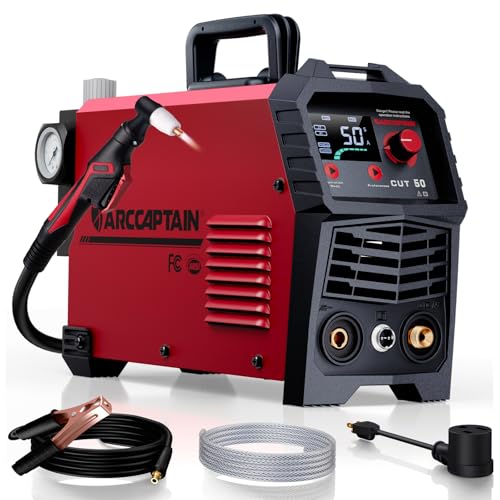
The ARCCAPTAIN 50A offers a useful middle ground for buyers who want dual-voltage flexibility without moving to a large shop-oriented machine. Its listed 13-pound weight and shoulder strap are practical for garage storage, mobile repair, or a work area where the cutter cannot stay permanently connected. The input range is identified as 110V/220V, with the listing showing 20–35A at 110V and 20–50A at 220V.
Its documented cutting information separates the two power levels clearly. The listing recommends up to 12mm at 35A on 110V and 18mm at 50A on 220V, with a stated 1/2-inch clean-cut figure. The front LED display shows operating information and error codes, while adjustable post-flow and 2T/4T operation give the operator more control than a basic single-setting cutter. An external compressor remains necessary, and the quick-connect air filter does not remove the need for clean, properly regulated air.
Pros
- 13-pound chassis and shoulder strap support mobile use
- 110V/220V operation suits different workshop power setups
- LED display provides current, voltage, and error information
- Adjustable post-flow can help manage torch cooling
- 2T and 4T cutting modes provide short-cut and continuous-cut options
Cons
- Requires a separate air compressor
- 110V output range is narrower than the 220V range
This model suits buyers who want a recognizable dual-voltage layout and moderate carrying weight without paying for app-based controls. It gives up some output and pilot-arc emphasis compared with the 55A machines, but its controls and display remain useful for general cutting. Select another model if cutting coated or rusty surfaces without contact is a central requirement and pilot arc is not clearly documented for the chosen configuration.
To buy this product, click here.
4. Bestarc 50A Plasma Cutter — Best Budget Pilot-Arc Controls
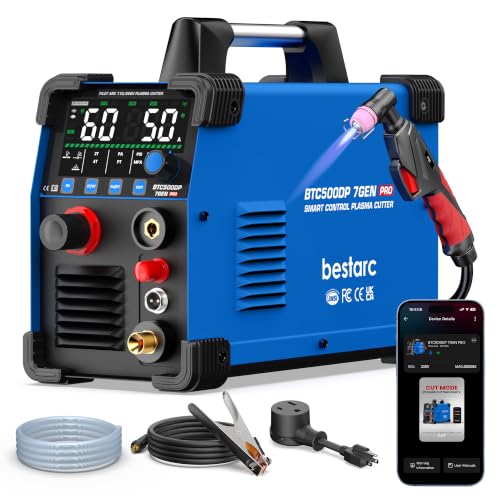
The Bestarc 50A is positioned for buyers who want useful controls and dual-voltage operation without moving into the heavier models. The listing puts its weight at 15 pounds and identifies 110V/220V input, non-touch pilot arc, an air-pressure display, and a front LED screen. That collection is helpful for someone moving between a home outlet and a workshop circuit, especially when the work includes expanded metal or surfaces that are not perfectly clean.
A notable detail is the adjustable pilot-arc duration, listed up to 15 seconds. Longer pilot-arc timing can assist with mesh or expanded metal, while shorter timing can reduce unnecessary consumable wear. The product information also states a recommended 50–80 PSI range and identifies a built-in metal air filter with a 1/4-inch NPT quick connection. Those features simplify connection, but the compressor is sold separately and air quality still affects consumable life and cut consistency.
Pros
- Dual-voltage 110V/220V input expands placement flexibility
- Non-touch pilot arc supports work on coated or contaminated surfaces
- Adjustable pilot-arc duration can suit mesh and expanded metal
- Front display shows air pressure, voltage, and current
- Built-in filter and quick-connect fitting reduce setup clutter
Cons
- 15-pound weight is higher than the lightest cutters here
- External compressor and manual air setup are required
The Bestarc earns this position for buyers who care about monitoring and pilot-arc adjustment more than absolute minimum weight. Compared with the ARCCAPTAIN 50A, it offers a more explicit pilot-arc control story, while the Reboot RBC6000D remains easier to carry. It is a reasonable fit for intermittent repair and fabrication work, but the listing’s maximum thickness figure should not be confused with a guaranteed clean cut through every 3/4-inch workpiece.
To buy this product, click here.
5. GNI 60A Plasma Cutter and Stick Welder — Best Two-Function Portable Unit

Some portable setups need to remove metal one day and join it the next. The GNI 60A addresses that need by combining a plasma cutter with a Stick welding function in an 11-pound chassis. Its cutting range is listed as 15–60A, while Stick output is listed as 15–140A for 1/16- to 1/8-inch electrodes. That combination can save bench space and reduce the number of machines carried to a repair location.
For cutting, the listing identifies a 10mm clean cut at 120V/35A and a 12mm clean cut at 240V/60A, with higher maximum thickness figures also stated. Non-touch pilot arc, 2T/4T modes, adjustable pilot-arc timing, and adjustable post-flow add useful control. The machine needs an external compressor, and its Stick capability should be viewed as a separate function rather than evidence that the plasma section cuts thicker material than its published clean-cut rating.
Pros
- Combines plasma cutting and Stick welding in one 11-pound unit
- Automatic 120V/240V input recognition supports varied work locations
- Non-touch pilot arc can start on uneven or coated metal
- Plasma output reaches 60A on the listed range
- LED display includes air-pressure and operating information
Cons
- Requires an external compressor for plasma cutting
- Two functions may be unnecessary for buyers who only need cutting
This is a strong choice for a mobile repair kit where Stick welding has genuine value alongside cutting. It is less compelling for someone who wants the lightest dedicated cutter, since the Reboot RBC6000D is lighter and avoids paying for a second process. Buyers should also confirm which leads and accessories are included in the current configuration before assuming the welding side is ready for use.
To buy this product, click here.
6. FEIFANKE 60A Plasma Cutter — Best for Drag Cutting

The FEIFANKE 60A takes a different approach to ease of use by emphasizing drag cutting. The product information says the nozzle can rest against the metal while the operator guides the torch, which may appeal to someone cutting thin material without wanting to maintain a precise stand-off distance. Its automatic 110V/220V adaptation and listed 20–40A output on 110V or 20–60A on 220V also make it flexible for home and workshop locations.
The published clean-cut figures are 9mm at 110V and 12mm at 220V, with maximum capacity listed higher than those numbers. A digital display reports voltage, current, and air pressure, and the included package is identified as containing a cutting torch, ground clamp, air regulator filter, and gas tube. The wording does not remove the need to confirm the compressor arrangement and electrical requirements, but the included air connection parts make the initial setup more straightforward.
Pros
- Drag-cutting design can simplify torch guidance on suitable material
- Automatic 110V/220V voltage adaptation supports changing work locations
- Digital display provides current, voltage, and air-pressure information
- 2T and 4T modes cover short and longer cuts
- Listing identifies a torch, ground clamp, air regulator filter, and gas tube in the package
Cons
- Published clean-cut capacity is lower on 110V than on 220V
- Drag cutting may be less suitable for applications that require a controlled stand-off
The FEIFANKE is a practical fit for light fabrication, brackets, body panels, and general maintenance where simple torch movement matters more than maximum thickness. It differs from the GNI machines by highlighting drag cutting rather than adjustable pilot-arc timing. Check the current manual for compressor requirements and consumable details before ordering, particularly if the cutter will be used away from a well-equipped shop.
To buy this product, click here.
7. ARCCAPTAIN 55A Plasma Cutter — Best for Higher-Output Portable Work

The ARCCAPTAIN 55A is aimed at buyers who want more cutting headroom than the lightest portable units provide. It is listed at 19.8 pounds, so it is still movable with its shoulder strap, but it is noticeably less convenient for repeated one-handed carrying than the 8.69-pound Reboot or 9.51-pound GNI. Its justification is output and control: the listing specifies 120V/240V operation, a 60% duty cycle, and up to 55A on the higher-voltage setting.
At 240V, the product information lists a 1/2-inch ideal clean cut and up to 3/4-inch maximum cutting thickness. Those are different measurements, and the maximum figure should not be read as the same thing as a clean production cut. A non-touch pilot arc, internal air-pressure sensor, AG60 torch, preset 60 PSI air pressure, and default five-second post-flow make the setup less involved, although the external compressor must provide the listed pressure and flow.
Pros
- 55A output and 240V input provide more capacity than lighter units
- 60% duty cycle is listed for the machine
- Non-touch pilot arc supports dirty, rusty, and coated surfaces
- Preset air and post-flow parameters simplify initial adjustment
- AG60 torch and rear-mounted filter are identified in the product information
Cons
- 19.8-pound weight reduces carrying convenience
- Requires an external compressor capable of the stated 60 PSI and 5.3 CFM guidance
This machine makes sense for mobile work that regularly approaches the upper end of a portable cutter’s capacity. It trades away the easy carry of the smaller models for a documented duty-cycle figure and higher output. Buyers working mostly from a household 120V outlet may gain more from a lighter lower-output unit, while buyers using 240V power and thicker stock should pay close attention to circuit requirements.
To buy this product, click here.
8. ARCCAPTAIN CUT55 Pro — Best for Digital Monitoring

The CUT55 Pro is the most control-focused option in this selection. Its listing describes app connectivity for adjusting parameters, monitoring status, saving settings, and accessing product information from up to 10 meters away. That may be useful when the cutter is positioned beside a large workpiece or when the operator wants to check status without repeatedly reaching for the front panel.
The machine supports 120V/240V input and lists a 12mm quality cut with a 20mm maximum thickness. Its non-touch pilot arc, pre-installed air regulator and filter, and automatic post-blow timing add practical convenience. The post-flow schedule changes with current, from five seconds at 20–34A to 10 seconds at 46–55A. App controls add complexity as well as convenience, and the current listing does not provide a machine weight in the supplied information, so its portability cannot be compared as confidently with the lighter models.
Pros
- App provides remote parameter adjustment and status monitoring
- 120V/240V operation supports different electrical setups
- Non-touch pilot arc suits contaminated or coated metal
- Automatic post-blow timing changes with the selected current
- Pre-installed air regulator and filter shorten the connection process
Cons
- The supplied product information does not state the machine weight
- App-based control may be unnecessary for simple cutting jobs
The CUT55 Pro is the better fit for a buyer who values digital monitoring and repeatable settings over the lightest possible package. Its published capacity is competitive with the ARCCAPTAIN 55A, but the missing weight information makes the portability claim harder to judge. Confirm the current app requirements, torch configuration, and compressor specifications before choosing it for remote or outdoor work.
To buy this product, click here.
9. Reboot Plasma Cutter with Built-In Compressor — Best Self-Contained Setup

The defining feature here is the integrated air compressor. Most portable plasma cutters in this roundup require a separate compressor, which means carrying another machine, hose, fittings, and a suitable power arrangement. Reboot’s self-contained design is aimed at the person who wants to move one cutting unit around a workshop or job area rather than build a complete air setup every time a cut is needed.
The product information describes an internal air pump, plug-and-play operation, and no external air connections. That should make setup cleaner for occasional cutting, especially in a small garage where compressor storage is a nuisance. The supplied information does not clearly state output amperage, clean-cut thickness, input voltage, weight, or duty cycle, so this product cannot be compared directly with the documented 55A and 60A machines for cutting capacity.
Pros
- Integrated air compressor removes the need for a separate external unit
- No external air hose or compressor connection is required according to the listing
- Self-contained design can save workshop storage space
- Plug-and-play setup suits occasional cutting away from a fixed compressor
- Internal pump is described as providing continuous airflow for cutting
Cons
- The supplied information does not state output, clean-cut thickness, weight, or duty cycle
- An integrated compressor may add weight or noise compared with a bare inverter cutter
This is the right kind of choice for convenience-first portability, especially if the alternative is buying and transporting a separate compressor. It is a weaker match for a buyer who needs a known thickness rating or wants to compare duty cycle and electrical requirements precisely. Before ordering, verify the current listing and manual for the missing specifications, consumable type, and operating limits.
To buy this product, click here.
How to Choose the Best Portable Plasma Cutter
Match Weight to the Way the Cutter Will Move
A cutter that stays beside a welding table has different portability needs from one carried across a property or loaded into a vehicle. The Reboot RBC6000D is listed at 8.69 pounds, while the GNI 55A is 9.51 pounds and the ARCCAPTAIN 55A is 19.8 pounds. Those differences affect carrying effort, storage, and how easily the machine can be positioned near a large workpiece.
Check 120V and 240V Requirements
Dual-voltage input gives a portable cutter more placement flexibility, but it does not make every circuit suitable for every output setting. Several models list different current ranges and cutting capacities at 120V and 240V. Confirm the required breaker, plug, and circuit before assuming a machine can deliver its maximum advertised output from a standard household receptacle.
Separate Clean Cut From Maximum Thickness
A clean-cut rating describes a more useful edge-quality target than a maximum severance figure. The latter may describe the upper limit at which the machine can separate material, often with more slag or slower travel. Compare products using clean-cut figures first, then treat maximum thickness as a secondary limit that depends on metal type, air supply, consumables, settings, and technique.
Understand the Air Requirement
A conventional plasma cutter needs dry, regulated compressed air. Built-in filters and regulators help connect the machine, but they do not replace the compressor. Check pressure and flow requirements together. A compressor that reaches the stated pressure but cannot maintain the required flow may produce inconsistent cutting and faster consumable wear.
Look for Pilot Arc When Surface Preparation Is Difficult
A non-touch pilot arc starts the plasma arc without requiring the torch tip to contact the workpiece. This can be useful on rusted, painted, coated, or expanded metal. It does not eliminate the need for correct air pressure, grounding, torch movement, and consumable maintenance, but it can make interrupted or uneven surfaces easier to approach.
Consider Torch and Consumable Availability
A portable cutter is easier to maintain when the torch and consumable type are clearly identified. The Reboot RBC6000D lists PT31 consumables, while the ARCCAPTAIN 55A identifies an AG60 torch. Confirm that replacement electrodes, nozzles, and shields are available for the exact model rather than assuming similarly shaped parts will fit.
Do Not Pay for Functions You Will Not Use
A Stick welding mode, app control, adjustable pilot-arc timing, or an integrated compressor can be useful, but each adds a different trade-off. The GNI combination unit makes sense when welding and cutting belong in the same mobile kit. A dedicated cutter is simpler if the only task is cutting, while the self-contained Reboot is easier to set up when a separate compressor would be inconvenient.
Best Portable Plasma Cutter FAQ
What makes a plasma cutter portable?
Portability depends on more than weight. A useful portable cutter combines a manageable chassis with suitable input power, a practical torch lead, convenient air connections, and controls that do not require a permanent shop installation. A heavier machine may still be portable if it includes a strap or handle, but repeated transport favors the lighter models.
Can a portable plasma cutter run from a household outlet?
Some models support 120V input, but the available output may be lower than the 240V rating. The product listings in this roundup show different current ranges at each voltage, and some identify substantial breaker requirements. Confirm the machine’s input instructions and your circuit capacity before cutting at the upper end of the range.
Do portable plasma cutters need an air compressor?
Most conventional units do. The Reboot model with a built-in compressor is the exception in this selection, while the other machines list external compressed air requirements. Filters and regulators included with a cutter simplify connection but do not generate the airflow needed for plasma cutting.
Is a non-touch pilot arc better for portable work?
It can be useful when portable work involves rusty, painted, coated, or uneven metal. The torch can start without touching the surface, which reduces the need to clean every starting point and can limit contact with the workpiece. It still requires correct settings and does not guarantee a clean cut through thick or poorly prepared material.
What is the difference between clean-cut and maximum cutting thickness?
Clean-cut thickness is the more useful figure for buyers who want a usable edge with manageable cleanup. Maximum thickness generally describes the upper separation limit under specified conditions. Material type, air delivery, amperage, travel speed, consumable condition, and technique can make real results differ from either published number.
Is a 60A plasma cutter automatically better than a 50A model?
Not automatically. Higher output can provide more capacity, but it may require 240V power, a larger breaker, more air, or a heavier chassis. A 50A cutter that weighs less and fits the available circuit may be the better portable choice for sheet metal and routine repairs.
Can a plasma cutter cut aluminum and stainless steel?
The product information for several cutters here identifies steel, stainless steel, aluminum, and copper as supported materials. Plasma cutting material capability is separate from welding process capability. Results still depend on thickness, air quality, amperage, consumables, grounding, and the exact product configuration.
Should a beginner choose a drag-cutting model?
Drag cutting can simplify torch movement on suitable thin material because the nozzle rests against the workpiece. It does not remove the need for proper safety equipment, grounding, air setup, and controlled travel. Buyers working on coated or expanded metal may prefer a non-touch pilot-arc model instead.
Final Verdict
The Reboot RBC6000D is the strongest overall choice in this group because it combines an unusually low listed weight with 120V/240V operation and a documented 1/2-inch clean-cut rating at 120V. That balance fits the central need behind a portable plasma cutter: enough capacity for general repair and fabrication without turning transport into a chore. It still requires an external compressor, and buyers must confirm the listed breaker and air requirements before choosing it.
The GNI 55A is a strong alternative for buyers who want non-touch pilot arc controls in a similarly light package, while the GNI 60A combination unit makes more sense when Stick welding belongs in the same mobile kit. For simple light-gauge work, the Forney Easy Cut 255 offers a straightforward 120V format, although its stated 3/16-inch steel capacity is far below the heavier dual-voltage options. Match the cutter to the available circuit, compressor, material thickness, and carrying routine rather than selecting by amperage alone.
