
A plasma cutter earns its place in a workshop by making clean separation faster than abrasive wheels, but the right machine depends on more than the largest amperage printed on the front panel. Input voltage, clean-cut capacity, air requirements, pilot-arc behavior, torch controls, and portability all shape how useful a cutter will be around a garage, fabrication bench, farm, or repair area.
A high maximum thickness can look tempting, yet it may matter less than reliable low-current control for sheet metal or a non-touch pilot arc for rusty plate. Buyers also need to distinguish a clean-cut rating from a maximum severance rating, and a 120V setting from the higher output available on 240V. The ARCCAPTAIN iControl CUT55 Prolux ranks first in our WeldPick comparison here because it combines dual-voltage flexibility, documented thickness capability, air-pressure monitoring, and remote control without narrowing its use to one specific type of project.
The nine models below range from compact 50A machines for home use to higher-output cutters with gouging, expanded-metal, or marking modes. Every model requires an external compressed-air supply, so compressor capacity and moisture control belong in the buying decision from the start.
Quick Answer
- Best Overall: The ARCCAPTAIN iControl CUT55 Prolux offers a strong balance of 120V and 240V operation, 55A output, app control, and a documented 7/8-inch maximum cut at 240V.
- Best for Higher Output: The YESWELDER CUT-65DS PLUS reaches 65A and adds dedicated modes for plate cutting, grating, gouging, and marking.
- Best Budget Option: The Bestarc 50A Plasma Cutter provides dual-voltage input, pilot arc, air-pressure display, and 2T/4T control in a compact package.
- Best for Portability: The ARCCAPTAIN 50A Plasma Cutter has a listed weight of 13 pounds and supports both 110V and 220V input.
Best Plasma Cutter Comparison Table
| Product | Best For | Input | Documented Cutting Capacity |
|---|---|---|---|
| ARCCAPTAIN CUT55 Prolux | Best overall balance | 120V / 240V | Up to 7/8 inch at 240V |
| YESWELDER CUT-65DS PLUS | Gouging and higher output | 110V / 220V | Maximum 1 inch at 220V |
| ARCCAPTAIN iControl CUT55 Pro | Digital controls | 120V / 240V | Quality cut 1/2 inch, maximum 3/4 inch |
| Bestarc 50A Plasma Cutter | Budget dual-voltage use | 110V / 220V | Clean cut 1/2 inch, maximum 3/4 inch |
| YESWELDER 60A Plasma Cutter | Non-HF starting | 110V / 220V | Maximum 63/64 inch at 220V |
| ARCCAPTAIN 50A Plasma Cutter | Frequent transport | 110V / 220V | Clean cut 1/2 inch, maximum 2/3 inch |
| YESWELDER CUT-55DS PRO | Non-HF shop cutting | 110V / 220V | Maximum 4/5 inch at 220V |
| ARCCAPTAIN CUT55 MP | App control and gouging | 120V / 240V | Listed up to 1 inch |
| Bestarc 50A Plasma Cutter Machine | Low-cost monitoring | 110V / 220V | Clean cut 1/2 inch, maximum 2/3 inch |
The detailed reviews explain where each cutter fits, where its published ratings have limits, and which differences matter in actual setup.
1. ARCCAPTAIN iControl CUT55 Prolux : Best Overall

The CUT55 Prolux is the most balanced choice in this selection because its documented specifications address several common workshop situations at once. It accepts 120V or 240V input, with the listing identifying a 9 to 12 mm cutting range at 120V and 14 to 22 mm at 240V. That spread matters for a buyer who may start with a household circuit and later move to a dedicated workshop supply.
Its second-generation MCU, real-time air-pressure detection, and non-touch pilot arc give the operator more information than a basic current knob and a simple pressure regulator. The pilot arc is useful on coated or rusty material because the torch does not need to begin against the workpiece. App control can adjust settings, monitor status, save configurations, and provide fault information from up to 10 meters away, although buyers who prefer entirely manual equipment may find that extra layer unnecessary.
Pros
- Supports both 120V and 240V input.
- Manufacturer-listed maximum cutting thickness reaches 7/8 inch at 240V.
- Real-time air-pressure monitoring helps identify supply problems.
- App control supports remote adjustment, status checks, and saved settings.
- Includes pilot-arc, expanded-metal, and rust-removal functions.
Cons
- The external compressor is sold separately.
- App-based controls may add complexity for buyers who want a basic manual cutter.
This model suits a garage or small shop that wants room to grow from household power to 240V operation. The expanded-metal and rust-removal modes also give it broader repair utility than a simple plate cutter. Buyers who only cut thin sheet occasionally may prefer a lower-cost 50A model, while those who need a higher documented output should look at the 65A YESWELDER.
To buy this product, click here.
2. YESWELDER CUT-65DS PLUS : Best for Higher Output
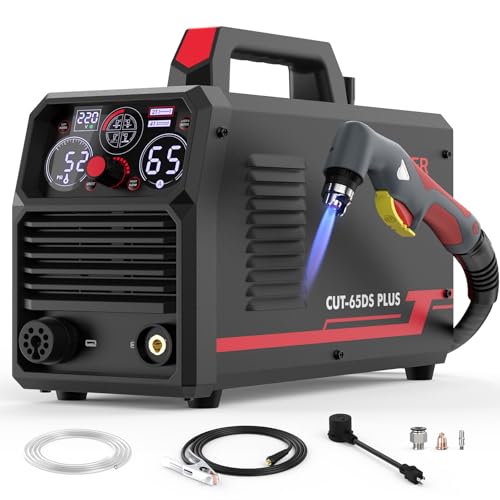
For buyers who expect thicker plate or want more than basic cut-through work, the CUT-65DS PLUS brings 65A output and four dedicated operating functions. The manufacturer lists a clean-cut figure of 5/16 inch at 110V and 9/16 inch at 220V, with maximum cut figures of 5/8 inch and 1 inch respectively. Those ratings are tied to the input voltage, so the higher number should not be treated as a 110V capability.
The four modes are the more meaningful distinction here. Plate cutting handles standard work, while grid cutting is aimed at grating and perforated metal. Gouging can remove welds or damaged material, and marking can create layout lines. Its non-high-frequency blowback start may also be preferable around sensitive electronic equipment, though the listing does not turn that feature into a guarantee for every electrical environment.
Pros
- 65A output provides more headroom than the 50A and 55A models here.
- Includes separate plate, grid, gouging, and marking functions.
- Non-HF blowback start reduces the electromagnetic interference associated with HF starting.
- Non-touch pilot arc supports cutting over rough, painted, or rusty surfaces.
- Published support includes a two-year warranty and North America service center.
Cons
- The higher capacity is most useful with 220V input, not a standard 110V circuit.
- Its broader control set may be more than occasional sheet-metal work requires.
This is a sensible pick for fabrication, repair, and layout work where gouging or grating appears regularly. It asks more from the electrical supply and budget than compact 50A cutters, but those extra functions give it a clearer purpose than simply buying a larger amperage number. Confirm the required compressor output and current circuit before choosing it for thick material.
To buy this product, click here.
3. ARCCAPTAIN iControl CUT55 Pro : Best for Digital Setup

The CUT55 Pro places its emphasis on digital adjustment and guided setup rather than maximum output. Its published figures identify a quality cut of 12 mm and a maximum of 20 mm, with 120V and 240V input support. That makes it a practical middle position for buyers who need more thickness capability than a compact 50A cutter but do not require the specialized modes of the YESWELDER 65A model.
App connectivity lets the operator adjust parameters, monitor the machine, save settings, and review status from a short distance. Intelligent post-blow changes with the selected current range, listed at 5 seconds for 20 to 34A, 8 seconds for 35 to 45A, and 10 seconds for 46 to 55A. The pre-installed regulator and filter reduce initial plumbing work, although compressed air remains an external requirement.
Pros
- Dual-voltage operation suits both home and workshop circuits.
- Documented quality and maximum cut ratings are clearly separated.
- App control supports parameter adjustment and status monitoring.
- Automatic post-blow timing changes with the selected current range.
- Pre-installed air regulator and filter simplify initial connection.
Cons
- The app is unnecessary for buyers who prefer direct front-panel operation.
- The listing does not provide the same specialized gouging and marking range as the YESWELDER CUT-65DS PLUS.
This model fits a buyer who values a guided digital interface and repeatable setup across different materials. Its 20 mm maximum is a manufacturer-listed limit, not a universal promise of clean cuts at every setting. A buyer focused on straightforward manual cutting may save money with the Bestarc 50A, while a fabrication shop needing gouging should move up to a cutter with dedicated modes.
To buy this product, click here.
4. Bestarc 50A Plasma Cutter : Best Budget Option
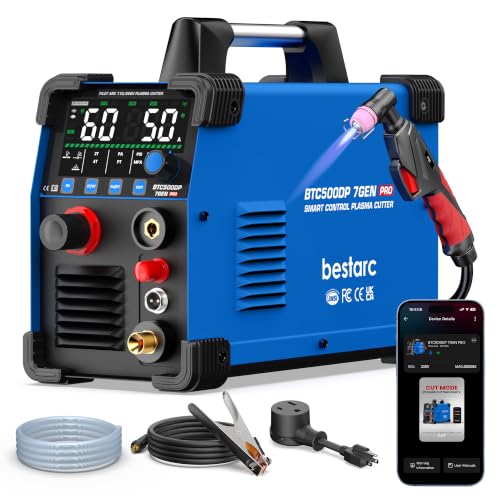
The Bestarc 50A model covers the core requirements many home users actually need: dual-voltage input, non-touch pilot arc, an air-pressure display, and a compact enclosure. The listing identifies a clean 1/2-inch cut and a maximum thickness of up to 3/4 inch, while also recommending air pressure in the 50 to 80 PSI range. These figures give the machine a useful place in garage repair and general metal-cutting work.
A built-in pressure sensor shows the incoming air supply on the front panel, which can help explain an unstable arc before the operator starts changing cutting current. The 2T mode suits short cuts, while 4T reduces trigger-holding during longer runs. At a listed 15 pounds, it is easier to move than the larger 55A and 65A machines, though its lower output gives thicker work less headroom.
Pros
- Supports both 110V and 220V input.
- Non-touch pilot arc is suited to rusty, painted, or coated surfaces.
- Front display shows air pressure, voltage, and current.
- 2T, 4T, pilot-arc, and post-flow controls cover varied cutting tasks.
- Listed 15-pound weight supports occasional transport.
Cons
- The external air compressor is not included.
- 50A output provides less capacity than the 55A and 65A alternatives.
This is the sensible lower-cost route for a buyer who wants pilot-arc operation without giving up 220V flexibility. It is especially well matched to household garages, farm repairs, and intermittent fabrication. For long runs through thicker stock, the higher-output YESWELDER or ARCCAPTAIN options provide more documented capacity and may justify their larger footprint.
To buy this product, click here.
5. YESWELDER 60A Plasma Cutter : Best Non-HF Option

The YESWELDER 60A offers a higher output ceiling than the 50A models while retaining dual-voltage flexibility. Its published maximum cut is 1/2 inch at 110V and 63/64 inch at 220V, while the clean-cut figures are listed separately at 5/16 inch and 5/8 inch. That distinction is useful because buyers often mistake a maximum severance figure for the thickness they can expect to cut cleanly.
Its blowback, non-HF starting system is the central reason to choose it. The machine also includes a non-touch pilot arc, digital display, and adjustable post-flow from 5 to 20 seconds. The IPT40 torch supports the stated cutting functions, but buyers should confirm the current bundle and consumable availability before ordering replacement parts.
Pros
- 60A output gives it more capacity than the basic 50A cutters.
- Non-HF blowback start can reduce electromagnetic interference concerns.
- Dual-voltage input supports home and workshop use.
- Separate clean-cut and maximum-cut figures improve specification clarity.
- Adjustable post-flow, 2T, and 4T modes support short and extended cuts.
Cons
- Its strongest published cutting figures depend on 220V input.
- The product information does not identify dedicated gouging or marking modes.
Choose this machine when non-HF starting and higher output matter more than app connectivity or specialized cutting modes. It suits repair work where the operator may encounter painted plate, rusty steel, or thicker stock. A buyer who wants the simplest setup can spend less on a 50A machine, while a shop that needs layout marking or grating control should choose the CUT-65DS PLUS.
To buy this product, click here.
6. ARCCAPTAIN 50A Plasma Cutter : Best for Portability
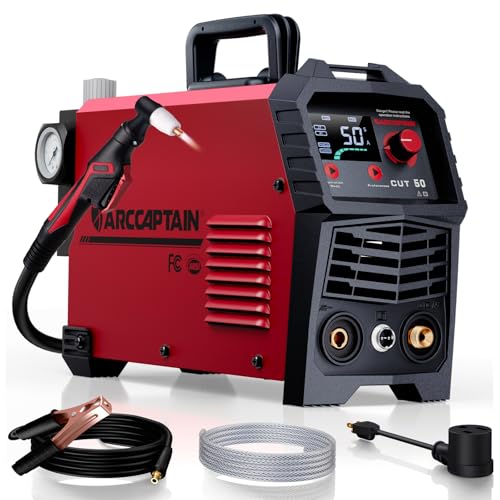
At a listed 13 pounds, this ARCCAPTAIN is the easiest machine in the selection to move between a garage bench, trailer, or outdoor repair area. Its 110V setting provides a 20 to 35A range, while the 220V setting reaches 20 to 50A. That makes the voltage choice meaningful rather than cosmetic, since the higher input opens access to the machine’s upper current range.
The manufacturer lists a 1/2-inch clean cut on common metals and a maximum recommended thickness of 12 mm at 110V or 18 mm at 220V. A front LED screen shows operating data and error codes, and the pre-installed 1/4-inch NPT filter makes air hookup more straightforward. It lacks the higher output and advanced app features of several larger options, but its shoulder strap and small footprint are useful when the cutter cannot live permanently beside the compressor.
Pros
- Listed 13-pound weight supports frequent transport.
- Dual-voltage operation provides flexibility across power setups.
- Front LED display shows current, voltage, and error information.
- Adjustable post-flow and 2T/4T controls are included.
- Pre-installed air filter uses a 1/4-inch NPT quick connection.
Cons
- 50A maximum output is lower than the higher-capacity models here.
- The external compressor is required and sold separately.
This cutter is a strong fit for mobile repair, occasional farm work, and small garages where storage space is limited. The compact format gives up some thickness capacity, so it is less suitable for repeated heavy plate work. Buyers who will carry the machine often may value the weight more than the extra controls found on heavier digital models.
To buy this product, click here.
7. YESWELDER CUT-55DS PRO : Best for Straightforward Shop Cutting

The CUT-55DS PRO occupies a practical middle ground with 55A output, 110V and 220V input, non-HF blowback starting, and non-touch pilot arc. Its listing separates a clean-cut rating of 5/16 inch at 110V and 25/64 inch at 220V from maximum figures of 5/8 inch and 4/5 inch. Those numbers suggest a machine aimed at general repair and fabrication rather than a dedicated heavy-plate cutter.
The IPT40 torch and digital display give the operator a clear view of current and air-pressure information. Post-flow can be adjusted from 5 to 20 seconds, while 2T and 4T modes suit short cuts or longer continuous work. Compared with the similarly rated ARCCAPTAIN CUT55 models, its main distinction is the non-HF blowback start and the simpler manual operating concept.
Pros
- Supports 110V and 220V input.
- Non-HF blowback starting system is suitable for interference-sensitive setups.
- Non-touch pilot arc can start over rough or coated metal.
- Digital display includes air-pressure and current information.
- Adjustable post-flow and 2T/4T modes support varied cutting lengths.
Cons
- Its clean-cut figures are more limited than the higher-output models.
- No app control or dedicated gouging mode is identified in the available information.
This model makes sense for a buyer who wants a conventional, dual-voltage plasma cutter with non-HF starting and clear front-panel information. It is less compelling for someone who expects to use remote monitoring or remove welds with a dedicated gouging function. The published ratings should also be read alongside the chosen voltage and air supply rather than treated as universal results.
To buy this product, click here.
8. ARCCAPTAIN iControl CUT55 MP : Best for App Control and Gouging

The CUT55 MP is aimed at buyers who need more than ordinary plate separation. Its documented functions include expanded-metal cutting, rust removal, and plasma gouging, alongside standard pilot-arc cutting. The machine uses a non-HF blowback start and supports 120V or 240V input, with the listing identifying a 12 to 15 mm range at 120V and 18 to 26 mm at 240V.
Its app can adjust current, monitor air pressure, display fault alerts, and track operating status. The front panel also monitors air pressure continuously, with a recommended pressure around 57.5 PSI. Buyers should pay attention to the instruction that a different nozzle is required for gouging, because that function changes consumable needs and should not be treated as identical to ordinary cutting.
Pros
- Non-HF blowback pilot arc supports interference-sensitive environments.
- Includes expanded-metal, rust-removal, and gouging functions.
- App provides remote monitoring and parameter adjustment.
- Real-time air-pressure detection can flag unstable supply conditions.
- Supports 120V and 240V operation.
Cons
- Gouging requires a nozzle change according to the product information.
- The app and additional modes add complexity compared with a basic plate cutter.
This model fits repair and fabrication users who will actually use gouging or expanded-metal modes. It is less persuasive for a homeowner who cuts a few brackets each year and has no need for remote status monitoring. The CUT55 Prolux ranks higher because its overall specification balance is broader, while this version earns its place through its specific non-HF and multi-function combination.
To buy this product, click here.
9. Bestarc 50A Plasma Cutter Machine : Best for Basic Monitoring

This Bestarc model targets the same broad home, farm, and workshop audience as the other 50A cutters, but its control panel places particular emphasis on air-pressure feedback. The manufacturer lists a 1/2-inch clean cut at 110V and a maximum recommended thickness of 2/3 inch at 220V. Those figures make it better suited to routine sheet, tubing, and moderate plate work than repeated cuts through thick stock.
The high-frequency non-touch pilot arc can begin over dirty, rusty, or painted material, while the PA setting allows the pilot-arc duration to be adjusted for mesh work or consumable conservation. The machine also provides 2T, 4T, and adjustable post-time controls. Air pressure is displayed for reference, but the regulator remains manual, so the operator still needs to set the compressor supply correctly.
Pros
- Dual-voltage input supports home and workshop use.
- Front display includes air pressure, current, voltage, and error codes.
- Non-touch pilot arc suits coated or rusty material.
- Adjustable pilot-arc and post-flow timing provide useful control.
- Pre-installed air filter and 1/4-inch NPT connector simplify hookup.
Cons
- Air pressure is displayed but must be adjusted manually.
- Its 50A output and 2/3-inch maximum rating limit thick-material work.
Choose this cutter for everyday garage or farm tasks where low cost, dual-voltage operation, and simple pressure feedback matter. It overlaps with the other Bestarc 50A model in core capability, so buyers should verify the current configuration and consumables before ordering. The ARCCAPTAIN 50A is lighter, while this Bestarc emphasizes a more detailed front-panel air indicator.
To buy this product, click here.
Buying Guide for the Best Plasma Cutter
Match Input Voltage to the Work
Dual-voltage machines provide more flexibility, but the cutting figures usually change with the input. A 50A cutter may offer a useful household-power range at 110V, while its higher current and thickness capability require 220V. Check the circuit, plug arrangement, and manufacturer requirements before assuming a machine can deliver its top rating from a standard outlet.
Separate Clean Cut From Maximum Cut
A clean-cut rating describes the thickness the manufacturer associates with a cleaner finished separation. A maximum or severance rating describes a more aggressive limit and may involve slower travel, more dross, or additional cleanup. The numbers also depend on material, air pressure, consumable condition, setup, and operator technique, so they are comparison points rather than universal guarantees.
Plan for Compressed Air
Every cutter in this roundup requires an external air compressor. The compressor must supply dry air at the pressure and flow listed for the machine, and moisture filtration matters because contaminated air can affect arc stability and consumable life. A pre-installed filter or regulator helps with connection, but it does not replace a suitable compressor or proper air preparation.
Choose Pilot Arc for Rough Surfaces
A non-touch pilot arc starts the plasma arc without requiring the torch tip to contact the workpiece. That is useful when cutting painted, rusty, coated, expanded, or uneven metal. Pilot arc does not remove the need for correct torch distance, air pressure, consumables, and travel speed, but it can make rough-surface work more practical than contact-start cutting.
Understand HF and Non-HF Starting
High-frequency pilot arc and non-HF blowback systems approach arc initiation differently. Buyers working near sensitive electronics may prefer a documented non-HF design, while others may place greater weight on the specific torch, output, or control layout. Do not treat one starting method as proof of superior cutting quality across every application.
Look at Controls That Match the Job
2T requires the trigger to be held, while 4T can start and stop with separate trigger presses for longer cuts. Adjustable post-flow keeps air moving after the cut to cool the torch, and pilot-arc timing can be useful for expanded metal. App control and automatic air-pressure monitoring add information and convenience, but they are less valuable if the operator wants a simple front-panel machine.
Check Consumables and Special Modes
Standard cutting, gouging, rust removal, and expanded-metal work may require different settings or consumables. The ARCCAPTAIN CUT55 MP, for example, identifies a nozzle change for gouging. Confirm which torch and replacement parts match the exact model, since similarly named plasma cutters may use different consumables or accessory bundles.
Best Plasma Cutter FAQ
Do Plasma Cutters Require an Air Compressor?
Yes. The machines reviewed here use compressed air, and the compressor is sold separately. Check the manufacturer’s required pressure and airflow, then provide dry, filtered air through the correct connection.
Is a 50A Plasma Cutter Enough for Home Use?
A 50A model can suit many home projects, including brackets, tubing, sheet metal, and moderate plate work. Its practical thickness depends on input voltage, material, air supply, consumables, and travel speed. A buyer who expects repeated thick-plate cutting should examine the higher-output models instead.
What Is the Difference Between Clean Cut and Maximum Cut?
Clean cut describes a more usable separation rating, while maximum cut or severance identifies a higher limit that may involve slower cutting and more cleanup. Compare these ratings separately and confirm the voltage and amperage attached to each figure.
Is Pilot Arc Useful for Rusty Metal?
Yes. A non-touch pilot arc can start without the torch tip touching the workpiece, which helps when the surface is rusty, painted, coated, or uneven. Surface preparation, correct air pressure, and suitable consumables still affect the result.
Can These Plasma Cutters Run on a Regular 110V Outlet?
The listed dual-voltage models support 110V operation, but their output range is lower at that input than at 220V or 240V. Check the required breaker and electrical specifications before connecting the machine. Do not assume the highest published thickness rating applies to household voltage.
Should I Choose a Non-HF Plasma Cutter?
A non-HF blowback design may make more sense for buyers concerned about electromagnetic interference around sensitive equipment. A high-frequency pilot arc may still suit other setups. The choice should follow the electrical environment, controls, torch system, and documented cutting requirements.
Does a Plasma Cutter Also Weld?
No. A plasma cutter separates conductive metal by creating a high-temperature plasma arc. It does not replace a MIG, TIG, or Stick welder. Some products may be sold alongside welding equipment or described as part of a broader fabrication setup, but cutting and welding remain different functions.
Final Verdict
Our top pick here at WeldPick is the ARCCAPTAIN iControl CUT55 Prolux because it balances 120V and 240V flexibility, a 55A output, documented thickness capability, pilot-arc cutting, air-pressure monitoring, and app-based controls. It is a better all-purpose fit than a basic 50A machine for buyers who expect their cutting needs to grow, while its ratings remain more approachable than the larger 65A option.
The YESWELDER CUT-65DS PLUS is the better choice for buyers who need dedicated gouging, grating, and marking modes or want more output at 220V. The Bestarc 50A model is a practical lower-cost alternative for ordinary garage work, and the lightweight ARCCAPTAIN 50A is easier to carry between locations. Whichever model you choose, verify the circuit, compressor, air filtration, torch consumables, and voltage-specific cutting ratings before ordering.
