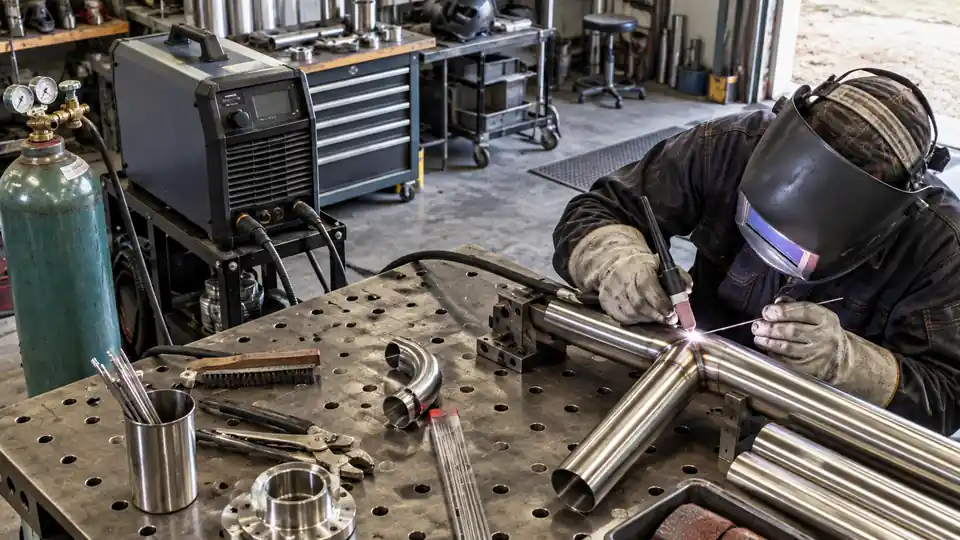
Stainless steel rewards control. A machine that looks powerful on paper can still be a poor fit if it lacks DC TIG, starts awkwardly, offers limited low-current adjustment, or leaves you buying a torch and regulator separately. For stainless work, stable arc control, clean shielding gas delivery, pulse options, and compatibility with the right filler rod usually matter more than a headline amperage figure.
The AZZUNO ACDC-200L is the strongest overall machine in this selection because it combines AC/DC TIG, pulse modes, high-frequency start, dual-voltage input, and compatibility with a foot pedal. The VEVOR 205A is a more focused DC TIG alternative, while the VEVOR multi-process model makes sense for buyers who want MIG, flux-core, Stick, and Lift TIG in one chassis. Several filler rods are included as supporting options, although they are consumables rather than welding machines and should not be mistaken for substitutes for a TIG power source.
Quick Answer
- Best overall: The AZZUNO ACDC-200L offers the broadest documented TIG feature set, including AC/DC operation, pulse, high-frequency start, dual-voltage input, and memory settings.
- Best focused DC TIG option: The VEVOR 205A TIG Welder is better suited to stainless steel, carbon steel, copper, and titanium when AC aluminum capability is not required.
- Best multi-process alternative: The VEVOR 200A Multi-Process Welder adds gas MIG, flux-core MIG, Stick, and Lift TIG, although its Lift TIG torch is listed as separate.
Best TIG Welder for Stainless Steel Comparison Table
| Product | Best For | Processes or Type | Input | Key Strength |
|---|---|---|---|---|
| AZZUNO ACDC-200L | Best Overall | AC/DC TIG, pulse, Stick | 110V/220V | HF start, memory, AC waveform control |
| VEVOR 205A TIG Welder | Focused DC TIG work | DC TIG, DC pulse TIG, Stick | 110V/220V | High-frequency start and LED display |
| VEVOR 200A Multi-Process Welder | Process flexibility | MIG, flux-core, Stick, Lift TIG | 110V/220V | Synergic control and LCD |
| HITBOX 200A Stick Welder | Portable occasional TIG | Stick and Lift TIG | 110V | Compact 5.9-pound chassis |
| ARCCAPTAIN ER308L Rods | Thin 304 stainless | ER308L filler rod | 1/16 inch | Five-pound package |
| SONNLER ER308L Rods | Classification-focused buyers | ER308L filler rod | 1/16 inch | Published composition details |
| YESWELDER ER308L Rods | General 304 stainless work | ER308L filler rod | 1/16 inch | Broad listed material compatibility |
| MorningRo ER309L Rods | Dissimilar joints | ER309L filler rod | 3/32 inch | Stainless-to-carbon steel applications |
| Convivium ER308L Rods | Small filler-rod sets | ER308L filler rod | 1/16 inch | 20-piece package |
The first four entries are welding machines. The remaining selections are stainless-steel TIG filler rods, included for readers who also need compatible consumables and because the supplied product set contains only four actual TIG-capable machines.
1. AZZUNO ACDC-200L TIG Welder, Best Overall

Stainless steel generally calls for DC TIG, but the AZZUNO ACDC-200L gives buyers considerably more room to grow. Its documented feature set includes DC and AC TIG, high-frequency start, pulse operation, spot TIG, cold welding, and Stick mode. That makes it a stronger long-term choice than a DC-only machine for a workshop that may later handle aluminum or other materials.
Dual-voltage input is useful in a garage with ordinary household power and in a shop wired for 220V. The listing also identifies a large LED display, ten memory settings, and compatibility with a 5K potentiometer foot pedal, although the pedal is sold separately. For thin stainless panels, pulse and cold modes may help manage heat input, while the memory function can reduce repeated setup work across different jobs.
Pros
- Supports AC and DC TIG for stainless steel, aluminum, and other work
- High-frequency start avoids the need to touch the tungsten to the workpiece for arc initiation
- Dual-voltage input suits more than one workshop power setup
- Pulse, spot, and cold TIG modes provide additional control options
- Ten memory settings help recall frequently used parameters
Cons
- Foot pedal compatibility is listed, but the pedal is sold separately
- The larger feature set may be more control than a buyer who only welds stainless steel needs
This is the most complete machine in the supplied selection and the clearest overall recommendation for buyers who want a dedicated TIG platform with future flexibility. A stainless-only user may spend more than necessary for AC functions, while a buyer who values one machine for several materials will benefit from the broader control set. Confirm the current manual and included-accessory list before purchase.
To buy this product, click here.
2. VEVOR 205A TIG Welder, Best for Focused DC TIG Work

The VEVOR 205A centers its design around DC TIG, DC pulse TIG, and Stick welding. That combination lines up well with stainless steel, carbon steel, copper, and titanium as listed by the manufacturer. Unlike an AC/DC machine, it does not offer documented AC TIG, so its appeal is greatest for buyers whose projects are firmly on the DC side.
High-frequency start is the most relevant feature for precise stainless work because it initiates the arc without the same contact-start method used by Lift TIG. The dual-voltage design gives it practical flexibility, while the LED display keeps settings visible during setup. Its listed weight of 18.6 pounds is manageable for occasional movement, though it is far less compact than the small HITBOX machine.
Pros
- DC TIG and DC pulse TIG directly suit stainless-steel work
- High-frequency start supports non-contact arc initiation
- 110V and 220V input provides power-source flexibility
- Stick mode adds a practical secondary process
- LED display makes parameter settings easier to read
Cons
- DC-only TIG limits its usefulness for aluminum compared with the AZZUNO
- The 18.6-pound chassis is less convenient for frequent transport than compact machines
This machine makes sense for a buyer who wants a relatively focused TIG and Stick setup without paying for AC controls that may sit unused. Stainless tubing, brackets, and general steel fabrication fit its documented process range, while aluminum-focused buyers should look elsewhere. Check whether the exact package includes the torch, regulator, and other accessories needed for your setup.
To buy this product, click here.
3. VEVOR 200A Multi-Process Welder, Best for Process Flexibility

Some buyers want TIG control for visible stainless welds but also need a faster process for general steel repairs. The VEVOR 200A addresses that broader workshop brief with gas MIG, gasless flux-core MIG, Stick, and Lift TIG. Its synergic control can adjust current and wire-feed speed according to wire thickness and voltage, which may simplify MIG setup compared with a fully manual machine.
For stainless TIG, the important limitation is the use of Lift TIG rather than documented high-frequency TIG. The listing also states that the Lift TIG torch is not included. That does not make the machine irrelevant, but it adds an accessory cost and gives the AZZUNO and VEVOR 205A a stronger position for buyers prioritizing TIG technique.
Pros
- Supports gas MIG, flux-core MIG, Stick, and Lift TIG
- 110V and 220V operation suits different electrical setups
- Synergic controls can simplify MIG parameter adjustment
- LCD screen provides a clear settings interface
- 11-pound spool capacity supports longer MIG work sessions
Cons
- Lift TIG torch is listed as not included
- Lift TIG offers less convenient arc initiation than a high-frequency TIG machine
Choose this model if the purchase needs to cover several welding processes rather than stainless TIG alone. It is a practical fit for a mixed garage setup where MIG and Stick may handle larger or less cosmetic work, while TIG is reserved for controlled stainless joints. Buyers seeking the cleanest TIG-focused configuration should rank it below the two dedicated TIG machines above.
To buy this product, click here.
4. HITBOX 200A Stick Welder, Best Compact Option

The HITBOX Arc200mini3 is primarily a 110V Stick machine with Lift TIG capability. Its documented 5.9-pound weight and compact dimensions make it the easiest unit here to carry between storage and a small work area. For a stainless-steel buyer who needs occasional Lift TIG rather than a full-featured TIG station, that compact format may be the deciding factor.
Hot Start, Arc Force, and the listed 60% duty cycle relate mainly to its Stick function. The product supports tungsten electrodes and identifies Lift TIG welding for material up to 4 mm, but it does not include the Lift TIG torch. Compared with the dedicated machines, the controls and starting method are more limited, so it belongs lower in a TIG-focused ranking.
Pros
- Very low listed weight makes transport and storage easier
- Operates from 110V input
- Supports Stick and Lift TIG modes
- Hot Start and Arc Force assist the Stick process
- Overheat, overcurrent, overvoltage, and overload protection are listed
Cons
- Lift TIG torch is sold separately
- No documented high-frequency start, pulse mode, or AC TIG capability
This is a sensible compact backup for buyers who primarily need Stick welding and only occasionally work with stainless steel through Lift TIG. It is less suitable for thin, appearance-sensitive stainless projects where non-contact starting and finer pulse control matter. The low weight is useful, but the small chassis should not be mistaken for the feature range of a dedicated TIG machine.
To buy this product, click here.
5. ARCCAPTAIN ER308L Stainless Steel TIG Rods, Best Filler for Thin 304 Stainless

These ARCCAPTAIN rods are consumables, not a TIG welder, but they are relevant to the stainless-steel setup because the listed ER308L classification is commonly associated with 304-family stainless applications. Each rod is 1/16 inch in diameter and 16 inches long, a size that suits controlled filler addition on thinner material when the joint and machine settings call for it.
The product listing specifies 100 percent argon or an argon and helium mix as shielding gas. It also identifies a five-pound package, which is more appropriate for regular fabrication than a small trial set. Buyers should match filler classification to the base metal and project requirements rather than selecting a rod only because the diameter looks convenient.
Pros
- ER308L classification is aimed at stainless-steel TIG applications
- 1/16-inch diameter suits many thin-material filler applications
- 16-inch length is a familiar TIG rod format
- Five-pound package supports repeated work
- Listed shielding-gas options are clear
Cons
- This product is filler rod and does not include a TIG power source
- ER308L is not automatically the correct classification for every stainless alloy or joint
Pair these rods with a suitable DC TIG machine when the base material and procedure call for ER308L. They are a better fit for a buyer who already owns a welder and needs a larger supply than for someone searching for a complete welding system. Storage and cleanliness still matter because contamination at the filler rod can affect stainless work.
To buy this product, click here.
6. SONNLER ER308L Stainless Steel TIG Rods, Best for Published Composition Details

SONNLER takes a more specification-oriented approach in the supplied listing. It identifies ER308L, a five-pound package, 1/16-inch rods, and a typical deposited composition that includes chromium and nickel figures. The listing also names stainless grades such as 304, 304L, 308, 308L, 321, and 347 as intended applications.
Those details help a buyer compare filler choices, but they should still be checked against the current product documentation and the welding procedure for the job. The rods require 100 percent argon or an argon and helium mix according to the listing. A stated two-year warranty and 30-day return period are also listed, though availability and terms should be confirmed before ordering.
Pros
- ER308L filler classification suits listed stainless applications
- Published composition details provide more comparison information
- Five-pound quantity suits recurring shop use
- 1/16-inch diameter supports controlled filler placement
- Shielding-gas guidance is included in the listing
Cons
- It is a consumable rather than a TIG welding machine
- Composition information should not replace verification against the required welding procedure
This option is useful for readers who want more visible classification and composition information before choosing a filler rod. It belongs beside a capable DC TIG setup, not in place of one. Buyers working with dissimilar metals or less common stainless grades should examine the required filler classification carefully before selecting ER308L.
To buy this product, click here.
7. YESWELDER ER308L Stainless Steel TIG Rods, Best for General 304 Stainless Work

YESWELDER positions this five-pound ER308L package for general stainless applications, including 304, 304L, 308, 308L, 321, and 347. The 1/16-inch by 16-inch format matches the size of several other rods in this selection, so the meaningful decision is less about physical dimensions and more about the listed classification, application range, and package quantity.
The low-carbon description is relevant to buyers concerned with intergranular corrosion in suitable applications. The listing specifies 100 percent argon or argon and helium shielding gas. As with every filler here, the rod must be matched to the base material and welding procedure rather than treated as a universal stainless solution.
Pros
- ER308L classification is listed for several common stainless grades
- Low-carbon description suits appropriate corrosion-sensitive applications
- Five-pound package supports repeated welding work
- 1/16-inch diameter offers a familiar option for controlled TIG filler use
- Shielding-gas guidance is clearly stated
Cons
- This listing supplies filler rods, not a TIG welder or torch
- The same 1/16-inch size may be too small for some thicker joints or procedures
Choose these rods as a general-purpose consumable for compatible stainless work when the classification fits the job. They are especially relevant to a reader who already owns the AZZUNO, VEVOR, or another suitable DC TIG machine. A different diameter or ER classification may make more sense for heavier sections, dissimilar joints, or a specific qualified procedure.
To buy this product, click here.
8. MorningRo ER309L TIG Rods, Best for Dissimilar Joints

ER309L serves a different purpose from the ER308L rods above. MorningRo lists these rods for joining stainless steel to carbon or low-alloy steel, making them the more relevant consumable for dissimilar-metal work. The 3/32-inch diameter and 39-inch length also differ from the shorter 1/16-inch rods, so this product is aimed at a different handling and joint requirement.
The listing identifies a two-pound package and a storage box, which may help keep the longer rods organized. It also describes low carbon content and chromium levels, but those claims should be checked against current documentation for the exact product. This is still filler metal, not a power source, and it does not replace the need for a DC TIG machine with suitable settings.
Pros
- ER309L is listed for stainless-to-carbon and stainless-to-low-alloy steel joints
- 3/32-inch diameter suits applications needing more filler than 1/16-inch rod
- 39-inch rods provide a longer format for some fabrication tasks
- Boxed packaging supports storage and transport
- Low-carbon formulation is identified in the product information
Cons
- ER309L is not the default choice for every 304 stainless joint
- This product is filler metal rather than a TIG welding machine
MorningRo is the specialist consumable in this group. It makes more sense for a clearly identified dissimilar-metal application than for routine 304 stainless fabrication, where ER308L may be the more familiar match. Confirm the required classification, diameter, and welding procedure before choosing it for structural or process-critical work.
To buy this product, click here.
9. Convivium ER308L TIG Rods, Best Small Filler-Rod Set

The Convivium set contains 20 ER308L rods in the same 1/16-inch by 16-inch format used by several larger packages here. That smaller quantity can suit a buyer learning stainless TIG or completing occasional repairs without committing to a larger supply. The listing mentions thin stainless sheet, tubing, handrails, and kitchen equipment as intended applications.
Its short listing provides less technical detail than the SONNLER or YESWELDER entries. The product information identifies the low-carbon ER308L type and stainless-focused use, but it does not provide the same composition detail or broader published gas guidance in the supplied data. Buyers should therefore verify the current package information and match the rods to their base material before welding.
Pros
- ER308L classification is aimed at compatible stainless-steel TIG work
- 1/16-inch diameter suits thin sheet and tubing applications listed
- 20-piece quantity is useful for occasional projects or practice
- 16-inch length matches a common TIG filler format
- Compact package avoids storing a larger five-pound supply
Cons
- Smaller quantity is less suited to frequent fabrication work
- The supplied listing provides limited technical detail beyond the basic classification and size
This set is best viewed as a modest consumable purchase for compatible stainless work, practice, or occasional repairs. It can complement a compact TIG setup, but it should not be confused with a complete welder package. Buyers with recurring production or repair needs may prefer one of the five-pound ER308L options instead.
To buy this product, click here.
Buying Guide for a TIG Welder for Stainless Steel
DC TIG Is the Core Requirement
Stainless steel is generally welded with DC TIG, so a machine must have a genuine DC TIG mode rather than a vague reference to TIG compatibility. The VEVOR 205A lists DC TIG and DC pulse TIG, while the AZZUNO lists both AC and DC TIG. AC capability is useful for aluminum, but it is not required for stainless steel alone.
The HITBOX and VEVOR multi-process machines use Lift TIG according to the supplied listings. Lift TIG can be useful when portability or multi-process flexibility matters, but it starts the arc differently from high-frequency TIG. The AZZUNO and VEVOR 205A list high-frequency start, giving them a more direct fit for buyers who prioritize TIG-specific setup.
Pulse and Heat Control
Thin stainless can discolor, distort, or lose its neat appearance when too much heat enters the joint. Pulse TIG alternates between higher and lower current according to the selected settings, which can help a skilled operator manage heat input and bead timing. The AZZUNO and VEVOR 205A list pulse TIG, while the HITBOX listing does not.
Pulse is a control feature, not a guarantee of a clean weld. Joint preparation, shielding gas, tungsten choice, travel speed, and technique still affect the result. Buyers should read the manual to understand which pulse settings are available and how they behave at different input voltages.
Input Voltage and Workshop Setup
Dual-voltage input gives the AZZUNO, VEVOR 205A, and VEVOR multi-process machine more flexibility than a 110V-only unit. A home garage may offer ordinary household power, while a dedicated shop may have a 220V circuit. The HITBOX is listed for 110V operation, which simplifies placement but gives the buyer fewer power options.
Do not assume that a supplied adapter makes every outlet suitable for the machine’s maximum output. Confirm circuit requirements, extension-cord guidance, grounding, and duty-cycle information in the current manual before operating the welder.
Filler Rod Classification Matters
ER308L is commonly associated with compatible 304-family stainless applications in the supplied product listings. ER309L is positioned differently, with MorningRo identifying stainless-to-carbon and stainless-to-low-alloy steel joints. Diameter matters as well. A 1/16-inch rod may suit thin work, while a 3/32-inch rod can provide a larger filler option for a different joint.
Filler metal should match the base alloy, joint design, service conditions, and applicable welding procedure. Matching only the rod diameter is not enough. Keep rods clean and stored according to the manufacturer’s guidance, particularly for stainless work where contamination can affect the finished joint.
Included and Optional Accessories
Accessory bundles vary sharply across these products. The AZZUNO listing includes a TIG torch, regulator, hose, collets, nozzles, and tungsten, while its compatible foot pedal is sold separately. The VEVOR multi-process listing specifically states that its Lift TIG torch is not included, and the HITBOX listing also identifies the Lift TIG torch as a separate purchase.
A lower-cost machine can become a less economical setup if the required torch, regulator, gas hose, or control pedal is missing. Before ordering, compare the included components with the equipment already in your workshop.
Best TIG Welder for Stainless Steel FAQ
Is AC TIG required for stainless steel?
No. Stainless-steel TIG work generally uses DC TIG. AC TIG is more relevant to aluminum and some specialized applications, so a buyer focused exclusively on stainless may prefer a DC TIG machine such as the VEVOR 205A.
Which product has high-frequency TIG start?
The supplied listings identify high-frequency start on the AZZUNO ACDC-200L and the VEVOR 205A. The HITBOX and VEVOR multi-process products are listed with Lift TIG, so buyers should not treat those starting methods as interchangeable.
Is the AZZUNO suitable for aluminum as well as stainless steel?
The AZZUNO listing identifies AC/DC TIG and aluminum capability. AC TIG is the relevant distinction here. Buyers should still confirm the current manual, torch setup, and recommended settings before welding aluminum.
What filler rod is commonly listed for 304 stainless?
Several products in this selection identify ER308L for 304 and 304L stainless applications. The exact filler choice should follow the base-metal specification and welding procedure rather than a general product description alone.
When is ER309L more appropriate?
The MorningRo ER309L listing positions it for dissimilar joints involving stainless steel and carbon or low-alloy steel. It should not automatically replace ER308L for ordinary 304 stainless work.
Does the VEVOR multi-process welder include a Lift TIG torch?
The supplied listing states that the Lift TIG torch is not included. Buyers choosing this machine for stainless TIG should confirm which torch and gas components are in the selected package.
Is Lift TIG adequate for stainless steel?
Lift TIG can weld stainless steel when the machine, torch, gas setup, and procedure are appropriate. It offers a different arc-start method from high-frequency TIG, so buyers who prioritize dedicated TIG control may prefer the AZZUNO or VEVOR 205A.
Should a beginner choose a 1/16-inch filler rod?
A 1/16-inch rod can be useful for thin stainless work, but the correct diameter depends on joint design, material thickness, amperage, and the welding procedure. The rod should be selected with the base alloy and machine settings in mind.
Final Verdict
The AZZUNO ACDC-200L is the strongest overall choice among the actual welders in this selection. AC/DC TIG, pulse, high-frequency start, dual-voltage input, memory settings, and foot-pedal compatibility give it the broadest documented control range. That extra capability may be unnecessary for a stainless-only buyer, but it gives the machine a stronger position for a workshop that may add aluminum or other materials later.
The VEVOR 205A is the more focused alternative for DC TIG and Stick work, while the VEVOR 200A makes more sense for buyers who want MIG, flux-core, Stick, and Lift TIG in one machine. The HITBOX is the portability pick, though its Lift TIG torch is separate and its controls are more limited. The remaining entries are filler rods, with ER308L options for compatible stainless work and ER309L for listed dissimilar-metal applications. Match the machine, torch, gas equipment, filler classification, and electrical supply to the actual joint before placing an order.
